You can tell if Halloween candy has been tampered with by checking eight things: torn or punctured wrappers, loose or re-applied seals, glue or extra ink on the pack, a mismatched label, candy that looks distorted or the wrong colour, an unusual chemical smell, an unexpected texture when squeezed, and any unwrapped homemade item. The whole check takes about ten minutes and a clean tray.
Here is the honest part, because it changes how you should run it. A University of Delaware researcher has studied the tampered-candy story for years and has never found a documented case of a child harmed by a randomly poisoned Halloween treat. Most “found a needle” turns out to be self-inflicted or ordinary damage. The check is still worth doing, because it catches real problems that have nothing to do with strangers: allergens, choking hazards, melted chocolate, and the small number of genuine incidents. If anyone may have eaten something suspicious, call Poison Control at 1-800-222-1222 before you start sorting.
Here are the eight warning signs, in the order they are easiest to spot during a sort:
- Torn, cut, or punctured wrapper, including pinholes
- A seal that is loose, doubled over, or feels warm and tacky
- Glue, staples, tape, or ink that looks re-applied
- A label that does not match the brand’s official packaging
- Candy inside that is distorted, misshapen, or the wrong colour for the box
- A solvent-like or chemical smell through the packaging
- Unexpected hardness, crunch, or oiliness when you squeeze it
- Any unwrapped, homemade, or repackaged item from a stranger
Table of Contents
- What You Need
- Step-by-Step: How to Tell if Halloween Candy Has Been Tampered With
- Inspect the Unopened Bag: How to Tell if Halloween Candy Has Been Tampered With
- Check Seals, Labels, and Tamper Evidence
- Look for Changes in Smell, Texture, or Appearance
- Verify the Product and Purchase
- Keep and Report Suspicious Candy Safely
- Know When to Call Poison Control
- Common Mistakes
- Judging by appearance alone
- Tasting it to check
- Treating a low price as proof
- Throwing the evidence away
- Mixing suspect candy back into the good pile
- Inspecting visually after someone has already eaten
- Frequently Asked Questions
- Can you tell if candy has been tampered with just by looking at the wrapper?
- Are resealed Halloween candy bags automatically unsafe?
- How can I check loose or homemade candy for tampering?
- Does an expiration date prove packaged candy is safe to eat?
- What should I do if my pet eats suspicious Halloween candy?
- What to Do First
What You Need
Gather the small things first. Most parents do this standing in a hallway at 7 p.m. with a flashlight in their teeth, and it goes badly.
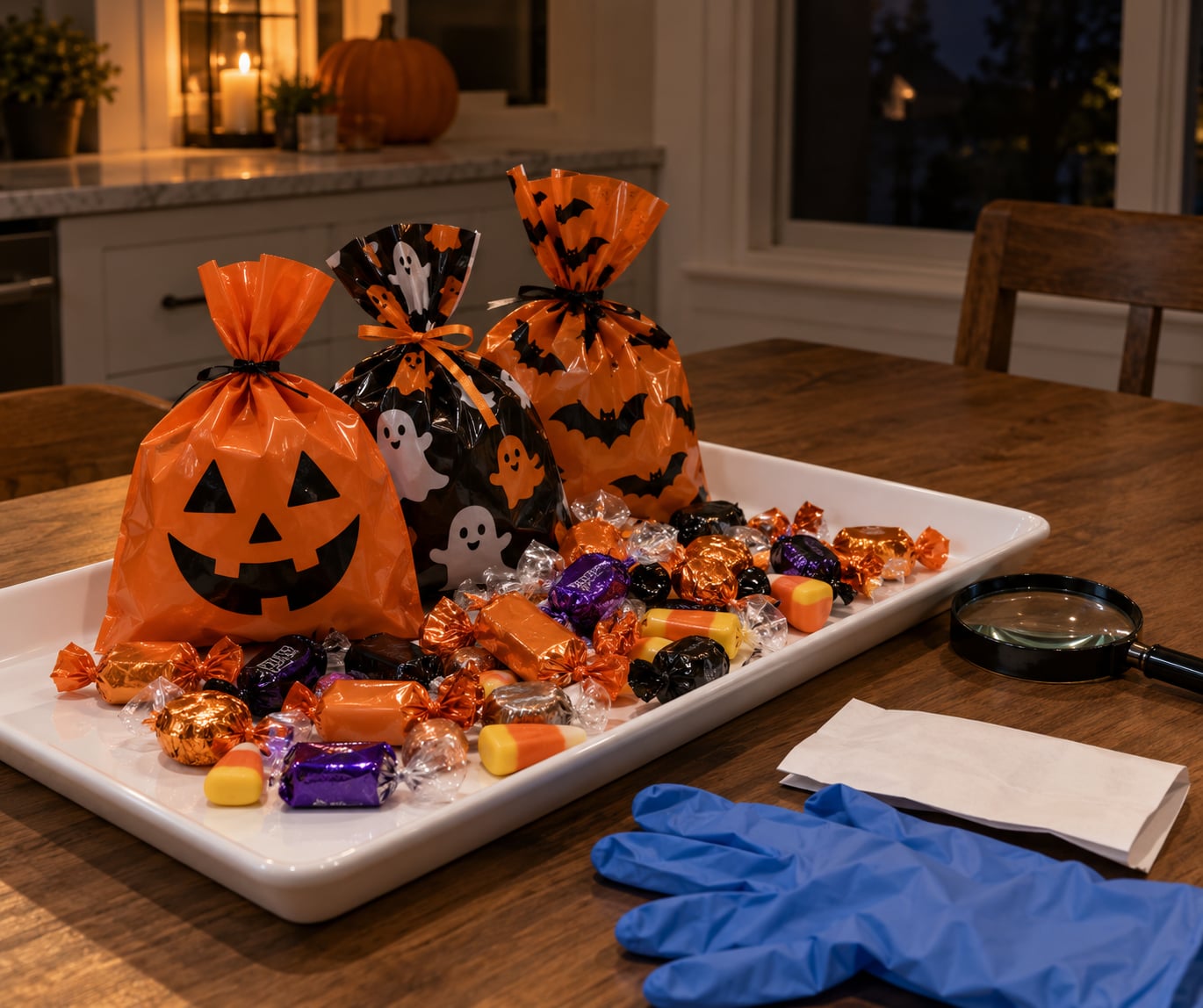
- A clean, light-coloured tray or sheet pan. White or stainless steel shows powder, oil, and discoloration that a dark table hides.
- A magnifying glass or your phone camera zoom. Pinholes are a millimetre across. The phone camera is genuinely better for this.
- A small flashlight. Shine it along the seam, not straight at it, so the raised edge of a re-seal catches light.
- Nitrile gloves. Not because touching candy is dangerous, but so you do not transfer the grease from your hands onto a wrapper you want to keep as evidence.
- The receipt or any purchase details. Bag, store, date, and amount. This is what lets a store or police department actually trace a lot number.
- A sealed container or zip bag. Something rigid for suspect items. Do not put them in the household bin where a child or dog can fish them out.
- Your phone, for the manufacturer’s website and the manufacturer contact line. Nearly every major candy maker publishes a consumer phone number and an ingredient and allergen lookup.
Step-by-Step: How to Tell if Halloween Candy Has Been Tampered With
Inspect the Unopened Bag: How to Tell if Halloween Candy Has Been Tampered With
Work at the bag level first, before you open anything. Compare the outer packaging against the brand’s official product images on the manufacturer’s website, looking at print colour, bag size, film finish, and the count of pieces shown on the front.
A substituted product is one of the commonest finds. A box that should hold assorted gummies in six colours but holds four pieces in two colours is not a factory error. PopSugar’s candy-tampering write-up flagged exactly this, and it is worth checking because an expensive-looking box with a thin count is the easiest thing to fake.
Turn the bag over and run your fingers along the bottom and side seams. A factory seal is a clean, continuous bead. A re-sealed one often has a second bead, a slightly raised strip, or a section that peels in two layers instead of tearing cleanly. Re-gluing leaves a faint sheen and often a faint adhesive smell that hits when the bag is warm.
Then check the count. Do the pieces add up to the number on the package? Ten pieces in a bag marked sixteen is a lighter bag, not a danger by itself, but it is a reason to look closer.
Check Seals, Labels, and Tamper Evidence
Factory-sealed commercial candy should have an unbroken seal, a printed lot or batch code, a complete ingredient and allergen panel, and an expiration or best-by date. If the package is a carton, the glued seam should look uniform along all four edges with no squeeze-out or lifting tab.
Things that point to a re-open: adhesive along a seam that the manufacturer would have heat-sealed, staples in a paper wrapper, tape over a tear, ink that sits on top of a scuffed area rather than under it, and a label applied at a slightly different angle from the rest of the print. A lot number that has been smudged, overprinted, or written over by hand is the one I would not accept. That code is how a manufacturer traces a production run.
Unmatched labels are the giveaway on counterfeit packaging. Wrong font, wrong allergen format, missing net weight, a web address that does not resolve, or an FDA statement that the real product does not carry. Trader Joe’s posted warning notices beside its gummy worms after reports of adverse effects circulated, and a well-known retailer is exactly the kind of brand people imitate.
Look for Changes in Smell, Texture, or Appearance
Do not taste anything to test it. Sniffing once, held a few inches away, is enough to notice a problem. What you are looking for is a solvent, alcohol, or nail-polish-remover smell, or a sharp chemical edge underneath the normal sugar smell.
Oily or greasy surfaces on a candy that should be matte point to a coating or an additive. White powder, discoloured patches, or film residue inside the wrapper mean something has been added or the candy has sat in moisture.
Squeeze each piece gently. Abnormally hard candy with something hard inside, a soft spot where a solid centre should be, or a texture completely unlike the same product you have eaten before all warrant discarding. Also check the piece itself against the wrapper: a candy that is dented, chipped, or shaped wrong while the wrapper art is crisp and clean has been handled.
One false positive worth naming, because it comes up every year: chocolate that melted and re-set inside a warm costume looks like a foreign object until you compare it with an identical piece from a cool bag. Same for candy crushed by a costume pocket. Know what normal damage looks like before you decide a piece is evidence.
Verify the Product and Purchase
Confirm the brand and product on the manufacturer’s site, then check whether the company lists a recall for it. Compare the ingredient list, allergen statement, and nutrition panel side by side with what’s printed on your wrapper. Any discrepancy in the allergen line deserves a phone call, not a guess.
Keep the receipt. Without it, a police non-emergency report has nothing to anchor a lot number to a store and a time. When you have a receipt, photograph the wrapper, the seal, the lot code, and the candy itself before anything is thrown away.
Loose and bulk candy gets a different standard, because there is no packaging to verify. Candy poured from a bulk bin at a discount store, repackaged by a third party, or sold from an unmarked container should be treated as unverified. Buy it yourself from the bin if you want it, or skip it.
Keep and Report Suspicious Candy Safely
Do not taste it, do not sniff it closely, and do not put it in the kitchen bin where a child or pet can reach it. Seal it in a rigid container or zip bag, write the date and where it came from on the outside, and keep it somewhere a child cannot get.
Photograph everything in place before you move it. Then report it: your local police non-emergency line for a possible tampering incident, the manufacturer’s consumer contact line for a possible counterfeit or quality problem, and the store where you bought it. Police in Detroit issued a genuine warning after seizing fake snack packages containing THC and mushrooms, and police in the Mattawa area warned parents after tampered chips tested positive. Those are the cases the report matters for.
Hosts have a matching responsibility. If you hand out homemade treats, wrap each one individually, put your full name and address on the label, and include a list of ingredients and allergens. An unwrapped brownie from a stranger with no label is indistinguishable from a tampered one, and most parents will treat it that way.
Know When to Call Poison Control
A doubtful package is a reason to isolate the candy. An actual exposure is a reason to call. Those are different things, and only the second one is an emergency.
Call Poison Control at 1-800-222-1222 if anyone ate the candy and you are unsure whether it is safe. Seek urgent medical care for trouble breathing, extreme drowsiness, confusion, a seizure, or collapse. Do not wait and watch for symptoms, and do not induce vomiting unless Poison Control tells you to.
I am not going to tell you what a symptom means. Poison Control has trained staff for exactly that call, it is free, and it is available around the clock. For a child who has eaten something and is behaving oddly, that is the whole decision: call them.
Common Mistakes
Judging by appearance alone
Looking is one input, not a verdict. A wrapper can be resealed and look perfect, and a wrapper can be torn by a five-year-old with sharp teeth while the candy inside is fine. Combine what you see with the source and the packaging evidence.
Tasting it to check
This is the one mistake with a real cost. If there is any question at all, the answer is discard, never taste. You gain nothing and you take on the risk you were trying to avoid.
Treating a low price as proof
A cheap bag is a reason to check the label against the official packaging, nothing more. Price is not evidence of tampering and it is not proof of safety either. Plenty of genuine deals exist, and plenty of counterfeit items are priced to look like deals.
Throwing the evidence away
Discarding first and thinking later means the report becomes useless. Photograph it, keep the wrapper and the receipt, then bin it.
Mixing suspect candy back into the good pile
One questionable item contaminates your ability to trust the whole haul. Move it to a sealed container immediately and keep sorting without it.
Inspecting visually after someone has already eaten
Looking at the wrapper changes nothing once a piece has been swallowed. If there was an ingestion, the call to Poison Control comes before the sort.
Frequently Asked Questions
Can you tell if candy has been tampered with just by looking at the wrapper?
Sometimes, but not reliably. A torn wrapper, pinhole, re-applied glue, or mismatched label is visible. A resealed factory seal can look perfect, which is why you also check the candy itself for distortion, discoloration, or unusual smell, and confirm the packaging against the brand’s official images on the manufacturer’s site. Visual inspection reduces risk; it does not eliminate it.
Are resealed Halloween candy bags automatically unsafe?
Treat them as unverified rather than automatically dangerous. A bag that has been opened and re-glued cannot be assumed to have its original contents, so the safe move is to discard it. Many sealed bags get damaged in transit, in a costume pocket, or by a sibling, so a damaged seal alone does not prove deliberate tampering. It simply means you cannot verify what is inside.
How can I check loose or homemade candy for tampering?
You cannot verify it, so skip it or buy your own from the source. Loose candy from a bulk bin, a repackaged bag, or an unwrapped homemade treat has no factory seal, no lot code, and no verifiable label. The American Academy of Pediatrics advises skipping homemade treats from strangers for exactly this reason. If you hand them out yourself, label each one with your name and a full ingredient and allergen list.
Does an expiration date prove packaged candy is safe to eat?
No. A date tells you about shelf life and quality under proper storage, not about whether the package was opened or altered. Neighbours handing out leftover stock from another holiday, chocolate that sat in a hot car, and candy stored in damp conditions can all be within date and still be poor choices. Check the date, then check the storage and the packaging separately.
What should I do if my pet eats suspicious Halloween candy?
Call a veterinarian or an animal poison control service right away, and bring the wrapper with you if you still have it. Chocolate, xylitol in some sugar-free gum and baked goods, and candy with nuts are the usual concerns. Do not wait for symptoms and do not give hydrogen peroxide or induce vomiting unless a vet tells you to. Many Halloween incidents involve dogs grabbing dropped candy from a treat bag.
What to Do First
Stop serving the candy. Put it down, move the children and pets away from the table, and photograph the bag, the seal, the lot code, and the candy where it sits.
Then seal any suspect item in a rigid container you can close, keep the receipt, and pick up the non-emergency line for your local police so the lot number can be traced. If anyone may have eaten it, call Poison Control at 1-800-222-1222 first and sort the rest afterwards. This is 2026, and the same ten-minute routine works every October.