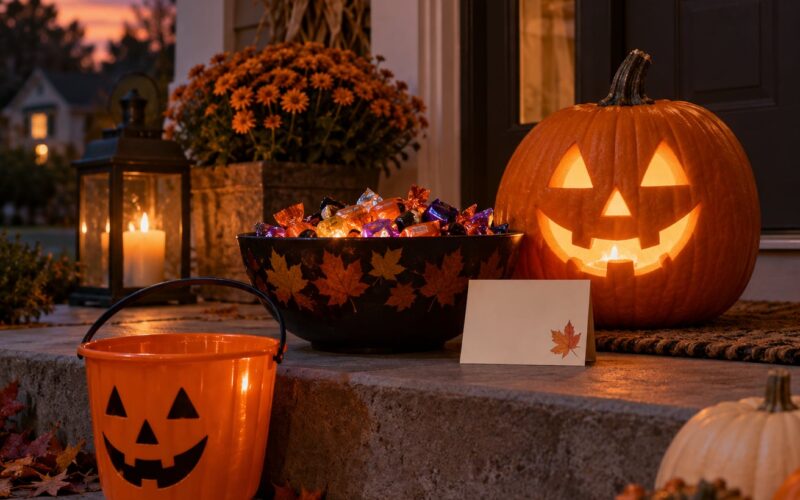
To host trunk or treat for a neighborhood, you need three things that most first-time organizers underestimate: a confirmed date with a rain plan, a one-way driving route with a clear exit, and enough decorated vehicles to feel worth the walk. Recruit 12 to 15 households, set rules in writing, budget about 2 to 3 pieces of candy per expected child plus a 20 percent buffer, and give yourself six weeks of lead time.
Trunk or treat is a car-free Halloween ritual where families decorate the backs of parked vehicles and kids walk from trunk to trunk collecting candy. It works beautifully on a residential street with driveways, not just in a school parking lot, which is where most published guides go wrong. This guide covers the planning, the layout, the candy math, the crowd and the cleanup for 2026 and every year after.
Table of Contents
- What You Need
- Planning supplies
- Safety supplies
- Decorating supplies
- Serving supplies
- Cleanup supplies
- How to Host Trunk or Treat for a Neighborhood: Step by Step
- How to Host Trunk or Treat for a Neighborhood
- Set the Date, Route, and Rain Plan
- Recruit Drivers and Assign Roles
- Create a Safe, Flowing Layout
- Decorate Personal Vehicles Without Hazards
- Choose and Prepare the Treats
- Run the Event and Watch the Crowd
- Clean Up and Thank Participants
- Common Mistakes
- Mistakes and Quick Fixes
- Final Safety and Hosting Tips
- Frequently Asked Questions
- How long should a neighborhood trunk or treat last?
- What should hosts do if it rains on trunk-or-treat night?
- How can a host accommodate children with candy allergies?
- Is it safe for children to walk between decorated vehicles?
- How many cars and volunteers does a neighborhood need?
- Conclusion
What You Need
The supply list for a neighborhood trunk or treat is shorter than most people expect, and almost everything on it is either borrowed or made at home. Group it into five buckets before you send out the first flyer.
Planning supplies
A one-page participant rule sheet, a sign-up sheet or form, printed flyers for the door-to-door canvass, and a master contact list with a phone number for the coordinator. Most organizers text a group chat instead of printing flyers, and that works if every house on the route is within walking distance. For a route spanning more than four blocks, paper still wins because a flyer can go on a fridge.
Safety supplies
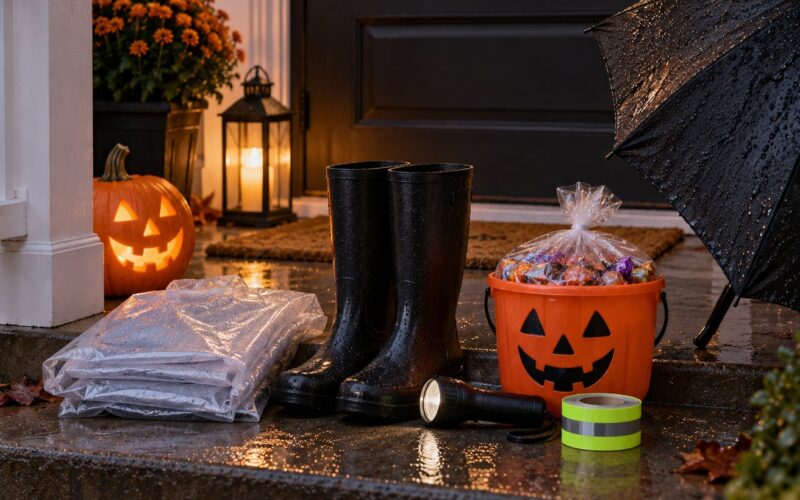
Reflective vests for anyone stationed near moving vehicles, a flashlight per crossing volunteer, cones or painter’s tape to mark pedestrian paths, a first-aid kit, and a portable light source at every trunk. A roll of reflective tape is a cheap way to outline a driveway exit at dusk, which is exactly when visibility drops.
Decorating supplies
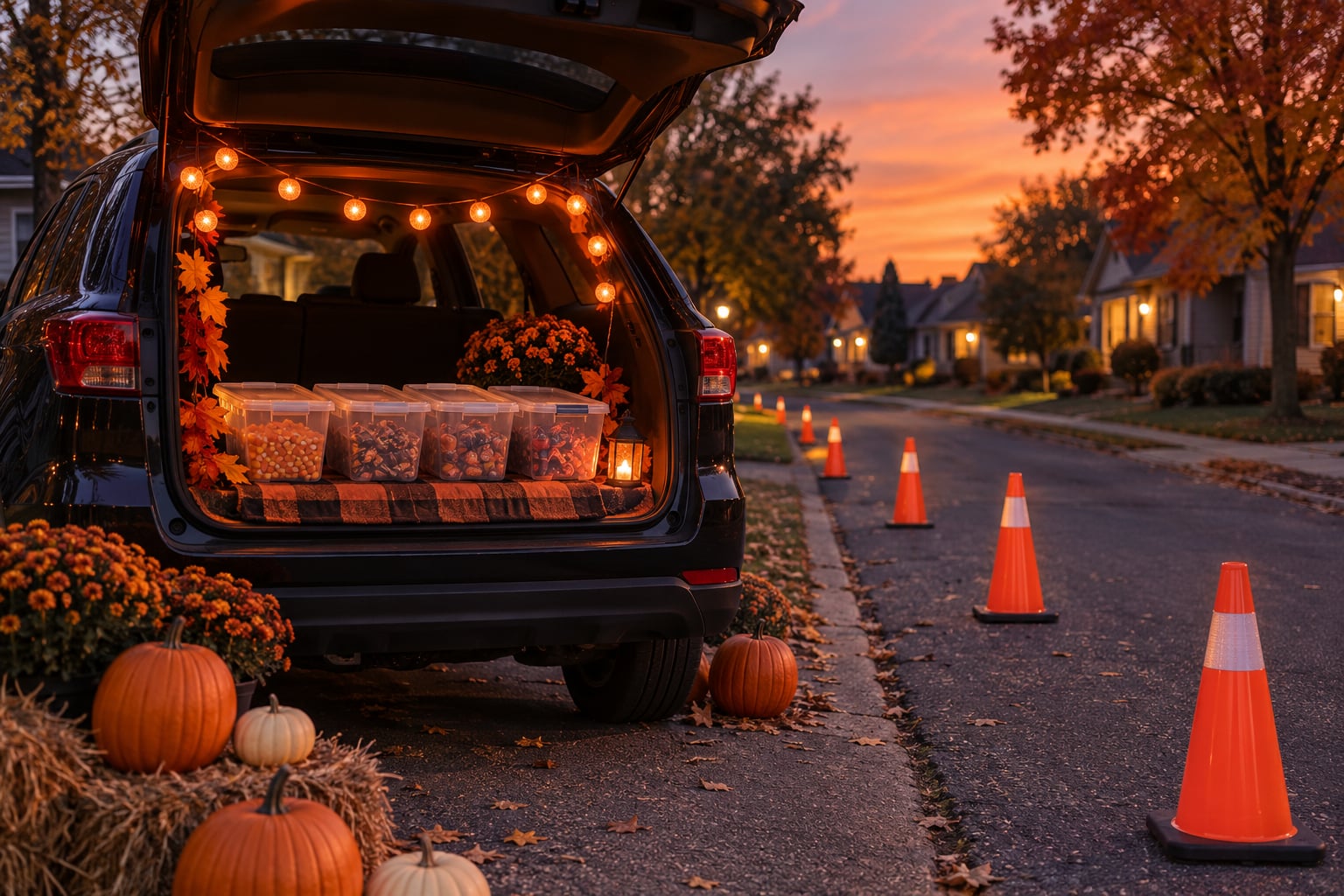
Removable decorations only: suction cups, painter’s tape, fishing line, a tablecloth for the trunk floor, battery-powered string lights, and a cardstock sign taped to the bumper with your trunk number. Budget alternatives come straight from the trick-or-treat forums: parents reuse their kid’s existing toy trucks, sports equipment, and Halloween dress-up sets, and thrift-flip dollar-store frames into gravestones and picture frames. Nothing needs to be nailed, screwed, or drilled into a car.
Serving supplies
Two or three lidded bins per trunk so candy stays dry and bug-free, a candy scoop, small paper cups or bags to portion treats, a flashlight in case a trunk goes dark, and printed inventory sheets so you know at a glance how much is left.
Cleanup supplies
Large trash bags, a litter grabber, a box for stray decorations and signs, and a plan for leftover candy. Keep a whiteboard or a shared note where each host logs how many pieces they handed out, because that number tells you whether to repeat the event next year.
How to Host Trunk or Treat for a Neighborhood: Step by Step
How to Host Trunk or Treat for a Neighborhood
The sequence below runs in order for a reason. Each step depends on the one before it, and skipping ahead is how events end up with a beautiful route and nobody to hand out candy. Work through it roughly six weeks before the event, then use the timeline to pace yourself.
| When | Milestone | Done when |
|---|---|---|
| 6 weeks out | Confirm date, route and rain plan; get HOA or street approval | Permission is in writing |
| 5 weeks out | Door-to-door canvass with flyers and sign-up sheet | 10 households have said yes |
| 4 weeks out | Send the rule sheet, order candy, confirm volunteers | Every trunk has a named adult |
| 3 weeks out | Walk the route at dusk and mark cones and paths | Entry and exit are obvious |
| 2 weeks out | Text all participants the arrival time and trunk number | No one is guessing on the night |
| 1 week out | Buy the remaining candy, fill bags, pack the first-aid kit | Everything is staged indoors |
| Event day | Set up 45 minutes early, run a two-hour window, close on time | Last car leaves by the end time |
| Day after | Litter sweep, thank-you message, notes for next year | Route is clear and neighbors are thanked |
Set the Date, Route, and Rain Plan
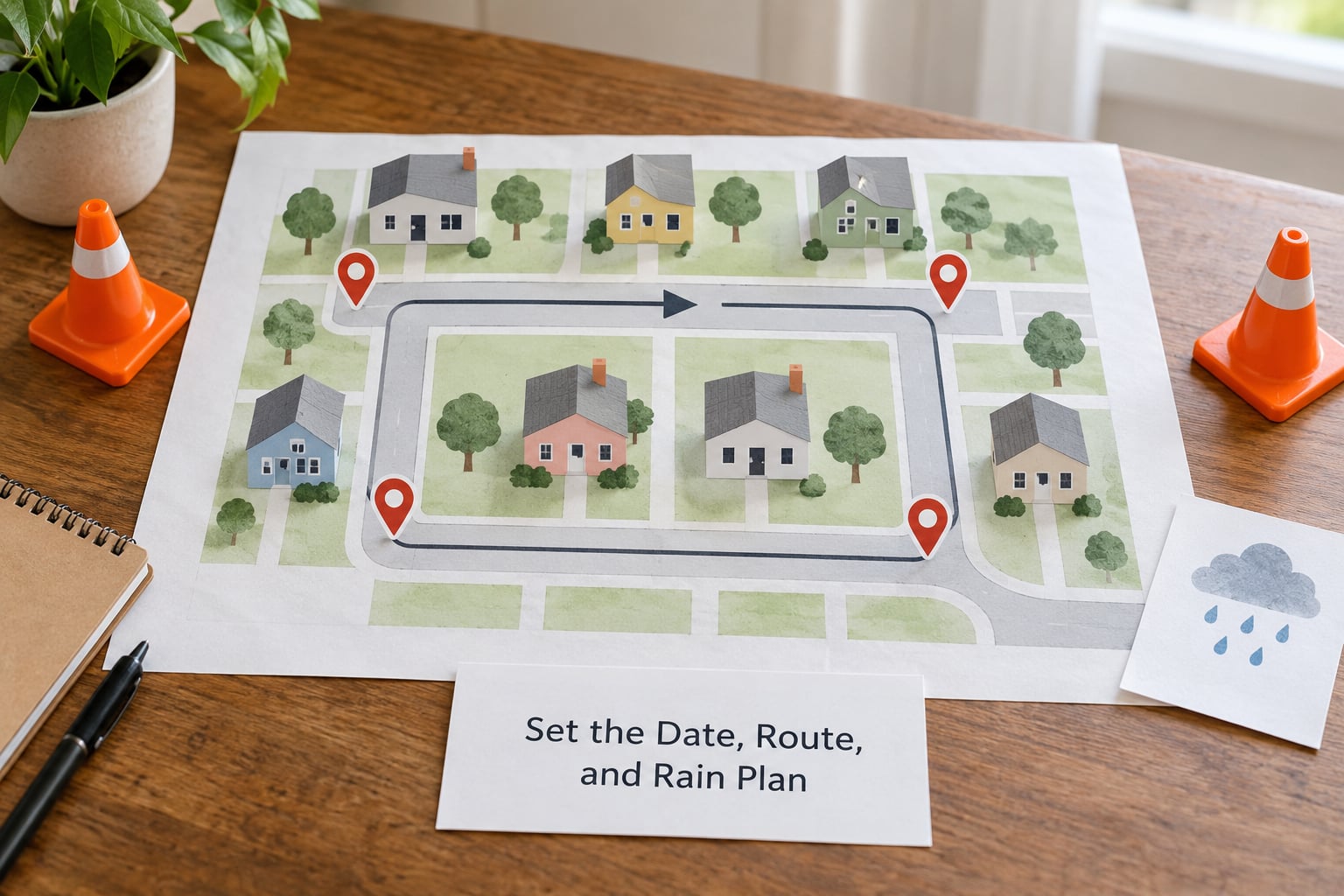
Pick a Saturday or the Sunday before Halloween night, and give yourself a two-hour window from about 5:30 to 7:30 pm so young kids are home before dark and older kids still have time. Start the date conversation early, because a residential street event may need approval from a homeowners association, a landlord, or the local traffic authority before any car parks on the pavement.
Map a one-way loop. Every vehicle faces the same direction, the route has one entry and one exit, and no car ever has to reverse toward a line of children. Skip busy intersections, keep the route away from main roads, and make sure an ambulance or fire engine could get through the middle of it if it had to.
Decide your rain answer before you need it. A rain date moved to the following weekend is the simplest option. A garage-or-treat alternative on the same night, where hosts hand out from open garages along the route, is the option that saves attendance. Have both answers ready, tell participants in advance which one applies, and check the forecast 48 hours out.
Recruit Drivers and Assign Roles
Twelve to fifteen decorated vehicles is the smallest number that still feels like an event. Below ten, kids walk too far for too few stops and neighbors notice the empty driveways, which is the failure mode organizers complain about most in Halloween forum threads.
Recruit door to door with a flyer, not just a post in the group chat. The neighbors who do not read the chat are exactly the ones who would have decorated. Ask each household directly, confirm they can park facing the direction of travel, and note their trunk number so you can build the route map.
Then write down the roles, because “everyone helps” turns into nobody supervising. You need a check-in host, greeters who hand out candy at each trunk, one crossing volunteer at every intersection, a traffic monitor at the entry point, a cleanup crew, and one backup coordinator with your phone number. Send every volunteer the same arrival instructions: where to park, what time to be there, and who to ask for on arrival.
Create a Safe, Flowing Layout
Space vehicles far enough apart that a child can walk between two trunks without stepping into a moving car. Keep the pedestrian side of the street clear of parked vehicles entirely, and mark the walking path with cones or tape where families must cross.
Set the speed expectation at walking pace and state it out loud at check-in. No one should be reversing out of a driveway while children are beside it; if a driver needs to leave, they wait until the crossing volunteer signals the path is clear. Add reflective tape to cone bases and to the rear of any undecorated car that stays parked on the route.
Keep one lane of the street open at all times for emergency access. Put your first-aid kit and a portable light where an adult can reach it without leaving their post, and know the street’s cross streets by name so you can describe your location to a dispatcher in one sentence.
Decorate Personal Vehicles Without Hazards
Decorations must never block the driver’s view, the mirrors, the lights, the license plate, or the rear window. That means nothing hanging from the rearview mirror, no fabric across the windshield, and nothing taped over brake lights or the third brake light. Hosts who arrive with a blanket over the trunk lid should pull it back before they drive away.
Three easy concepts work for most families. A sports theme uses a team blanket over the closed trunk lid, pennants on the side mirrors, and a poster taped flat on the bumper. A spooky theme uses orange lighting, foam tombstones, and a battery lantern set on the ground so the display lights itself at dusk. A character theme uses the kid’s costume: a wizard trunk with a cauldron bin, a princess trunk with a pink tablecloth, a dinosaur trunk with green flashlights and plastic plants.
Number every trunk with a cardstock sign. Numbered stops let you direct families, map the route, count how many children came, and give out prizes by number instead of by guesswork.
Choose and Prepare the Treats
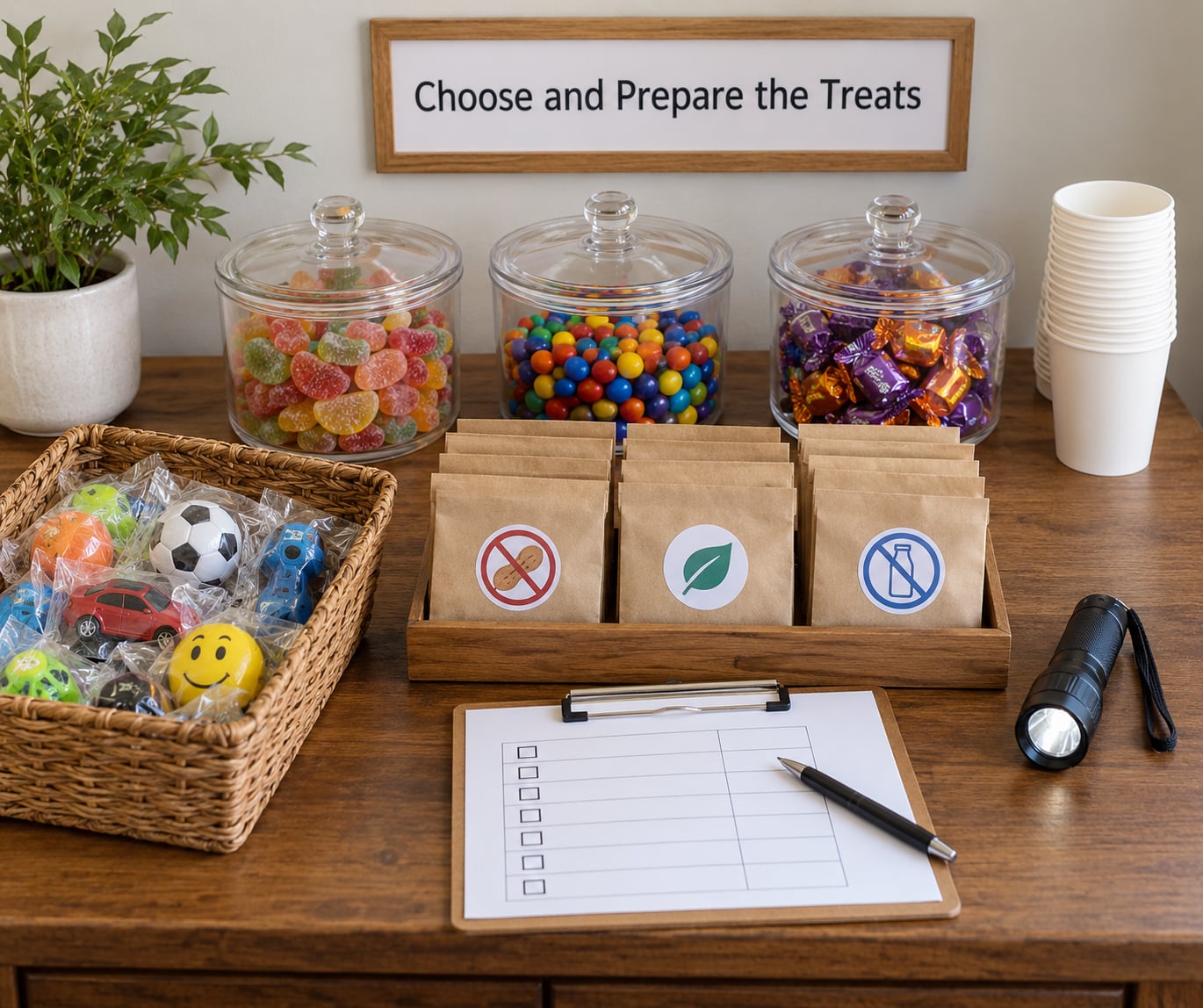
Run the candy math before you shop. Multiply your expected number of children by the pieces each child will receive, then add 20 percent. Running out is the single most reported real-world failure, and it always happens on a warm, beautiful night when turnout is double your estimate.
| Expected children | 2 pieces each | 3 pieces each | With 20% buffer (3 each) |
|---|---|---|---|
| 40 | 80 | 120 | about 145 |
| 80 | 160 | 240 | about 290 |
| 150 | 300 | 450 | about 540 |
| 250 | 500 | 750 | about 900 |
Stock three categories, not one. Individually wrapped candy is the base. Small toys, stickers, glow sticks, and pencils cover parents who do not want sugar, and they survive a bag of loose candy in a coat pocket. Allergy-aware packets, clearly labeled and kept separate, matter more every year, so ask participants in advance whether anyone needs them and have a plan for handing them straight to a parent.
Keep treats in sealed bins with lids, not open bowls on the ground. Serve from the trunk or from a table beside it so nothing sits at child height on the pavement. Portion into small cups or bags so a single visit is predictable and leftovers stay sealed, and have a flashlight in each bin because dusk arrives early and a dark trunk looks closed to a five-year-old.
Run the Event and Watch the Crowd
Open with a short welcome. Tell families the start time, the end time, where the route begins and ends, and the two rules that matter: no running, and every child stays with their adult. Say it out loud from the check-in table rather than assuming a sign was read.
Keep the serving rhythm steady. One greeter hands out, one stands beside the trunk watching the path, and nobody opens a trunk lid without looking left and right first. Refresh candy in batches from a central supply rather than topping up every trunk, so you always know how much is left in total.
Plan for the two things that will happen anyway. Agree on a meeting point and a phone number for lost children before the event starts, and ask the crossing volunteer to escort any family that gets separated back to the check-in table. Keep a walkway and both ends of the route clear at all times, and count cars out of the exit rather than relying on everyone leaving at once.
Close on time. A five-minute warning at the halfway mark prevents the awkward scramble where children are still walking when adults are loading trunks.
Clean Up and Thank Participants
Assign the cleanup crew before the event, not after. Litter picking takes about as long as setup, so a two-person crew with grabbers and bags should be walking the route while the last families head home.
Collect dropped candy and stray wrappers, pull signs and cones, and check that no child left a costume piece or a toy behind. Note the problems: which driveway was blocked, which trunk ran out early, where the path was confusing. That list is the most useful thing you will have when you plan 2026 plus one.
Handle leftover candy deliberately. Many organizers send extras to a shelter, a food pantry, or an after-school program rather than dumping them; check the organization’s policy first. Return borrowed tables, extension cords, and signs the same night, then send participants a short thank-you message with the date and the number of children who came.
Common Mistakes
Mistakes and Quick Fixes
Confusing traffic flow. Fix: publish a one-way map with a single entry and exit, and put a volunteer at the entry point who explains the direction to every arriving car. Two-way traffic on a residential street with children in the road is how someone gets hurt.
Too few trunks, too few volunteers. Fix: treat 12 decorated vehicles as the floor, canvass door to door at five weeks out, and cancel early rather than running a route with four cars. An event with six trunks gets remembered as a disappointment, and that memory costs you next year’s volunteers.
Opening a trunk without checking behind you. Fix: every greeter looks left and right before the lid goes up, and children are asked to stand to one side of the trunk rather than directly behind it.
Overdecorating the vehicle. Fix: write one rule into the participant sheet about the driver’s view, mirrors, lights and plate. If a display blocks any of them, it gets adjusted before the car moves.
Too much candy per child. Fix: agree on two or three pieces and put it in writing. Hosts who hand out a handful per trunk have nothing left for the families who walk the route last.
Poor lighting. Fix: arrive an hour before sunset, put a light source in every trunk, and wear reflective vests at every crossing. Most trunk-or-treats run in dusk and most near-misses happen there.
No weather answer. Fix: publish both options with the invitation, so nobody has to guess on the night.
Cleanup left to the last household. Fix: name a crew and give it a job before the event starts.
Final Safety and Hosting Tips
Keep one person watching each active area, and make their job watching rather than handing out candy. Assign no more than about 20 children to a greeter so nobody is looking away from the path.
Ask every adult to hold their child’s hand at every trunk, and say why: the risk is not strangers here, it is vehicles. No running, no crossing between parked cars, and no opening a trunk from the road side.
Have the coordinator’s phone number and the local emergency number on the check-in table along with the street name and nearest cross street. Communicating allergy information in advance beats explaining it at the trunk.
Encourage hosts to pull forward and leave slowly, one vehicle at a time, once the route closes. Nothing ends a neighborhood tradition faster than a car backing up through a crowd.
Frequently Asked Questions
How long should a neighborhood trunk or treat last?
Plan a two-hour window, usually 5:30 to 7:30 pm. Two hours is long enough that families with young children arrive early and stay comfortable, and short enough that volunteers, mostly parents with young kids of their own, do not burn out. Announce the closing time at the halfway mark so nobody is still walking the route when adults start loading trunks.
What should hosts do if it rains on trunk-or-treat night?
Decide your answer before the event and put it in the original invitation. The simplest option is a rain date the following weekend. The option that keeps the tradition alive is a garage-or-treat on the same night, with hosts handing out from open garages along the same route. Check the forecast 48 hours ahead, message everyone by text, and do not leave the decision to the night itself.
How can a host accommodate children with candy allergies?
Ask participants about allergies when you send the rule sheet, not on the night. Set aside clearly labeled allergy-aware packets at one or two trunks, keep them separate from loose candy, and hand them directly to a parent rather than to the child. Offer non-food alternatives such as stickers, glow sticks, and small toys at every trunk so a parent can skip candy without their child feeling left out.
Is it safe for children to walk between decorated vehicles?
It is, when the route is designed properly. Vehicles park in a single direction with a one-way flow, the walking side of the street stays clear of cars, cones or tape mark a pedestrian path, and a volunteer stands at every crossing. Children stay with an adult, no one runs between trunks, and a greeter looks left and right before any trunk lid opens. Keep one lane open for emergency access.
How many cars and volunteers does a neighborhood need?
Twelve to fifteen decorated vehicles is a realistic minimum for a residential route, and twenty is comfortable. Match volunteers to the crowd rather than to the cars: one greeter per trunk, one crossing volunteer per intersection, one person at check-in, one traffic monitor at the entry, and a two-person cleanup crew. For a route of eight to ten households, two volunteers per household covers those roles.
Conclusion
Start with four things this week: confirm the date and the rain answer, get written permission for the street, walk the route and map a one-way loop, then canvas door to door for decorated vehicles. Clear traffic flow, an adult at every trunk, simple decorations, and a named cleanup crew are what separate a neighborhood trunk or treat people want to repeat from one they quietly stop attending.