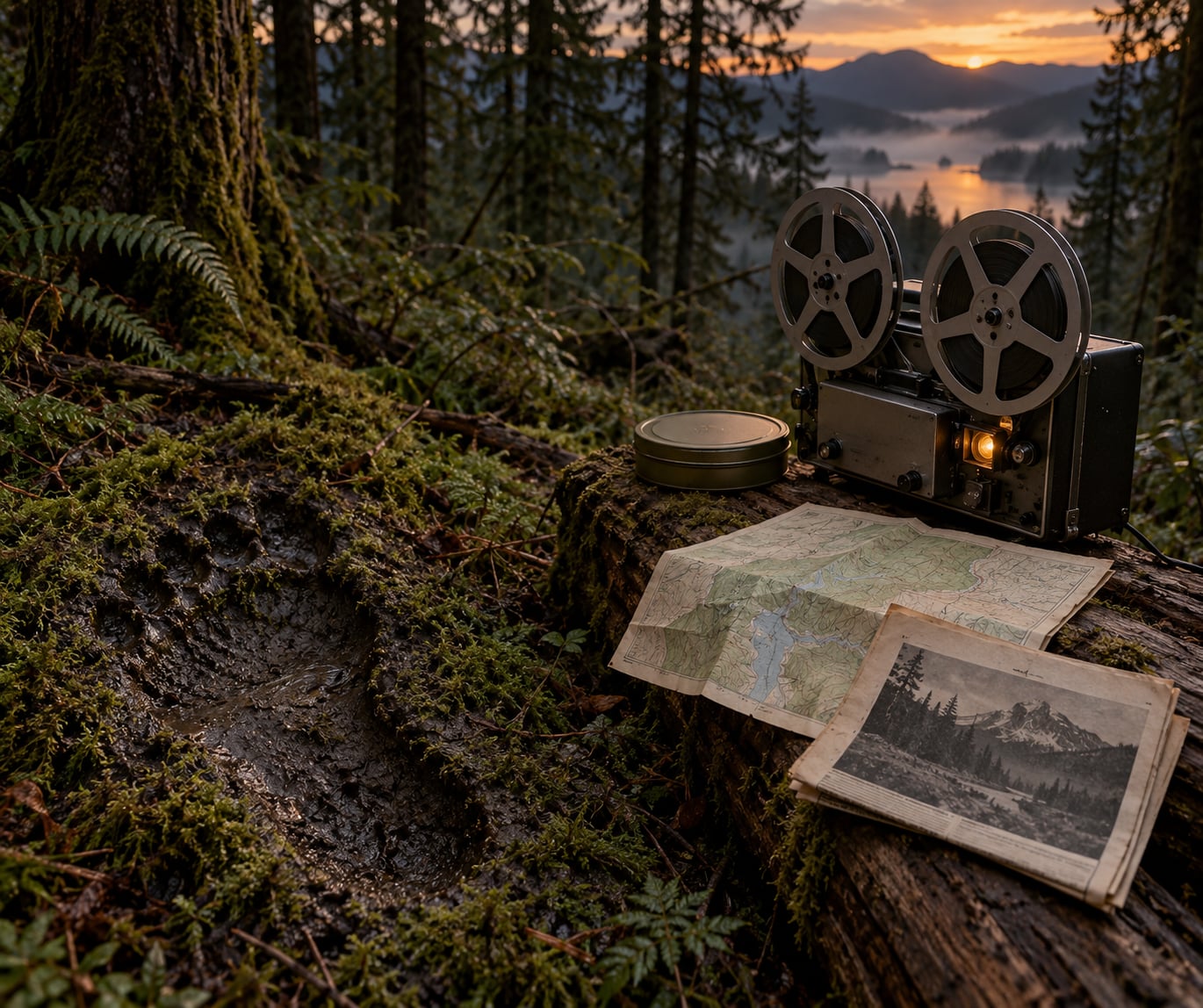
Bigfoot stories took hold in America through layers, not a single moment. Indigenous oral traditions in the Pacific Northwest supplied the deep root, nineteenth and early twentieth century wild-man newspaper reports created a regional pattern, and a 1958 column in the Humboldt Times turned scattered anecdotes into a national craze that advertising, magazines, film and television pushed ever further.
The creature people call Bigfoot is also known as Sasquatch, a large hairy bipedal being said to haunt the forests of the Pacific Northwest. Most researchers now treat its history as four separate strands: pre-contact spirit traditions, colonial-era wild man tales, twentieth century sighting reports, and a mass media legend built after 1958. Confusing those strands is where most of the arguing happens.
I have read through the primary accounts, museum catalogue entries and the standard histories of the subject, and the pattern is clear. Hoaxes exist in the file, genuine misidentifications exist in the file, and there are a small number of reports nobody has fully explained. What does not exist anywhere in the file is a body, a skeleton or a set of remains accepted by mainstream biology.
So this is not a debunking. It is an account of how a regional campfire story became a national identity, and why it is still generating newspaper columns, Halloween costumes and arguments a full century later.
Table of Contents
- How Bigfoot Stories Took Hold in America: The Short Answer
- Where the Bigfoot Story Really Begins
- The Events That Made Bigfoot Famous
- How media amplification turned local reports into a mass craze
- Why the Patterson-Gimlin Film Changed the Legend
- What Made Bigfoot Believable to Many Americans
- How Bigfoot Stories Repeated and Reinforced Themselves
- How Bigfoot Became a Modern Horror Icon
- Frequently Asked Questions
- Who invented the name Bigfoot?
- What was the first reported Bigfoot sighting in America?
- Was Bigfoot popularized by Indigenous peoples or modern media?
- Why are Bigfoot’s footprints considered suspicious?
- How did the Patterson-Gimlin film affect the Bigfoot legend?
- Conclusion: Where to Start With the Bigfoot Story
How Bigfoot Stories Took Hold in America: The Short Answer
Four forces did the work. First, Native nations of the Northwest Coast and the Plateau had long described wild, hairy beings in their own languages and on their own terms. Second, settlers and explorers brought a global wild man archetype, something like a large ape or ogre, and attached it to American forests. Third, regional newspapers printed a run of ordinary-looking reports, and readers began to see a pattern where there had only been coincidence.
Then came the amplifier. In 1958 a California road contractor named Ray Wallace wrote to the Humboldt Times about enormous tracks near Eureka, and columnist Andrew Genzoli turned it into a joke about a relative of the Abominable Snowman. Two follow-up columns ran it straight, and within months the story was in national papers, pulp magazines and television.
That is the real answer to how bigfoot stories took hold in America. The sightings mattered less than the coverage. A dozen unexplained tracks become a national monster the moment print media agrees to treat them as one subject.
Where the Bigfoot Story Really Begins
The earliest layer is not American in the way most retellings imply. Coast Salish communities of the lower Fraser and Puget Sound tell of Tsonoqua, a small, hairy, forest-dwelling wild being with a forceful temper. Among the Sts’ailes First Nation, Tsonoqua accounts function as warnings, not curiosities: keep away from certain woods, or pay for it. Around the Klamath country of northern California and Oregon, the tsiatko tradition describes wild, hairy beings connected to the deep woods and to the idea of going living in the forest.
The name Sasquatch itself comes from Sasq’ets in Halq’emeylem, a Coast Salish language. Oregon Encyclopedia notes that Bigfoot is essentially an Anglicisation of that term. Other communities had their own names, including a stick Indian figure at Warm Springs and accounts kept by Nehalem Tillamook people, who recalled a 19th century encounter tied to Clara Pearson.
Be careful here, because this is where careful history gets harder than the folklore. Similar descriptions of hairy beings appear across many cultures worldwide, and that does not prove they all descend from one creature or one story. It also does not prove they are unrelated. Both readings are defensible, and readers should treat confident single-origin claims with suspicion.
The popular claim that Sasquatch appears in pre-contact Northwest Coast art is contested by Indigenous voices. The widely reproduced mask is generally dated to the early-to-mid 1800s, which puts it squarely in the colonial period, not before it.
The second layer is older than Bigfoot but shaped the American version. European and Asian folklore was full of wild men, hairy ogres and mountain spirits. When settlers pushed into the Pacific Northwest, they arrived expecting to meet one. Their journals describe hairy beings often enough that a pattern emerges, and that pattern is where the modern American story starts.
John W. Olsen of the Bigfoot Information Center, who has spent decades on the subject, makes a useful distinction: the traditions describe spiritual and wild beings, while the modern sightings describe an animal with a biological body. Those are different claims, and they got blended together in the popular imagination.
The Events That Made Bigfoot Famous
Here is the dated record that most retellings skip. Read it as a sequence of separate events rather than a proof, because several entries were later exposed as hoaxes.
| Year | Event | Why it mattered |
|---|---|---|
| 1865 | The pioneer George Gibbs described an ape-like being seen on the Nooksack River in Washington territory | One of the first written settler descriptions in the Northwest |
| 1904 | A tracking party at the Sixes River in Oregon reported a wild man sighting | Gave the Oregon record its first regional entry |
| 1924 | Reports of an ape-like creature around Mount St. Helens | Placed the creature near a landmark readers could recognise |
| 1931 | Albert White, a British Columbia trapper, described a large bipedal creature in the Skagit Valley | One of the earliest eyewitness claims later widely cited |
| 1937 | The Spokane Giant hoax surfaced | Showed how easily a fake could travel as news |
| 1957 | Raymond Lyman claimed a sighting near Bluff Creek, California | Set up the region where the story would detonate |
| 1958 | Ray Wallace wrote to the Humboldt Times about giant tracks; Andrew Genzoli published a wry column, followed by two follow-ups | The moment the regional story became a national one |
| 1959 | Bigfoot began replacing Sasquatch as the everyday American name | A memorable nickname travelled better than a tribal term |
| 1967 | Roger Patterson and Bob Gimlin filmed an alleged encounter at Bluff Creek | Produced the only motion picture material of consequence |
| Mid-1970s onward | Peter Byrne opened the Bigfoot Information Center in The Dalles, Oregon | Gave researchers a physical base and a public-facing voice |
| 1987 | Harry and the Hendersons reached cinemas | Reframed Bigfoot as a gentle guardian rather than a threat |
| 1989 and 2009 | Bigfoot served as a centennial mascot for Washington and Oregon | Civic groups adopted the creature as a regional emblem |
| Today | AI-generated and manipulated imagery circulates as evidence | Makes visual verification harder than it has ever been |
Two entries on that list need honest labelling. The Wallace tracks of 1958 were later linked by a relative to carved wooden feet made for the purpose, and many researchers now treat them as hoaxed even though Wallace himself appears to have believed in them. The Patterson and Gimlin footage of 1967 remains genuinely disputed, which is a different problem entirely.
How media amplification turned local reports into a mass craze

The mechanism was ordinary and repeatable. A local item appears in a small newspaper. Somebody at an associated paper picks it up. By the time it reaches a wire service, the hedging is gone and the creature has become a fact. The Truth or Consequences radio programme once offered a reward for a Bigfoot body, which did less for science than it did for participation.
Print built the audience. Adventure magazines aimed at men and pulp paperbacks turned the creature into an antagonist, and readers bought the next issue looking for the payoff. Columbia Records issued a novelty record of the Patterson and Gimlin audio. Model kits, trading cards, plush toys and a 1967 fast food advertisement all put Bigfoot in front of people who had never read a single sighting account.
Local clubs and guided expeditions created the culture. Print shop operators and campgrounds near Bluff Creek learned to sell maps and tell stories. Print the cast, sell the book, run the expedition, and everyone involved has a reason to keep going.
Publicity also manufactured evidence. Once coverage made Bigfoot famous, imitation tracks became a small cottage industry, including casts made from carved wooden feet. Some hoaxes were jokes. Others were outright fraud. And genuine witnesses did real harm to themselves, because a sincere report from a nervous forester in bad light is easy to dismiss once the press has decided the whole subject is theatre.
That last point deserves weight. Discrediting the fraudsters does not settle the reports from people who never wanted attention in the first place.
Why the Patterson-Gimlin Film Changed the Legend

On October 10, 1967, Roger Patterson and Bob Gimlin said they filmed a figure at roughly 80 feet distance on Bluff Creek Road, using 16mm colour film that was later copied and circulated. The subject walks upright, turns, and looks like nothing catalogued in North American primate biology. That last point matters as much as the footage itself.
Believers leaned on analysis. Grover Krantz examined the images for dermal ridge detail and read structure consistent with a heavy primate foot. Jeff Meldrum later documented the morphology work in print. John Bindernagel, a field biologist who has studied the case, has argued the footage is inconsistent with the prank claims made by a hoaxer. Writer Joshua Blu Buhs documented how the film was received at the time.
Skeptics leaned on the context. The film arrived with almost no surrounding footage, the visible day-to-day flip in apparent height of the subject attracted comment, and the sequence has resisted independent verification. Some have argued the film is a costume work made by a Hollywood associate of Patterson. The Arizona State Museum, which catalogues the Bluff Creek casts, treats the physical evidence record separately from the film.
Then there is the reaction, which is really the story. Newspapers ran the footage seriously and then ran it as a joke, sometimes in the same week. It was parodied immediately, which is its own kind of endorsement, since parody requires recognition. And in 1968 a businessman bought distribution rights and screened the film theatrically, turning what had been a local argument into a national spectacle.
Whatever the footage shows, the effect is not in dispute. Bigfoot became a cinematic shape, which is a different kind of existence than a newspaper rumour.
What Made Bigfoot Believable to Many Americans
Start with geography. The Cascade forests and the interior woods of the Pacific Northwest are genuinely remote, and a large animal moving through them would be hard to see. Low light, fog, fallen timber and distance all do the work that a creature’s supposed camouflage is credited with.
Then consider the evidence itself. Elusive animals leave few remains, and a lack of remains cuts both ways. Believers read the absence as concealment. Skeptics read it as absence. Neither side can produce a body, and no conclusive physical evidence of Bigfoot has been accepted by mainstream biology.
Misidentification does most of the heavy lifting in the ordinary cases. Bears on hind legs, elk with unusual profiles, cougars at odd angles and humans in bad light account for a large share of well-documented reports. The interesting cases are the residue, and the residue is small enough that honest researchers disagree about every one of them.
The Gigantopithecus theory belongs here too. The idea that a large ape survived in the forests of Asia and crossed into North America is not new, but no Gigantopithecus fossil has ever been found in American soil, and the theory has produced no evidence of its own.
Cultural factors do the rest of the work. The United States has a long frontier mythology in which wilderness holds creatures that civilisation has not reached, and Bigfoot fits that shape exactly. There is also a durable distrust of official explanations, and a zoo story that can be dismissed by anyone who has spent time in an actual zoo does not land the way a shadowy creature in a fir forest does.
There is a real ethical problem underneath the affection, and it deserves naming. Communities on r/IndianCountry have pushed back hard against commercial culture repackaging their traditions as generic Sasquatch lore. That tension is not a side issue. It is part of how the legend has spread, and how it spreads next.
How Bigfoot Stories Repeated and Reinforced Themselves
Put the sequence in order and the reinforcement becomes obvious. Inherited storytelling supplied a creature with moral weight in specific communities. Settler accounts gave it a body and a range. Twentieth century regional reports gave it a pattern. Castable evidence made it portable, because a plaster cast is something you can hold, photograph and pass around.
Then publicity did the rest. Each retelling raised the story’s reach, and each raise produced more retellings, imitation tracks and small commercial products that kept the name in circulation. The 1967 film supplied an image that any artist or costume shop could reproduce. Every later novel, programme, advertisement and mascot carried that image further from the original witness who started it all.
By the end of the twentieth century the creature no longer needed an eyewitness. It had a brand. Which is why the story has outlived so many of the specific claims that made it famous.
How Bigfoot Became a Modern Horror Icon
Bigfoot’s later life is mostly entertainment, and the line between mockery and affection blurred decades ago. Horror films use it as a threat. Children’s programmes use it as a shy friend. Documentaries use it as a subject. Television reality shows treated expeditions as entertainment, which paid for fieldwork and made every claim look like show business at the same time.
Commerce has been the quiet engine. Every October the creature appears as a costume, a mask, a yard decoration and a party prop. Those masks are almost entirely modern commercial products with no connection to any Native tradition, despite what the marketing sometimes implies. If you want the genuine article in terms of cultural record, read about the Sts’ailes and Halq’emeylem traditions directly, from the nations themselves.
Civic branding followed. Bigfoot served as a centennial mascot for Washington in 1989 and Oregon in 2009, and several states have discussed legislation protecting the creature as an endangered species. Being written into law as a protected animal is about as strong a sign of cultural durability as a story can earn.
The legend also spread far past the Northwest. The Tennessee Wildman, first reported in the 1870s, is the classic regional case, and reports from Pennsylvania, Florida and the Appalachian states show a creature that travels through retelling rather than through habitat.
None of that settles whether Bigfoot exists. It does explain why so many people believe it does, which was the actual question.
Frequently Asked Questions
Who invented the name Bigfoot?
The nickname Bigfoot is generally credited to California loggers and to the 1958 Humboldt Times coverage of Ray Wallace’s tracks near Eureka, where columnist Andrew Genzoli referred to a relative of the Abominable Snowman. Sasquatch is the older term, taken from Sasq’ets in the Halq’emeylem language. The everyday American name displaced it during the following decade.
What was the first reported Bigfoot sighting in America?
There is no verified first sighting, and dates depend on whether you count Indigenous oral tradition or settler documentation. The first widely cited written settler account is George Gibbs in 1865 on the Nooksack River, followed by a 1904 report at Oregon’s Sixes River and 1924 reports around Mount St. Helens. Each is a reported claim, not a confirmed observation.
Was Bigfoot popularized by Indigenous peoples or modern media?
Both, in separate layers. Indigenous nations of the Northwest Coast and Plateau had long traditions of wild, hairy forest beings, including Tsonoqua among Coast Salish and tsiatko among Klamath peoples. But the modern American monster was built by media, above all the 1958 Humboldt Times columns and the 1967 Patterson-Gimlin footage. Treating the two as the same story is a common error.
Why are Bigfoot’s footprints considered suspicious?
Large prints are often assumed unique to Bigfoot, but bears and large mammals leave prints that can look convincing under the wrong conditions, and hoaxes are common enough to matter. Investigators respond by checking stride length, arch shape, toe arrangement and dermal ridge detail rather than size alone. The 1958 Wallace casts were later linked to carved wooden feet made for the purpose.
How did the Patterson-Gimlin film affect the Bigfoot legend?
The 1967 Bluff Creek footage supplied the first widely seen moving image of the creature, and that changed everything. Newspapers treated it as both evidence and joke, parodies followed within months, and a theatrical release turned it into a spectacle. Whether or not it is genuine, it fixed the public image of Bigfoot as an upright, hairy figure and made the legend globally recognisable.
Conclusion: Where to Start With the Bigfoot Story
Bigfoot became an American legend because stories of different kinds kept reinforcing one another: inherited traditions, regional witness accounts, cheap newspaper coverage, casts that could be carried from camp to camp, one disputed film, and a century of entertainment built on the image.
Start with the newspaper investigations of the early 1960s and the 1967 Bluff Creek footage, then set what the record actually supports against the picture most people carry in their heads. The gap between those two things is the most interesting part of the story, and it is still open.