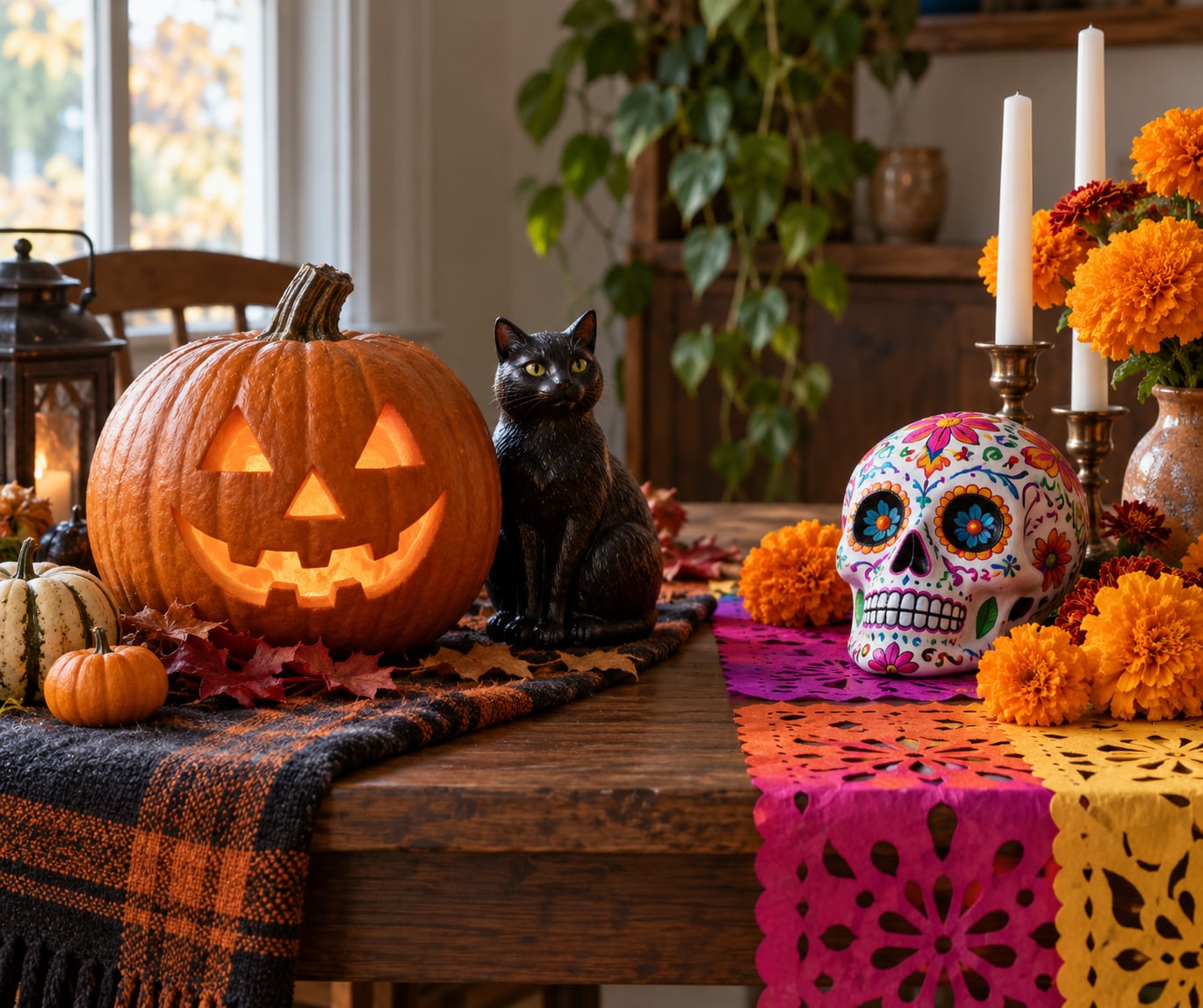
Halloween happens on one night, October 31, and centers on costumes, mischief, and fright. Day of the Dead is a multi-day Mexican observance, centered on November 1 and 2, where families welcome deceased loved ones back with home altars, photographs, candles, and their favorite foods. Different history, different purpose, different mood. Knowing how Day of the Dead differs from Halloween matters most in late October, when both show up on the same calendar and in the same costume aisle.
Every year I see the same thing in the party supply drawers: a calavera makeup kit filed next to the vampire cape, as though they belong to the same night. They do not. One of them belongs with an altar and a photograph of someone’s grandmother.
Table of Contents
- How Day of the Dead Differs from Halloween at a Glance
- Where the Traditions Come From
- How Halloween Came to the United States
- How Day of the Dead Developed in Mexico
- Was Halloween Inspired by Day of the Dead? No
- How Modern Celebrations Crossed the Border
- Halloween and Day of the Dead Dates
- How Each Holiday Uses Symbols
- What goes on an ofrenda
- Different Meanings Behind the Dead
- Food, Costumes, and Party Traditions
- Halloween or Day of the Dead: Which Celebration Fits Your Event?
- Can You Observe Both Together?
- Frequently Asked Questions
- Is Day of the Dead the same thing as Halloween?
- Why is Day of the Dead celebrated on November 1 and 2?
- Do people wear costumes on Day of the Dead?
- What food is traditionally served on Day of the Dead?
- Is Day of the Dead a Mexican celebration?
- Can children learn about both Halloween and Day of the Dead?
- Conclusion
How Day of the Dead Differs from Halloween at a Glance
| Category | Halloween | Day of the Dead |
|---|---|---|
| Timing | One night, October 31 | Multi-day, commonly October 31 through November 2 |
| Origins | Ancient seasonal and folkloric observances tied to the end of summer, later merged with Christian All Saints’ Day | Indigenous Mexican remembrance practices blended with Spanish Catholic observances |
| Geographic roots | Ireland and Scotland, then carried to North America | Central and southern Mexico, now celebrated far beyond it |
| Core purpose | Mischief, fright, and storytelling around ghosts and monsters | Remembering the dead and welcoming them back symbolically |
| Tone | Playful, spooky, commercial | Joyful, colorful, familial, sometimes bittersweet |
| Central symbols | Jack-o’-lanterns, ghosts, skeletons, monsters, costumes | Ofrendas, cempasuchil marigolds, calaveras, papel picado, candles, portraits |
| Typical food | Candy, pumpkin pie, party snacks | Pan de muerto, tamales, mole, fruit, sweet bread baked for the dead |
| Face paint and dress | Costumes and masks meant to conceal identity | Calavera paint applied so every face, living or dead, reads the same |
That last row is the one most people miss. A Halloween costume hides who you are for a night. Calavera face paint does the opposite: it puts you on equal footing with the skeletons walking beside you, whether you are three or eighty-three.
Where the Traditions Come From
Both observances sit at an old seasonal hinge: late autumn, when the harvest is in and the year is turning over. What they do at that hinge is completely different, because they came from different peoples solving the same problem in different ways.
How Halloween Came to the United States
Halloween grew out of a cluster of older things. Samhain, a Gaelic seasonal festival marking the end of harvest and the start of the darker half of the year, is the ancestor most people name first. Christian communities layered on All Saints’ Day and All Souls’ Day observances, which left October 31 as the eve of the saints: All Hallows’ Eve.
The idea of spirits crossing back into the living world runs through those older practices. So does disguising. If spirits wandered out on that night, folklore says, hiding behind a costume kept you from being noticed. That logic sits at the root of trick-or-treating, where children became unrecognizable on purpose.
When Irish and Scottish immigrants arrived in North America in large numbers during the 19th century, they brought those customs with them and mixed them with autumn harvest parties, autumn fairs, and mischief that had been going on anyway. The jack-o’-lantern, originally carved turnips and rutabegas, became a pumpkin once pumpkins showed up in North American gardens and proved cheaper than root vegetables.
How Day of the Dead Developed in Mexico
Día de los Muertos grew from Indigenous Mexican practices of honoring the dead, especially among Nahua communities, and then met Spanish Catholicism after the conquest. The Aztec calendar counted a dedicated month for honoring the deceased, the ninth month of the eighteen-month year, when the dead were said to return.
Spain brought All Saints’ Day and All Souls’ Day in November, and the two systems overlapped rather than erased each other. That blending is why families today still hold La Novena, nine nights of prayer and altar preparation leading into the main days.
Was Halloween Inspired by Day of the Dead? No
No. The two observances grew independently, roughly 1,500 years apart and on different continents. Halloween’s documented lineage runs through Gaelic and Christian Europe; Day of the Dead’s runs through Indigenous Mesoamerica and colonial-era Catholicism. Neither borrowed from the other, and Day of the Dead is not a Mexican Halloween.
That label does real damage in Mexican and Mexican-American communities, because it compresses a multiday family remembrance into one party night. On r/halloween, users push back on the same wording, describing Day of the Dead as more spiritual in nature than Halloween. As researchers who study the two side by side put it, one is about terror and mischief and the other is about color and joy.
How Modern Celebrations Crossed the Border
Over the 20th century, migration and expanding media pushed Día de los Muertos far beyond Mexico. Large Mexican-American communities in cities such as Los Angeles, Houston, and Chicago built public parades, cemetery gatherings, and altar workshops that now draw visitors from everywhere.
That visibility is why the two holidays get tangled in American public life. Halloween decorations go up across whole blocks on October 31, while a Día de los Muertos parade happens the same night. Nothing about that overlap means one holiday grew out of the other.
Halloween and Day of the Dead Dates
Halloween is October 31. Day of the Dead is primarily November 1 and 2, with many households beginning preparations earlier and some regions observing related dates across the wider period. The two sit next to each other on the calendar and not on top of each other.
| Day | Who it honors | What typically happens |
|---|---|---|
| October 31 (La Novena, or its start) | Preparations | Nine nights of prayer and altar building run up to November 1 in many regions; some start the observance on this night |
| November 1 | Children | Altars for deceased children, families gathered at home and at the cemetery |
| November 2 | Adults | Altars for deceased adults, grave cleaning and decoration, candles lit through the night |
The November 1 and 2 split traces back to Catholic All Saints’ Day and All Souls’ Day, which fall on those dates. In practice many families keep altars up across both days and do not draw a hard line between them.
The confusion is understandable. Halloween advertising starts in September, and Día de los Muertos events in the United States are frequently scheduled on October 31 because that is when people are already out in costume-adjacent crowds. If you want the real thing, aim for the cemetery gatherings and altar events on the weekend nearest November 1 and 2.
How Each Holiday Uses Symbols

Halloween symbols do one job: make a familiar thing look strange. A carved pumpkin with a face is a root vegetable turned uncanny, and the whole night leans on that trick. Ghosts, vampires, witches, and monsters are creatures built to frighten, then worn as jokes.
Day of the Dead symbols do something quieter. The ofrenda is a home or cemetery altar built to welcome returning spirits. The cempasuchil marigold matters because its scent and color are said to guide spirits back along petal trails laid from the grave to the door. Calaveras, in sugar, papier-mache, or painted clay, are named for the person they represent, which is why an ofrenda may hold several generations of them together.
What goes on an ofrenda
The exact arrangement changes by household and region, but these items show up on most of them, and each one does a job:
- A photograph of the person being remembered, because this altar names individuals rather than death in general
- Their favorite foods and drinks, set out so the returning spirit has something familiar to enjoy
- Candles and copal incense, whose light and scent are traditionally used to guide spirits along the path
- Cempasuchil marigolds, laid in a trail or in bunches, for their scent and their orange color
- Pan de muerto, the round bread marked with crossed bones, offered to the dead and eaten by the living
- Objects the person used, a tool, a hat, a Bible, a photograph album, a glass of a favorite drink
- Flowers and greenery, cut fresh for the altar rather than reused from a grave bouquet
- A salt cross or a decorated arch in some regions, part of the welcome rather than decoration
Papel picado, the perforated paper banner, hangs in windows and around altars. Cut flowers, sugar skulls, and tissue-paper huehue (an old word for torn paper used in Day of the Dead decorations) add color because brightness is the point.
Different Meanings Behind the Dead
Halloween’s dead are fictional and temporary. The ghost in the window is a story device that resets when the lights come on. Dressing as one is a form of play, and the rules of play are what make it fun.
Day of the Dead treats the dead as continuing members of the family. On r/AskLosAngeles, people planning to attend a cemetery event ask nervously about what to wear, because the setting itself signals that this is not a costume night. The dead are invited, not mocked, and the tone is hospitality rather than fear.
The best-known symbol makes that clear. La Calavera Catrina was created by printmaker José Guadalupe Posada as a satirical skeleton of an elegant European-dressed Mexican woman, mocking a ruling class that dressed above its station. Diego Rivera later painted her into a famous mural, and she eventually became the emblem of the whole holiday. A satire of vanity turned into the costume you can buy today, which is precisely the tension costume shoppers keep running into.
Is Day of the Dead supposed to be scary? No. Grief exists in it, especially at a fresh loss, but the design of the observance is joyful and colorful by intent. Death is presented as a relationship to be maintained, not a shock to be delivered.
Food, Costumes, and Party Traditions

Halloween food is designed to be portable and handed over a fence in the dark: candy corn, chocolate bars, small packaged treats. Parties run on noise, candy bowls, and film props. Nobody needs to know much about the food to take part.
Day of the Dead food is eaten at a table, usually with family, and part of it is set out and never touched by the living. Pan de muerto goes on the altar first, then onto plates. Tamales, mole, fruit, sweet breads, and pan dulce show up depending on the region, and family recipes differ as much as they do at any holiday meal.
It is worth saying plainly that not every participant celebrates the same way. Some families keep a private altar and never attend a public event. Some communities are more religious and treat the days as sacred rather than festive. Some towns in Mexico hold gatherings that are enormous, loud street parties with musicians, while nearby villages hold quiet cemetery vigils.
Costumes tell the same story. On October 31 you choose a character. Around November 1 and 2, dress tends to be a choice to participate: calavera paint, traditional clothing, or something personal and colorful rather than scary or sexy. A Halloween aisle sells sexy skeletons; a Día de los Muertos gathering generally does not ask for that.
Halloween or Day of the Dead: Which Celebration Fits Your Event?
Pick Halloween for a costumed night. Trick-or-treating, a haunted-house theme, horror films, scary games, and a party where the goal is to be frightened all fit its history and its rules. Nothing about it requires a history lesson at the door.
Pick Day of the Dead when the point is remembrance or cultural learning. Building an ofrenda with your kids, attending a parade or cemetery gathering, joining a papel picado or altar workshop, or hosting a meal where you talk about someone you have lost all fit this observance better.
A few practical notes for shoppers. Calavera face paint kits and full-body Catrina costumes are widely sold in October, so read the packaging before you buy a costume that turns a satirical or ritual figure into a Halloween gag. A face paint kit you use with your own clothes is a different purchase from a ready-made costume, and most Mexican and Mexican-American readers would rather see one than the other. If you already bought the costume, wear it to a Day of the Dead event rather than to a trick-or-treating night, and skip the fake wounds and blood.
Build an ofrenda even if you are not Mexican. A grandmother’s photograph, her tea, and a candle do not require permission, and families are usually glad to explain what they put on theirs. Where it goes wrong is treating the dead as a prop, putting a joke item on the altar, or posing someone else’s grave for a photo. On r/AskLosAngeles, that cemetery-photo behavior is the complaint that comes up most, and it is a real one.
Can You Observe Both Together?
Yes, and a lot of families already do. Bicultural households describe trick-or-treating on October 31 and then putting up their ofrenda the next day, without treating the two as rivals. Each one keeps its own date, its own food, and its own reason, which is the part that makes it work.
For schools, libraries, and hosts, the same rule applies. Present them as two observances with two histories, in two sections of the room or on two clearly labeled parts of the program. When you show them together, say out loud where each one comes from and why. Once you explain that Halloween descends from Gaelic and Christian seasonal practice and Day of the Dead from Indigenous Mexican practice and Catholicism, the room stops confusing them.
For families still inside the overlap of grief and the season: you do not have to pick. Remembering someone on your own terms, on the date that fits them, is the whole point of the holiday. People who lost someone recently often describe feeling pressured to choose between grief and partying, and they rarely need anyone to tell them which is the right one.
Frequently Asked Questions
Is Day of the Dead the same thing as Halloween?
No. Halloween is a single night on October 31 built around costumes, mischief, and fright, with roots in Gaelic seasonal practice and Christian All Saints’ Day. Day of the Dead is a multi-day Mexican observance, mainly November 1 and 2, where families build ofrendas to welcome deceased loved ones back. Calling it Mexican Halloween flattens a family remembrance into a party theme.
Why is Day of the Dead celebrated on November 1 and 2?
Those dates come from the Catholic calendar: November 1 is All Saints’ Day and November 2 is All Souls’ Day. Indigenous Mexican practices of honoring the dead already existed in that season, and Spanish Catholicism merged with them after the conquest. The result is a holiday where families honor children on November 1 and adults on November 2, often with both altars standing across both days.
Do people wear costumes on Day of the Dead?
Some people dress up, but it is not the tradition’s purpose. Face painted as a calavera is common and meaningful, since it shows everyone as equal to the dead. Ready-made sexy skeleton costumes are a different thing and generally land badly at Day of the Dead events, especially in cemeteries. Colorful traditional clothing or calavera paint fits the tone far better than a Halloween aisle costume.
What food is traditionally served on Day of the Dead?
Pan de muerto, the round bread marked with crossed bones, is the most recognizable item, and it usually goes on the altar before anyone eats it. Families also serve tamales, mole, fruit, sweet bread, and the deceased’s favorite foods and drinks. Recipes and menus differ by region and by household, so there is no single fixed menu that applies to every celebration.
Is Day of the Dead a Mexican celebration?
Yes. It grew from Indigenous Mexican practices, especially among Nahua communities, and blended with Spanish Catholic observances after the conquest. It is now celebrated far outside Mexico, especially in Mexican-American communities in cities like Los Angeles, Houston, and Chicago, and it is recognized by UNESCO as intangible cultural heritage. Its Mexican origin is not optional context, though. It is the fact the whole celebration rests on.
Can children learn about both Halloween and Day of the Dead?
Yes, and it is a good way to teach that different holidays come from different places for different reasons. Keep the two separate: trick-or-treating and jack-o-lanterns for Halloween, and for Day of the Dead build a small altar with a photograph, a candle, and marigolds while you talk about someone your child or the family has lost. Simple and honest beats a costume shop’s version of either one.
Conclusion
How Day of the Dead differs from Halloween comes down to direction. Halloween builds a wall for one night and then takes it down. Day of the Dead builds a table, sets a place, and leaves the door open.
Start by deciding what your event is actually for. If it is a costume party, keep it on October 31 and let Halloween be Halloween. If it is about someone you have lost, put the altar up on the first or second of November, learn what the items mean, and skip the jokes. Read up on the history before you borrow the symbols. It takes an afternoon and it is the difference between participating and borrowing.
Updated for 2026.