To keep kids safe while trick or treating, go out before dark, stay on sidewalks, cross together at marked crosswalks, keep young children within arm’s reach, make costumes highly visible, and inspect every treat at home before anyone eats it. Most of the plan takes about ten minutes to set up on the front porch.
The reason that plan starts with traffic instead of candy is the numbers. On October 31, children are roughly four times more likely to be hit by a car and about twice as likely to die in a pedestrian crash than on any other night of the year, according to SafeKids and the National Highway Traffic Safety Administration. Around 62 percent of those child pedestrian deaths happen mid-block rather than at an intersection, which is exactly where a distracted group of costumed kids wanders.
The American Academy of Pediatrics publishes Halloween guidance for every age group, and most of it boils down to preparation, visibility and supervision. Here is how I would run the night with my own kids, step by step.
Table of Contents
- What You Need to Keep Kids Safe While Trick-or-Treating
- Step-by-Step
- Step 1: Set the Plan Before the Night Begins
- Step 2: Choose a Costume That Does Not Limit Visibility
- Step 3: Teach Children What to Do at a Door
- Step 4: Stay Aware on Streets, Driveways, and Sidewalks
- Step 5: Carry Identification and Basic Supplies
- Step 6: Inspect Candy and Food Before Eating It
- Step 7: Have a Plan for Separation, Suspicious Activity, or Emergencies
- Common Mistakes
- Frequently Asked Questions
- At what age can kids trick or treat without an adult?
- What are the 10 most important trick-or-treating safety rules?
- How should I check my child’s Halloween candy?
- Is it safe for toddlers to eat Halloween candy?
- What should I do if my child eats a suspicious treat?
What You Need to Keep Kids Safe While Trick-or-Treating
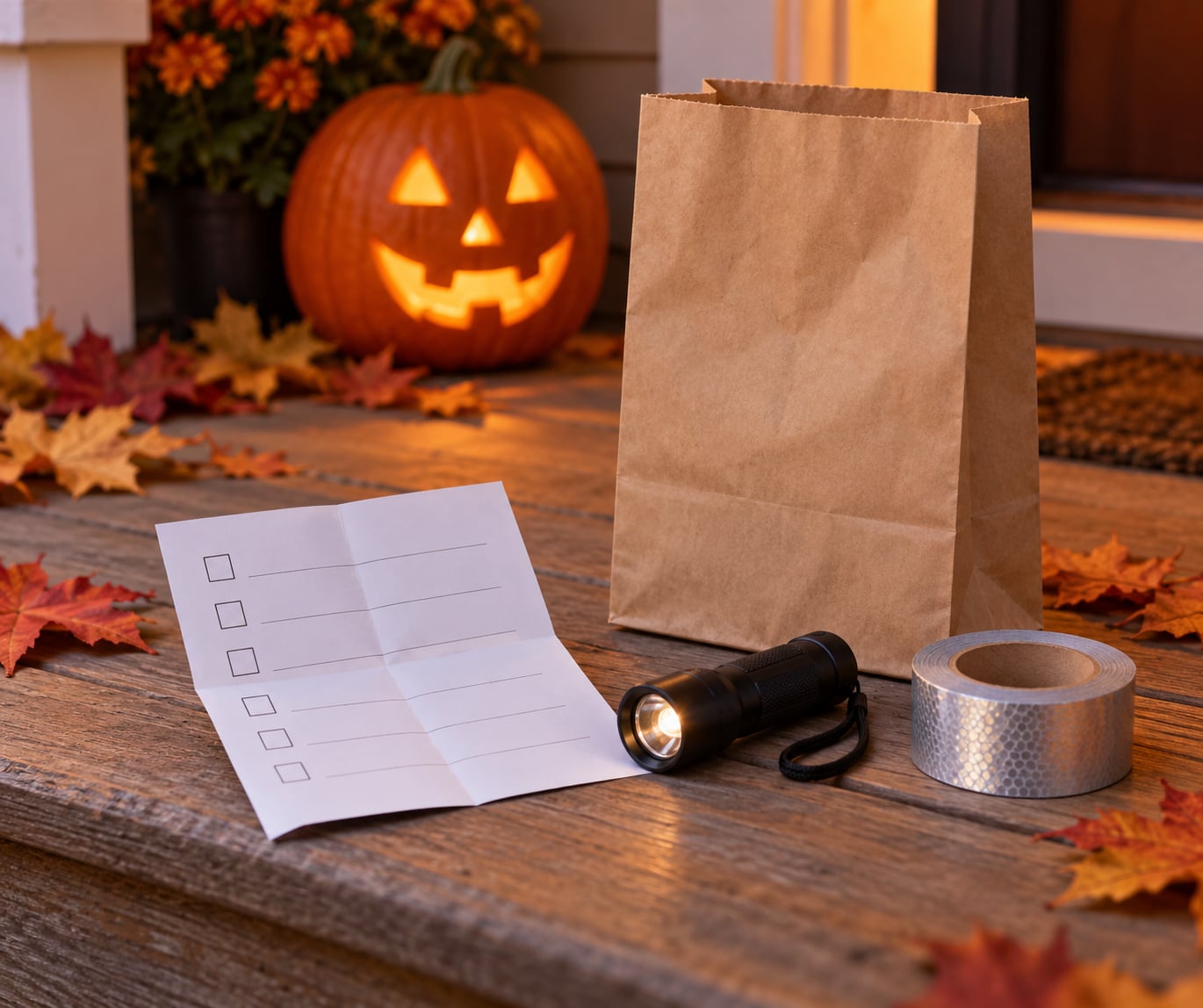
Gather everything in the thirty minutes before you walk out the door, because nobody remembers the flashlight at 6 p.m.
- A charged phone. Full battery, one in each adult’s pocket, with emergency contacts pinned to the lock screen.
- Comfortable shoes. Swap costume boots for sneakers your kids have already worn. A blister at block three is what turns a planned route into an argument.
- Reflective tape or a glow necklace. Tape goes on sleeves, pant legs, backs and shoes. Put it on the treat bag, not just the costume.
- A flashlight. One adult carries it and sweeps it ahead on unlit stretches.
- Identification. A card with the child’s name, your phone number and your home address in the treat bag or pocket, plus a wristband for younger kids.
- Water and a small first-aid kit. Both adults carry them; children do not.
- Allergy-safe treats you control. Pre-approved candy in a separate bag, plus any epinephrine auto-injector if a child has a diagnosed allergy.
- A written route and a check-in time. Text or screenshot the route to another adult who is not going.
Pack light. A child carrying a water bottle, a costume accessory and a full pail is a child who cannot use a hand on a curb or grab yours in traffic.
Step-by-Step
Step 1: Set the Plan Before the Night Begins
Agree on the route, the meeting place and the return time while everyone is still indoors and calm. Five minutes on the front step prevents most of the problems that come up later on a dark street.
Decide together which houses count. The rule most families settle on is simple: the porch light is on, or someone is clearly home, and we never enter a house or a car no matter who asks. Say the meeting place out loud too, something specific like the big oak tree at the corner rather than “back home,” which means different things to a seven-year-old at 9 p.m.
For a group outing, budget roughly one adult per three to six children, the ratio SafeKids uses. That number is not about suspicion. It is about how fast a group of small people moves in different directions when a dog or a firework goes off.
Tell the kids what happens if they get separated: stop where they are, find a house with a lit porch, and do not leave. Wandering to look for you is what turns a small mix-up into a search.
Step 2: Choose a Costume That Does Not Limit Visibility
Fit matters more than looks. A costume that is too long catches on fences, a wide-brim hat blocks peripheral vision, and a mask that slips means a child walking half blind at the edge of a driveway.
Check three things before the night. Hems should sit above the knee so the child can see their own feet. Any hat, wig or accessory should be secured so it cannot snag. And masks should come off in favor of non-toxic face paint, which does not limit the field of view.
Skip costume shoes entirely and skip plastic swords, spears and anything sharp. If the costume is dark, treat visibility as a real problem rather than a detail: reflective tape on arms, legs and shoes, a glow necklace or bracelet, a light-up pail, and a flashlight for anything past the sidewalk.
Two cautions parents ask about most. The FDA regulates decorative contact lenses as medical devices, and costume lenses have been linked to eye infections and scratches, so skip them unless they are prescribed and fitted by an eye doctor. And if your child has photosensitive epilepsy, check whether the neighborhood is using strobe lights before you walk the block.
Step 3: Teach Children What to Do at a Door
Give them a short script rather than a lecture. Walk up with the adult, wait to be invited closer, say thank you, and step back toward the sidewalk.
Two rules do most of the work. First, no house and no car, ever, for any reason, including an adult who looks familiar or says they are a friend of yours. Second, the child never eats anything on the street; the treat bag stays closed until an adult has looked through it at home.
Practice it once at home with a neighbor or a relative so the words feel normal. Kids remember a rehearsed line under pressure, and they remember silence under pressure too.
Step 4: Stay Aware on Streets, Driveways, and Sidewalks
Traffic is the real risk on this night, so the plan has to be built around it. Start before dark when you can, and pick a route with sidewalks, street lighting and steady foot traffic. A quiet cul-de-sac with no sidewalk is a worse route than a busier street with a continuous walkway.
Cross only at intersections and marked crosswalks, and cross as a group. Stop at the curb, look left, look right, look left again, and make eye contact with the driver before stepping out. Mid-block crossings are where most of these crashes happen, and a driver does not expect a small person in a wizard costume to appear between two parked cars.
That is also why you never dart out from behind a parked vehicle or a driveway. Walk around it, even if it adds twenty steps.
Keep phones in pockets. Distracted walking is a proven hazard, and a child reading texts at a dark intersection is a child who cannot hear a car. Walk, don’t scroll, and keep the whole group within a few steps so nobody breaks off alone.
If you are driving behind the kids, park at the next block and walk rather than crawling along behind them at five miles an hour with your headlights on. Parents ask about this often, and the version that slows traffic and startles a child is worse than the version that requires you to get out of the car.
Step 5: Carry Identification and Basic Supplies
Identification is what turns a lost child from a search into a phone call. Put the caregiver’s name and number on a card in every child’s treat bag, and add a wristband for anyone under eight.
Adults carry water, a flashlight, a small first-aid kit, and any medication the child needs. A charged phone per adult with location sharing on is the simplest backup layer you can add, and if you have a Bluetooth tracker, clip it to a costume hem rather than a pocket.
Check that everyone knows the family’s phone number and can say a parent’s name out loud. Toddlers often can, and small kids repeating it back to a helpful adult is genuinely useful.
Step 6: Inspect Candy and Food Before Eating It
Nothing gets eaten on the street, and nothing gets eaten until an adult has gone through the bag under a good light. Sorting takes about fifteen minutes for a typical haul.
Toss anything unwrapped, torn, discolored or in packaging you do not recognize. That last category matters more than most parents expect: homemade and lookalike edibles, including cannabis-infused gummies and chocolates that copy familiar packaging, are a real problem because they look exactly like a fun-sized wrapper.
For children under four, remove choking hazards: hard candy, gum, popcorn, jelly beans, gummy candy, pumpkin seeds and whole nuts. Skip the small toys that come in treat bags, which block the same way a marble does.
For a child with a food allergy, read every label, including the frosting and the manufacturing line, because allergen cross-contact in the same facility is common. The Teal Pumpkin Project, run by Food Allergy Research and Education, asks households to put a teal pumpkin on the porch to signal allergy-friendly treats. Carry two auto-injectors if the child is old enough and trained to use one, and know where they are before you leave the house.
Parents searching for allergy-friendly options can also check FARE’s resources for guidance. For anything medical beyond a known, managed allergy, ask your pediatrician rather than a forum.
Step 7: Have a Plan for Separation, Suspicious Activity, or Emergencies
Decide in advance so nobody has to think clearly under stress. If a child is separated: they stop, they stay put or find the nearest lit house, and they do not run toward you. Adults check both directions along the route, then call; most mix-ups resolve in a couple of minutes.
If a child feels uncomfortable at a door, they walk away immediately without arguing, and tell an adult as soon as they are safely away from the house. Teach that as a skill, not a rule to be broken under pressure.
If anyone is in immediate danger, call 9-1-1 and give your street address, the nearest cross street, the direction the child was last heading, and a description of what they are wearing. Those four details are what dispatchers ask for first, and having them ready saves minutes.
For a suspected swallowed treat that is not an emergency, call Poison Help at 1-800-222-1222. For difficulty breathing, swelling, or a child who is hard to wake, call 9-1-1 first, then Poison Control. Keep the package with you, because the label tells them the exact product and dose.
One myth to drop before the night starts. Reported razor blades and needles hidden in Halloween candy are overwhelmingly urban legend, and parents who chase that fear tend to relax about the risks that actually hurt children: traffic, tripping in costume, low visibility, and eating a treat before it is checked.
Common Mistakes
Almost every problem I have seen on Halloween night traces back to one of these, and all of them are fixable in the half hour before you leave.
- Skipping the route conversation. Kids improvise routes beautifully, usually into traffic. Fix: agree on the route, the meeting place and the return time out loud before anyone puts on a costume.
- Costumes that fit badly. Long hems, loose hats and oversized boots cause trips and blocked vision. Fix: hem above the knee, secure accessories, and use your own sneakers.
- No identification in the treat bag. Fix: a name card and phone number in every bag, plus a wristband for younger children.
- Letting kids run ahead. A child six steps ahead is a child a driver sees too late. Fix: keep the group within arm’s reach of an adult, no exceptions.
- Eating candy on the street. Fix: the bag stays closed until an adult inspects everything under a light at home.
- Dark costumes with no visibility gear. Fix: reflective tape on sleeves, legs, back and shoes, plus a glow necklace or light-up pail.
- No meeting point. “Somewhere near the tree” fails in the dark. Fix: name a specific landmark everyone can point to.
A few extras worth doing: go out before dark when you can, check the weather and have an indoor backup in mind, and if your block is full of young kids, consider a daytime or trunk-or-treat event, which is calmer and far easier to supervise.
After the night, sort the haul rather than letting it disappear. Ration the chocolate, keep sugar near mealtimes to protect bedtime, and brush teeth as usual. For families who want to skip door-to-door entirely, trunk-or-treat at a school or park removes traffic exposure and concentrates the treats in a controlled space, and many of those events advertise allergy-aware hours.
Frequently Asked Questions
At what age can kids trick or treat without an adult?
There is no official age, so maturity and the route decide it rather than a birthday. Most families walk with children through the elementary years, then let them go with a sibling group around age eight or nine, on a familiar route, with a shared phone location, a check-in time and an agreed return time. Agree on the rules in daylight, and keep walking together for another year if the child tends to dart toward cars or forgets the plan.
What are the 10 most important trick-or-treating safety rules?
Start before dark, plan the route, stay on sidewalks, cross as a group at marked crosswalks, make the costume visible with reflective tape or glow gear, keep young children within arm’s reach, never enter a home or a car, never eat treats on the street, carry identification and a charged phone, and inspect all candy at home before anyone eats it. Add a flashlight for dark blocks and a teal pumpkin signal for allergy-friendly homes.
How should I check my child’s Halloween candy?
Sort the treats at home under a bright light, not on the sidewalk. Throw away anything unwrapped, torn, discolored, or in packaging you do not recognize, including lookalike edibles that imitate fun-size candy wrappers. For children under four, remove hard candy, gum, popcorn, jelly beans, gummies, pumpkin seeds, whole nuts and small toys from the bags. If your child has a food allergy, read every label for allergen cross-contact and keep two epinephrine auto-injectors on hand.
Is it safe for toddlers to eat Halloween candy?
Toddlers can eat many Halloween treats, but hard candy, gum, popcorn, jelly beans, gummy candy, pumpkin seeds and whole nuts are choking hazards for children under four, and small toys from treat bags block the same way a marble does. Set those aside first. Watch portions too, since a full bag in one sitting is a stomachache and a ruined bedtime, and offer water alongside the sweets.
What should I do if my child eats a suspicious treat?
Save the wrapper, because the label tells Poison Control the exact product and dose. Call Poison Help at 1-800-222-1222 for a suspected swallowed treat that is not an emergency. Call 9-1-1 first for difficulty breathing, swelling of the face or throat, or a child who is hard to wake, then call Poison Control while help is on the way. For a known allergy, use the auto-injector immediately and still call 9-1-1.
Start with the part most families skip: the ten-minute conversation on the porch about the route, the meeting place and the return time. Everything else in this plan is equipment and habit, but that conversation is the one thing that has to happen before the costumes go on. Refresh this checklist each September and the numbers will still hold next Halloween.