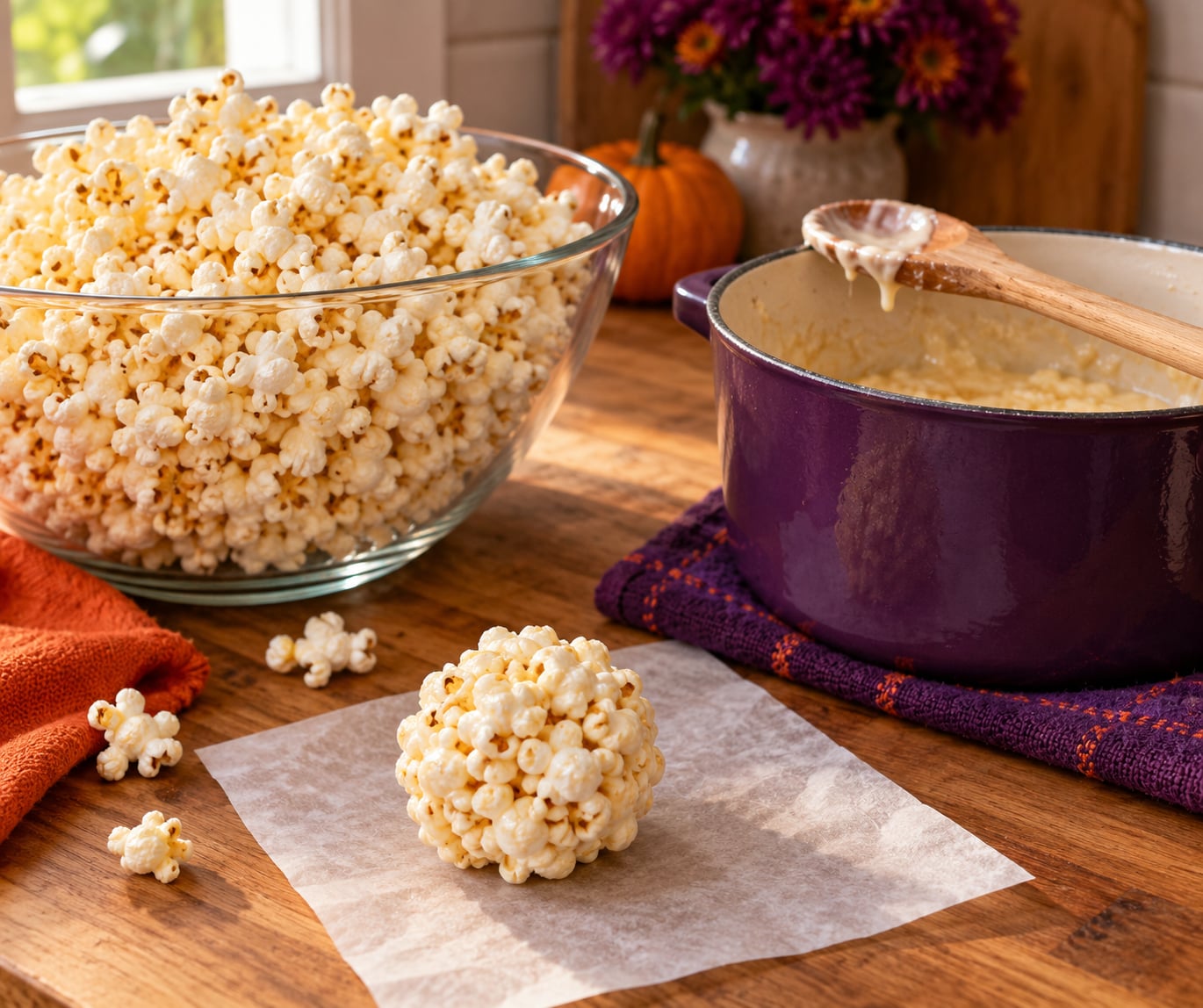
Popcorn balls hold together when warm popcorn gets coated in melted marshmallow and butter, then gets pressed firmly with greased hands and chilled until the coating hardens. Here is how to make popcorn balls that hold together, plus what to do when a batch crumbles anyway.
The whole method takes about 25 minutes of active cooking, then another 30 minutes in the fridge. That chill is not optional. Marshmallow coating is soft and slightly tacky while it is warm, so a ball that feels underdone in your hand is usually fine once it cools.
Marshmallow is the friendliest binder for beginners because there is no thermometer and no guessing at a sugar stage. It also forgives a busy kitchen, since the coating stays workable longer than cooked caramel does. If you want the crisp, brittle version from old movie nights, the sugar-syrup method near the end of the steps is closer to what you remember.
Table of Contents
- What You Need
- Step-by-Step: How to Make Popcorn Balls That Hold Together
- Mix the Sticky Coating Until It Clumps
- Fold in the Popcorn Without Crushing It
- Shape and Chill the Popcorn Balls So They Hold Together
- If You Want the Crunchy Syrup Version Instead
- Common Mistakes
- Frequently Asked Questions
- What keeps popcorn balls from falling apart?
- Can I use marshmallow fluff instead of marshmallows?
- How do I fix popcorn balls that are too loose?
- What is the best binder for popcorn balls?
- How long should popcorn balls chill before serving?
- Can popcorn balls be made ahead and frozen?
- Conclusion
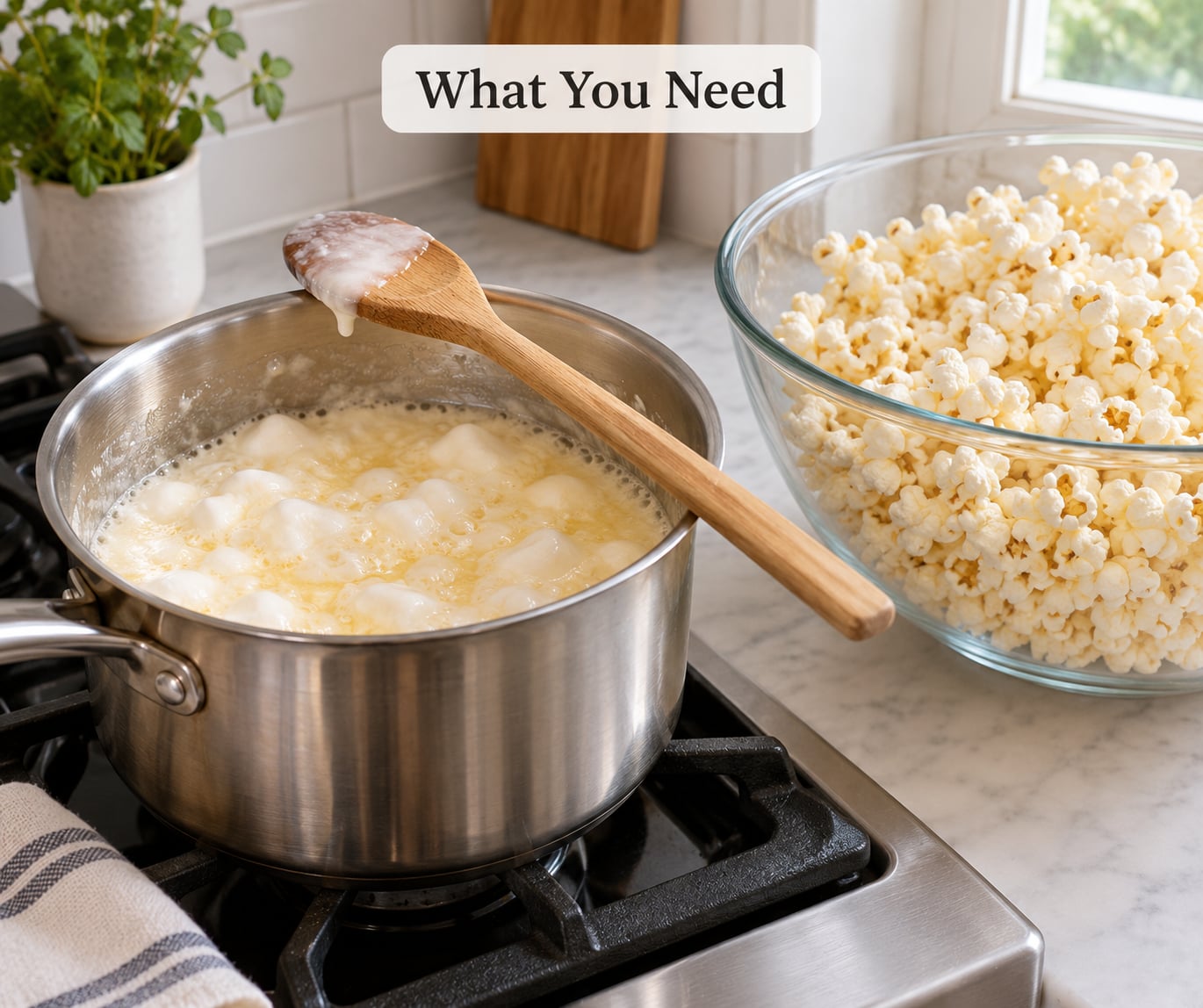
What You Need
This recipe makes about 20 medium popcorn balls, roughly the size of a plum. Have everything measured before the butter hits the pan, because the shaping window is short once the marshmallows melt.
- 10 cups air-popped popcorn, about half a cup of unpopped kernels
- 10 ounces marshmallows, roughly 30 regular-size or 5 cups of mini
- 3 tablespoons unsalted butter, plus more for your hands
- 1 teaspoon vanilla extract
- A pinch of salt, which sharpens the sweetness
- Optional: food coloring, candy pieces, sprinkles, peanuts, or drizzle-able chocolate
Air-popped corn gives you more control and less unpopped grit than microwave bags, but microwave popcorn works fine. Three bags yield roughly the 10 cups you need. Just pick out the hard little kernels at the bottom of the bag, since they resist coating and end up loose in the bowl.
Grease everything before you start cooking: the mixing bowl, the wooden spoon, the baking sheet, and your palms. If you do not own a silicone pastry brush, a small jar of melted butter left on the counter does the same job in about a minute.
Substitutions work in predictable ways. Honey replaces the sugar in syrup methods but cooks darker, so pull it off the heat a touch earlier. Dulce de leche and chocolate or caramel sweetened condensed milk make a much fatter, softer coating that shrinks as it sets and rarely holds a round shape. For a crunchier result, use less marshmallow, closer to 8 ounces, and let it cool uncovered before chilling.
Step-by-Step: How to Make Popcorn Balls That Hold Together
Three things decide whether these balls survive being picked up: hot enough coating, an even coat on every kernel, and real compression when you shape them. The steps below build in that order.
Mix the Sticky Coating Until It Clumps
1. Melt the butter first. Put 3 tablespoons of butter in a large saucepan or stockpot over medium-low heat and let it melt without foaming or browning. Swirl the pan so it coats the bottom and sides.
2. Add the marshmallows and stir slowly. Tip in the marshmallows and keep the spoon moving in small circles, pressing the lumps against the side of the pan. Stirring constantly is what keeps the coating smooth. Patches that sit too long over heat turn into tough rubbery bits you cannot stir back out.
3. Take it off the heat before adding vanilla. When the last marshmallow shape disappears and the mixture looks like thick pale glue, pull the pan off the heat. Stir in the vanilla, a pinch of salt, and any food coloring now, since the mixture is hot enough to fade a color added earlier.
The cue is simple: the mixture pulls away from the pan in a slow ribbon when you lift the spoon. That is the moment to move. Carry on once the marshmallow turns loose and matte, and it will never fully set, because the melted fat has separated from the sugar.
Avoid the overheating mistake here. Syrup-based coatings scorched past their stage turn bitter and hard like glass, and marshmallow is far more forgiving. Constant stirring and a medium-low burner are the whole trick.
Fold in the Popcorn Without Crushing It
4. Warm the popcorn first if you have time. Spread the popcorn on a baking sheet and warm it at 300F for about 10 minutes, then measure it straight into your greased bowl. Warm popcorn takes the coating into its crevices instead of letting it sit on the surface as a shell.
5. Pour the coating over the popcorn and fold. Scrape every bit of marshmallow out of the pan, then use a spatula or wooden spoon to lift popcorn from the bottom and fold it over the top. Keep turning until the bowl contents stop looking like popcorn and start looking like one sticky mass.
You are looking for two cues. Every visible kernel is glossy and no white is showing through, and no loose kernels sit in the bottom of the bowl. Loose kernels at the bottom mean there is not enough coating to bind them, and they will show up as crumbs on the finished plate.
Go gently with the fold. A big aggressive stir turns half the batch into fine crumbs that dry out by the next morning. The coating looks wet enough to seem too loose at first; give it a minute and it tightens as the heat moves into the popcorn.
Mix-ins go in during this fold. Candy pieces, mini marshmallows, sprinkles, and peanuts all ride along with the popcorn, which keeps them from settling at the bottom of each ball. Add chocolate drizzle after shaping, once the coating has set.
Shape and Chill the Popcorn Balls So They Hold Together
6. Butter your hands and scoop. Rub butter into your palms until they shine, or slip on thin plastic gloves and butter those instead. A wet, cold hand makes the coating grab and tear, which is the single most common reason shaping stalls halfway through.
7. Compress harder than feels natural. Take a heaped cup of mixture, cup both hands around it, and press firmly until the ball flattens slightly and the seams disappear. Loose popcorn will not bond to loose popcorn. You want to push out every air pocket you can feel, because those pockets are what crumble later.
8. Flatten the bottom and chill. Set the ball on the greased sheet, press the bottom into a flat disc so it sits instead of rolling, and repeat until the bowl is empty. Refrigerate 30 minutes, or until firm to a light touch. Keep them there while you decorate.
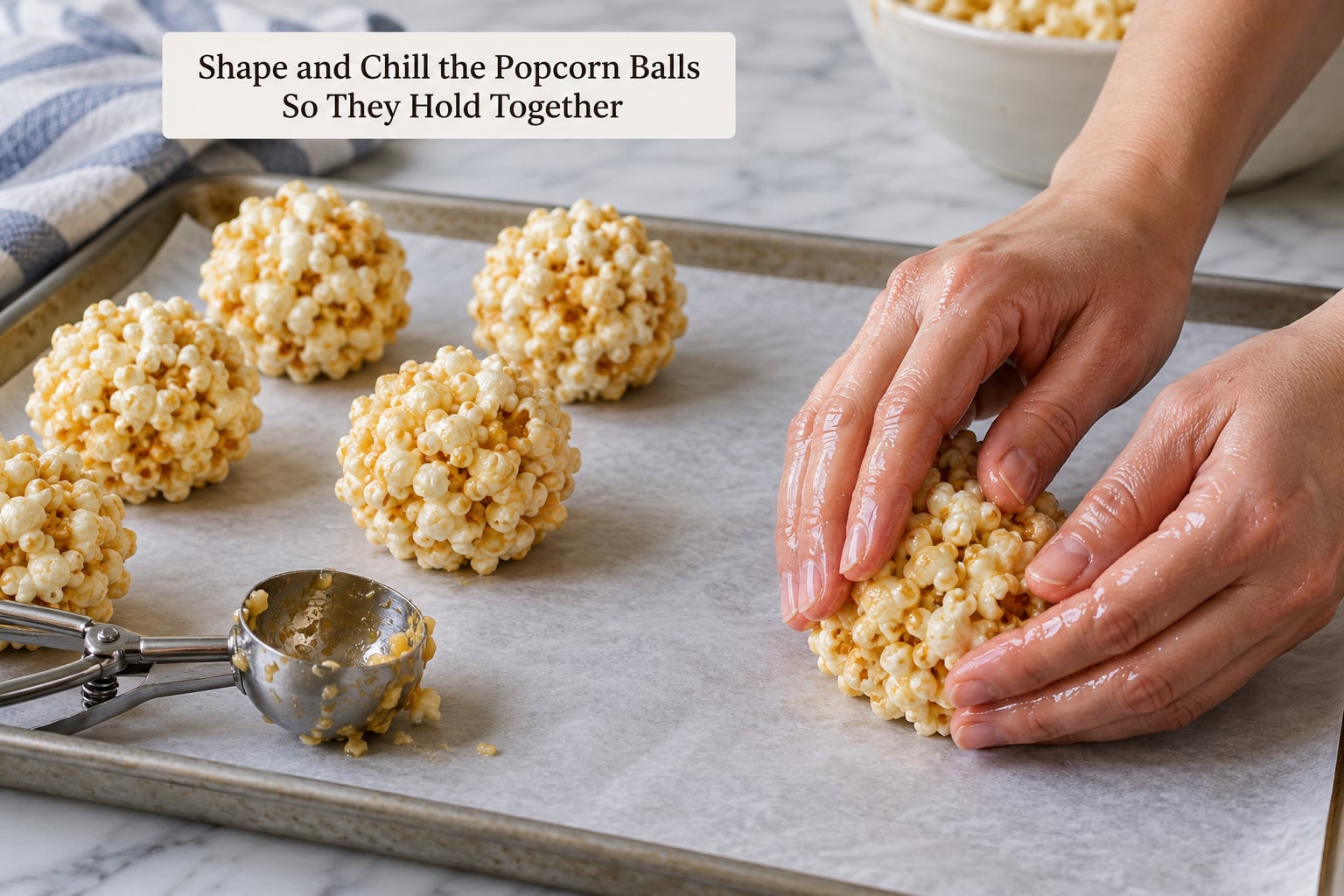
Turn them once or twice during the first few minutes if your kitchen is warm. A gentle roll keeps them spherical without flattening the sides.
Once the marshmallow version has set, you can drizzle or dip in melted chocolate, then return them to the fridge for 10 minutes to harden the shell. For the vintage look, wrap each ball in clear cellophane and twist the top; the twisted-cellophane popcorn ball is the version most people remember from parties decades ago.
For storage, press the plastic wrap or parchment right against the popcorn and keep the container airtight at cool room temperature for 2 to 3 days for the best texture. After that the coating picks up moisture and the popcorn softens. Refrigeration stretches them to about 5 days but dries them out slightly, so bring them to room temperature for 20 minutes before serving. Freezing works for up to 2 months if you freeze them first on a tray so they stay round, then bag them once firm.
If You Want the Crunchy Syrup Version Instead
The marshmallow method gives a soft, chewy ball. For the old-fashioned crunch, cook a sugar syrup instead, and the thermometer becomes the tool that matters.
| Candy stage | Temperature | What the balls turn out like |
|---|---|---|
| Soft ball | 236-240F | Tacky, soft, bendable. Fine for kids who dislike crunch, but fragile in the hand. |
| Firm ball | about 260F | Holds a shape, slight chew, less crunch than old-fashioned balls. |
| Hard ball | 250-265F | Firm, glassy, brittle shards that crunch when bitten. This is the classic ball. |
The classic base recipe is 12 cups popped popcorn, 1 cup granulated sugar, half a cup light corn syrup, and a quarter cup butter, plus a pinch of salt and a teaspoon of vanilla. Combine sugar, corn syrup, and butter, bring to a boil, then cook without stirring until a candy thermometer reads 255F, somewhere inside the hard ball range. Off the heat, stir in the vanilla, add a teaspoon of baking soda for a lighter coating, and immediately pour over warm popcorn.
Below roughly 250F the syrup never reaches enough concentration to form a rigid crystalline matrix when it cools, so the ball crumbles in your hand. Above about 265F the sugar burns, turns bitter, and the whole batch tastes scorched. A teaspoon of vinegar or lemon juice stirred in at the start pulls the syrup into a lighter, less grainy coating, which is the fix for the complaints about syrup-heavy popcorn balls tasting like a blob of corn syrup.
A no-corn-syrup version swaps in half a cup of maple syrup and half a cup of brown sugar with the same amount of butter and a teaspoon of vinegar, boiled to the same range. It tastes more like autumn than candy, which suits a harvest table.
Common Mistakes
Almost every disappointing popcorn ball traces back to one of five things. Find the row that matches what happened in your kitchen and change that one variable before you try again.
| What went wrong | Why it happened | The fix |
|---|---|---|
| Balls fall apart the moment they cool | The coating never reached a firm set, which happens with under-cooked syrup, or the popcorn was too cold to absorb it. | Warm the popcorn to 300F for 10 minutes and use 10 ounces of marshmallow per 10 cups of corn. Cool syrup does not soak in. |
| Balls crumble when you bite them | Not enough coating relative to popcorn, so kernels sit loose against loose kernels. | Raise the marshmallow to 10 ounces for 10 cups of popcorn, and compress each ball until no air pockets remain. |
| Balls are sticky and grab everything | Hands or the baking sheet were ungreased, or the balls sat in the fridge uncovered. | Butter the palms, parchment, or wax paper the balls touch, and cover during chilling. |
| Coating feels rubbery or tough | The pan was left on the burner too long, letting the marshmallow scorch and the fat separate. | Take the pan off the heat the instant the last lump disappears and stir only until smooth. |
| Balls collapse and shrink | A high-fat binder such as condensed milk, dulce de leche, or a very thick drizzle was used. | Use plain marshmallow, sugar syrup, or peanut butter thinned with a little hot popcorn, and chill before judging the shape. |
Two more habits fix most failures. Work in batches of about six cups of popcorn rather than a full bowl, because a large batch cools below working temperature while you are still shaping the first balls. And use warm, buttered hands rather than wet ones; cold water on a sticky surface makes the coating tear away from the popcorn instead of sliding off your palms.
To rescue a batch that already broke, warm it gently in the pan with a splash of melted butter and one or two marshmallows, stirring until it clumps again, then re-form and re-chill. It will not be as crisp as the first round, but it will hold.
For allergy safety, use sunflower seed butter or coconut oil in place of peanut butter in any school or classroom batch, and check your marshmallows and popcorn for cross-contact with nuts, dairy, or wheat. Keep the finished balls away from any nut butter on the counter while they chill.
Frequently Asked Questions
What keeps popcorn balls from falling apart?
Warm popcorn plus enough binder plus firm compression. Warm the kernels at 300F for 10 minutes so the coating reaches into every crevice, use 10 ounces of marshmallow for every 10 cups of popped corn, and press each ball hard enough that it flattens slightly. Air pockets are what crumble, so compress more than feels natural.
Can I use marshmallow fluff instead of marshmallows?
You can, but expect a softer result. Marshmallow fluff has less sugar and more water, so it produces a ball that stays pleasantly chewy and holds together well for several days. It will not set into the brittle crunch of a cooked syrup ball. Use about 7 cups of fluff in place of 10 ounces of marshmallows and chill as usual.
How do I fix popcorn balls that are too loose?
Warm the loose mixture in the pan over low heat with a tablespoon of melted butter and one or two extra marshmallows, then stir until it pulls together in a sticky mass. Re-form the balls and chill them again for 30 minutes. You can also press the finished balls between sheets of parchment under a flat weight to compact them.
What is the best binder for popcorn balls?
Marshmallow is the easiest for beginners because it needs no thermometer and stays workable. Cooked sugar syrup gives the crisp, brittle crunch, and peanut butter mixed with warm popcorn makes a no-cook version that holds firmly. Whipped topping or condensed milk makes a fatter, softer ball that shrinks and rarely keeps a round shape.
How long should popcorn balls chill before serving?
Give them at least 30 minutes in the fridge, or until they feel firm to a light touch. A ball that is still slightly tacky when warm is fine; the coating finishes hardening as it chills. If you are adding a chocolate shell, chill the shaped balls first, then let the dipped balls sit another 10 minutes for the chocolate to set.
Can popcorn balls be made ahead and frozen?
Yes, though fresh is better. Airtight at cool room temperature they stay good for 2 to 3 days, and refrigeration stretches that to about 5 days while firming up the coating slightly. For freezing, set the balls on a tray until solid, then bag them and freeze for up to 2 months. Thaw them at room temperature for 20 minutes before eating.
Conclusion
Start with fresh popcorn, warm it, coat it thoroughly in the melted marshmallow mixture, and press each ball firmly enough that it visibly flattens before you chill it for 30 minutes. Those four things, done in that order, are how to make popcorn balls that hold together in your hand and stay that way for a few days.
Keep your first batch small, about six cups of popcorn at a time. Shaping goes faster when the coating stays warm, and small batches give you more chances to get the compression right before you make the big one.