Yes, babies can absolutely go trick-or-treating, and most parents who try it say the door-to-door reception is friendlier than they feared. Learning how to trick or treat with a baby is mostly about timing: head out early, keep the route to a few blocks, carry instead of carrying-and-walking, and get home before your baby hits the wall of overtired. You will probably knock on six doors instead of forty, and that is exactly the right amount.
Babies are not trick-or-treating for the candy. They are coming along because it is a family tradition, and because you will want the photos of a tiny pumpkin strapped into a stroller in about six years. This guide covers how to do the whole night without turning into a stress marathon, whether you have a three-week-old or a wobbly two-year-old.
The one thing worth saying up front: staying home is a perfectly good choice too. If your baby is teething badly, the weather is awful, or you are barely holding it together, take the photos at home, hand out treats to the neighbourhood while someone else watches the baby, and call it Halloween. Everything below is about making the outing work if you go.
Table of Contents
- What You Need
- Step-by-Step: How to Trick or Treat with a Baby
- Choose a Comfort-First Costume
- Pick the Right Time and Route
- Use a Stroller, Carrier, or Safe Walking Setup
- Make Trick-or-Treating Manageable
- Handle Candy and Treats Responsibly
- Have a Backup Plan for Weather and Fatigue
- Common Mistakes
- Frequently Asked Questions
- How old should a baby be to go trick-or-treating?
- Can a baby eat Halloween candy?
- What time should you take a baby trick-or-treating?
- Is trunk or treat better for a baby than door to door?
- How do you keep a baby warm in a Halloween costume?
- What if my baby will not leave the stroller or cries at every house?
- A Simple Halloween Tradition
What You Need
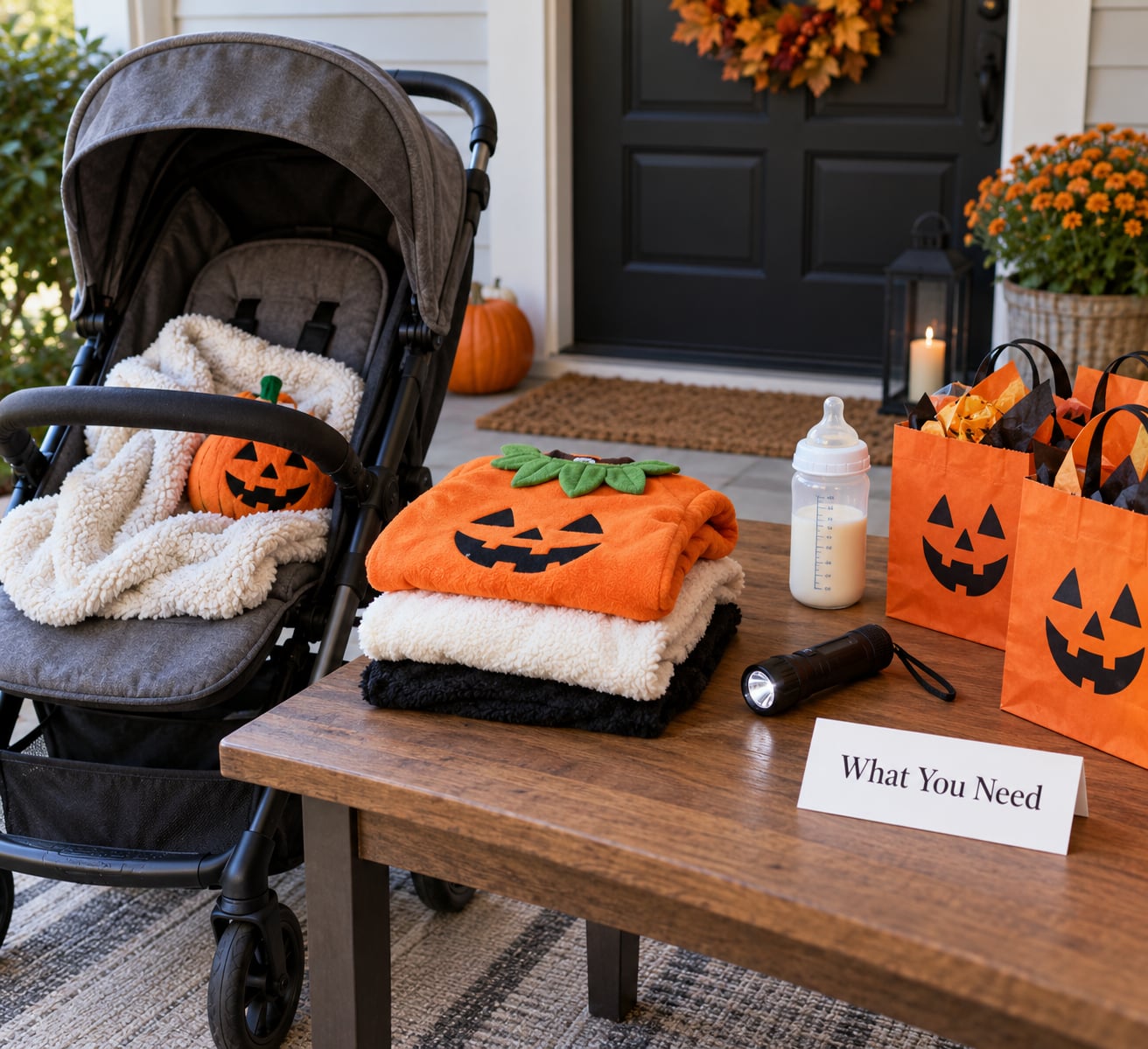
Nearly everything on this list you probably own already. That is the good news about trick-or-treating with a baby: the gear is ordinary parenting gear, not special Halloween equipment.
- A comfort-first costume. A pumpkin, friendly monster, animal, or a seasonal bib-and-bandana set. Skip anything that requires a full body zip, a stiff bonnet, or a mask.
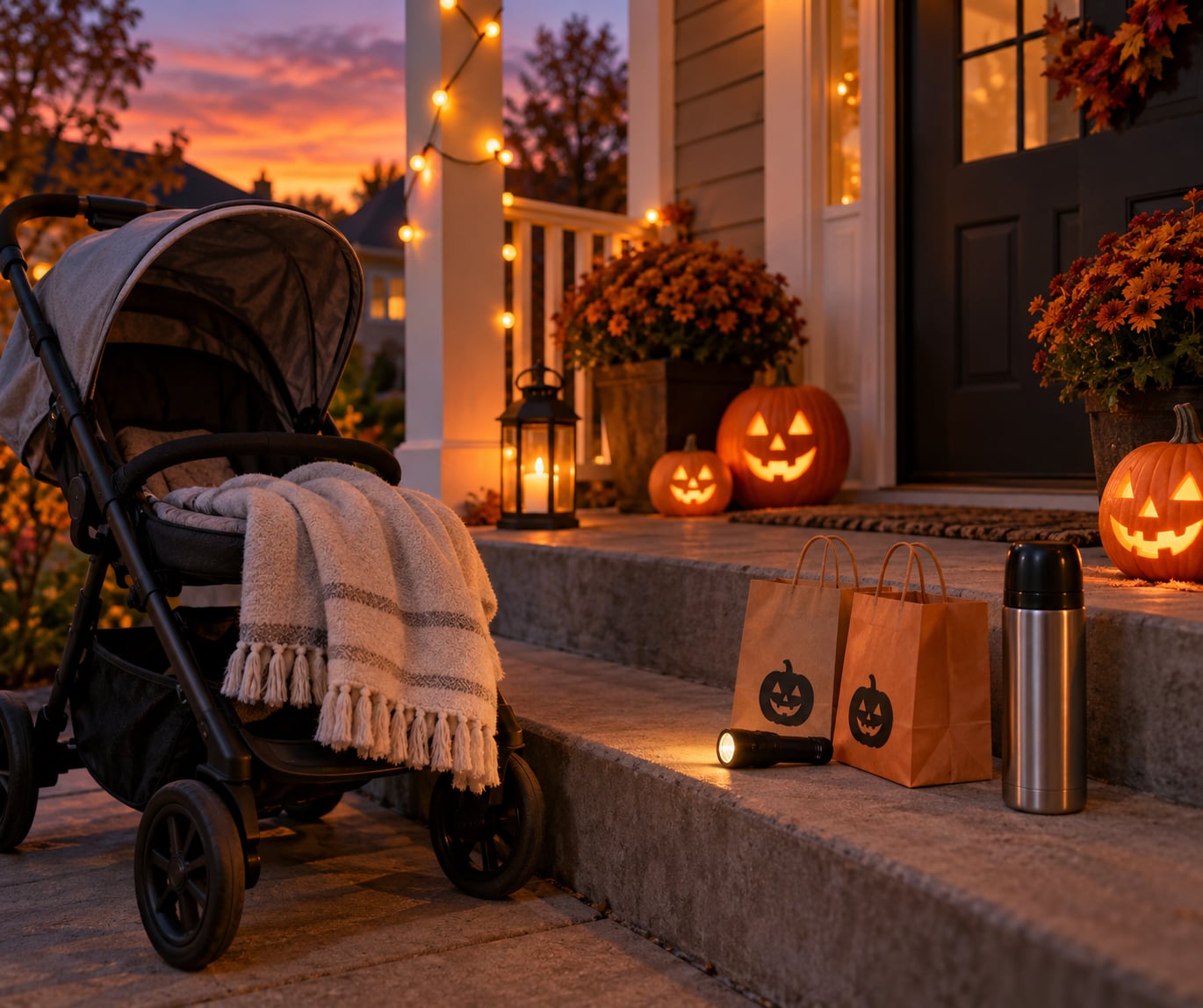
- Weather layers. October evenings turn cold fast, and babies run cold in a costume over a jumper. A sleep sack or muslin blanket clips over most strollers.
- A stroller or soft-structured carrier. Either one works. A carrier keeps your hands free; a stroller gives you a place to park.
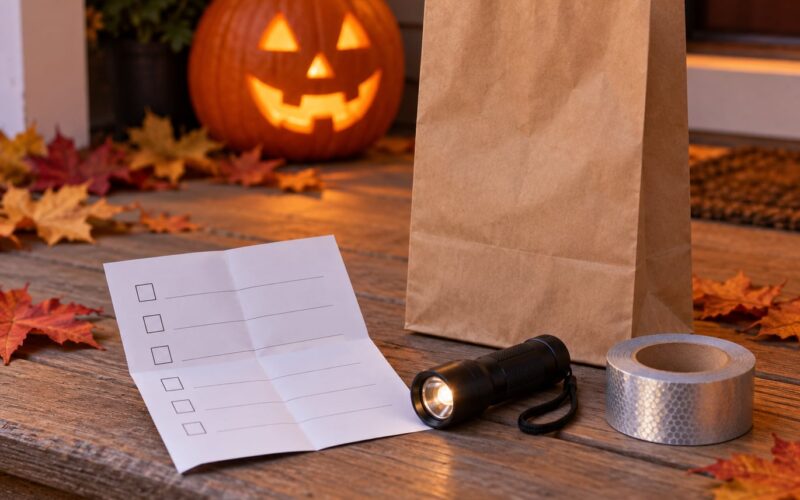
- A light. A small flashlight or a headlamp on your head so you can see kerbs and steps. It also makes you more visible to cars.
- A treat bag and a nappy bag. Wipes, a change of clothes, a nappy, and a small snack for you. Babies have a sixth sense about when you are about to need a nappy.
- Identification. A card with your name and number in the stroller basket or carrier pocket, in case you get separated.
- A simple candy plan. Decide in advance what you will hand out, what you will do with anything your baby receives, and what happens at doors where nothing is offered.
Add a thermos of milk or formula and a change of outfit, and you have covered almost every realistic problem on the night.
Step-by-Step: How to Trick or Treat with a Baby
Work through these in order and the night takes care of itself. Each step is designed to be adjustable, because every baby is different and the whole point is a flexible plan rather than a strict one.
Choose a Comfort-First Costume
Pick a costume your baby can breathe, move, and be changed in. The practical test is simple: can you get a nappy on and off in this outfit, and is there at least one layer you can remove if they get hot? A fleece-lined pumpkin onesie, a soft animal hoodie, or a bib with a bandana and a tail all pass that test. Multi-piece costumes with detachable ears, stiff collars, masks, and capes do not.
For a baby under six months, the costume is basically a photo opportunity. They will not wear it for more than the walk from the car to the porch. For older babies, anything that fits over a normal outfit without compressing the tummy works well. Avoid hats with cords or ties, anything that trails near a wheel, and long sleeves over a car seat harness.
Dress at home, not at the door. A costume that goes on over a jacket and comes off in one piece is the difference between a fun first Halloween and a fussy one.
Pick the Right Time and Route
Leave when most families are still eating dinner, roughly 5:30 to 6:30 in the evening, and aim to be home 60 to 90 minutes later. Early means fewer houses, calmer doorsteps, and a baby who is still awake for their bedtime instead of being wrecked by it. It also means fewer cars on the road, which is safer for everyone.
Work backwards from bedtime rather than forwards from dusk. If your baby normally goes down at 7, plan to be home at 6:15 whether you have knocked on three houses or thirty. Choose a loop within five minutes of home so a nappy emergency never turns into a rescue mission. Porch lights on houses you know are a good first run, since occupied homes are more likely to have treats out.
Set a hard cutoff time in your own head before you start. It is much easier than deciding in the middle of a cold street at 6:45 that you should probably go home now.
Use a Stroller, Carrier, or Safe Walking Setup
Use a stroller if your baby is settled and the route is smooth, a carrier if you have stairs, kerbs, or uneven pavement, and babywearing only if you are already confident in it and the walk is short. Parents who babywear while trick-or-treating often find the weight becomes uncomfortable after the first ten minutes, so test the carrier indoors the week before.
A stroller is fine as long as you can push it with one hand on a kerb and lift it over steps. If you are carrying an infant car seat, a frame or canopy that fits the seat makes the whole night simpler. Skip a car seat costume unless your baby is already fully weaned from the car seat by day; using a car seat outdoors is where injuries happen.
Whatever you choose, do not drape anything over the stroller hood. It blocks airflow and can tip the balance. In the dark, a light-coloured blanket or a small clip-on light is what other walkers and drivers need to see.
Make Trick-or-Treating Manageable
Decide before you leave who carries things. If your baby is in a stroller, you carry the treat bag and the baby is an observer, which is honestly the entire job. Do not try to hold an increasingly heavy baby, a flashlight, a treat bag, and a door-handle at the same time.
Set a house rule that keeps the night simple. My suggestion: knock on every house with a lit porch, say happy Halloween once, take whatever is offered, and do not knock again if the baby is crying. If your baby walks and has a nappy, they get exactly zero treats and a sticker instead, otherwise you will be negotiating with a toddler at midnight.
Wearing a costume yourself changes the tone at the door. A costumed adult with a bundled baby reads as a family that made an effort rather than as someone passing through, and the whole doorstep interaction goes a little warmer.
Handle Candy and Treats Responsibly
Under one, a baby cannot safely eat Halloween candy. Hard sweets, gum, popcorn, nuts, and small hard sweets are choking hazards, and melted chocolate is both a choking risk and a toxic one for dogs, which is worth remembering if your family has one. The American Academy of Pediatrics is the reference point here, and your own pediatrician can answer anything specific to your baby.
Decide in advance what you hand out. Ideas that work for babies who are not eating trick-or-treat sweets include teething biscuits, Mum-Mums, dried fruit such as raisins for older babies who are already eating solids, small yogurt pouches, or a small toy. Ask about allergies before you hand anything to anyone.
Plan for the moment a neighbour says sorry, I do not have anything for a baby. A simple reply works: he will not eat it, but thank you, that is kind. Then move on. Most adults handing out treats are not judging your baby’s age, and almost none of them are worth explaining yourself to.
Decide too what happens to everything collected. Donating it, saving a portion for a toddler potty-training reward, or dropping it into a Halloween gingerbread house project all work better than eating it yourself for three weeks.
Have a Backup Plan for Weather and Fatigue
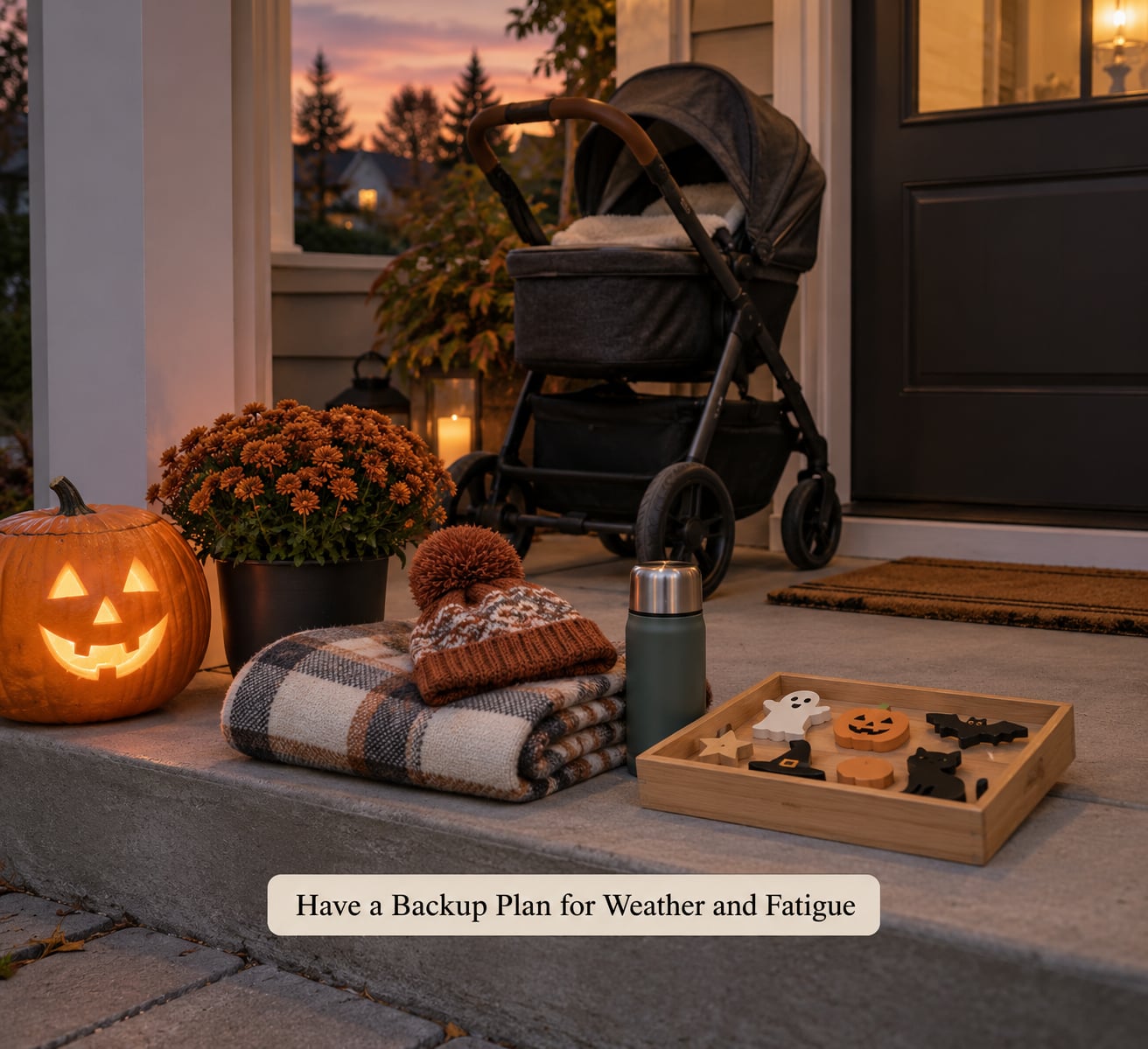
Know your exit before you start. The backup for a baby who melts down is not pushing through, it is turning back, going home, and calling the night done. Build the route so the halfway point is a bench, a car, or a neighbour’s lit porch you can sit on for a few minutes.
For rain, cold, or wind, the alternatives are better than most people expect. A trunk-or-treat event, a shopping-centre Halloween event, or a neighbour’s covered porch gives your baby the costumes and lights without the street. A short stroll to watch the decorations from the sidewalk is the sweet spot for babies under a year old.
For heat, dress the baby in the costume and nothing else underneath, and pick cotton or muslin rather than fleece and fake fur. Hot weather dressing is a genuine problem for Halloween outfits, and it is the reason so many parents end up with the costume worn open over a vest.
If the night ends early, it was not a failure. The photos get taken either way, and a baby who slept through the night will be in a better mood for the ones you take in daylight the next morning.
Common Mistakes
Most of what makes this hard is avoidable, and usually with one small change made the week before rather than on the night.
Restrictive costumes. Anything that stops a baby reaching their feet, sitting properly in a stroller, or being changed in the dark will end the outing early. Fix: dress for the baby who is on the porch, not the child in the catalogue photo.
Outings that run past bedtime. This is the number one complaint from parents who have done this. Fix: set a clock time before you leave, and make the rule that leaving early is always allowed.
Treating the baby like they are collecting candy. Handing a six-month-old a full sweet bag, or letting a one-year-old graze from a bucket, is how a good night becomes a sick one. Fix: treats go in a separate bag, out of reach, and you hand out something age-appropriate instead.
Dark streets with no light. Push a stroller over kerbs you cannot see and something will eventually go wrong. Fix: a headlamp, a light-coloured blanket, and reflective strips on the stroller.
No weather layers. Fix: sleep sack or muslin blanket clipped over the stroller, hat in the basket for the walk home, and a plan for arriving home before the temperature drops.
Copying an older sibling’s Halloween. A four-year-old can be out until 9 and walk the whole street. A baby cannot, and trying to make one do that is a bad evening for everyone. Fix: separate the outings if you have the adults, and reunite for the photos at home.
Frequently Asked Questions
How old should a baby be to go trick-or-treating?
Any age, including newborns, though the experience changes completely. Under six months, plan a 20-minute stroll in a carrier and skip the knocking. From six to twelve months, a stroller and a handful of nearby houses works well. Between one and two, they can walk short stretches and react to the costumes. There is no age when it becomes unsafe on its own, as long as the nap and bedtime plan is yours, not theirs.
Can a baby eat Halloween candy?
Not under one year. Most sweets are choking hazards at that age, and melted chocolate is a choking risk as well as a toxicity risk for pets. Older babies on solids can usually manage soft fruit, teething biscuits, or yogurt pouches. Keep the treat bag out of reach and hand out something age-appropriate instead, then ask your own pediatrician if you have a specific concern.
What time should you take a baby trick-or-treating?
Go earlier than you think. Leaving around 5:30 to 6:30 in the evening means fewer doors, calmer houses, lighter traffic, and a baby who is still awake at bedtime. Work backwards from your normal bedtime and set a hard home time rather than judging it on the night. In most neighbourhoods the early window is the most reliable way to have a calm outing.
Is trunk or treat better for a baby than door to door?
For most babies, yes. A trunk-or-treat event gives your baby costumes, lights, and other people to watch without you covering a street, climbing steps, or managing a stroller over kerbs. It is also an easy first outing, because you can leave the moment your baby has had enough. Door to door is better once your baby is walking and tolerates a carrier for 45 minutes.
How do you keep a baby warm in a Halloween costume?
Layer a muslin blanket or sleep sack over the stroller hood, clip it on the side so it cannot blow away, and keep a hat and a warmer outfit in the bag for the walk home. Choose fleece-lined or cotton costumes over thick fur and fake fur padding, and avoid a waterproof outer layer that traps heat and sweat. Check the temperature at the first house rather than waiting for shivering.
What if my baby will not leave the stroller or cries at every house?
Let your baby stay in the stroller. It is not a failure, and some babies simply prefer a warm seat to being carried in a cold street. Walk past, wave at people, and let your baby watch the costumes from under the blanket. If the crying is constant, go home early and take the photos at home instead, because a short happy night beats a long one that ends in tears.
A Simple Halloween Tradition
If you do one thing from this guide, make the plan short. Pick a route within a few minutes of home and a time that puts you back before bedtime, choose a costume your baby can breathe and be changed in, and treat the evening as a memory rather than a candy run.
Everything else, the carrier test, the light, the blanket, the honest answer to a neighbour with no baby-appropriate treats, is detail you can sort on the day. The tradition survives on the photos, and photos are easy to take at home if the street turns out to be a bad call.
Reviewed for 2026. For anything specific to your baby’s health, feeding, or allergies, check with your own pediatrician.