Creepypasta is a short horror story posted online in the shape of a real document — a journal entry, a chat log, a wiki page, a police report — so the reader has to decide for themselves that it isn’t true. To learn how to write a creepypasta that feels real, you borrow an ordinary container, fill it with mundane specifics like dates and model numbers, and withhold exactly one thing: an explanation. Restraint does the work that gore usually gets asked to do.
Most beginners reach for a monster and a jumpscare. Both are the easy way out, and both make the story feel like a story. The effect this genre runs on is much subtler, and it takes about nine steps to get right.
The short version:
- Pick one specific fear a real person would recognise, not a grab bag of spooky ideas.
- Set it somewhere ordinary: a bedroom, a rented flat above a laundrette, a school gym.
- Frame it as a document — a chat log, a diary entry, a wiki edit history.
- Write first person, and let the narrator doubt themselves at least twice.
- Choose three sensory details that are accurate, not five that are frightening.
- Give the threat one rule, and let the reader learn it before you explain it.
- Introduce small wrongness, then escalate it in five beats instead of ten.
- Stop one fact short of confirmation.
- Cut anything that only exists to shock, then test it on one reader.
Below is how each of those works in practice.
Table of Contents
- What You Need
- Step-by-Step: How to Write a Creepypasta That Feels Real
- 1. Start with one believable fear
- 2. Build the story around ordinary surroundings
- 3. Use a first-person or documentary frame
- 4. Ground the horror in sensory details
- 5. Establish a rule for the threat
- 6. Add small inconsistencies instead of constant chaos
- 7. Escalate the consequences gradually
- 8. End with an unresolved implication
- 9. Revise for clarity, restraint, and fear
- A worked example of the anatomy
- Common Mistakes
- Frequently Asked Questions
- How long should a creepypasta be?
- Is first person always the best point of view for a creepypasta?
- What are the main tips for writing an effective creepypasta?
- Is creepypasta appropriate for younger readers?
- Can ChatGPT write horror stories?
- How do I stop my horror story from feeling fake?
- Conclusion
What You Need
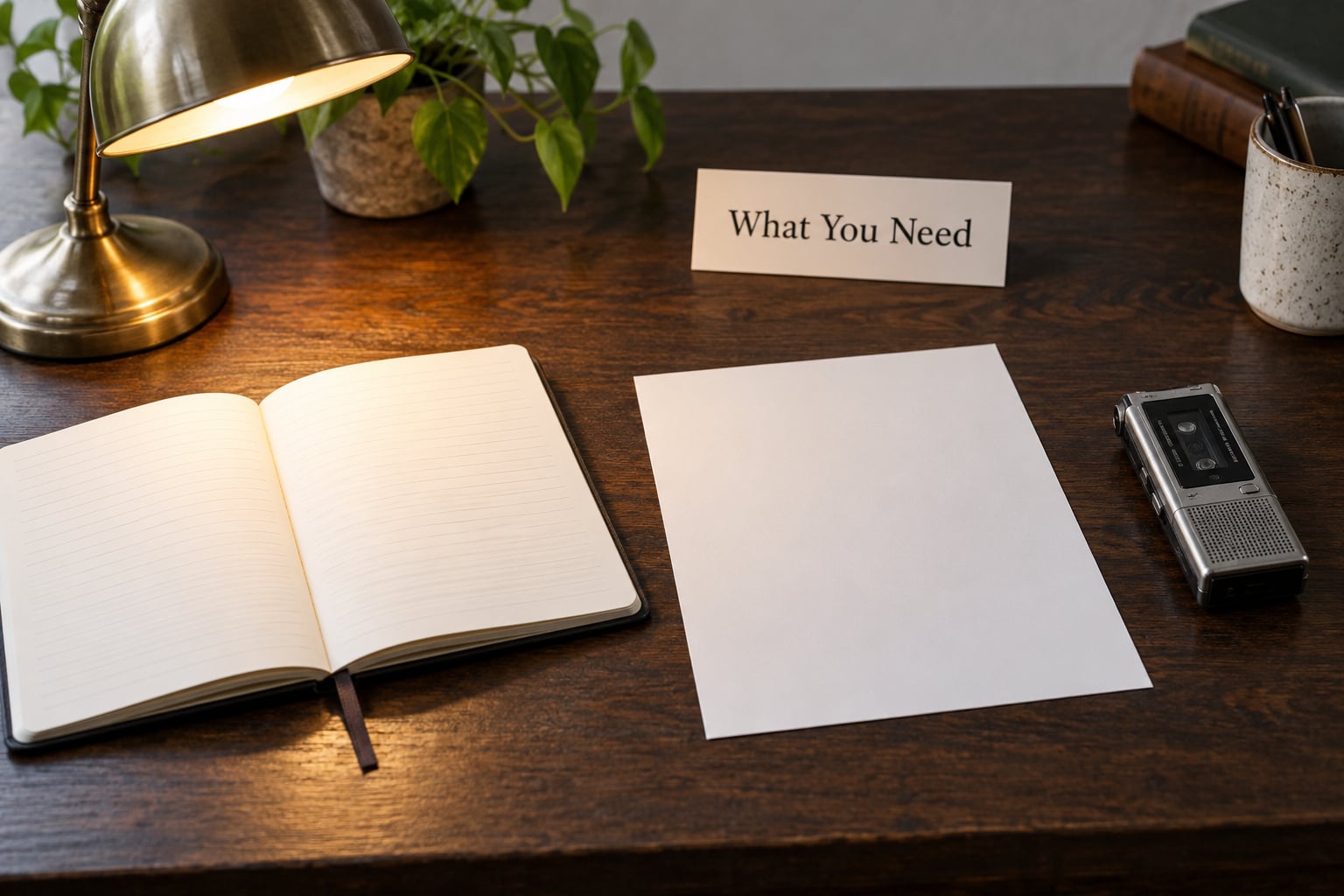
You need five things before you write a word, and none of them are software. A focused fear premise. A setting a reader can picture without effort. A container format that explains why this document exists. A handful of ordinary details, the kind nobody would think to invent. And a clear point where the rules of reality break.
The container is the one most writers skip, and it is doing more work than they realise. Readers already know how to distrust a story and how to half-believe a screenshot. Hand them a form they recognise and they will start reading in a different mode.
These are the formats that work most often, with the opening line each one usually takes and the feeling it sets up:
- Journal entry. “March 14th. I know how this reads now.” Triggers confession and self-blame, and it suits grief, guilt and slow dread better than anything else.
- Chat log transcript. “10:41 pm — my sister: are you awake” Triggers the sense of being watched right now, which makes it good for present-tense panic.
- Text file dump. “notes.txt — recovered from a school laptop” Triggers distrust of evidence itself, so it fits institutional cover-ups.
- Wiki article. An edit history showing 400 deletions in one night. Triggers erasure and revisionism, and it suits threats that stay unknowable.
- Police report. “Caller declined to give a name or location.” The institutional calm is the effect, and it works for rural myth and serial events.
- Forum post. “I found this in a used bookstore, no title on the spine.” Casual contagion, best suited to objects, media and games.
- Audio transcript. “[00:00:12] — (no speech. HVAC unit audible.)” Silence treated as evidence, which makes it a strong fit for isolation and absence.
One warning about the film form. Found footage horror is a movie genre built on video. Written found footage means a document that claims to be recovered, transcribed or archived, and it borrows the same distrust without needing an image.
Step-by-Step: How to Write a Creepypasta That Feels Real
1. Start with one believable fear
Choose a specific fear and narrow it to one question. Not darkness, not the idea that something is out there — something like why the bedroom door was open when the narrator is certain they latched it, or why the smoke alarm chirps at 4 a.m. in an empty flat.
This works because a broad premise gives a reader nothing to argue with. A narrow premise is a small claim they will test against their own life, and the moment they start testing it, they are inside the story. You can check the step by asking whether your fear could be stated in a single sentence with a question mark. If it needs a paragraph, it is still two stories.
2. Build the story around ordinary surroundings
Put the horror in a place the reader already has. A studio flat with thin walls. A bus route with one service an hour. A secondary school changing room. Familiarity is not decoration here — it is the engine that lets a supernatural event slip past a reader’s scepticism.
Contrast does the rest. The stranger the room is, the more the reader treats your story as fiction. A basement stairwell at a normal house is more disturbing than a nameless castle, because the reader’s brain supplies the house and therefore the family.
3. Use a first-person or documentary frame
First-person narration is the default for a reason: it hands the reader access to somebody’s private account, and people lie to themselves in documents far more convincingly than narrators do on a page. A forum post, a recovered file, an interview transcript and a personal confession all work, because each one justifies a selective point of view.
Keep that selection deliberate. A narrator who notices the time and the sound but not their own fear is telling you where to look. If you want readers to feel watched, keep the narrator oddly calm about the wrong things and frightened by the right ones.
4. Ground the horror in sensory details
Pick three accurate sensory facts and stay inside them. The radiator knocking twice and stopping. Cold coming off the hallway floor rather than the room. A smell of wet grass in a flat with no plants. Accuracy is the whole trick — a detail nobody would invent is stronger evidence than an invented one.
Piling on sensation is the opposite move. Six competing descriptions read as an author reaching, and readers register the strain. Test the step by striking half your sensory details and seeing whether the scene got clearer. Usually it does.
5. Establish a rule for the threat
Give the danger one rule and let the reader learn it before you explain it. A repeated behaviour, an unexplained ritual, a changed name, a timestamp that lands in a specific range, a room where a door should not be. A rule is what makes the story feel coherent rather than random, and it lets readers anticipate trouble on their own.
Check the step by reading only the rule scenes in isolation. If they make sense as their own small sequence without the surrounding context, the rule is doing the work it should.
6. Add small inconsistencies instead of constant chaos
Unease comes from one detail being wrong, not from everything being wrong. A clock four minutes fast that nobody set. A chair moved back to where it started but with dust disturbed. The same phrase in the narrator’s mouth twice, phrased identically both times, because memory repeats verbatim.
This is the step people overcorrect. If every object in every room is subtly off, the story becomes exhausting and the reader stops trusting the narrator entirely. One oddity at a time, with enough ordinary material around it to make the oddity stand out.
7. Escalate the consequences gradually
Move in five beats: something is normal, then something is wrong, then it is wrong again, then somebody else notices, then it responds. Each beat should cost the narrator something — an object, a routine, a relationship, an explanation they were relying on.
The mistake is jumping straight to the worst thing you can imagine. A story that opens at its most extreme has nowhere to go. Show the narrator getting more involved and less able to dismiss what is happening, and let the reader reach the conclusion a step before they do.
8. End with an unresolved implication
The weak ending explains. It names the entity, dates its origin, hands the reader a full account of what happened to everyone involved. Readers feel the tension drop immediately, because you have given them a shape for something they preferred not to look at directly.
The stronger ending adds one final fact and stops. The narrator never heard the recording back. The last line contradicts something stated earlier without pointing at the contradiction. The document ends mid-beat. What you want is plausible deniability — the reader can walk away still arguing about what happened, and that argument keeps the story alive after you have stopped writing.
9. Revise for clarity, restraint, and fear
Run a specific checklist, not a general polish. Is the timeline clear enough that a reader could place every scene in order? Does every detail serve the premise, or is one there because it sounded good? Did the scare grow out of evidence, or out of a shock image you inserted? Have you explained anything the reader could have inferred?
Then hand it to exactly one person and ask a narrow question: where did you stop believing it, and where did you want to stop reading? Those two answers are usually in different places. Most writers get the scare working and lose the reader earlier, or hold attention perfectly and never deliver a jolt.
A worked example of the anatomy
One submission on r/NoSleepAuthors shows what this looks like at sentence level. It opens with an investigator frame and case numbering, introduces a named video artifact whose upload date reads 0 0 0, gives ritual instructions as numbered steps, then runs a verbatim witness transcript labelled by speaker with stage directions such as the witness shifting in the seat. The witness produces a physical prop, a black bulky laptop. The closing line admits the narrator never saw the artifact himself.
Nothing in that story is invented from nowhere. It is case files, an upload field, and a man’s own admission, and the horror lives entirely in the gap between what the file says and what the interviewer never asks.
Common Mistakes
Most drafts that feel fake fail in the same eight ways, and each has a specific fix.
- Over-explained lore. The origin of the entity, the history of the house, the society that started it all. Fix: cut every paragraph that answers a question the reader did not ask. If the backstory matters, hide it in a document the narrator quotes rather than narrates.
- Clichés used as a crutch. Slenderman, 666, permanent marker, 3-3-3, a pale child. Fix: use one, at most, and treat it as a cultural object the narrator notices rather than as a threat in itself. A Terraria forum thread from over a decade ago packs stories with these details as a joke, which tells you they read as genre signifiers. That only works while the rest of the prose holds up.
- Inconsistent rules. The threat ignores its own conditions in chapter three. Fix: write the rule down on paper before drafting and check every scene against it. Inconsistency reads as a plot hole; a rule with one unexplained exception reads as a mystery.
- Revealing the monster too soon. A full visual description of the antagonist in the first third. Fix: describe the effect instead — what it does to objects, to light, to the narrator’s hearing. Readers will build a worse image than you can write.
- Every sentence dramatic. Constant present tense, exclamation, short paragraphs stacked with no air. Fix: write the calm passages too. Real accounts are mostly flat, and the flatness is what makes the loud moments land.
- All-caps and broken grammar. Writers are told repeatedly that shouting and sloppy spelling destroy the illusion of seriousness. That advice is right, and it also causes real damage to non-native English writers, who worry their real grammar errors disqualify them. Correct spelling is fine. A panicky narrator typing in capitals on purpose is also fine, as a choice.
- Gore as the default fix. Reaching for injury when the story lacks tension. Fix: implication. A room described after someone left it says more than anything shown directly.
- A twist that voids the story. Revealing the narrator was insane, a child, or a liar at the end. Fix: the ambiguity has to leave the threat standing. If the last line explains away everything you built, you have not ended ambiguously, you have cancelled the story.
Frequently Asked Questions
How long should a creepypasta be?
Most published creepypasta run between 1,000 and 2,000 words. Length matters far less than structure. A short story with one clear rule, five escalation beats and an ending one fact short of confirmation beats a long one that explains its lore. If you are stuck, write the first thousand words and see whether the rule has appeared twice by the end of them. If it has not, the problem is structure, not length.
Is first person always the best point of view for a creepypasta?
First person is the default because a private account feels less composed than a narrated story, but it is not the only option that works. A cold third-person investigator report, a chat log between two people and a wiki article with a heavily edited history all create distance the reader can lean into. Choose the viewpoint whose blind spots you want, then refuse to let the narrator notice them.
What are the main tips for writing an effective creepypasta?
Start from one recognisable fear rather than a list of spooky ideas. Set it in an ordinary location readers know. Frame the story as a document. Ground it in three accurate sensory details instead of ten frightening ones. Give the threat a single rule. Escalate in five beats. End one fact short of confirmation. Then cut every paragraph that explains something the reader could infer, and test the draft on one person.
Is creepypasta appropriate for younger readers?
It depends entirely on the story, and on where it is published. NoSleep, the largest creepypasta submission site, enforces a no-graphic-content standard, so material there is written to imply rather than display. The parenthesised content-warning tags used on the creepypasta wiki exist because stories range from mild to severe. Check the tags and the site rules before recommending a specific story to a child, and read anything aimed at them yourself first.
Can ChatGPT write horror stories?
It can produce competent paragraphs and it will still struggle with the thing this genre runs on. A generated account tends to escalate steadily, explain itself at the end and describe the threat directly, which are the three habits that make a creepypasta feel fake. Many readers now recognise the rhythm immediately. Using a model for brainstorming rules and sensory details is fine; using it for the voice and the ending is where it flattens.
How do I stop my horror story from feeling fake?
Ask what your story is currently pretending to be. If the answer is a story, the problem is framing rather than content. Borrow a document format, add three mundane details nobody would invent, and remove one line of explanation from every paragraph. Then check the narrator. A narrator who never doubts anything is a narrator the reader has no reason to trust, which quietly turns the whole thing back into fiction.
Conclusion
Believable horror is a construction problem, not a gore problem. You choose one ordinary location, one fear a real person would admit to, and one rule the threat obeys. You write it as a document, you fill the document with details nobody would think to invent, and you stop one fact short of confirming anything.
That is the whole method. Open a blank page tonight, pick a bedroom you have actually slept in, and start with the first ordinary detail that feels slightly wrong. Do not add the monster yet.