To start reading horror fiction as an adult, borrow one book that matches a genre you already enjoy, set a personal intensity limit before you open it, and give yourself one weekend to finish. That really is all it takes. Most adults who claim horror is not for them are reacting to films, and horror novels cannot reproduce what a film does to you.
A jump scare needs a sudden noise, a fast cut, a strobing light and a score that tells you to flinch. A book has none of those. It has sentence rhythm, withheld information, and a voice in your head that keeps reading past the point where a moviegoer would look away. That is the whole reframe, and it usually opens the genre faster than any reading list does.
This guide takes roughly an hour to work through and then one book to complete. You do not need to read it in order. You will end with a subgenre you actually want to try, not a vague idea that horror is a thing other people enjoy.
October 2026 update: I still add books to this whenever a new one lands that fits a profile below, and the notes here reflect what I have handed to friends who swore they were done with fiction.
Table of Contents
- What You Need
- A library card or an ebook account
- A bookmark and a notes app
- A way to track books and content warnings
- A reading setting you actually believe
- Step-by-Step: How to Start Reading Horror Fiction as an Adult
- 1. Define What Kind of Scary You Want
- 2. Start With a Beginner-Friendly Collection
- 3. Check Content Warnings Without Spoiling the Book
- 4. Read at Your Own Pace
- 5. Notice What You Like and What You Do Not
- 6. Build a Simple Horror Reading Habit
- Common Mistakes
- Frequently Asked Questions
- What are some good beginner horror books for adults?
- What horror book should I read first if I hate gore?
- Is horror fiction scarier than horror movies?
- Should I read horror books in series order?
- How do I know if a horror book is too scary for me?
- What if I hate my first horror book?
- Conclusion
What You Need
Four things, none of them expensive. Get these in place and the actual reading becomes frictionless.
A library card or an ebook account
A public library card gets you hundreds of horror titles with no commitment at all. If your library uses OverDrive or Hoopla, the ebook and audiobook versions come with the same card, and Libby is the usual app for borrowing them.
Borrowing matters here for a reason specific to this genre. You are going to bounce off a few books before one lands, and a borrowed book that misses costs you nothing but the trip to the shelf.
A bookmark and a notes app
You need somewhere to write down what a book did to you. Most people who cannot finish a recommendation list have no way to remember why a book did not work for them, so they keep picking the same kind of book.
A phone notes file titled something plain like horror log is enough. Three lines per book: what it scared you with, what it did not do well, and whether you would read that author again.
A way to track books and content warnings
Any reading tracker works, including the built-in one on your phone. What matters is that it shows you your content warnings before you commit, not that it looks nice.
Goodreads, StoryGraph, and most library catalogs list reader-supplied content warnings on the book page. Publisher pages often carry a short version. See step 3 for how to use them without talking yourself out of everything.
A reading setting you actually believe
Pick the conditions you will genuinely repeat. Daylight and a couch, a commute on public transport, an audiobook on a walk. Whatever you choose, make it the default rather than an exception you have to motivate yourself toward.
Step-by-Step: How to Start Reading Horror Fiction as an Adult
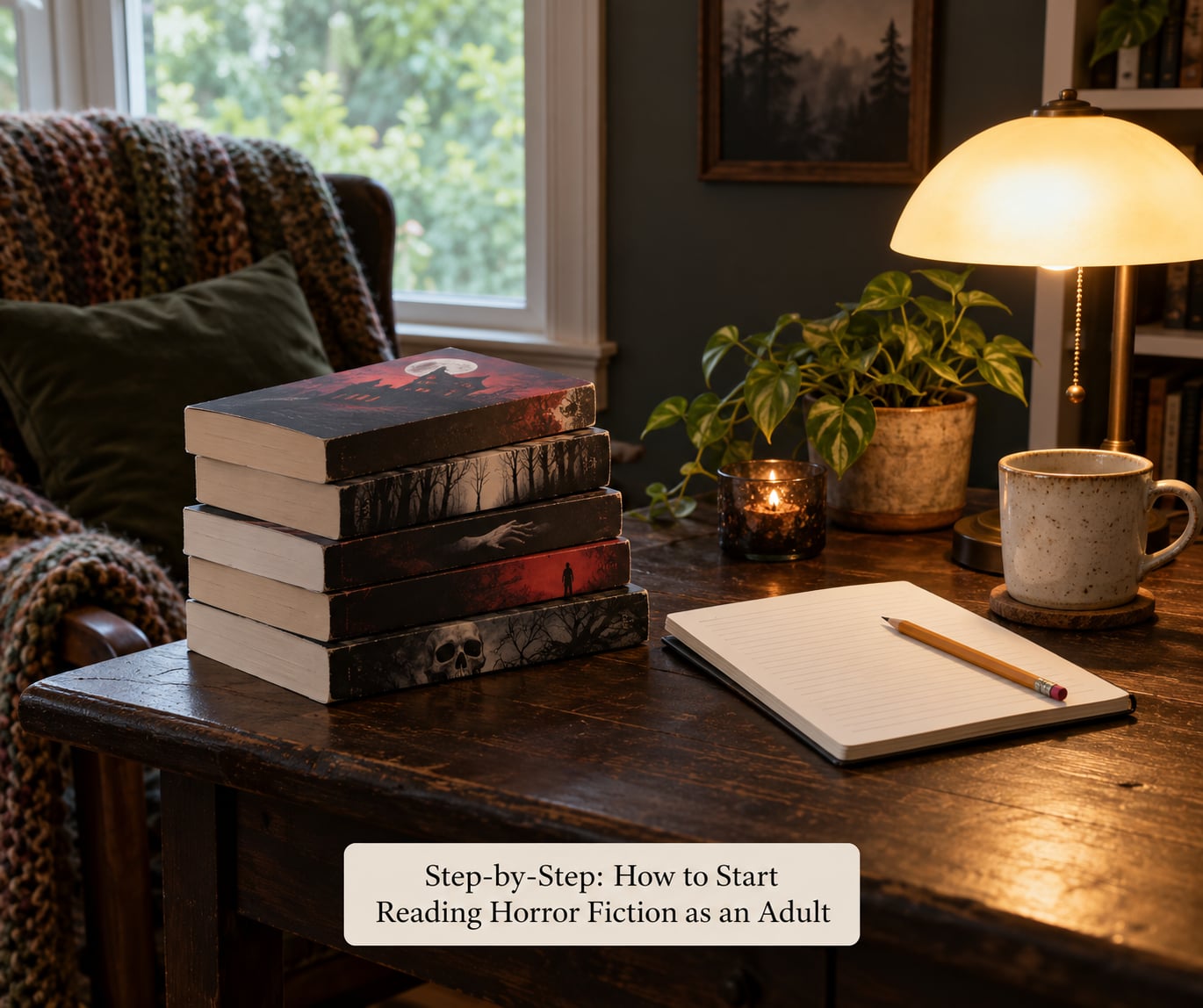
The process takes six steps, and the order matters because each one narrows your choices. Do them in sequence and you will have a book in hand tonight without scrolling through forty recommendations.
1. Define What Kind of Scary You Want
Horror is not one experience, and beginners lose months because they assume it is. The categories below cover almost everything you will meet, and each one produces a different feeling rather than a different volume of gore.
Psychological horror lives inside a character’s head. The fear comes from not trusting the person telling the story, which is why the label unreliable narrator shows up so often here. Expect dread, not bloodshed.
Gothic fiction is the ancestor of the whole genre. A house, a secret, an inheritance, and slow rot. It is atmospheric rather than violent, and it reads like a period novel with a shadow in it.
Folk horror is rooted in place and ritual. A village with a custom nobody explains, a harvest, a fair that only appears once a year. Think Shirley Jackson’s The Haunting of Hill House and Something Wicked This Way Comes by Ray Bradbury.
Cosmic horror is fear of something too large to negotiate with. Humans are incidental. H. P. Lovecraft built the template; the Imago Sequence by Laird Barron is its clearest modern descendant. Most readers treat this as a second or third step rather than a first.
Haunted house is the one most people picture when they hear the word horror. A location that is doing something to the people inside it. It works in any intensity from gentle to brutal.
Possession horror centers on something taking control of a person. It is intimate and claustrophobic because the threat is inside rather than outside.
Slasher fiction is a killer, a location, and a countdown. It is the subgenre closest to horror film, so it is a reasonable bridge if you already like thrillers.
Body horror turns the threat inward, onto flesh and identity. It is intense and often philosophical. Splatterpunk is the opposite pole: graphic violence as shock and dark humor, in the tradition of Clive Barker’s The Books of Blood.
Short fiction is worth naming too, because a collection of ten stories is the easiest commitment you can make. Horror anthologies and single-author collections let you sample six kinds of horror without investing in six novels.
Pick one to two that match your temperament. If you read for atmosphere and place, start with gothic or folk. If you read for unreliable, twisting plots, start with psychological. If you read for tension and countdown, start with slasher or possession.
2. Start With a Beginner-Friendly Collection
Your first horror book should be short, widely recommended, and about two hundred pages or fewer if you can find one that length. Doorstoppers lose beginners, and the genre has plenty of novellas.
If you want a single committed answer: The Haunting of Hill House by Shirley Jackson. It is the most complete introduction to the genre that exists. The dread is atmospheric, there is almost no graphic content, and the prose is clean enough that a reader with no habit at all will not bounce off it.
If your taste runs to modern voices with sharp edges, What Moves the Dead by T. Kingfisher is a strong second. Cassandra Khaw, Hiron Ennes, Sara Gran, Jennifer McMahon, and Simone St. James come up repeatedly in reader recommendations for people who found modern horror easier to get into than the classics.
If you want the version with emotional weight rather than pure dread, Pet Sematary by Stephen King is the one people describe as creepy and emotionally difficult at the same time. That combination is often what converts a reader who is not looking to be frightened.
Two habits help here. First, borrow before you buy, since the book you should read is the one you keep, not the one everyone names. Second, if a famous title keeps getting recommended to you and you keep not starting it, treat that as information rather than a failure. Readers on r/horrorlit get tired of the same handful of suggestions for exactly this reason.
3. Check Content Warnings Without Spoiling the Book
Content warnings are a screening tool, not a reason to skip a book. The goal is to know what you are walking into so you can decide, not to find out if you have to avoid something.
Where to look, in rough order of usefulness: the Goodreads or StoryGraph book page, which carries reader-submitted warnings alongside reviews; the publisher or editor page, which usually names the broad categories; and the top reviews on a retail listing, where readers mention specifics. For series, check the whole series rather than just book one, because that is exactly where surprises tend to sit.
Three screens for your first read: grief, harm to children or animals, and sexual violence. Those come up most often in the questions readers ask about first-time horror, and knowing in advance that they are there takes the ambush out of them.
If a book has a warning that genuinely stops you, take the next book. There are hundreds. Nobody in r/horrorlit will think less of you for it.
4. Read at Your Own Pace
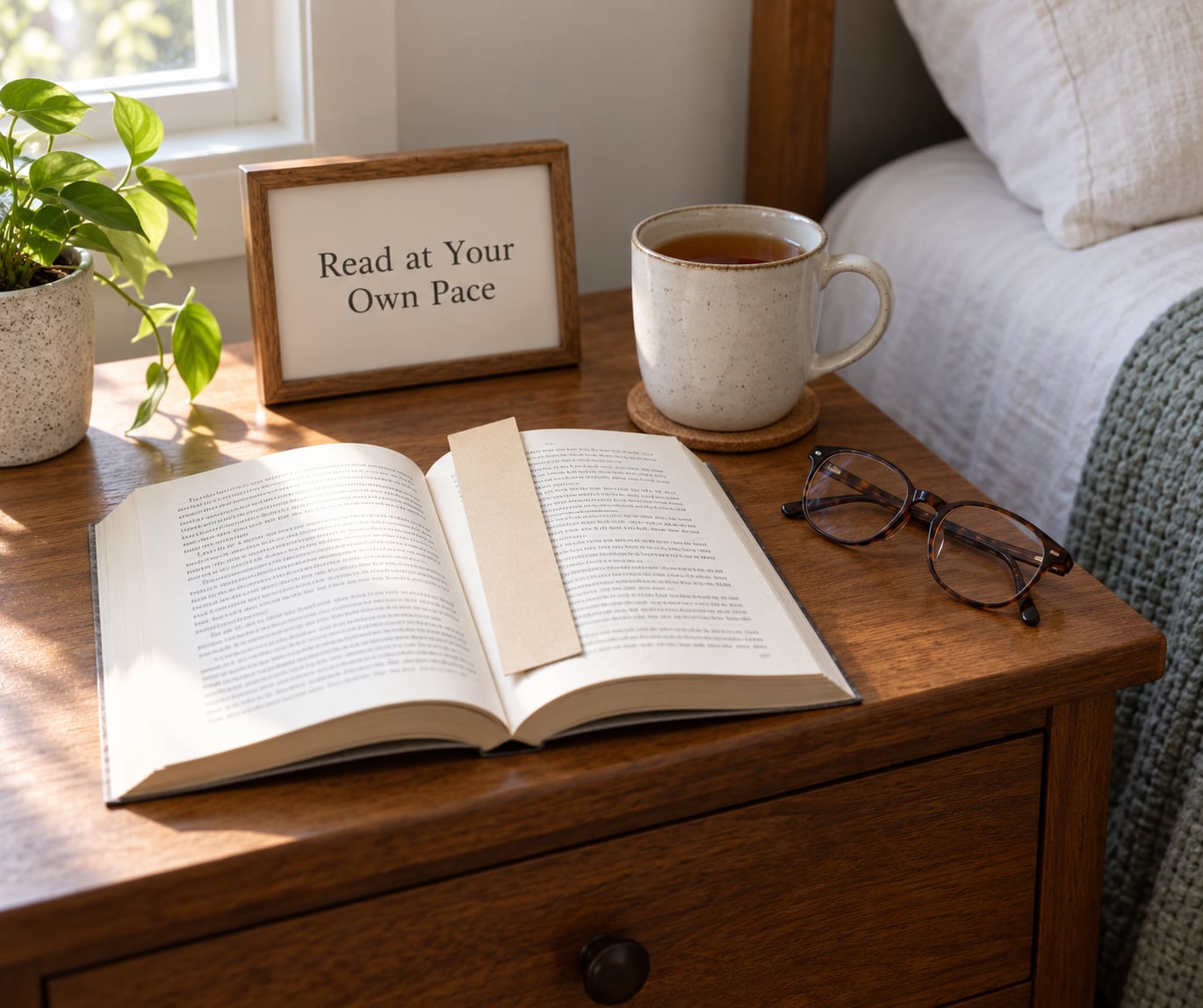
You are allowed to read horror in daylight, sitting up, in a room with other people in it. Many adults who go on to love the genre read that way for years first. It costs nothing and it works.
You are also allowed to put distance between you and the story, which is the single most useful trick beginners get told and ignore. A physical distance, more distance in time, or a different medium all work. An audiobook can be easier because you are also driving, walking, or cooking, and prose can be frightening in a way that sound is not.
Beyond that: skip descriptive passages if a scene is getting to you, reread anything confusing rather than stalling on it, and take a night off without deciding anything about the book. If a book stops being worth the effort after eighty pages, put it down. That is not a failure of nerve, it is just information.
One last permission, and readers need it more than they expect: you are allowed to abandon a horror book you do not finish. See step 5 for how to make that productive rather than a reason to abandon the genre.
5. Notice What You Like and What You Do Not
This is the step people skip, and skipping it is why their second book is the same as their first. Horror tells you very little about what you want unless you write it down.
Track six things per book: atmosphere, whether you liked the characters, whether the scares landed, the pacing, the writing style, and the emotional intensity you can tolerate. Three lines in your notes file is enough.
Then look for the pattern rather than the verdict. If you wrote atmosphere as the thing you liked three books running, you are a gothic or folk horror reader now, and the next book is easy to pick. If you could not stand a slow middle, you have a pacing preference, not a flaw, and you can steer toward novellas and slasher fiction.
Readers also report that horror that hits emotionally converts them more reliably than horror that merely frightens them. If your log keeps mentioning a scene for its grief rather than its tension, that is a real preference and a whole shelf of books to follow.
6. Build a Simple Horror Reading Habit
Pick a target you will actually hit. Two horror books a month is plenty. More than that and you will speed through them, which is the fastest way to end up disliking a genre.
Alternate rather than binge. A horror book after a romance or a mystery reads as a palate cleanser; five in a row reads as homework.
Use short fiction on busy nights. A single story from an anthology needs five minutes and no commitment, and it keeps the genre present in your life during weeks when a novel will not happen.
Choose each next book for a reason you can say out loud: same author, same subgenre, similar length, or a book because someone whose taste you trust liked it. Popularity alone is the worst of those reasons, and it is how readers end up in a slump of interchangeable books.
On series, read in order. Horror series often carry character arcs and recurring monsters forward, and starting at book two is the most common reason people decide they do not enjoy the subgenre. If you want to sample without committing, read the first in a series and stop cleanly rather than jumping around.
Common Mistakes
Starting with the most graphic book you can find. Gore and quality are unrelated axes. Starting with something extreme gives you an accurate impression of the genre’s loudest corner and nothing else. Start with atmosphere instead, which is the part that actually hooks people.
Copying an intimidating reading list. A fifty-title list built by someone who has read horror for twenty years is not a beginner path, it is a bibliography. Take one title from it and stop reading the list.
Treating intensity as quality. The book that frightened you most is not automatically the book that is best written. Judge a horror novel the way you would judge any novel, on characters, structure, and prose.
Ignoring content warnings. Walking into a book blind is not brave, it is just avoidable, and readers who check warnings tend to finish far more books than readers who refuse to.
Abandoning every book too quickly. Two hundred pages is not long. If you quit something at forty pages because it did not scare you, you may be judging a book that builds slowly. Give the ones you pick deliberately a full chance.
Treating horror as a test of courage. Nobody needs to prove anything by finishing a book. Your reading life is allowed to be comfortable, and the adults who read the most horror are the ones who never had to prove anything to anybody.
A few things that help most in the long run: read horror in the season you want to read it, since October changes what a haunted house feels like; tell someone what you are reading so you have someone to debrief with; and remember that abandoning one book is a normal event, not a verdict on the genre.
Frequently Asked Questions
What are some good beginner horror books for adults?
Start with something short and atmospheric rather than graphic. Shirley Jackson’s The Haunting of Hill House is the most complete introduction to the genre, with dread instead of bloodshed. What Moves the Dead by T. Kingfisher is a modern option with a lighter touch, and Pet Sematary by Stephen King is the pick if you want horror that lands emotionally rather than just frighteningly.
What horror book should I read first if I hate gore?
Choose gothic, folk, or psychological horror and avoid slasher, body horror, and splatterpunk entirely. All three of those subgenres treat violence as a feature rather than an implication. Folk and gothic horror build dread through atmosphere, place, and ritual, and the most famous examples, Hill House and Something Wicked This Way Comes, contain almost no graphic detail at all.
Is horror fiction scarier than horror movies?
Usually less immediate, and often more unsettling over a longer stretch. Films deliver fear in sudden bursts through sound, editing, and lighting. Novels work through cumulative dread, withheld information, and narrators you cannot quite trust. That difference is why plenty of adults who skip horror films happily read horror novels, often with a lamp on and in the daytime.
Should I read horror books in series order?
Yes, especially for your first series. Horror sequels carry forward character arcs, recurring creatures, and world-building, and starting mid-series is a common reason people conclude they dislike a subgenre they have barely tried. If you want a taste before committing, read the first book and stop there rather than jumping to book three for the excitement of it.
How do I know if a horror book is too scary for me?
Check reader content warnings on Goodreads, StoryGraph, or the top reviews on a retail listing, then decide from there. For a first read, screen specifically for grief, harm to children or animals, and sexual violence, since those come up most often. Then set the conditions: daylight, a shared room, an audiobook on a walk. Intensity is adjustable even when content is fixed.
What if I hate my first horror book?
Write down three lines about it before moving on: what it did well, what it did badly, and whether you would read that author again. Most disappointing first reads fail on pacing or atmosphere, not on horror, so the notes tell you what to pick next. Then choose a different subgenre rather than a different book in the same one, and treat the first attempt as calibration.
Conclusion
Pick one book tonight. Choose it because its subgenre matches the fiction you already enjoy, check its content warnings, and set the reading conditions that make you comfortable. Then read it like any other novel and write three lines about it when you finish.
If it lands, you now know your subgenre and you can go straight down that shelf. If it does not, you have lost nothing but a weekend and you are better at picking than you were this morning.