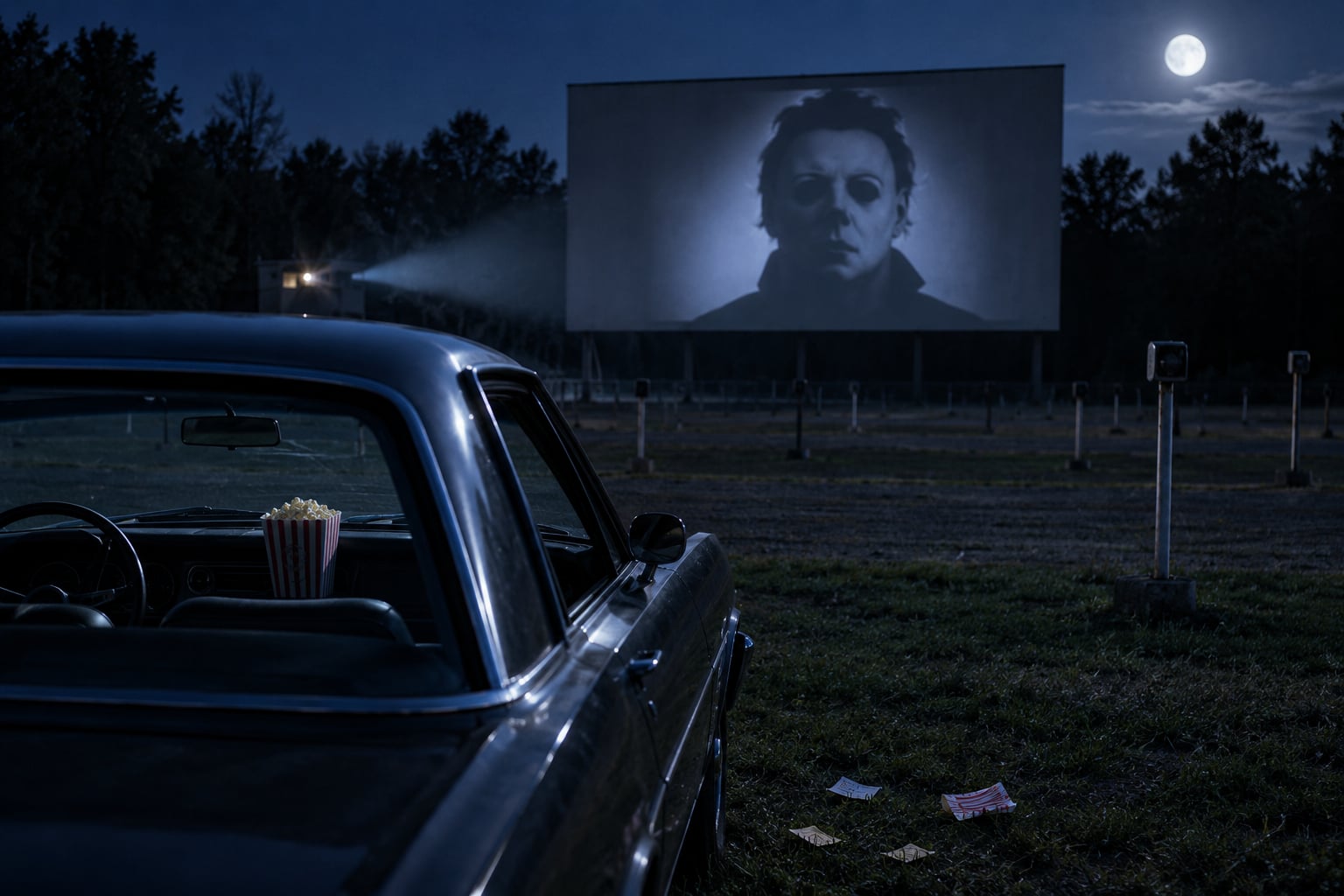
Slasher movies became popular for three connected reasons: one cheap film proved the formula made money, a wave of copycats pushed the violence further and sold volume, and teenagers told each other about it until a Friday night screening felt like an event. John Carpenter’s Halloween (1978) supplied the template, Friday the 13th (1980) raised the gore ceiling, and within three years the market was so crowded with masked-killer pictures that the style turned into a shared language. Understanding how slasher movies became popular explains far more than a film trend, including the mask business that drives costume aisles every October.
Here is the short version before the long version.
- A tiny budget met a huge audience. Halloween was made for a bit over 300,000 dollars and returned more than 70 million dollars worldwide, which handed every other studio a green light.
- The formula was repeatable. Teen ensemble, isolated location, concealed killer, rising body count, one survivor. A director could build a hit without a star or a special-effects department.
- Violence escalated in public. Friday the 13th and its sequels pushed gore that audiences had never seen in a multiplex, and the competition to shock drove volume through the early 1980s.
- The audience was young, social and repeat-going. Group outings at the drive-in, weekend matinees and late-night first-run double features turned a single viewing into a social ritual with its own vocabulary.
- The villains escaped the films. A mask, a weapon and a name were easy to sell every October, which kept the slasher commercially alive long after the originals lost their freshness.
Table of Contents
- How Slasher Movies Became Popular
- What Counts as a Slasher Movie?
- Where the Slasher Genre Began
- How Slasher Movies Became Popular in the 1970s
- What Made the Slasher Formula Work?
- Why the 1980s Made Slashers a Mainstream Favorite
- Which Films Defined the Genre’s Golden Era?
- How the Genre Changed After the 1980s
- Why Slasher Movies Still Matter
- Frequently Asked Questions
- When were slasher movies most popular?
- What movie popularized the slasher genre?
- Why do people enjoy slasher movies?
- What is the final girl in a slasher film?
- What was the first slasher movie?
- Are slasher movies still popular today?
- Conclusion
How Slasher Movies Became Popular
Slasher movies became popular because a repeatable storytelling shape met cheap production costs, a large teenage audience with nowhere else to go on a Friday, and a distribution moment when a movie could still be discovered by accident at a drive-in or a neighborhood theater.
The mechanics matter more than the films themselves. Horror had always sold, but before 1978 it sold as exploitation: drive-in double bills, regional circulation, adults only. Halloween was different because it was filmed in 17 days, cost a small fraction of what a studio drama cost, went out wide through the Compass International Pictures pipeline, and grossed more than 70 million dollars against roughly a quarter of a million spent. Any executive who saw that arithmetic could green-light a copy within a month.
The copies arrived, and they changed in a specific direction. The first wave was nearly identical, then the gore ceiling climbed as studios competed to be the most extreme picture in the market. That escalation is why slasher films became the bloodiest mainstream horror of the era and why the audience started asking who could out-shock whom.
Then the backlash arrived, which is not a contradiction but a companion piece. When the body count became the marketing hook, critics and parent groups pushed back, the ratings board capped the violence, and the era closed. What survived that squeeze was the slasher’s image, not its gore. A mask is easy to draw, easy to sew and easy to put on a child in October, which is why the genre’s commercial afterlife lives in costume aisles rather than multiplexes.
What Counts as a Slasher Movie?
A slasher film is a horror story in which a killer stalks a group, usually teenagers, and murders them one at a time with a bladed or pointed weapon, usually with the killer’s face and motive concealed until the climax. Psycho thrillers, monster pictures and giallo also contain murders, so the categories need separating.
| Category | Killer | Violence | Key example |
|---|---|---|---|
| Slasher | Human, usually masked, motive explained late | Shown mostly through aftermath and sound | Halloween (1978) |
| Giallo | Human, often masked, motive from a past crime | Stylized, close-up, sometimes eroticized | A Bay of Blood (1971) |
| Splatter | Any | Extended and graphic, set-piece focused | Blood Feast (1963) |
| Monster film | Not human | Destruction and pursuit | Universal monster cycle, 1930s |
| Psycho-thriller | Human, motive psychological | Deliberately restrained | Psycho (1960) |
Four conventions recur in almost every genre entry. The setting is cut off, so help is far away: a camp, an island, a suburban street, a college. The killer is concealed, so the audience can read the mask as a shape rather than a person. The killing happens out of full view, and what you get is a flash, a scream, an empty room, a body discovered later. And the film withholds the killer’s point of view, sometimes entirely, which is the single most effective trick in the format.
Not every film with a killer qualifies. Carrie (1976) is a supernatural tragedy, The Silence of the Lambs (1991) is a procedural chase, and Scream (1996) mocks the genre from inside it. Fans argue about these constantly, usually in the comments of any film history thread, and the argument is genuinely unresolved.
Where the Slasher Genre Began
The slasher developed out of several traditions at once rather than arriving in a single year. Psycho (1960) established the human killer and the idea that a familiar place can become a trap. Blood Feast (1963) set the standard for graphic close-quarter killing. Italian giallo films, above all Mario Bava’s A Bay of Blood (1971), put a group of young people in an isolated house with an anonymous killer working through them.
Black Christmas (1974) is the film most often credited as the direct ancestor, because it has the sorority house, the killer’s point of view shot, the phone calls, the suppressed violence and the unanswered questions. The Texas Chain Saw Massacre (1974) supplied something different: named killers, a decaying family, a remote location and an argument that the horror was social rather than supernatural.
Which one is the first slasher is the longest-running argument in the genre. A Bay of Blood has the partying victims, Black Christmas has the structure, Texas Chain Saw has the terror, and Psycho has the blueprint. Naming a single winner tells you more about the writer than the film.
How Slasher Movies Became Popular in the 1970s
Slasher movies became popular in the 1970s because the pieces arrived within four years and because the business model changed underneath them. Black Christmas (1974) and The Texas Chain Saw Massacre (1974) were modest regional releases that found their audiences through word of mouth and midnight bookings rather than national advertising.
Halloween (1978) was the film that turned a habit into a genre. It was shot almost entirely at night with the teenagers wearing street clothes, which made the danger feel ordinary rather than theatrical. It was cheap, it was fast, and it went out through a multi-pipeline independent distribution system that got it in front of thousands of screens at once. The word-of-mouth curve kept climbing through the summer of 1979 and into 1980.
Two details are worth separating here, because they are often merged. Critical regard for Halloween was mixed at the time and improved later, when John Carpenter’s career grew and the film was reassessed. Cultural and commercial influence arrived immediately and were enormous. A film can be a template before anyone calls it a classic, and that is exactly what happened.
When a Stranger Calls (1979) copied the babysitter setup from Black Christmas and made money, which proved the second wave would not need permission. By the end of the decade, studios knew that a masked killer in a house with no adults was a bankable idea.
What Made the Slasher Formula Work?
The format works because it builds suspense out of the audience’s information rather than the killer’s violence. Six conventions do most of the heavy lifting.
- An ordinary group of people who ignore warnings. The audience knows the danger and watches the characters not know it, which produces dread without any threat on screen.
- A killer whose face and motive are delayed. Absence lets the audience build a worse monster than any mask design.
- Killing off screen. Restricted violence means less screen time for gore and more for the walk back to an empty room.
- Escalating false alarms. Every false alarm resets the tension and teaches the audience that their relief is wrong.
- A shrinking cast. Each death narrows the possibilities, so late scenes run on paranoia rather than action.
- A final reversal. A last scare, a surviving killer or a twist that reframes the whole film rewards the audience for paying attention.
Concrete examples make this clearer than the list does. In Halloween, the babysitter scene works because nothing violent is shown; the camera looks at the door, the audience supplies the rest. In Friday the 13th, the axe through the door is graphic for 1980 and brief, so the shock lands harder than a long sequence would have. In A Nightmare on Elm Street (1984), Wes Craven turned the premise inside out by making the killer’s victims the dangerous ones, which kept the genre alive after saturation had already set in.
Carol Clover’s 1992 book Men, Women, and Chain Saws named the survivor who outlasts the killer, the final girl, and argued that the character has more power than her shrinking screen time suggests. The term is now standard, and the argument about it is not settled.
Why the 1980s Made Slashers a Mainstream Favorite
The 1980s turned a successful picture into a fixture of American genre cinema. Sequels multiplied because the first entry proved the audience came back for the villain, not the victim. Cable television and home video put late-night horror in living rooms that had never been a horror market, and drive-ins and mall theaters gave the films an audience with time to kill and no other place to go.
The economics explain the rest. Horror was among the cheapest genres to make, so a modest theatrical return counted as a hit, and a theatrical hit funded the next one. That loop is why roughly a hundred slasher features appeared in the United States between 1978 and 1984, most of them aimed at teenagers, most of them low-budget, and most of them gone within a decade.
| Distribution route | How it extended the genre | What it cost the genre |
|---|---|---|
| Theatrical first run | Word of mouth, packed midnight shows, an event atmosphere | Money and release slots were scarce |
| Sequels and franchise films | Guaranteed audience, new villain designs, cross-promotion | Rapid creative exhaustion and plot decay |
| Home video and cable | Repeat viewing, a catalog that never left the market | Beat-up rental copies, stagnant expectations |
Two pressures worked against the films at the same time. The ratings board pressured studios toward less explicit violence, and parents groups organised protests, most visibly against Silent Night, Deadly Night (1984). Critics also turned on the genre, and Gene Siskel and Roger Ebert used their 1981 walkout review to make an argument about horror being unsuited to a group audience. Studios responded with cut versions shot for a lower rating, a convention that became known as the censor bait double version.
There is no reliable evidence linking slasher viewing to violent crime. The panic of the 1980s was moral rather than statistical, and studies of media effects have not found this link.
Which Films Defined the Genre’s Golden Era?
Golden age usually means 1978 to 1984, and the list below is deliberately selective. Each entry added something the others did not have.
| Film | Year | What it added |
|---|---|---|
| Black Christmas | 1974 | The sorority house template, killer point of view, suppressed violence |
| Halloween | 1978 | The affordable template, a modern villain, ordinary settings |
| Friday the 13th | 1980 | Gore escalation and the imitation wave, plus a killer with a backstory |
| Prom Night | 1980 | Satire and self-awareness inside the format |
| My Bloody Valentine | 1981 | Set-piece creativity, with a genuinely inventive killing mechanism |
| The Texas Chain Saw Massacre | 1974 | A working-class cast, real locations and horror with a social argument |
| Sleepaway Camp | 1983 | Shock value and a genre camp favourite decades later |
| A Nightmare on Elm Street | 1984 | A rules-based supernatural killer that reinvents rather than repeats |
The differences matter. Halloween is restrained and archetypal. Friday the 13th is rough and physical. The Texas Chain Saw Massacre is documentary in texture and brutal in intent. A Nightmare on Elm Street is nearly a fairytale about rules. Calling them one genre flattens exactly the differences that made the era worth studying.
How the Genre Changed After the 1980s
Slasher popularity did not vanish in 1985, it splintered. The 1981 saturation point was the mechanism that broke the market: when roughly a hundred films arrive in six years, casual viewers stop finding the next one remarkable, and studios cut back. What remained was the franchise, which moved to home video and direct-to-video entries with low budgets, fast production and a fan base that bought on name recognition alone.
Meanwhile the genre absorbed two new influences. The Silence of the Lambs (1991) made horror respectable with critics and studios, which opened space for the psychologically ambitious films the slasher formula had been crowding out. Then Scream (1996) rewrote the rules from the inside. Wes Craven and Kevin Williamson kept the whodunit mystery but added self-awareness, celebrity casting and jokes aimed at the audience’s own genre literacy, and the film out-grossed films ten times its size.
Scholarship sorts the result into three eras: the classical period from 1974 to 1993, the self-referential period from 1994 to 2000, and the neoslasher cycle from 2000 to 2013, when Saw (2004) and other high-concept entries borrowed the structure while updating the tone and the cast.
The 2020s have brought another wave built on the same trick: honour the rules, then break one. Terrifier 2 (2022), Bodies Bodies Bodies (2023), Halloween Kills (2021), Scream (2022) and Ti West’s In a Violent Nature (2024) all keep the group, the mask and the isolated house, and then refuse to follow the old script about who dies and why.
Why Slasher Movies Still Matter
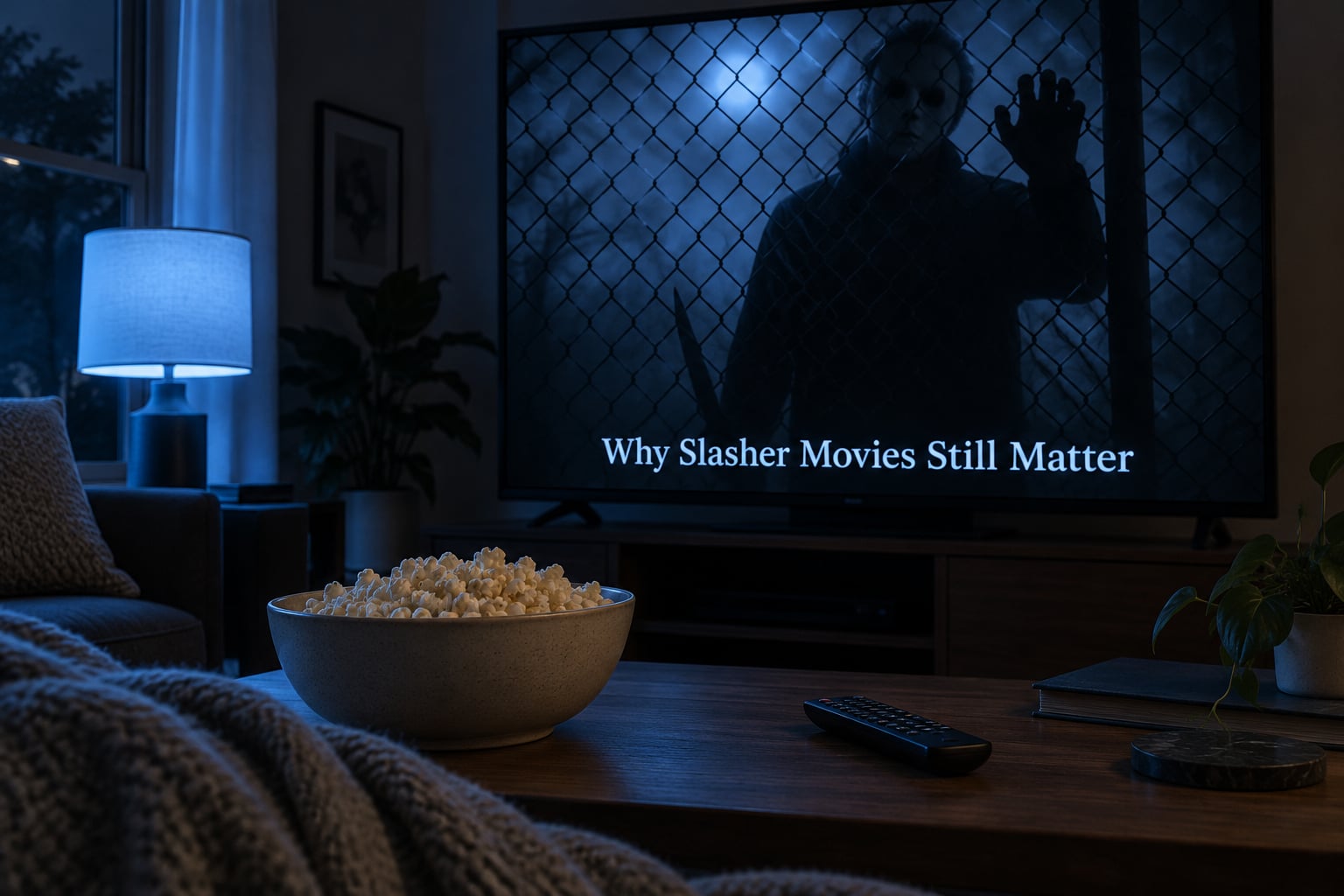
Slasher movies still matter because the formula escaped the genre and became standard horror equipment. Scares that withhold the image, villains who return, a survivor who fights back and a mask reveal all descend from these films, and modern horror from Get Out to smaller surprises still uses their instincts.
The most durable legacy is commercial, and it lands every October. Michael Myers, Jason Voorhees and Ghostface need no origin story to sell a mask to a child, because the film version already did the character work. Mask catalogs, costume aisles and haunted house queues in October are partly the slasher’s doing, which is why this genre has stayed visible even in years when no new slasher film performed well.
The format also travels. Television borrowed it with Scream and American Horror Story, video games built careers around Jason Voorhees and killer characters in asymmetric multiplayer horror, and the shared language has become a badge of identity for fans who argue about taxonomy online as a matter of pleasure rather than scholarship.
Critically, the slasher has a poor reputation it partly deserves. There are genuinely lazy sequels and empty imitations, and the argument that the style peaked in 1984 has real force. The counterargument is simpler: no other horror form has been this thoroughly built upon by everything that came after it.
Frequently Asked Questions
When were slasher movies most popular?
Slasher movies were most popular from about 1978 to 1984, and the single busiest year was 1981, when more than a dozen arrived and casual audiences began to feel overserved. The audience stayed large through the late 1980s, but the creative peak and the cultural peak are usually placed in that seven-year window.
What movie popularized the slasher genre?
Halloween (1978) is the standard answer, because it was cheap, shot almost entirely at night, and made more than 70 million dollars worldwide on a budget of roughly a quarter of a million. Genre historians often prefer A Bay of Blood (1971) or Black Christmas (1974), which had the structure years earlier, but neither reached a wide audience.
Why do people enjoy slasher movies?
The genre offers controlled fear: the danger is entirely fictional and entirely known, which makes it a safe way to rehearse a threat. The group setting adds a social layer, since the viewing ritual works best with friends, and the repeatable rules let an audience play along with the film instead of merely watching it.
What is the final girl in a slasher film?
The final girl is the surviving character who faces the killer at the end, usually someone defined in the first act as passive, shy or overlooked. Carol Clover coined the term in her 1992 book Men, Women, and Chain Saws, and argued that the character usually defeats the killer through resolve rather than force.
What was the first slasher movie?
There is no agreed answer. A Bay of Blood (1971) has the partying victims, Black Christmas (1974) has the complete structure, The Texas Chain Saw Massacre (1974) has the terror, and Psycho (1960) has the blueprint. Horror fans argue this in every thread where the question comes up, and each answer reveals more about the person making it than the film.
Are slasher movies still popular today?
Yes, though the audience now splits between franchise entries and low budget newcomers that deliberately break the rules. Terrifier 2 (2022), Bodies Bodies Bodies (2023) and In a Violent Nature (2024) all earned their attention by honouring the formula and then subverting it. The masks and costumes also keep the genre commercially visible every October.
Conclusion
Slasher movies became popular because they turned the fear of something you cannot see into a repeatable, shared experience, and because the economics rewarded anybody who could copy the shape. One cheap film proved the money, the copycats pushed the violence until the backlash arrived, and the mask outlived the gore.
Start with Black Christmas (1974) for the structure, then Halloween (1978) for the template and Friday the 13th (1980) for the escalation. After that, watch how each era argues with the one before it.