You get into horror movies by starting small, screening a film for its actual scares before you press play, and watching in a room you fully control. Most people who scare easily have never tried a gentle horror film. They go straight to the loudest, most notorious title, bolt, and decide the whole genre is closed to them. Pick something atmospheric instead, give yourself permission to pause, and work up over a few weeks. It takes about an hour of prep and one evening to start.
That reaction is more common than you think. Horror is a huge category now, not just slashers: there are folk stories, haunted-house films, slow burns, cosy horror, monster movies, and prestige films where the dread is quiet. Somewhere in there is a film that gets to you without wrecking your evening.
Table of Contents
- What You Need
- Step-by-Step: How to Get Into Horror Movies If You Scare Easily
- 1. Decide Whether You Actually Want to Watch It
- 2. Research the Movie Without Spoiling the Story
- 3. Choose the Right Setting and Screening Time
- 4. Lower the Sensory Pressure
- 5. Start Small Before a Big-Scare Movie
- 6. Make Breaks and Exits Part of the Plan
- 7. Judge the Experience by Comfort, Not Toughness
- Common Mistakes
- Frequently Asked Questions
- Should I watch horror movies alone if I scare easily?
- Can I stop a horror movie if it becomes too scary?
- How do I avoid jump scares in a movie theater?
- Do subtitles make horror movies less scary?
- What should I do before watching a horror movie at home?
- How can I tell whether I am excited or just pressured to watch?
- Conclusion
What You Need
You do not need special equipment or a particular movie night ritual. You need five things, and all of them are things you can arrange today.
Ten minutes of screening. A content summary, a rating, and one honest review from someone with similar tastes. Most streaming services and databases let you see the rating and a written content advisory before you commit.
A room you control. Your own TV, your own brightness, your own volume, a pause button you are allowed to use. A rented theater gives all three away.
Daylight or an early evening slot. Watching at 1 a.m. alone in a dark house adds three things horror does not need: silence, darkness, and no way out.
One person who knows your limit. A friend, a partner, a roommate. They do not have to hold your hand, they just have to not make fun of you and be willing to pause.
A break option. An intermission you have permission to use, or a show with a second episode, or a film you can stop halfway and abandon without a discussion afterwards.
None of this is about forcing yourself to watch something you do not want. It is about removing uncertainty, which is where most of the fear actually lives.
Step-by-Step: How to Get Into Horror Movies If You Scare Easily
Seven steps, in order. The order matters more than the specifics. Do not skip to step five because a film sounds impressive.
1. Decide Whether You Actually Want to Watch It
Curiosity and pressure look identical from the outside, and they pull in opposite directions. Curiosity is a question: I want to know what this is like. Pressure is a deadline: everyone else is watching it and I have to keep up.
One test helps. Read the honest worst-case review, the one that says this film is brutal or boring or both, and then notice which reaction you have. If your honest reaction is “that sounds unpleasant,” you are being pressured, not curious. Pass, and pick something else this month.
That is the whole point of this step. Fear of missing out is expensive, and horror is not a scarce resource. There is always another film next month.
2. Research the Movie Without Spoiling the Story
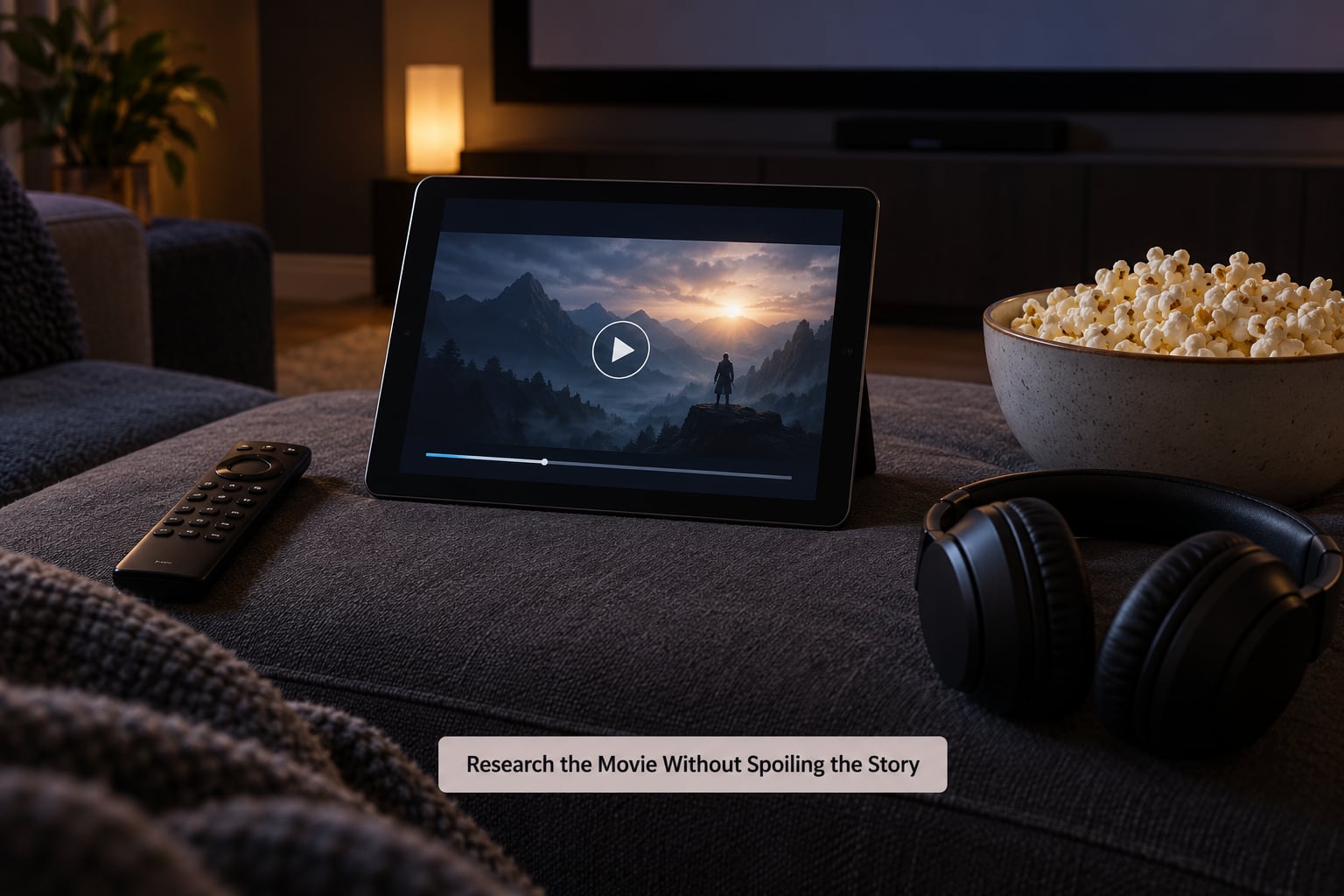
Read the plot, not the commentary. A full plot summary takes the surprise out of a story, and surprise is the ingredient that actually spikes your heart rate. Knowing that the killer is someone in particular removes about half the dread while leaving the film watchable.
Avoid spoiler explainers, franchise “ending explained” videos, and the comment sections. Those are built for people who have already seen it, and they hand you the exact images you are hoping to avoid.
What you do want is a trigger check. Look for an honest content advisory or a trigger list, and check the specific things that bother you: gore, animals, children, claustrophobic spaces, sexual violence, illness, body horror. Community trigger databases exist for this and take a minute. Horror fandom talks about these openly, so the information is there.
Then watch the trailer once, ideally in the middle of the day. The trailer is the honest pitch. If your reaction to the trailer is a small smile rather than a jolt, the film is probably going to be fine.
3. Choose the Right Setting and Screening Time
Home wins for a first attempt, every time. You control the brightness, the volume, the pause button, and the lights. A theater takes all four away and adds a hundred other people’s reactions, which longtime horror-goers themselves cite as a reason to wait before going out.
If you do go to a theater, pick a row near the front-middle rather than the back or the very middle. The back can put you behind a tall stranger, and dead center puts every surround sound directly into your ears. Aisle seat gives you a fast, low-drama exit.
Screening time matters more than seating. Late evening alone is the hardest version of this: it is quiet, dark, and there is nothing after it. An early evening with company leaves you with somewhere to go afterward.
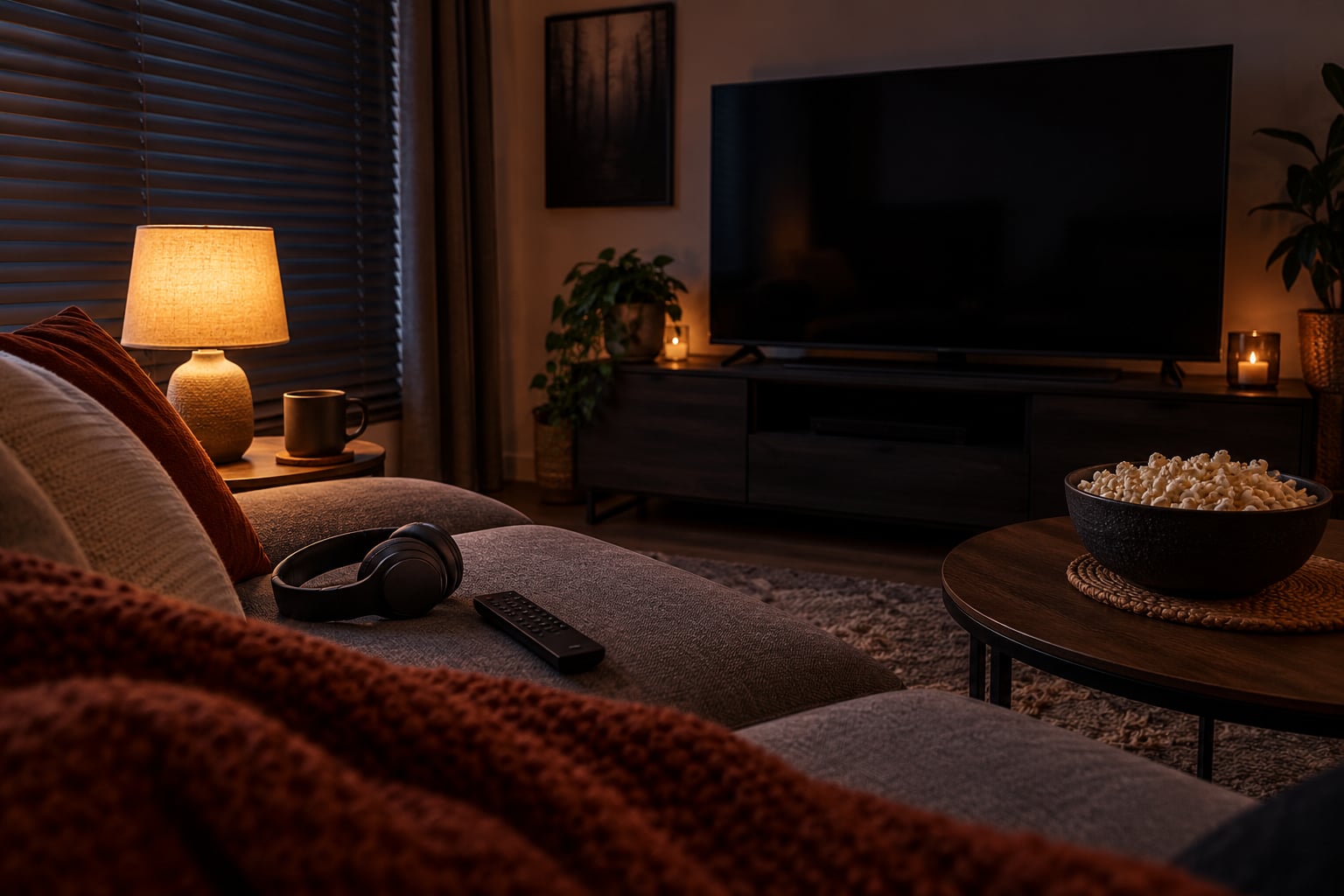
For most people the first three viewings should be at home, in daylight or with a lamp on, with a second film lined up as a reset.
4. Lower the Sensory Pressure
These are all normal ways to get into horror movies if you scare easily, and none of them are giving in.
- Turn brightness down a notch, not off. A black screen in a dark room makes the room feel larger and the sounds closer.
- Keep volume low enough that you can hear your own fridge humming. Sound design is doing most of the work, and volume is the dial that controls it.
- Put on subtitles. Yes, even though there is usually no dialogue to follow. The text occupies a small part of your attention and leaves less for the sound design.
- Keep a lamp on in the room behind you. Ambient light tells your brain the space is a normal room you chose.
- Silence notifications and close the chat window. The urge to check your phone is a good way to miss a jump scare you had braced for.
- Sit further back than feels natural. Distance is a surprisingly effective volume control.
Pausing is the strongest tool you have, and it is free. Before you press play, decide out loud that you are allowed to pause after any scene that spikes you, with no justifying needed.
5. Start Small Before a Big-Scare Movie
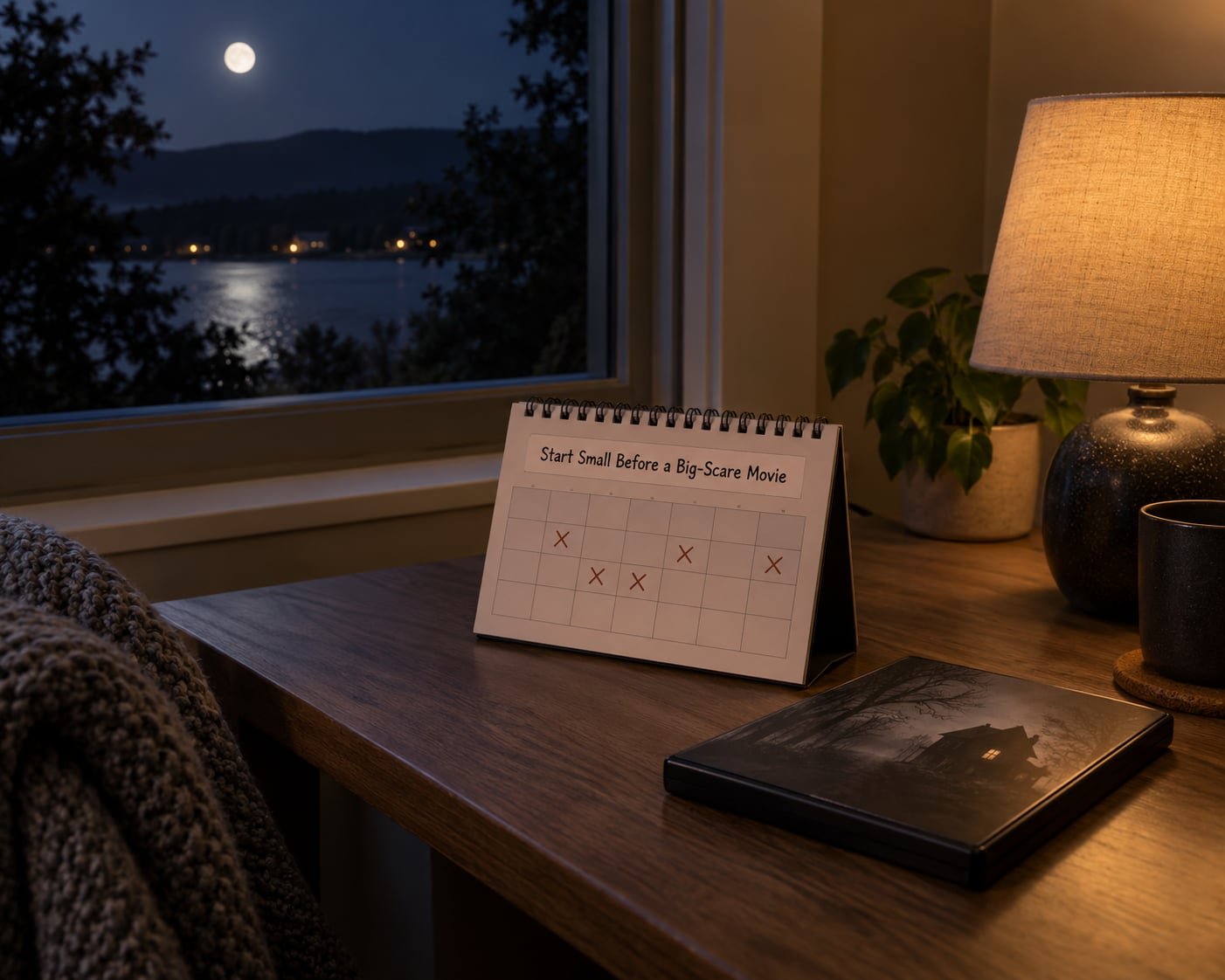
Work up in tiers, one film at a time, with a few days between. The aim is not to reach the most notorious film in the genre. The aim is to get to a point where horror is something you choose, rather than something that happens to you.
Tier one, atmosphere with almost no shock. Slow-burn supernatural films, haunted-house stories, and anything set in daylight. Dread rather than violence. Watch one and check in with yourself the next day: did it leave you unsettled, or just interested?
Tier two, tension without gore. Psychological films where the threat is implied, and older films whose practical effects no longer read as real. Pre-digital horror often lands gentler because your brain files it as a movie, not a photograph.
Tier three, one real jump scare at a time. A classic monster film, a contained thriller. Expect maybe one startle moment. That is fine. That is the whole exercise.
Tier four, only if you get there and want to. Franchise slashers and the films people use to prove something. Plenty of people never want tier four and still love the rest of the genre.
A month of roughly one film a week gets most people through tiers one and two with real confidence. Some take three months. There is no deadline, and you can stop climbing at any tier indefinitely without having failed at anything.
6. Make Breaks and Exits Part of the Plan
The movies that ruin horror for nervous viewers are the ones where stopping felt like a confession. Fix that before the film starts, not in the middle of it.
Tell your companion the exact sentence, out loud, beforehand. Something like: “If I say bathroom break, I mean bathroom break, and I do not want a debrief on the way back.” That one line does more work than any coping technique, because it removes the social cost of leaving.
Pick shows with intermission, or films you can pause without losing a scene. After an intense stretch, a reset of ten minutes in a lit room with a glass of water does more than any breathing exercise mid-scene.
And know the exit. Aisle seat, a door on your side, a seat two rows from the aisle in a theater. Leaving early is a legitimate outcome, and a film that made you leave taught you something about your limits for free.
7. Judge the Experience by Comfort, Not Toughness
Afterwards, ask three questions: did I enjoy any part of it, am I still thinking about it in a way I dislike, and do I want to watch another one. That is the whole review. Anything about whether you were brave is somebody else’s metric.
Plenty of first film experiences are boring, or funny, or mildly disappointing. That is normal and it is fine. Horror fandom threads are full of people discovering they simply do not react to films, and nobody wasted an evening.
Disliking a film you worked up to is also a normal result. It means you got information about your taste, which is cheaper than the alternative.
Common Mistakes
Starting with a franchise film because it is famous. The most talked-about horror movies are usually built around startle moments, not atmosphere. That is the hardest possible entry point, and it is chosen by default. Start with tier one and let the famous ones stay famous from a distance for a while.
Watching because a group invited you. This is the single most common pattern in advice forums, and it is the one that ends with a person deciding horror is not for them. Accept the invitation for the plans, watch something else, or watch a tier one film and say so in advance. Nobody has ever been harmed by watching A24 instead.
Reading spoiler explainers before the film. It feels like research. It is the opposite, because it hands you the exact images with no protective processing time.
Sitting in the darkest, farthest row with the volume up. Maximum dread for zero benefit. Aisle or near the front, volume down.
Binge-watching to prove a point. Three films in one weekend is how a bad reaction becomes a memory. One film, a few days apart.
Treating the reaction as a personal failing. Horror is engineered by thousands of people to produce exactly what you felt. Responding to it is the genre working, not you being weak.
Two habits help more than the rest: keep watching during the day at first, and always stop while you still feel like you could watch more. Ending on your own terms is what makes the next attempt easy.
Frequently Asked Questions
Should I watch horror movies alone if I scare easily?
Not for a first attempt. Horror is much easier alone once you already know you enjoy it, but on the way in, a person who knows your limit removes the fear of being judged for pausing or leaving. If you must watch alone, pick a film you can pause, keep a lamp on, and line up something unspooky to switch to afterwards so the evening has a clear end.
Can I stop a horror movie if it becomes too scary?
Yes, and you should decide that before the film starts rather than during it. Say the sentence out loud to whoever you are with so leaving costs nothing socially. Pausing works too, and losing the plot is a far better outcome than losing an evening to dread. A film you stopped at forty minutes taught you the same thing one you finished would have.
How do I avoid jump scares in a movie theater?
You cannot fully avoid them, since nobody publishes a startle-avoidance guide, but you can reduce the damage. Take an aisle seat near the front rather than dead center or the back row, where surround sound lands hardest. Films that play in daytime matinees tend to be gentler in practice, because the audience reacts less. If you can, check whether the theater prints a content advisory.
Do subtitles make horror movies less scary?
They can, slightly, and the reason is attention rather than distraction from the image. Subtitles occupy a slice of your focus, which leaves less for the sound design, and sound design is where most horror startles live. If you are not deaf or hard of hearing and subtitles would normally annoy you, this is not the moment to be purist. The effect is small but real.
What should I do before watching a horror movie at home?
Read the plot summary, check a content advisory for the specific things that bother you, and watch the trailer in daylight rather than at midnight. Then set up the room: lamp on, volume low, brightness down slightly, notifications off, and a second film or episode ready as a reset. Tell anyone in the house what your stopping phrase is, and let the evening have a planned end.
How can I tell whether I am excited or just pressured to watch?
Read the harshest honest review first, the one that describes the film as brutal, boring, or both. Curiosity is excitement about a specific thing, and it survives knowing the worst. Pressure is obligation, and it makes a brutal review feel like a reason to cancel. If knowing the worst makes you want it more, you are in. If it makes you want out, pick a different film without regret.
Conclusion
Start with one film this week. Read its plot, check its content advisory, watch the trailer at lunch, then watch it at home with a lamp on and the volume low. Agree in advance that you can pause or leave, and have something harmless queued up after.
Getting into horror is about curiosity and knowing your own limits, not about bravery or a number of films survived. The genre is wide enough that there is a film for every nervous viewer, and you get to pick the one that fits tonight. Try one, tell someone how it went, and only then decide what goes on the 2026 Halloween list next.