Practical effects are the monsters, masks, miniatures and stunts you can see being built on set and filmed for real. CGI, short for computer-generated imagery, is created digitally and added during post-production. In horror, the gap between them matters more than in any other genre, because the whole contract of the genre is that the threat is physically in the room with you.
I have watched the same creature scenes back and forth for years, and the tell is almost always the same: real light, real contact, real weight. This guide breaks down how the two approaches differ in a scene, what each one is genuinely good at, and how to tell which one a film used. Last checked for October 2026, with examples that go from 1979 to the Monsterverse era.
Table of Contents
- How Practical Effects Differ from CGI in Horror: At a Glance
- What Makes Practical Effects Feel Real?
- Prosthetic makeup and appliances
- Animatronics and puppetry
- Miniatures, sets and stunts
- What Makes CGI Useful in Horror?
- Environments and worldbuilding
- Creature work at scale or in motion
- Blood, gore and dismemberment
- Digital doubles and body replacement
- How Practical Effects Differ from CGI in Horror During a Scene
- Previsualization and planning
- On the day
- Lighting, sound and finishing
- Continuity and revisions
- Which One Is More Frightening?
- Cost, Safety, and Practical Limitations
- Which Should You Choose?
- Frequently Asked Questions
- Are practical effects scarier than CGI in horror films?
- Is CGI cheaper than practical effects on a horror movie?
- Are practical effects safer than CGI on a horror set?
- Why did studios stop using practical effects in horror?
- Can a horror film use practical effects and CGI together?
- Conclusion
How Practical Effects Differ from CGI in Horror: At a Glance
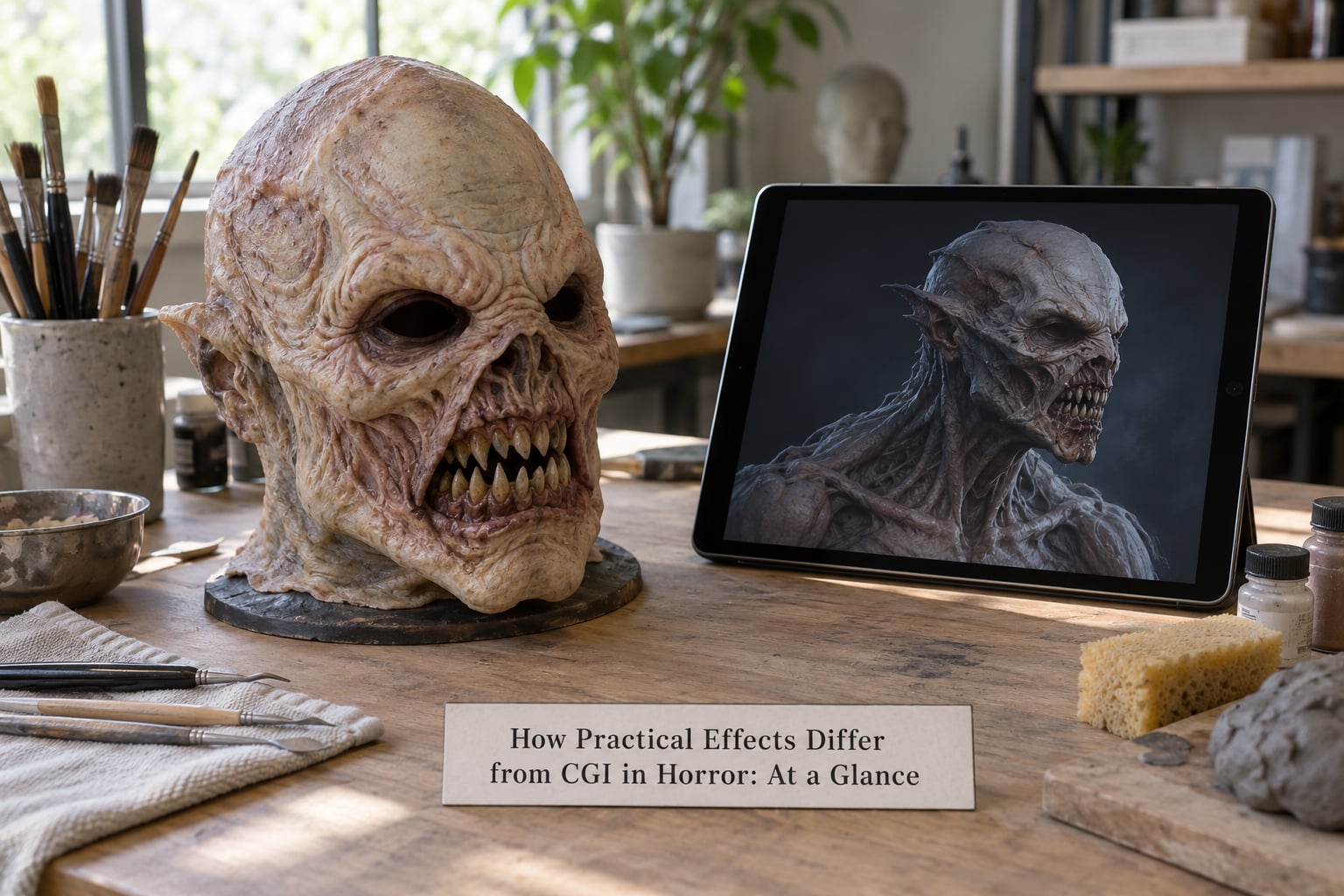
Short version: practical effects win when a creature has to be touched, frightened of, or believed in, and CGI wins when a shot is impossible, vast, or cheaper to render than to shoot. Most of the differences below come down to one fact. A practical effect is a physical object that exists before the camera rolls, so it takes light, casts shadow, has weight, and can be reacted to. A digital effect is added after filming, so it has to be told how to match everything the real world already did for free.
| Criterion | Practical effects | CGI |
|---|---|---|
| How it is made | Fabricated, sculpted, moulded or performed in physical form | Modelled, animated and rendered on computers |
| Actor performance | Real object to block against, touch and flinch at | Actor performs against eyelines, marks or a green screen |
| Lighting and shadow | Catches real light and casts a real shadow automatically | Must be lit and shadowed to match the plate |
| Texture and weight | Real surfaces, real mass, real resistance | Has to simulate both convincingly |
| Sound | Recorded live on set alongside the scene | Designed and mixed after the fact |
| Cost shape | High day rate, high crew, reshoots are expensive | Art hours add up per shot, revisions are cheap |
| Revisions | Locked once the shot is filmed | Adjustable, re-renderable, extendable in post |
| Safety | Real risk of injury, fire, weather and stunts | Safer to film, demanding on render hardware |
| How it ages | Textures date, models look dated | Older digital work shows its artefacts |
| Audience read | Believable, sometimes overpowering | Impressive when invisible, distracting when not |
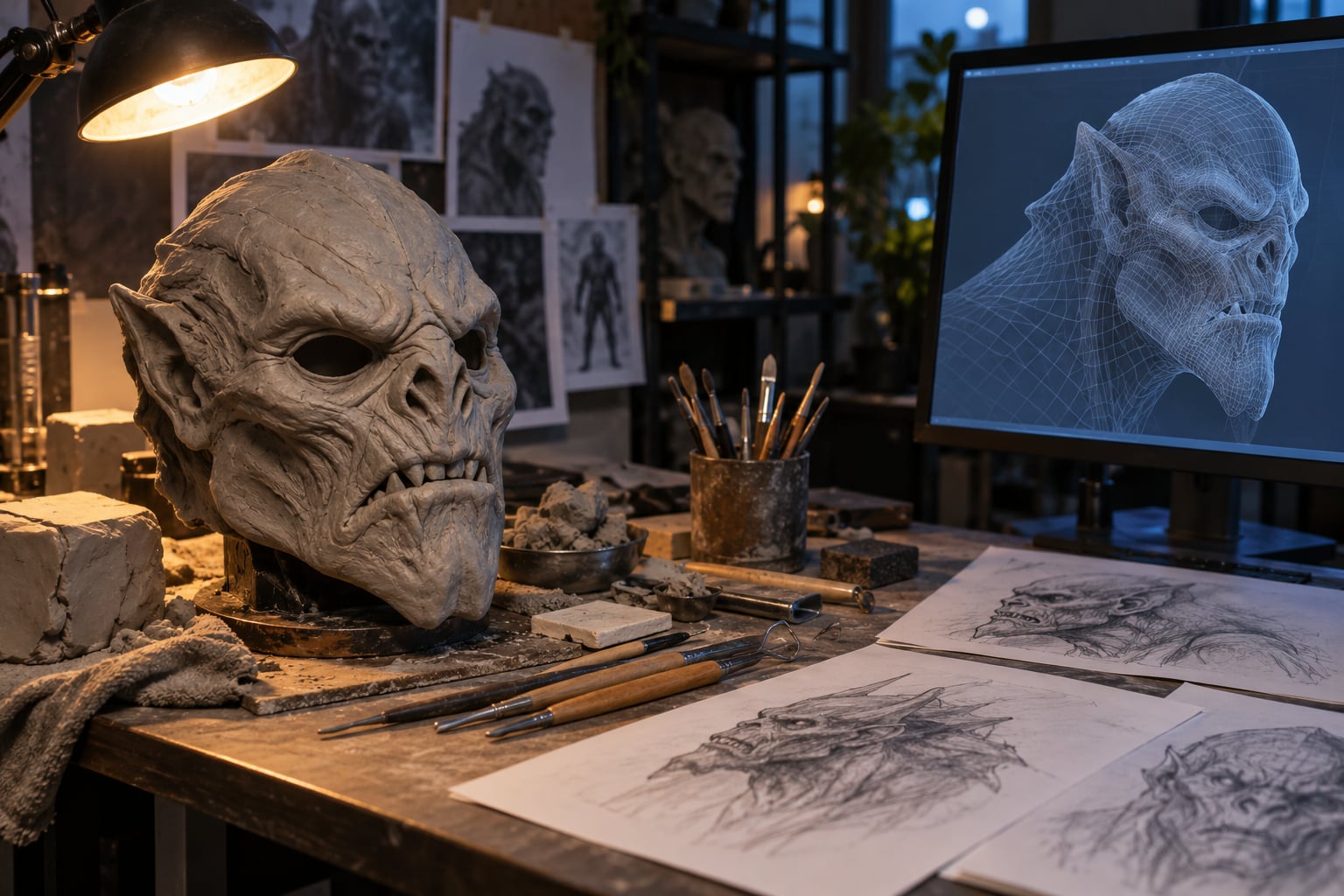
One more definitional note worth having early, because people use the words loosely. Special effects, or SFX, is the on-set craft: prosthetics, animatronics, breakaway glass, squibs, pyrotechnics, stunts. Visual effects, or VFX, is the post craft: compositing, matte paintings, creature rendering, cleanup. When a costume department makes a silicone appliance and a creature effects team rigs hydraulics underneath it, that is SFX. When a digital team models a creature and renders it into the same frame, that is VFX. The comparison everyone is really asking about is SFX against VFX.
What Makes Practical Effects Feel Real?
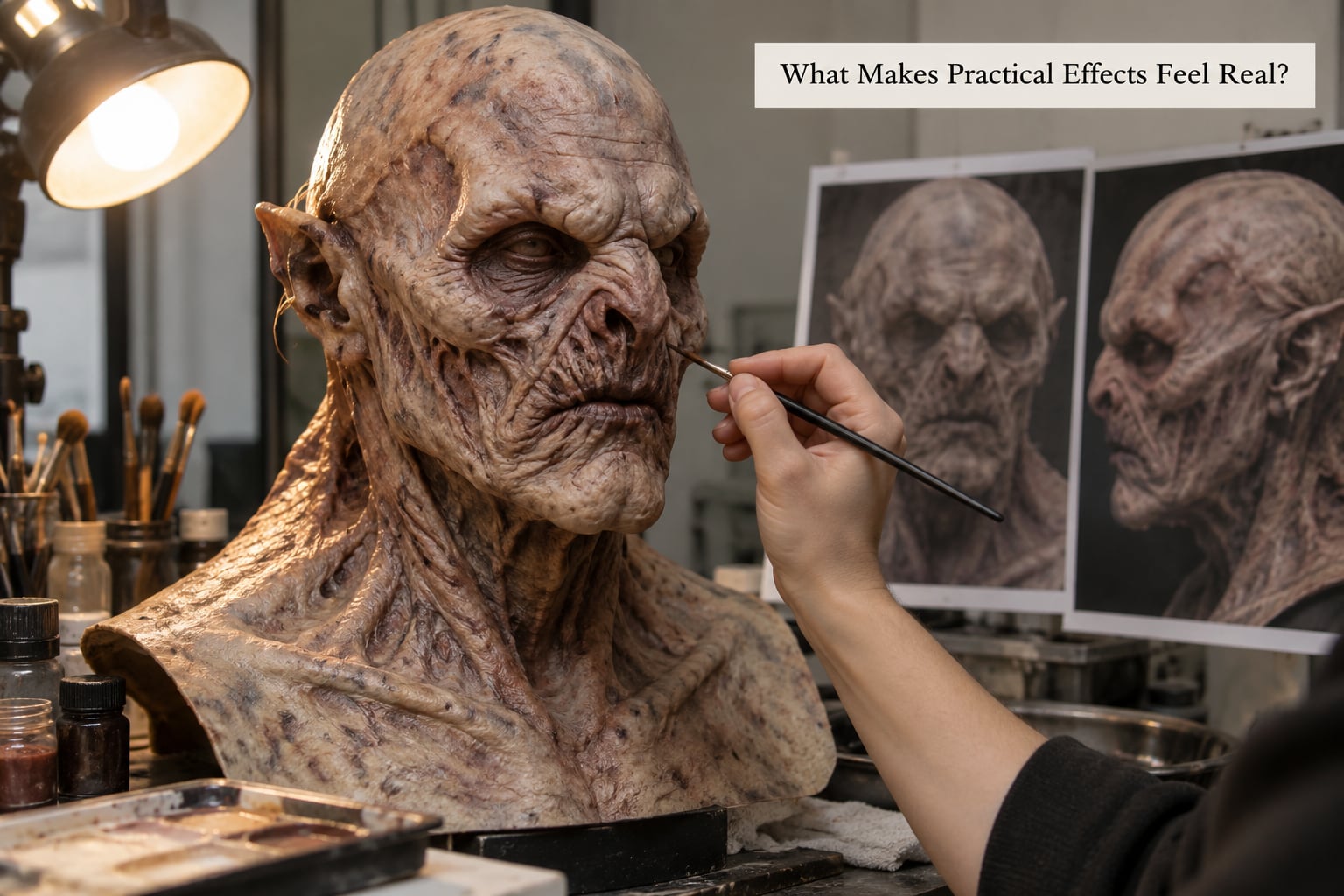
Physical effects feel real because the laws of physics apply to them without anyone having to render anything. Sunlight lands where it lands. The monster blocks the key light and throws a shadow across the actor’s face, and the actor flinches away from that shadow because it is actually there. A digital creature, by contrast, starts as a finished-looking image and has to be reverse-engineered into the same conditions.
Prosthetic makeup and appliances
A latex or silicone appliance gives an actor a real face to act behind, with weight and edges that catch light. Transformation scenes work because the change is happening on skin the camera can actually focus on. The 1986 version of The Fly is the benchmark: the make-up is uncomfortable to watch, and that discomfort is the point. An American Werewolf in London 1981 pushed the same idea into full-body transformation, where the seams and the bulk of the suit are the horror.
Animatronics and puppetry
An animatronic is a mechanism, so its movement is limited by cables, servos and puppeteers working in real time. That limitation is exactly why the 1982 version of Alien still works, and it is also why puppets get used even when filmmakers have the budget to go digital. You cannot hide a bad cable on a creature that is only half in frame. A full rubber suit is the cheaper cousin of the same idea, and audiences tend to spot it faster, which is the point people sometimes miss: a badly made suit can be more frightening than a clean render, because it reads as wrong in a way the brain cannot resolve.
Miniatures, sets and stunts
Miniature and built environments behave like real architecture under a real camera, including the way a light source falls off across a model. Practical stunts put a real body through a real fall, and the fear response of watching someone you know is in danger is hard to fake. John Carpenter’s films are a steady reference point here, where practical tension and minimal effects did most of the work.
None of this makes practical effects automatically better. It makes them reliable at a specific set of things: contact, weight, reaction, and the small number of frames where an audience member’s eye is checking whether something is real.
What Makes CGI Useful in Horror?
CGI is useful in horror when the shot asks for something a physical production cannot safely or sensibly deliver, and when the digital work is aimed at environments and scale rather than at the creature in the actor’s arms. Horror audiences themselves tend to draw the same line. In one long-running thread on what CGI is best used for in horror, the recurring answer is anything that is not the monster standing in the room.
Environments and worldbuilding
Endless corridors, collapsing structures, alien badlands and impossible scale are cheap in digital and ruinous in practical. A ruined city block that would take a crew months to build costs a fraction of that as an extension of an existing plate, and it can be adjusted after the fact. This is the one area where nobody serious argues the practical route is better.
Creature work at scale or in motion
Digital work is the right tool when a creature has to run, climb, breathe fire, change form mid-shot, or appear in dozens of shots across a film. The Monsterverse is the clearest modern example, where a digital creature carries both the money and the spectacle across multiple films, and fans of that approach are as vocal as the practical-effects loyalists. Where it gets harder is a close-up face under a hard key light, which is the situation audiences judge most harshly.
Blood, gore and dismemberment
Here digital work has the worst reputation in the genre, and the complaint is consistent enough to name plainly: CGI blood looks too clean. Real arterial spray is a fine mist that soaks and sticks, and the face of the person it hits keeps moving. Digital fluid tends to behave like a solid, and it stops. The people who defend CGI most often still say the same thing, which is that they object to the blood specifically rather than to digital work in general.
Digital doubles and body replacement
When a stunt or a transformation would destroy a performer, a digital double takes the hit. This is standard safety practice, and it is a large part of why effects supervision now leans on it. It is also where horror gets an extra boost, because a body that looks slightly wrong is more disturbing than one that is merely broken.
How Practical Effects Differ from CGI in Horror During a Scene
The difference is easiest to see by following one shot from prep to delivery. The same scene, built practically and built digitally, travels through completely different steps, and most of the visible quality gap comes out of that journey rather than out of the final image.
Previsualization and planning
A practical creature is designed around what it can physically do. Movement is limited by the operator, the rig and the puppeteer, so a fight scene gets choreographed around a creature that is heavy, slow, or tethered to a cable. A digital creature is designed around a rig, so the fight can be blocked for the best-looking frames first and the rig is built to match.
On the day
Practical work happens on set, inside the shoot day, with the effect physically present and usually lit by the same units as everything else. Digital work usually happens on set too, but the real work happens later: an actor is framed against a green screen, a blue expanse or a motion capture rig, and their performance is captured for later to be combined with an element that does not exist yet. The performance is genuinely good in both cases, but the eyelines differ. Against a physical monster an actor can look slightly past the operator’s shoulder and read the intent; against a mark, the eyeline lands on a piece of tape, and a viewer who is looking for it will find the difference.
Lighting, sound and finishing
Light is the biggest automatic advantage of the practical route. A physical creature is in the frame during lighting, so it receives the same key, the same fill and the same atmosphere as the actors, and it blocks light the way a real object would. A digital element has to be relit after the fact, and the moment that relighting does not quite match the plate is the moment the audience feels it. Sound follows the same split. Practical sounds are recorded live on the day and carry real room tone. Digital creature sounds are designed and mixed afterwards, which is a genuine advantage when a creature needs a sound no animal makes, and a disadvantage when the sound is supposed to feel like it came from inside the room.
Continuity and revisions
Once a practical shot is filmed it is fixed. The creature’s arm is where the creature’s arm was, and if the cut does not work, the fix is another shoot day. Digital shots can be reframed, extended, re-lit, and re-rendered, which is why revisions on a digital film tend to happen at the edit stage and revisions on a practical film tend to happen at enormous expense. This is the strongest practical argument for CGI, and it is a scheduling and money argument rather than an aesthetic one.
Which One Is More Frightening?
Physical effects are usually more frightening in horror, and the reason is not that they look better. It is that they behave. A creature that misses a step, that sways when the operator gets tired, that arrives slightly late, produces a real flicker of uncertainty in the viewer, and uncertainty is the raw material of the genre. A perfectly smooth digital movement is impressive and reads as designed, which is a different kind of reaction entirely.
Horror is also the genre that punishes digital work hardest, and that is a psychology point rather than a quality point. Audiences will accept a digital dinosaur, a digital superhero or a digital wasteland because the story asks for spectacle, and spectacle is explicitly allowed to be artificial. Horror asks the opposite. It asks the viewer to accept that something in that room is real, so a single artefact reads as a broken promise rather than as a stylistic choice. The same audience that shrugs at a digital city will call a digital face waxy in the same film.
Imperfection matters for the same reason. A practical mask with a visible seam is unsettling because the seam is information the viewer cannot use. A face that is almost but not quite right produces the uncanny valley effect, a strong sense of something almost human or almost alive that the mind cannot pin down. Careful CGI can sit in that same space deliberately. Bad CGI lands on the wrong side of it.
Then there is the choice not to show anything. Horror that hides the threat, which is what found-footage and mockumentary films tend to do, sidesteps the whole argument by never putting the monster on screen. In one of the more argued-about threads on the practical side, the recurring example was The Blair Witch Project, offered as proof that restraint and a handheld camera beat spectacle. That approach is a third lane rather than a victory for either side, and it is worth knowing about when you are deciding what to watch.
Cost, Safety, and Practical Limitations
Nobody should tell you practical effects are cheap. A physical creature that works is expensive because of the fabrication, the crew, the shooting days, and the cost of doing a take again. CGI is expensive in a different currency: artist hours per shot, render time, and a post schedule that keeps growing as revisions accumulate. Comparing the two as a single number is meaningless, because a small number of hard practical shots can cost less than a single sequence that changes design three times.
Safety runs the other way from cost, and this is the practical approach’s real weakness. Stunts, pyrotechnics, breakaway glass, creatures operated at height and heavy suits in hot lighting all carry genuine physical risk to performers and crew. Digital doubles, digital blood and virtual camera moves remove that risk almost entirely, which is a large part of why they became standard. The trade is that the shot no longer contains a real event, and some directors find they miss the realness they were chasing in the first place.
Weather and location bites practical work hard. An animatronic that depends on an exterior set needs the weather, and a reshoot costs more than the original. Digital work is weather-independent after capture, which is one of the quiet reasons studios moved toward it.
Both sides age badly, which is the honest answer to the age question. Practical effects from the 1970s and 1980s often hold up well, because the craft was the point and the photography suits the physical look. But some practical monster designs now look conspicuously like toys, and a creature suit that reads as rubber in a modern widescreen frame is dated in a way an effects team would never accept. Digital work from even a decade or two ago also shows its seams, particularly in skin texture, hair and crowd work. The genuine advantage of the practical route is that people are used to it looking old, because they know it was old when they saw it.
Which Should You Choose?
Choose practical effects when the scene depends on a person reacting to something physical, when the shot is close to a face, when the danger is to a performer, and when the audience is meant to be unsure whether they are watching something real. Choose CGI when the environment has to be vast or impossible, when the creature needs to move in ways no rig allows, when revisions are certain, and when the physical version would put someone at risk.
For an indie or a small crew, the practical route is more reachable than most people assume. Breakaway glass, hanging lights, a doorway rigged to move, simple prosthetic wounds and a good sound design can carry a scare a long way. The genre’s most frightening films are frequently the ones with the least on screen. For a studio production, the choice is usually a hybrid, and the hybrid is where the craft argument is least interesting. A physical creature suit for close shots, a digital version for the wide shots, real stunt work for the fall, digital cleanup for the cuts, and sound designed in post.
If you only care about the viewing experience, the practical-versus-digital question is usually less interesting than the question of whether the film respects the rule it set itself. Horror works best when it commits to a point of view. Films that mix both without a reason tend to feel like neither, and that is a craft problem rather than a technology problem.
Frequently Asked Questions
Are practical effects scarier than CGI in horror films?
Usually, and the reason is behaviour rather than quality. A physical creature has weight, misses a step sometimes, and arrives a fraction late, and that unpredictability unsettles viewers. Digital work is smooth and controlled, which reads as designed. Horror also punishes digital artefacts harder than other genres because the genre asks the viewer to believe the threat is really in the room.
Is CGI cheaper than practical effects on a horror movie?
Neither one is cheap, and they cost different things. Practical work burns shooting days, crew time and fabrication, and a retake is expensive. CGI burns artist hours and render time per shot, but revisions are cheap once a shot exists. A handful of hard physical shots can cost less than one digital sequence that changes design several times during post.
Are practical effects safer than CGI on a horror set?
The opposite. Stunts, pyrotechnics, breakaway props, heavy creature suits and performers working at height all carry real physical risk. Digital doubles, virtual camera moves and simulated gore remove that risk almost entirely, which is much of why they became standard. Digital work trades physical danger for render time and a different kind of creative distance.
Why did studios stop using practical effects in horror?
Economics, more than taste. A physical creature needs fabrication, a crew and shooting days, and it cannot be changed after the fact. Digital work allows revisions at the edit stage, works in any weather, and scales across many shots and sequels. Studios moved toward it because post-production control is cheaper than reshoots, not because the results were automatically better.
Can a horror film use practical effects and CGI together?
Yes, and most well-made modern horror does. A common pattern is a physical creature suit for close shots where faces are visible, a digital version of the same design for wide shots and fast movement, real stunt work for falls and impacts, and digital cleanup and sound design in post. The two approaches conflict only when a film mixes them without a reason the audience can feel.
Conclusion
Practical effects and CGI differ in one useful way: the practical one is a real object that the camera films, and the digital one is an addition the camera never saw. If you are choosing for a horror scene, start with practical work for anything an actor has to touch, fear, or bleed, and move to digital when the shot is impossible, vast, or likely to change shape twice before the release date. Whatever you pick, commit to it, because audiences forgive a creature that looks like a puppet far more easily than one that looks like nothing at all.