A jump scare works by tripping your startle reflex, an involuntary brainstem response that fires within roughly a tenth of a second of an unexpected sight or sound. Your amygdala flags the stimulus as a threat, your hypothalamus fires the sympathetic nervous system, and adrenaline hits your bloodstream before your conscious brain has worked out that nothing was actually there. That is how jump scares work on your brain, and the gap between the reflex firing and your brain confirming safety is the jolt you feel.
There is one distinction worth holding onto for the rest of this article: the startle reflex and fear are two different events. Your body reacts first, and the feeling comes afterwards.
Table of Contents
- What happens in your brain during a jump scare?
- The fast response: why your body reacts before you think
- How prediction, attention, and novelty shape the scare
- What is the difference between surprise, fear, and fright?
- How jump scares work on your brain
- Why do some people barely react to jump scares?
- Why do jump scares feel stronger in movies, games, and haunted houses?
- Can repeated jump scares stop feeling scary?
- What happens to your brain after a jump scare?
- How to enjoy jump scares without overwhelming your senses
- Frequently Asked Questions
- Why does a jump scare make my heart race?
- Do jump scares cause genuine fear or just surprise?
- Why do jump scares work better in haunted houses?
- Why do some jump scares not scare me at all?
- Can getting used to jump scares change how they feel?
- Is it normal to remember a jump scare long afterward?
- Conclusion
What happens in your brain during a jump scare?
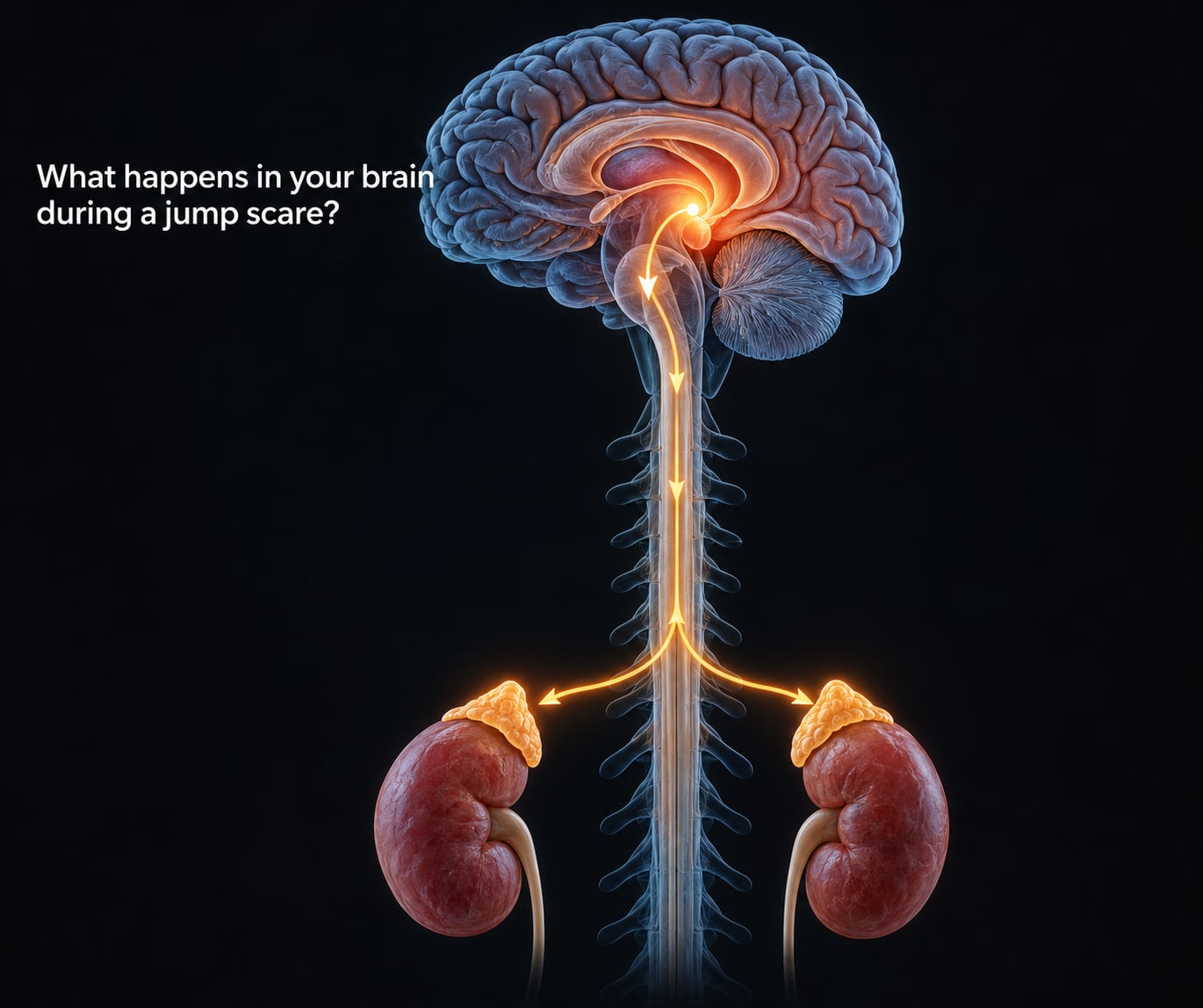
Six stages run in sequence, and the first three finish before you have consciously identified what you saw. A sudden sound cuts through a quiet room, a face fills a dark doorway, a figure steps out of a corridor, and the whole chain fires in the order below.
- Orient first. Your brainstem swings attention toward the unexpected stimulus, usually in well under 100 milliseconds, before anything else happens.
- Judge threat. The amygdala, an almond-shaped structure deep in the brain, assesses how dangerous that stimulus is. It does not wait for your reasoning.
- Switch on alarm. The hypothalamus, sitting just below the amygdala, triggers the sympathetic nervous system and the adrenal glands.
- Flood the blood. Adrenaline and cortisol are released, moving fuel to your muscles and shutting down anything non-essential.
- Change the body. Heart rate climbs, breathing stalls then quickens, muscles lock, pupils dilate, digestion pauses, and blood moves to your limbs.
- Reassess. The prefrontal cortex catches up, finds no real danger, and the parasympathetic system begins winding everything back down.
Two things follow from that ordering. Your body acts before you think, and your interpretation lags the reflex by seconds or sometimes longer. That is also why a fake scare feels genuine for a moment even when you knew it was coming.
Researchers in Finland used fMRI imaging while people watched horror clips and found heightened activity in regions tied to emotion processing and threat evaluation during jump scares. In plain terms, the same systems that light up when a real threat appears light up for the edited one too, because your brain reacts to what it is given, not to what it knows about the filming.
The fast response: why your body reacts before you think
The reason you cannot stop the reaction is that the first part of the pathway barely involves conscious thought. Sound and light information reaches the brainstem, which treats any sudden, loud, or unexpected signal as a potential threat by default.
The amygdala sits next door and does the appraisal. It weighs sensory cues such as a sudden face, a dark shape, a sharp noise, and movement in your peripheral vision. When the cue reads as threatening, the amygdala communicates with the hypothalamus.
The hypothalamus is the switchboard. It activates the sympathetic branch of the autonomic nervous system, which sends signals down the spinal cord to your adrenal glands. Those glands release adrenaline into your bloodstream within seconds, and the effect is immediate: a faster heart, harder breathing, more blood in your arms and legs.
Cortisol follows a longer path and arrives over the following seconds to minutes. It prepares your body for a sustained effort rather than a single jolt. For one jump scare that machinery is wildly overbuilt, which is part of why the feeling lingers.
Your prefrontal cortex, the region tied to reasoning and perspective, is the last piece to arrive. It is also the piece that can be overridden by panic, which is why a scare in the third act of a film often lands harder when you are already tense.
How prediction, attention, and novelty shape the scare
Your brain runs a continuous model of what should be happening right now. Doors open. The corridor is empty. Nobody is behind you. A jump scare is not frightening because of what is on screen, it is frightening because that screen breaks the model.
Three things decide whether a scare succeeds. The first is novelty: an image you have never seen is harder to classify, so the threat system stays at high alert longer. The second is sensory channel: a sudden noise behind your head is more effective than the same noise ahead of you, because you cannot visually check it.
The third is attention. If your focus is narrow, as it is when you are watching a dark screen or walking a dim corridor, your brain allocates more processing to that one channel. Darkness removes the visual information that would normally let you classify a shape as harmless, so the ambiguity is higher.
Placement matters for the same reason. A scare in the first ten minutes gets a jump; the same scare placed after ninety minutes of mounting dread tends to feel cheap, because your tension was already high enough and the surprise was the only thing missing.
What is the difference between surprise, fear, and fright?
Surprise, fear, and fright are related but distinct. Surprise is the recognition that something did not match your expectation, and it can be pleasant, like a birthday you had forgotten. Fear is a threat appraisal that produces arousal and an urge to act. Fright is the experience of the body reacting before the mind catches up, and it is the one people mean when they describe a jump scare.
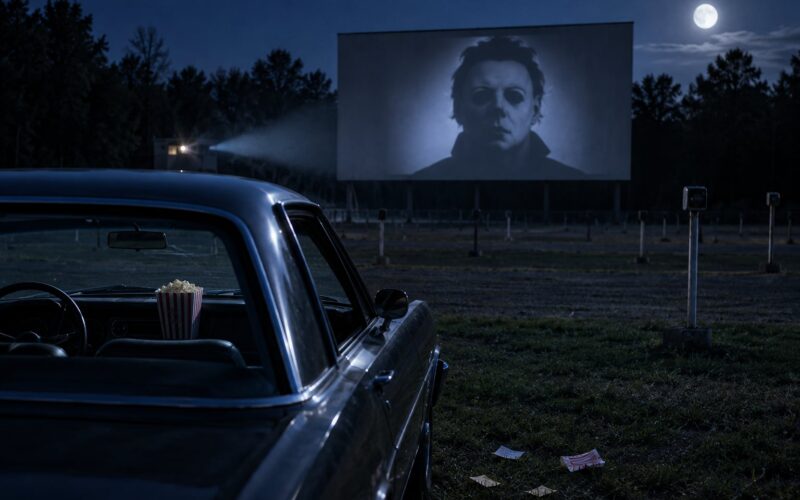
They can also occur at different moments in one scene. Take a masked figure stepping out of a dark hallway in a horror film. The surprise lands first when it appears. Fear arrives when your brain decides it might be a threat. The fright is the physical spike before either of them, the flinch you felt in your shoulders before you consciously thought the word dangerous.
The order is not fixed either. With a very familiar horror franchise, the surprise may never arrive because you predicted the reveal, yet your body still flinches at the volume of the cue.
How jump scares work on your brain
Sudden detection, rapid threat appraisal, an involuntary orienting of the eyes and head, a physiological arousal wave through the sympathetic nervous system, and a slower conscious interpretation that follows. Each stage runs on a different clock, which is why the reflex always beats the reasoning.
Why do some people barely react to jump scares?
People who seem immune to jump scares are usually not reacting without an inner response. The reaction shows up late, quietly, or as an enjoyment rather than a flinch. Several factors sit behind the difference.
- Familiarity with the conventions. Horror veterans have seen the music swell, the shot hold too long, and the wide angle point at an empty doorway. They recognise the grammar and the effect flattens.
- Baseline arousal. People who were already wound up before the sound tend to have a stronger startle. Commenters in Reddit threads on the acoustic startle reflex make this point repeatedly.
- Attention style. Someone absorbed in a conversation may register the cue late and quietly. The stimulus still arrives; the orienting response is just slower.
- Sensory processing. Differences in how sound and contrast are processed mean the same cue can read as threatening to one person and unremarkable to another.
- Temperament and prior experience. General anxiety, previous frightening experiences, and how you respond to uncertainty all shift how much a sudden stimulus is worth reacting to.
A strong reaction is not a sign that something is wrong. It means your threat system is sensitive and your nervous system is doing exactly what it was built to do.
Why do jump scares feel stronger in movies, games, and haunted houses?
Each medium attacks the reflex through a different channel and controls predictability differently. The format changes what your brain can check before it reacts.
| Format | What senses it attacks | How it exploits the reflex | Predictability |
|---|---|---|---|
| Cinema | Vision and loud audio in darkness | Conceals the cue until the cut, then hits sight and hearing together | Low, but fixed by the edit |
| Video games | Vision, sound, and controller vibration | Buys time to prime the player, then violates the expectation the game set up | Medium, and partly chosen by the player |
| Haunted houses | Touch, darkness, and unpredictable direction | Removes the screen as a buffer and controls when the cue appears | Very low |
| Virtual reality | All of the above, plus proximity | Places the cue inside the viewer’s personal space with no frame around it | Lowest of the four |
Haptics are the interesting case in games. A controller vibration can arrive before you have consciously identified anything on screen, which means the arousal starts earlier than the image would allow. Research on haptic fear in games found this kind of touch-driven response carries an emotional weight that visuals alone did not reach, which is why some players say a physical controller gets to them in a way a screen never does.
Haunted houses work on the same principle with less mercy. You cannot pause, your field of view is limited, and the darkness removes information, so the prediction model your brain is running is constantly incomplete.
Can repeated jump scares stop feeling scary?
Yes, and the mechanism is habituation. Repeated exposure to a stimulus reduces your response to it, which is the same process that lets a backfire not startle you after the tenth time you hear it.
Predictability is a second factor. Once your brain can model the pattern, the prediction error shrinks, and prediction error is what registers as threat. Horror sequels that repeat the same shock sound get weaker each instalment for this reason alone.
There is also contrast. A scare works better against a stretch of quiet, so a director who spends forty minutes at full volume leaves nothing for the loud moment to contrast against. When a film jumpscares you five times in twenty minutes, the third one is barely cheaper than the first but feels far less effective.
Voluntary exposure mostly desensitizes rather than sensitizes. Commenters on Reddit science threads describing repeated horror viewing tend to describe testing and expanding their own limits, and researchers studying fear learning make a related point: learning a stimulus is safe weakens the fear response attached to it.
What happens to your brain after a jump scare?
The recovery is slower than most people expect, and it is the phase almost no popular explanation covers. Your body does not snap back the moment you realise the figure was an actor.
First, attention stays locked on the source of the threat for a while, scanning for a second cue. You keep looking at the doorway even after you know it is empty, because the system that turned toward the stimulus has not received the all-clear.
Second, your heart rate decays along a curve rather than dropping instantly. Adrenaline has a finite life in the bloodstream, and for a few minutes after the scare you are effectively running a smaller version of the fight-or-flight response with no current threat to justify it.
Third, adrenaline built for muscle use that never arrived. The unused fuel gets processed into lactate, which is associated with the shaky hands, weak knees, and jittery feeling people report in the minutes afterwards. Cold sweat, ringing ears, and the sense that your hearing came back slightly muted are part of the same settling process.
Finally, memory formation kicks in. The hippocampus files the moment with high emotional salience, which is why you can recall the exact frame from a film you watched years ago while forgetting most of the plot around it. Your brain treats it as important because at the moment it happened, it believed it was.
How to enjoy jump scares without overwhelming your senses
If the reaction is bigger than the moment deserves, a few adjustments help more than trying to tough it out.
- Watch with the lights up. Ambient light reduces the ambiguity that makes visual cues frightening, because your brain has more information to classify with.
- Sit further back from the screen. It sounds trivial, but being closer raises the apparent size and speed of an on-screen reveal.
- Take a break after a heavy one. Waiting a couple of minutes lets your arousal finish decaying before you stack another one on top.
- Skip the interactive surprises. In haunted attractions, ask about no-touch options and where the actors will appear. Knowing the route removes the novelty that the reflex feeds on.
- Lower the volume for games, not for the story. If sound is your trigger channel, some players find it easier to follow horror titles with reduced audio, though this costs atmosphere.
None of this is about avoiding the genre. It is about keeping the reaction in the range where it stays fun instead of draining.
Frequently Asked Questions
Why does a jump scare make my heart race?
A sudden sight or sound triggers the startle reflex, which runs through the brainstem before conscious thought. The amygdala flags the stimulus as a threat and the hypothalamus activates the sympathetic nervous system, releasing adrenaline from the adrenal glands. That surge raises heart rate and redirects blood to your muscles within seconds, and the effect decays slowly afterward, which is why your pulse can stay high for a few minutes after the scare has passed.
Do jump scares cause genuine fear or just surprise?
Usually both, and they arrive in a fixed order. The startle reflex fires first, producing the flinch and the jolt in your chest before you have identified anything. Fear follows when your brain interprets the stimulus as a threat. Surprise alone is not frightening; what makes a jump scare work is the gap between your body’s reaction and your brain’s later conclusion that there was no danger.
Why do jump scares work better in haunted houses?
A haunted attraction removes the buffers that soften a scare on a screen. You cannot pause, your field of view is limited, darkness strips away visual information, and you do not know where the next actor will appear. Because the stimulus arrives unpredictably and close to you, the prediction error is larger and the threat system stays at a higher level for longer.
Why do some jump scares not scare me at all?
It is usually a combination of habituation and baseline state. Horror veterans recognise the conventions, so the effect flattens. People who were already tense before the cue tend to react harder, because a high baseline arousal lowers the threshold. Attention style and individual sensory processing also matter, since some people register the stimulus late and quietly rather than not at all.
Can getting used to jump scares change how they feel?
Yes. Repeated exposure produces habituation, the same process that makes a familiar everyday sound stop startling you. As your brain learns a stimulus is safe, the fear response attached to it weakens and predictable shocks lose their effect. That is a main reason the third film in a franchise tends to feel less frightening than the first, even when the production value is higher.
Is it normal to remember a jump scare long afterward?
Completely normal. Emotional arousal during an event strengthens memory encoding, which is why a single shocking frame from a film can stay vivid for years while the rest of the plot fades. The memory is useful rather than a sign of a problem. If fear memories start appearing without any present trigger and interfering with daily life, that is worth raising with a doctor.
Conclusion
The mechanism is simpler than the feeling. A jump scare triggers an involuntary startle reflex, the amygdala flags the threat, the hypothalamus fires the sympathetic nervous system, and adrenaline moves through your body before your prefrontal cortex gets a vote. Your brain then catches up, finds nothing there, and spends the next few minutes switching everything off.
When you analyse a scare, or sit through one that lands harder than expected, watch for that sequence in order. Detection, appraisal, arousal, then interpretation. Once you can see the stages separately, the jolt becomes a readable mechanism rather than something that just happens to you.