Horror comedies balance laughs and scares by alternating between the two tones rather than mixing them at once: the joke deflates built-up tension so the next scare lands harder, and the horror keeps the comedy from turning into a running gag with nothing at stake. The films that work let you accept the danger first, then puncture it.
That is the whole trick, and it is harder than it looks. Plenty of movies labelled horror-comedy are comedies that happen to contain a monster, and the audience knows it within ten minutes. Others stay genuinely tense and let the humour sit in the cracks. The difference is craft, not luck, and once you can name the moves you start spotting them everywhere.
Table of Contents
- What makes a horror comedy work as both comedy and horror?
- How do comic timing and horror timing differ?
- How Horror Comedies Balance Laughs and Scares
- How comic timing controls audience tension
- How character goals make both comedy and fear matter
- How tonal contrast strengthens both forms of humor
- How writers use a laugh-and-scare rhythm
- When should a horror comedy become scary for real?
- How laughter can actually increase fear
- What works in films and television but often fails in writing?
- How can you judge whether the balance is working?
- Frequently Asked Questions
- What is the secret to balancing horror and comedy?
- Should a scary scene come immediately after a joke?
- Can too many jokes make a horror movie less scary?
- What makes horror comedy funny?
- Is laughter always a sign that a scare failed?
- Conclusion
What makes a horror comedy work as both comedy and horror?
Tonal balance means neither tone wins permanently. The film leans horror, lets the audience settle, tips into comedy for relief, then leans back into danger before the joke has fully died. Horror and comedy are unusually good partners here because both are built on the same machinery: an expectation the audience half-knows, a held beat, and a release.
Comedy runs on anticipation and violation. The audience predicts where the punchline goes, and the laugh arrives when the film misses on purpose. Horror runs on anticipation and interruption. The audience anticipates a shape in the dark, and the fear arrives when the film changes the terms. Same setup, opposite outcome.
That shared engine is also why horror comedies feel stranger than their two genres do apart. Each half resets the other’s expectations. After a jump scare, a joke feels like relief. After a joke, the sudden quiet feels loaded, because the audience has just been trained to expect a punchline and gets dread instead.
Three things have to be true for the balance to hold. The characters need wants the audience cares about, the danger has to be real enough that it would land without the jokes, and the humour has to come from somewhere other than the monsters themselves. Break any one and the film tips toward parody or toward dread.
How do comic timing and horror timing differ?
Both are timing crafts, but they aim in opposite directions. Comic timing keeps the audience slightly behind the information so the gap becomes funny. Horror timing keeps the audience slightly ahead of the information so the gap becomes dread.
A joke needs a setup, a delay, and a turn. The delay is where the comedy lives, and cutting it early is why some jokes fall flat. A scare needs a hiding place, a silence, and a break. The silence is where the horror lives, and filling it with music is why some stingers feel like nothing.
The overlap is false alarm. A sound in the dark that turns out to be nothing is a scare that failed and a joke that landed, which is exactly why the technique is so widely used. The trick is making sure the false alarm resolves. If the audience is still braced when the credits roll, the last twenty minutes felt like waiting rather than playing.
Another difference: comic timing lives mostly in performance and horror timing lives mostly in the edit. A joke can survive a mediocre cut. A scare cannot, because the scare is a change in the image and the audience has to register the change as danger rather than as a cut.
How Horror Comedies Balance Laughs and Scares
Nine techniques show up again and again in the films that get both reactions out of the same scene. None of them is complicated on its own, and most are invisible when they work.
- Play the fear straight. The monster, the wound, the locked door get treated as genuinely threatening. Nobody winks at the camera first.
- Alternate registers instead of blending them. Whole scenes lean one way or the other. Simultaneous comedy and terror is much harder to sell.
- Use jokes as pressure valves. A joke after a scare is a release valve that lets the next scare have somewhere to fall.
- Build the humour out of character. Funny because of who someone is, not because of what they happen to say.
- Let self-aware commentary replace a scare. Talking about the rule you are breaking is suspense of a different kind.
- Set comedy against consequence. A broad joke lands harder when the consequence next to it is real and specific.
- Escalate. The stakes and the gross-out factor both climb, and each out-runs the last.
- Change the score, not just the volume. Musical contrast signals a tone switch faster than dialogue can.
- Make the audience slightly ahead of the characters. Dramatic irony turns a mistake into dread and a reveal into a punchline at the same time.
How comic timing controls audience tension
Misdirection is the main tool. A scene set up so the audience is sure the obvious thing is coming lets a director delay, subvert, and land the surprise while the tension stays high the entire time. The scare never fully discharges, so the joke has somewhere to go.
The rule of three works the same way in both tones. The first two beats establish the pattern, and the third breaks it. In horror the break is a body on the floor that was not there a second ago. In comedy the break is a character behaving completely out of character, which is funnier when the audience has learned to trust that character.
Callbacks also reduce how much a joke costs. A joke that refers back to something from twenty minutes earlier costs almost no tension, because the audience is doing recognition work rather than bracing work. That makes callbacks the safest joke to use in a horror scene, and it is why long horror comedies can afford more humour than short ones.
Reaction shots do the opposite and are riskier. A cut to a face processing something awful is one of the most reliable ways to make an audience laugh and shiver at the same moment, but the shot has to be short and has to be played honest. A held reaction shot becomes the buffer problem, where the audience has finished laughing and is now just sitting there.
How character goals make both comedy and fear matter
A joke attached to a goal hurts more than a joke attached to nothing. If a character wants something specific and specific, and that want is silly, the joke inherits their whole situation. If the situation turns dangerous, the same character is now genuinely vulnerable and the earlier silliness turns into something the audience regrets laughing at.
That is how emotional investment rescues tonal balance. You can be relaxed about a joke when the character is fine. You cannot be relaxed about a joke from someone who is about to die badly.
Competing relationships help too. Two characters who want incompatible things generate humour naturally, and the same disagreement gets sharper when one of them is holding a weapon. Assigning a goal to almost every speaking character is a practical version of this: the scenes without a stated want are the scenes where jokes fall out of nowhere.
How tonal contrast strengthens both forms of humor
Contrast is the cheapest upgrade available to a horror comedy. A silly conversation in a genuinely threatening room is funnier than the same conversation in a safe one, because the room keeps reminding you that the situation has not actually been defused.
The same logic works in reverse. A moment of real dread following a run of gags lands with extra weight, because the audience has been enjoying itself and does not want the levity to stop. Directors exploit this by cutting from a broad gag straight into silence and a slow push, a combination the audience experiences as a punch to the stomach even when nothing violent occurs.
Absurd juxtaposition works the same way at the level of plot. Somebody calmly discussing paperwork while something terrible happens in the same room is a durable gag, and it stays funny precisely because the something terrible is not being taken seriously by anyone else in the frame.
How writers use a laugh-and-scare rhythm
The reliable pattern runs in four beats: build, release, unsettle, resolve. Tension accumulates, a joke lets some of it out, something quietly changes that the audience notices before the characters do, and the change either pays off or becomes the next joke.
Two mistakes kill the rhythm. The first is mechanical alternation, where every scare is immediately answered by a gag and the audience starts predicting the swaps. The second is comedy that arrives during the tension rather than after it, which teaches the audience that a scare means a joke is coming.
Better scripts vary the length of the intervals. A long stretch of sustained dread earns a bigger laugh afterward than a short one, so the space between registers is where the balance is really tuned. Scenes that swing hard in both directions inside the same minute feel busy, not balanced, and the audience stops settling into either feeling.
Testing a horror comedy usually means reading it aloud to a room of people who cannot see the visuals. If the laughs cluster in the wrong places or arrive before the beat has landed, the fix is almost always a timing change rather than an extra joke.
When should a horror comedy become scary for real?
Real threat should arrive at points of no return, where the characters cannot simply walk away and the choice they make will cost something. Comedy can be suspended around those moments without being abandoned, because the audience will tolerate a hard beat if they trust that the levity comes back.
The distinction is whether the film is using the scare as punctuation or as consequence. Punctuation is a spike between jokes, and it is fine for it to be brief. Consequence changes the story, and it should arrive near the end, after the audience has learned to expect the spikes.
Comedy loses its power when the danger is reversible. Jokes during a scene where the threat is already gone are just jokes in a horror film. Comedy gains power when the danger is live and the characters are coping badly, because the inadequacy is the joke and nobody is safe enough for it to be funny on its own terms.
How laughter can actually increase fear
Laughter discharges tension, and discharged tension is what a scare needs to work with. The audience comes out of a laugh slightly deflated and slightly uncertain, and that lowered guard is the raw material of the next scare. Without the laugh, the audience would simply be at peak alertness, and peak alertness is much harder to shock.
Comic underreaction does the same thing without the release. When a character responds to something monstrous with mild irritation, the audience is left holding their own fear while the character refuses to acknowledge the situation, which is a far more disturbing place to be.
Deliberate forbidden behaviour adds a third layer. The audience is not just watching a rule get broken, they are watching it get broken by someone they like, and the discomfort of complicity does not lift when the joke does. Relief theory, incongruity, and superiority are useful shorthand for why any of this feels good, but the practical version is simpler: mix incompatible feelings in the same moment and the audience has to hold both at once.
That also explains why horror comedies rewatch well. The tension is real enough to remember and light enough to replay.
What works in films and television but often fails in writing?
A great deal of what sells tonal balance has no page equivalent. A performer can hold a straight face for four seconds after everyone else has stopped laughing. A shot can hold two seconds past comfortable. Music can change key under a scene and tell the audience to get ready. Prose has to state all of that, which means it either gets wordy or gets left out.
The screen also lets a film jump register instantly. A hard cut from a comedy scene to a horror scene does the tonal work in one frame, and a book or an article has to spend a paragraph on the same transition.
Casting does something writing cannot. An actor with real physical presence gives a character danger for free, and a joke in the mouth of that actor lands differently from the same joke read by someone harmless. Funny actors can also play genuine threat, and the choice of which one to cast decides how a scene reads.
This is also where the three labels matter, because people conflate them and get burned. Horror-comedy aims at both reactions. Witty horror is a horror film that happens to be funny, and its scares come first. Horror parody is a comedy about a horror film, and the scares are a costume.
| Label | Primary aim | Does it scare? | Usual failure |
|---|---|---|---|
| Horror-comedy | Both, in alternating scenes | Yes, in the horror scenes | Comedy crowds out the danger |
| Witty horror | Fear first, humour second | Yes, and the jokes help | It gets grim and loses the release |
| Horror parody | Laughter at the genre | No, not reliably | Nothing is left to be scared of |
How can you judge whether the balance is working?
Ask four questions. If the joke were removed, would the scene still be frightening? If the scare were removed, would the scene still be funny? Do the two halves live in different scenes rather than fighting inside one? And does the fear escalate rather than staying at the level it started at?
Audiences are good at this even when they cannot explain it. Horror fans reliably complain that being marketed a film as horror-comedy makes them stop bracing for scares, which is why so many of them would rather find a horror film with jokes in it than one sold on the label. If you want a genuine scare, look for the witty horror description instead.
| Film | Year | Genre lean | What works | What nearly breaks it |
|---|---|---|---|---|
| Shaun of the Dead | 2004 | Comedy-first, with real teeth in the back half | The horror beats are played straight once the characters stop joking | The first act jokes so hard that the switch feels abrupt |
| An American Werewolf in London | 1981 | Horror-first, incidentally funny | Comic transformation sequences and dry narration under genuine threat | The balance depends on tone you have to be in the mood for |
| The Texas Chainsaw Massacre 2 | 1986 | Leaning comedy | The character writing is funny and the chainsaw scenes are played straight | The comedy runs so long the horror arrives as an interruption |
| Creepshow | 1982 | Horror-first anthology | Direct address keeps the horror sincere between sketches | The framing comes across as parody to some viewers |
| What We Do in the Shadows | 2014 | Comedy only | Deadpan characters behave as if the horror is mundane | No genuine threat anywhere, so nothing lands as scary |
| The Cabin in the Woods | 2011 | Meta-horror, both on purpose | The rules are stated plainly and then obeyed seriously | Self-awareness makes some viewers stop caring |
| Tucker and Dale vs. Evil | 2010 | Comedy-first with a real body count | The killers are played straight; only the leads are oblivious | Without that split it would be a parody |
| Bodies Bodies Bodies | 2022 | Horror-first with games and parties | The horror is real and the banter stays on the characters | Continues into the finale when the jokes would have cost more |
Those are useful anchors, but genre lean is a marketing question more than a quality question. A comedy-first film that treats its danger seriously is more frightening than a horror-first one that treats it as a costume, and the scariest horror comedies are usually the ones where the ratio is deliberately lopsided rather than perfectly even.
If you are picking something for an October 2026 watch night and want the room to laugh and the lights to stay off afterwards, pick by tone rather than by label. Witty horror gives you the safer bet when the audience is new to the genre, and a proper horror-comedy when the audience already knows what a real scare feels like.
Frequently Asked Questions
What is the secret to balancing horror and comedy?
The secret is alternation rather than mixture. Horror comedies balance laughs and scares by letting whole scenes lean one way at a time, keeping the fear played straight so the audience accepts it, and putting jokes in the gaps so tension can discharge. A joke delivered while the threat is still live reads as a joke about the threat, which kills the fear without landing the humour.
Should a scary scene come immediately after a joke?
Not immediately. The gap between the laugh and the scare is where the balance lives, and a longer, quieter gap makes the next scare land harder because the audience has settled again. A scare placed the instant a punchline dies usually feels like a counter-punch, which reads as competitive rather than escalating. Let the joke finish and the room go quiet first.
Can too many jokes make a horror movie less scary?
Yes, and this is the most common failure in the genre. Once the audience knows a joke follows every scare, they stop bracing, because the scare is now a setup rather than a threat. Horror fans describe exactly this effect when a film is marketed as a horror-comedy in advance. The damage is done before the first scene ends, and no amount of later gore fully repairs it.
What makes horror comedy funny?
Mostly character, not punchlines. Humour built from what someone wants, how badly they want it, and how they cope with fear is funny whether or not anything supernatural is happening. Jokes that depend on a monster behaving absurdly, or on the film reminding you it is a movie, are funnier for about a scene and then they feel like a parody. Whichever source a joke comes from, the fear has to stay real around it.
Is laughter always a sign that a scare failed?
No. Laughter releases tension, and discharged tension is what the next scare needs in order to work. What matters is where the laugh falls. Laughter during the approach to a scare means the danger has been demoted to a bit, while laughter after a genuine scare means the audience is still holding both feelings at once. The tell is whether anyone is still frightened during the laugh.
Conclusion
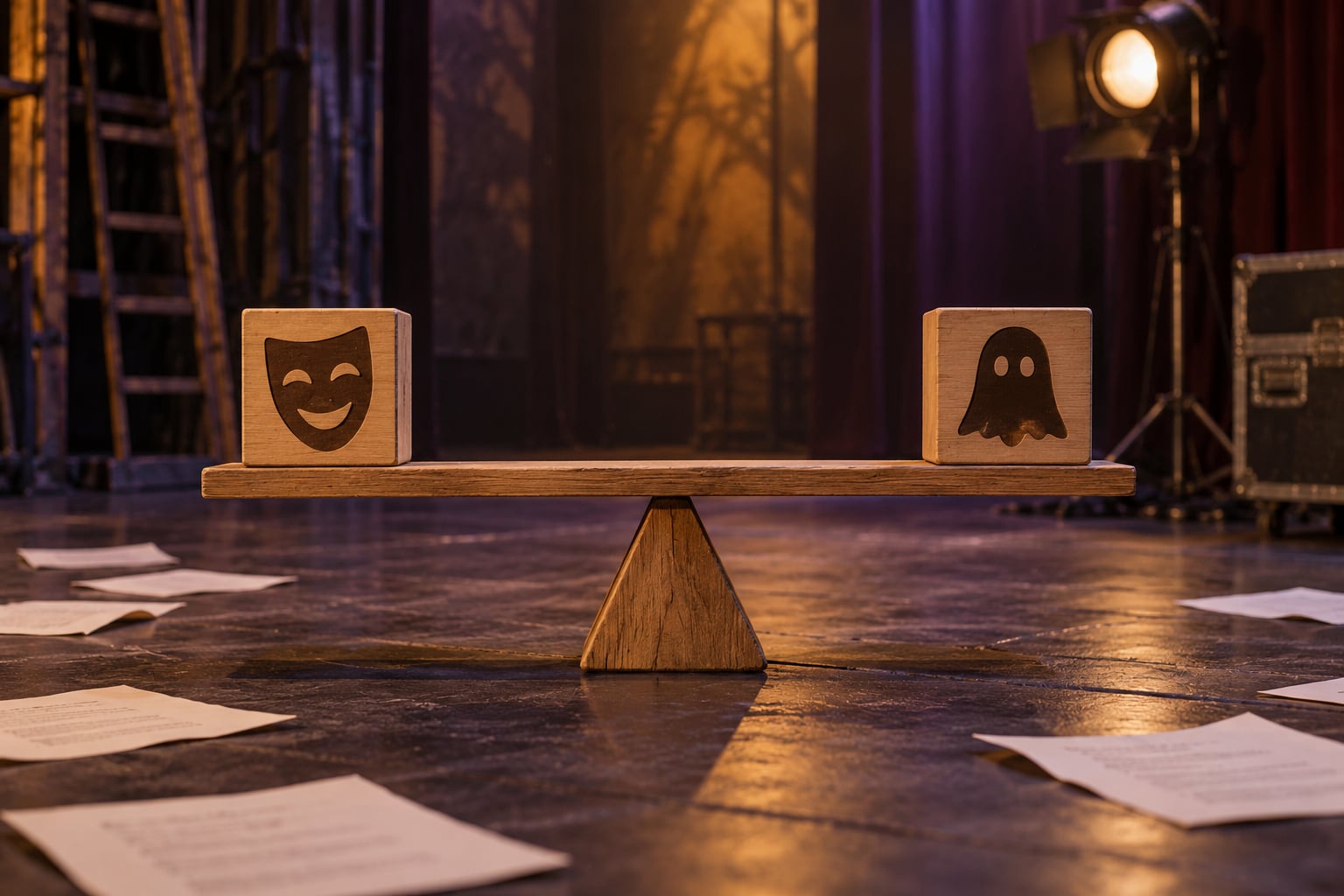
Horror comedies balance laughs and scares by treating the fear as real, letting whole scenes lean one tone at a time, and putting the jokes where tension can safely discharge. The practical version is a see-saw rather than a blend, and the danger is knowing which side is heavy at the moment the film needs it.
If you are writing one, start by deciding what each major scare has to accomplish beyond making people flinch. If the answer is a reaction and nothing else, it is punctuation, and it will feel thin when it arrives. If the answer is a choice the character has to live with, the laugh before it will feel like relief instead of a warning.