To build suspense in a horror story, pick one question your reader wants answered, refuse to answer it, and force your protagonist to act anyway. Tension comes from that gap — the reader knows a question is open while the character makes a decision without an answer. It takes an afternoon of planning and one careful pass per scene.
The trouble is that suspense is easy to describe and hard to execute. Most drafts confuse it with dread atmosphere, or with a jump scare at the end of a chapter. Both can exist in a horror story, but neither is suspense on its own.
Below is the process I use, broken into nine steps. It works for a 2,000-word short story and a 90,000-word novel, though the timing changes. If you want the theory behind it first, read the steps once through, then come back and apply them scene by scene.
First updated for October 2026, and revised whenever I run into a new hole in a draft.
Table of Contents
- What You Need
- A character with something specific to lose
- A threat or an uncertainty
- One suspense question
- An escalation ladder
- A withholding plan
- Step-by-Step: How to Build Suspense in a Horror Story
- 1. Establish What the Character Fears Losing
- 2. Plant a Suspense Question
- 3. Withhold the Full Explanation
- 4. Let the Character Choose a Risky Action
- 5. Escalate the Stakes in Small Steps
- 6. Use Pacing, Silence, and Interruption
- 7. Deliver a Partial Reveal, Then a New Question
- 8. Make the Resolution Pay Off
- 9. Read the Scene for Rising Tension
- Common Mistakes
- Using shock in place of suspense
- Explaining the threat immediately
- Writing scenes with no threat in them
- Repeating the same fear
- Relying on gore
- Breaking your own rules
- Making the reveal unsupported
- Frequently Asked Questions
- What are the three elements of suspense?
- What is the difference between suspense, surprise, and shock?
- How do I build suspense in a short story when I have no room for a slow build?
- How much of the threat should I reveal before the payoff?
- Do jump scares work in prose?
- How do I keep suspense alive across a full novel?
- Conclusion
What You Need
Before drafting, five things have to exist on paper. A scene without them will feel flat no matter how much atmosphere you pile on.
A character with something specific to lose
Not “lives” — a name, a relationship, a body part, a memory, a routine. Specificity is what makes the threat bite. If your lead has nothing to lose, a scene of them in a dark hallway is just a person in a hallway.
A threat or an uncertainty
Something outside the character’s control, or something they cannot explain. Horror works on both. A locked door nobody opened is often stronger than a figure in the doorway, because the reader cannot finish imagining it.
One suspense question
A single sentence the reader will want answered. “Who is making the sound in the cellar?” “Why does the photograph show four people when there are only three?” More than one at a time splits the reader’s attention and flattens the pressure.
An escalation ladder
Three or four rungs, written down in order, each worse than the last. This keeps you from stalling in the middle where most drafts sag.
A withholding plan
A note on what you will reveal, roughly when, and what you will keep back. Not a twist outline — a list of which doors you leave closed and which ones you open halfway.
Step-by-Step: How to Build Suspense in a Horror Story
Here is the full sequence. Suspense is generated by two mechanisms that run the whole time: you ask a question and delay the answer, and you manage the gap between what the reader knows and what the character knows. Everything below is one of those two things, done more deliberately.
1. Establish What the Character Fears Losing
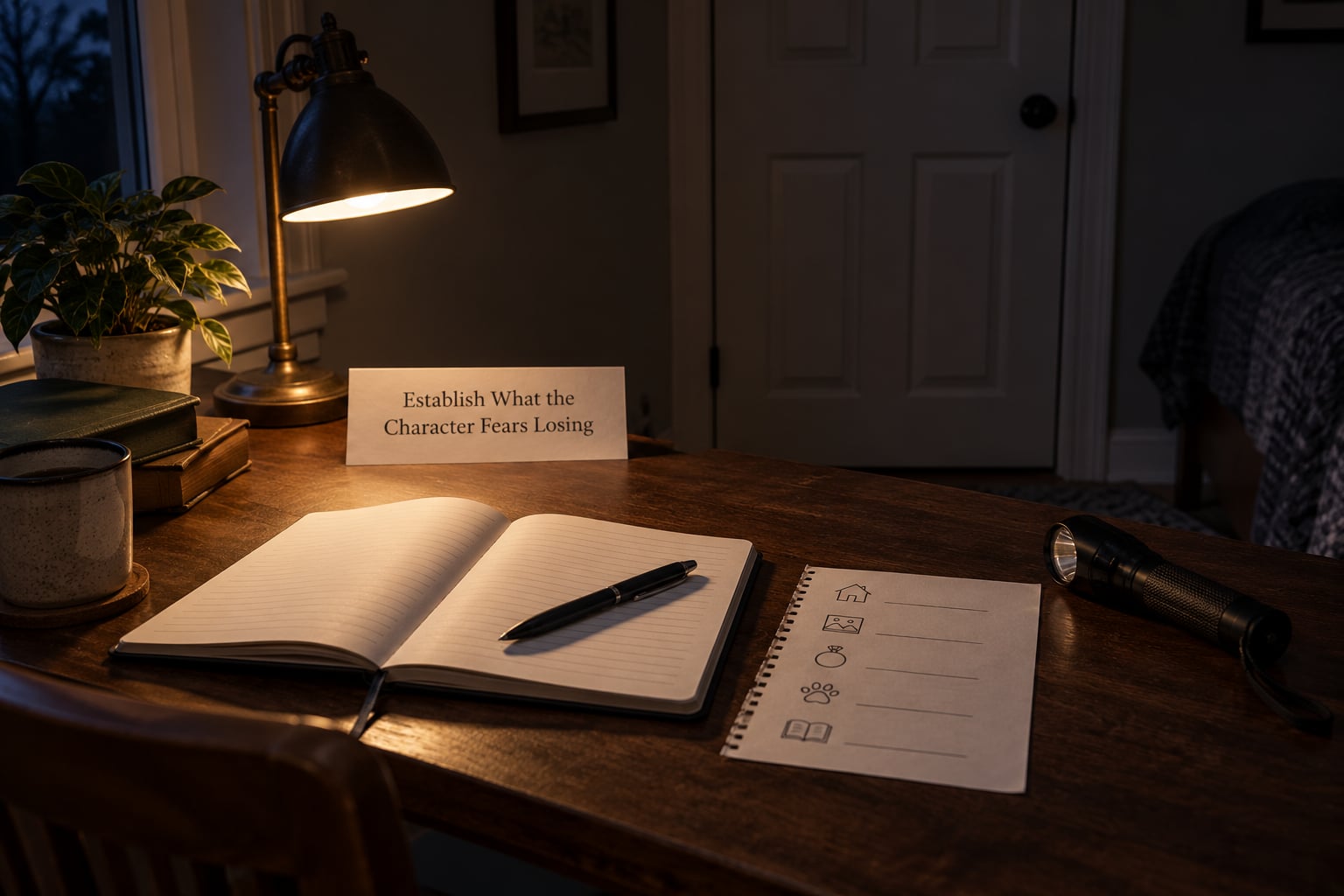
Stakes come first, and they need to be personal before they get large. Give the protagonist one thing that would actually hurt them: a brother in the hospital, a dog that is the only living thing that trusts them, a house they’ve been slowly repairing.
Then show the fear through behavior rather than explanation. Your character checks the hall twice. They stop listening to music. They rehearse an apology to someone who hasn’t done anything. Readers read behavior as feeling, so trust the behavior.
The test is simple. Ask what the reader is willing to lose by page ten. If the honest answer is “I don’t know yet,” the stakes are not attached yet.
2. Plant a Suspense Question
Planting means writing the moment the question appears in the reader’s head, clearly enough that it lodges there. The strongest ones are plain statements: “The third bedroom had been locked since she was twelve.” A question the reader forms themselves lands harder than one you announce.
Write that moment down and keep it near your draft. Once it exists, every scene either pushes on it or ignores it deliberately. Scenes that ignore it are allowed, but they need to make the question louder by absence.
3. Withhold the Full Explanation
Once the question is in, you have to hold the answer back, and the hard part is doing it fairly. Partial information is the tool: you give the reader something real, just not the whole shape.
Three techniques carry most of the weight. Competing interpretations let two explanations both fit the evidence, so the reader leans toward the wrong one. Misleading clues are honest facts that point somewhere else — a smell attributed to the neighbour’s pipe, a footprint that reads as a child’s. Withheld context means the character has a piece of information they are not sharing yet, because they do not trust it.
Fairness means the reader can look back at page four and see the real clue. If the reveal depends on a detail that appears for the first time in the final chapter, you have cheated, and readers feel it even when they cannot name why.
4. Let the Character Choose a Risky Action
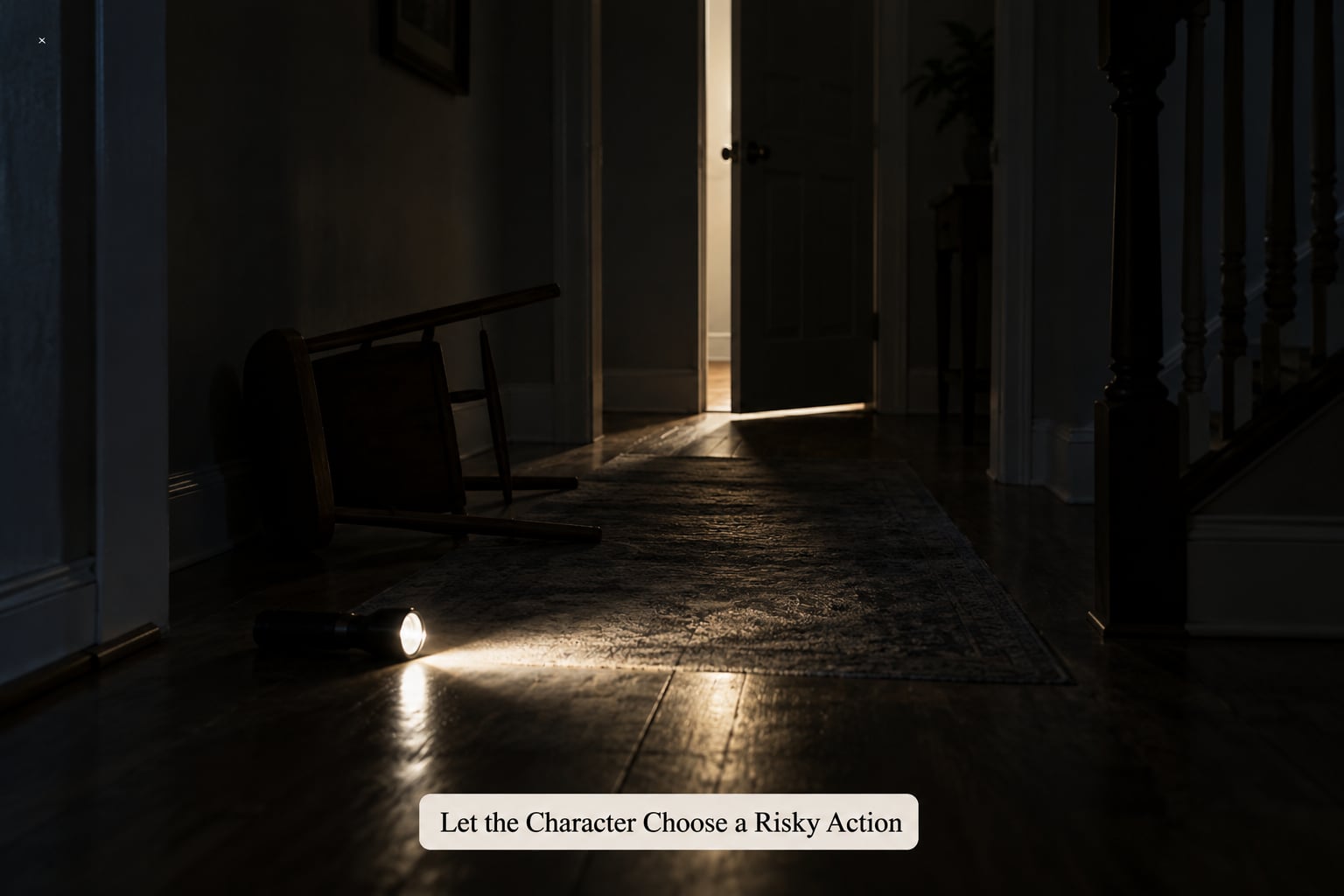
Suspense intensifies when the protagonist has to move without information. They open the door knowing what might be behind it. They lie to the person who could help. They keep walking down the corridor instead of going back.
This is where suspense turns into character. The choice tells the reader who your protagonist is under pressure, and pressure is the only reliable test of personality. A careful person makes a different bad decision than a reckless one, and the reader learns more in one scene than in three pages of backstory.
Give the choice a cost the character can see coming. Not a death, just a trade: safety for speed, truth for silence. The character picks the worse option on purpose, and the scene inherits its tension from that.
5. Escalate the Stakes in Small Steps
Move from unease to threat to immediate danger by changing one thing at a time. Not two, not three. One change per beat keeps the reader able to track what got worse, which is what makes dread climb instead of flatten.
Tools that work well: shorten the time available, block the obvious exit, raise the personal cost, or reduce the character’s options. Each of these removes a little room. A locked bathroom with a broken handle is more frightening than the same room with a working door.
What usually does not work is volume. Repeated loud scares in a row stop registering after the second one, and readers begin predicting the rhythm. Add pressure to a quiet scene instead of raising the noise.
6. Use Pacing, Silence, and Interruption
Pacing is sentence-level before it is scene-level. Short sentences speed a moment up. Long ones with subordinated clauses slow it down and let dread accumulate. In a horror scene I usually alternate: a long sentence that walks the character toward the door, then a short one that arrives.
Silence is punctuation with the sound removed. A gap between two lines of dialogue, a paragraph break where nothing happens, an unnarrated minute at three in the morning — these let readers supply the horror themselves, and supplied horror is always worse than described horror.
Interruption is the cheapest effective cliffhanger. Cut a scene mid-action, at a decision or a discovery rather than in the middle of an argument. Whatever the reader was turning the page to find should start the next chapter. Break the action itself and you cheapen the moment.
7. Deliver a Partial Reveal, Then a New Question
Answering your suspense question should not end the scene. Give the reader enough to confirm or disrupt their expectation, then replace the question with a more specific one. The shape goes from “what is in the cellar?” to “why is it using my mother’s voice?”
Each answer narrows the danger, which raises the stakes and refreshes the pressure. This is how you extend a scene past its first surprise, and it is how you get through the sagging middle of a novel without inventing a second threat.
Know which kind of answer you are writing. A confirmation lets the reader feel clever for guessing right. A disruption invalidates the guess and forces them back to the start, and it is the harder of the two to earn.
8. Make the Resolution Pay Off
The payoff has to arrive from material the reader already has. Connect the ending to the planted question, to a clue from the opening, and to the thing the character feared losing in step one. When those three meet, the reader feels the story close rather than end.
Let the character pay something. Loss, a scar, a relationship that never repairs, a version of themselves they cannot go back to being. Horror is the genre where an unresolved cost feels like a cheat, and the cost does not have to be death to land.
Resolving the original question should also close the loop you opened for the reader’s expectations. If you spent forty pages suggesting the safe house was haunted, either prove it or give a reason it wasn’t, in the same scene.
9. Read the Scene for Rising Tension
Mark your scene like a pulse chart. Find the sentence where the reader first feels uneasy, the point where they expect an answer, the moment the danger escalates, and the line where tension peaks.
Then read each paragraph and ask a single question: did the situation change? If the paragraph’s job could have been done by any other paragraph — more description, more weather, more worry — it is filler, and it should go. Cut material while the tension is rising and the rise gets steeper.
Finally, check that the peak is where you think it is. Writers frequently build to a moment the reader stopped worrying about two pages earlier. Reading aloud catches that faster than anything else I know, because your ear hears the drag before your eye does.
Common Mistakes
Seven failures account for most flat horror scenes, and each one has a straightforward fix.
Using shock in place of suspense
A sudden loud moment gets attention for a second. Suspense keeps attention for chapters. Fix it by asking what the reader is waiting for, and delaying that answer instead of interrupting the scene.
Explaining the threat immediately
The moment you name the monster, define its rules and explain its origin, the mystery stops working. Fix it by deciding one thing the reader must not learn yet, and holding it until the pressure peaks.
Writing scenes with no threat in them
Character scenes between the scares are not automatically rest. A conversation is suspenseful if the listener knows something the speaker does not. Fix it by giving every scene a small unanswered question.
Repeating the same fear
Three variations of the same chase is one chase. Fix it by changing the type of danger each time — physical, relational, informational — so the reader is afraid of something new.
Relying on gore
Detail on a wound does not create dread; it creates a mechanism the reader has already processed. Keep the camera on the character’s reaction instead. Vomit, scratching, and the sound behind the door hit harder than an inventory of injuries.
Breaking your own rules
If the creature cannot cross running water on page fifty, it cannot cross it on page two hundred. Fix it by writing a short rule sheet before drafting, and treating it as law unless the reversal is the story’s central discovery.
Making the reveal unsupported
The twist arrives, nobody saw it coming, and readers feel robbed. Writers on writing forums say the opposite problem just as often — beta readers guess twists that were telegraphed too heavily. Fix it by planting a clue with an innocent explanation attached, then planting a second clue that contradicts it.
One habit helps with all seven. Read the scene aloud to someone who has not seen the draft and ask where they stopped caring. The gap between what you meant and where they looked up is your revision list.
Frequently Asked Questions
What are the three elements of suspense?
The three elements are an unresolved question, stakes attached to the answer, and delay. The question keeps the reader oriented forward, the stakes make the answer matter, and the delay is what turns an ordinary scene into a tense one. Remove the delay and you have drama. Remove the question and you have atmosphere.
What is the difference between suspense, surprise, and shock?
Suspense is anticipation: the reader knows something is coming and waits for it. Surprise is the arrival of the unexpected, the moment the anticipation was aimed at the wrong place. Shock is a sudden jolt with no build-up, loud and immediate. Horror uses all three, but only suspense keeps a reader turning pages after the scene ends.
How do I build suspense in a short story when I have no room for a slow build?
Compress by cutting stages, not beats. Open mid-escalation rather than at the beginning, plant your suspense question in the first three paragraphs, and make every scene turn the situation. A short story can afford one big reveal instead of four partial ones. What it cannot afford is a scene where nothing gets worse.
How much of the threat should I reveal before the payoff?
Reveal enough that the reader can guess, and enough that the guess feels like their own idea. Give them the shape of the danger, one detail about its rules, and no explanation of why it is there. If your beta readers spot the twist every time, the clues are too loud; if nobody sees it at all, check that the clues exist before the reveal.
Do jump scares work in prose?
They can, but they behave differently than on screen. Writers frequently note that a sudden jolt in a story lands as a trick rather than fear, because the reader controls the pace and can simply stop reading. A quieter equivalent works better: a line of dialogue that reveals something the character clearly did not know.
How do I keep suspense alive across a full novel?
Give every chapter its own small suspense question that resolves within a few pages, layered under the larger one. Between those, keep pressure alive with change rather than volume: a new cost, a shorter deadline, a narrower set of options. Readers forgive a slow middle if they can feel the ground shifting under the character.
Conclusion
Suspense is not atmosphere and it is not a scare. It is an open question, something the reader cares about losing, and time spent inside that uncertainty while the character acts without an answer.
Start small. Pick one thing your protagonist would be devastated to lose, plant a single question about what is threatening it, and write one scene in which the answer is denied while the character makes a decision anyway. That scene is the whole method in miniature, and the rest of the nine steps are how you stretch it to the length you need.