Candy became the standard Halloween treat in the United States between the 1930s and the 1950s. Candy existed long before that, but it only became the default once it was cheap, shelf-stable and individually wrapped, and once marketing turned Halloween into a sales season. Before then, the door-to-door ritual was already a fact of life in most neighborhoods.
That distinction matters if you have ever wondered why Halloween looks the way it does. The trick-or-treating custom is far older than candy. The phrase itself was first printed in a Canadian newspaper in 1917, and for decades many adults treated the practice as a form of extortion. What changed was not the ritual. What changed was what a family could put in a child’s hand without any preparation at all.
Here is the chain, from soul cakes on a doorstep to a pillowcase full of fun-size bars, and the parts of it that are documented versus the parts that get retold every October.
Table of Contents
- What Did People Give Children on Halloween Before Candy?
- How Did Candy Become the Main Halloween Treat?
- How Did Trick-or-Treating Change What Children Received?
- When Did Candy Start Replacing Traditional Treats?
- Why Did Candy Companies Promote Halloween?
- How Is Candy Connected to Modern Halloween Culture?
- How Has Candy Consumption Changed Over Time?
- Why Do Some Families Choose Non-Candy Treats?
- Frequently Asked Questions
- What was the first Halloween treat?
- When did candy become popular for Halloween?
- Why is candy associated with Halloween?
- Did people always give candy on Halloween?
- What are alternatives to candy for trick-or-treaters?
- How much candy is expected at Halloween?
- Conclusion
What Did People Give Children on Halloween Before Candy?

Before commercial candy, Halloween treats were food that already existed in a household: fruit, nuts, baked goods and small coins.
The roots sit even further back. Samhain is the ancient Celtic harvest festival that marked the start of winter, observed in parts of Scotland and Ireland. Souling is the door-to-door begging for soul cakes that carried a Christian overlay: bakers gave out cakes or pastries on All Hallows’ Eve in exchange for prayers for the dead. A soul cake was a round, spiced bread, not a sweet confection as modern cookies are.
Guising is the Scottish and Irish custom of performing a song, poem or joke in disguise and receiving a treat in return. Mumming is the related medieval practice of going door to door in costume for food or drink. Both existed before the United States did, and both make clear that the door-to-door treat exchange was ancient long before any candy factory ran a Halloween production line.
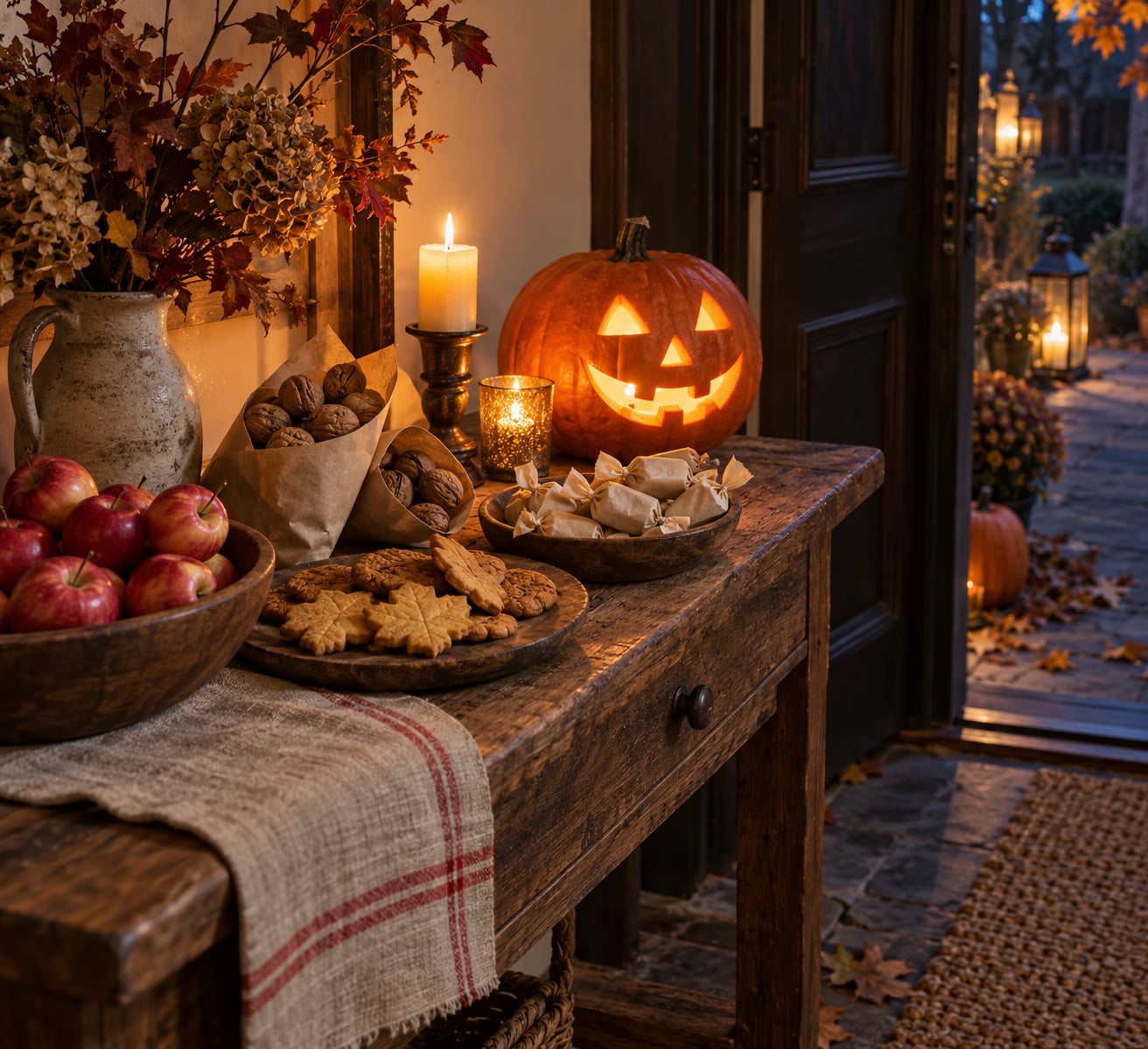
What did that look like in practice? Apples and nuts, a homemade cookie or two, sometimes a coin. Households also handed out popcorn balls, and some gave children small toys. A sugar skull or a caramel-coated apple in the 1950s was already a homemade project that took an afternoon.
The important thing for the question of how candy became the main Halloween treat is that none of these required a supply chain. They also did not scale. One popcorn ball is one popcorn ball, and a household expecting thirty children at the door on one night is in a completely different position from a household expecting three.
How Did Candy Become the Main Halloween Treat?
Five forces did it: mass production, the individually wrapped wrapper, postwar abundance, advertising that treated Halloween as a shopping occasion, and a trick-or-treating ritual that was suddenly large enough to need feeding. Remove any one of them and candy does not fully take over.
| Era | What children were given | Why it changed |
|---|---|---|
| Samhain and souling | Soul cakes, spiced bread | Begging for the dead on All Hallows’ Eve, not a treat for children |
| Medieval to 1800s | Fruit, nuts, baked goods, coins | Household kitchens already had the food on hand |
| 1917 to 1920s | Whatever a household felt like, or nothing | First printed “tricks or treats”; treat giving still informal |
| 1930s | Popcorn balls, cookies, fruit, nuts | Communities organized trick-or-treating to stop vandalism |
| 1942 to 1947 | Less of everything | Sugar rationing paused the trend |
| 1950s to 1960s | Individually wrapped bars and fun size | Cheap factory candy plus postwar advertising |
| 1970s onward | Assorted bags, full-size bars, themed assortments | Supermarket seasonal displays and national campaigns |
Start with packaging. A factory-wrapped piece of candy costs a fraction of what a homemade treat costs in effort, keeps for months on a shelf, and can be handed out with one hand while you hold a door. An unwrapped homemade good is a food safety question and a preparation question in the same breath. Wrappers solved both at once, and they turned the doorway into a supply chain.
Then scale. The postwar baby boom flooded neighborhoods with children, and the number of doors a group could walk in one evening grew. Households that once gave a coin now had to plan for thirty or forty children.
How Did Trick-or-Treating Change What Children Received?
Trick-or-treating turned a household’s treat budget from a gesture into a supply problem, and that is the mechanism most people miss.
The 1920s are remembered as a trick-or-vandalize era, when older groups went door to door expecting something and were refused often enough that they damaged property instead. By the 1930s communities organized the practice deliberately as social control: give the children a treat, keep them moving, and the vandalism stops.
Once every child on a street went every year, households began to expect the ritual as annual rather than exceptional. An expected guest gets a planned portion. That is why the treats moved from fruit in a bowl, shared and random, toward individually wrapped pieces handed out one at a time, each child receiving their own.
Neighbors reinforced it socially too. The adult who handed out one apple while everyone else handed out bars was the neighbor people talked about. Trick-or-treating became a community standard, and candy became the way households met it.
When Did Candy Start Replacing Traditional Treats?
The documented milestones put the replacement between the 1920s and the 1950s, with a wartime pause in the middle.
Some milestones are solid and worth quoting. The phrase “tricks or treats” appears in The Sault Daily Star in Ontario in 1917, and readers on etymology forums consistently find that surprising, because most Americans assume the phrase is ancient. Candy corn dates to the 1880s, when it was sold as chicken feed, and production took off after 1898. World War II brought sugar rationing from April 1942 to June 1947, which held the trend in place.
What is murkier is the idea of a single founding moment. Some history sites argue candy entered Halloween in the 1920s, while others put the real handoff in the 1930s, when household handouts began. Both are defensible because candy was available before it was customary, and customary before it was cheap.
The myths are worth naming so you can skip them. No one decided in a meeting that candy would replace apples. The replacement was gradual, regional, and driven by logistics.
Why Did Candy Companies Promote Halloween?
Because Halloween turned out to be a perfect second selling season: once a year, no gifting competition, and a built-in excuse to buy.
Candy makers had promoted the product nationally long before they promoted the holiday. The National Confectioners Association ran a National Candy Day in 1916, decades before Halloween advertising existed. What changed after the war was television. Hershey’s launched the first national television campaign for Reese’s Peanut Butter Cups in 1970, and campaigns like it taught shoppers to think of specific bars in specific seasons.
Retail built on that. Seasonal assortments arrived where a bag of loose sweets once sat, themed wrappers appeared each October, and supermarkets built endcaps and seasonal aisles around the holiday. By the 1970s Halloween was routinely described as one of the biggest selling periods of the retail calendar.
Nothing about this was sinister. It was ordinary seasonal merchandising applied to a holiday that already had a tradition attached to it, and the tradition did the heavy lifting by giving the marketing something to hang on.
How Is Candy Connected to Modern Halloween Culture?
Candy is now the part of Halloween people can see, count and photograph, which makes it feel like the holiday itself.
Costumes need something to complete the outfit. Parties hand out candy as favors. School events run on treats, and carved pumpkins have become containers for it. Neighborhood association rules, safe routes, and the tradition of leaving a light on all exist so that a child can walk from door to door with a container.
That is the deeper answer to how candy became the main Halloween treat. It did not just replace an older snack. It became the visible evidence that the ritual happened, and a Halloween with no treat bag feels unfinished to most adults who grew up with one.
How Has Candy Consumption Changed Over Time?

The scale changed first. A single apple or a few nuts became a haul, and the haul moved into the pillowcase.
The format changed too. Full-sized bars were the norm through much of the twentieth century, and adults who remember handing those out still talk about the cost per kid. Fun-size portions let a household cover a whole street cheaply, which reinforced the practice instead of shrinking it.
Assortments replaced the single handed-out piece. A household now buys a mix so children can trade, and trading has become part of the night’s fun rather than a leftover annoyance.
Taste shifts slowly and unevenly. Candy corn, once a fixture for decades, now splits adults by generation, with older respondents more likely to claim it and younger ones more likely to skip it, while chocolate bars dominate overall. The sweet spot is not fixed, and every decade’s kids reject what the previous decade handed them.
Why Do Some Families Choose Non-Candy Treats?
The reasons are practical more than ideological, and most households use a mix.
Allergies are the first one, and for a child with a severe allergy, an unlabelled wrapped sweet is a genuine risk that no parent should be asked to gamble on. Choking concerns come next, since small hard candies are a known hazard for younger children.
Dietary restrictions matter too, whether that is sugar, dairy, gluten or a family that simply does not eat much of it. Dental concerns and household waste get less attention but come up every year, usually with the same sentence about the pile lasting until February.
Candy survives all of this because it is cheap, sealed, shelf-stable and instantly understood by a child. A household offering stickers, coins, glow sticks or small toys is making a reasonable accommodation, not replacing the holiday.
Frequently Asked Questions
What was the first Halloween treat?
The earliest door-to-door treats were soul cakes, round spiced breads given out on All Hallows’ Eve during souling, when bakers asked for prayers for the dead. Before that, children received whatever the household had, usually fruit, nuts, baked goods or a small coin. Commercial candy came much later, and only became standard in the mid-twentieth century.
When did candy become popular for Halloween?
Candy became popular for Halloween between the 1930s and the 1950s. Organized trick-or-treating revived in the 1930s with homemade food, sugar rationing from 1942 to 1947 interrupted the trend, and cheap individually wrapped candy after the war made door-to-door handout easy. By the 1970s, national candy advertising had turned it into a retail season.
Why is candy associated with Halloween?
Candy is associated with Halloween mostly because of packaging economics. A wrapped piece is cheap, shelf-stable and hygienic, so a household can hand out thirty in one evening without baking anything. When manufacturers started advertising the holiday and supermarkets built seasonal displays around it, the association reinforced itself. That is the core of how candy became the main Halloween treat rather than simply a common one.
Did people always give candy on Halloween?
No. For most of the history of the holiday, households gave fruit, nuts, popcorn balls or homemade cookies, and many gave nothing at all. The phrase trick or treat was first printed in a Canadian newspaper in 1917, and through the 1920s adults often treated the practice as extortion. Candy only became the expectation after mid-century.
What are alternatives to candy for trick-or-treaters?
Common alternatives include sealed stickers, glow sticks, bubbles, small toys, pencils, coins and homemade play dough in sealed bags. Many families hand out a mix so every child in the neighborhood gets something, which avoids singling out kids with allergies or dietary restrictions. The container is the real tradition, and most children care far more about the walking and the trading than the contents.
How much candy is expected at Halloween?
Expectation varies a lot by neighborhood, and the amount you hand out depends on how many children actually come to your door. Adults commonly report covering between twenty and fifty children on a busy street, which is why many buy fun-size assortments instead of full-size bars. Asking your neighbors roughly a week ahead gives a better number than any average figure.
Conclusion
The short version is that candy did not invent trick-or-treating. It arrived after a ritual that was already centuries old, and it won for practical reasons: cheap to buy, sealed, shelf-stable and fast to hand out.
Start there and the modern holiday makes sense. Fun-size packaging, supermarket displays, candy company campaigns and even the family debate over whether to hand out full-size bars are all downstream of one decision made by millions of households between the 1930s and the 1950s.