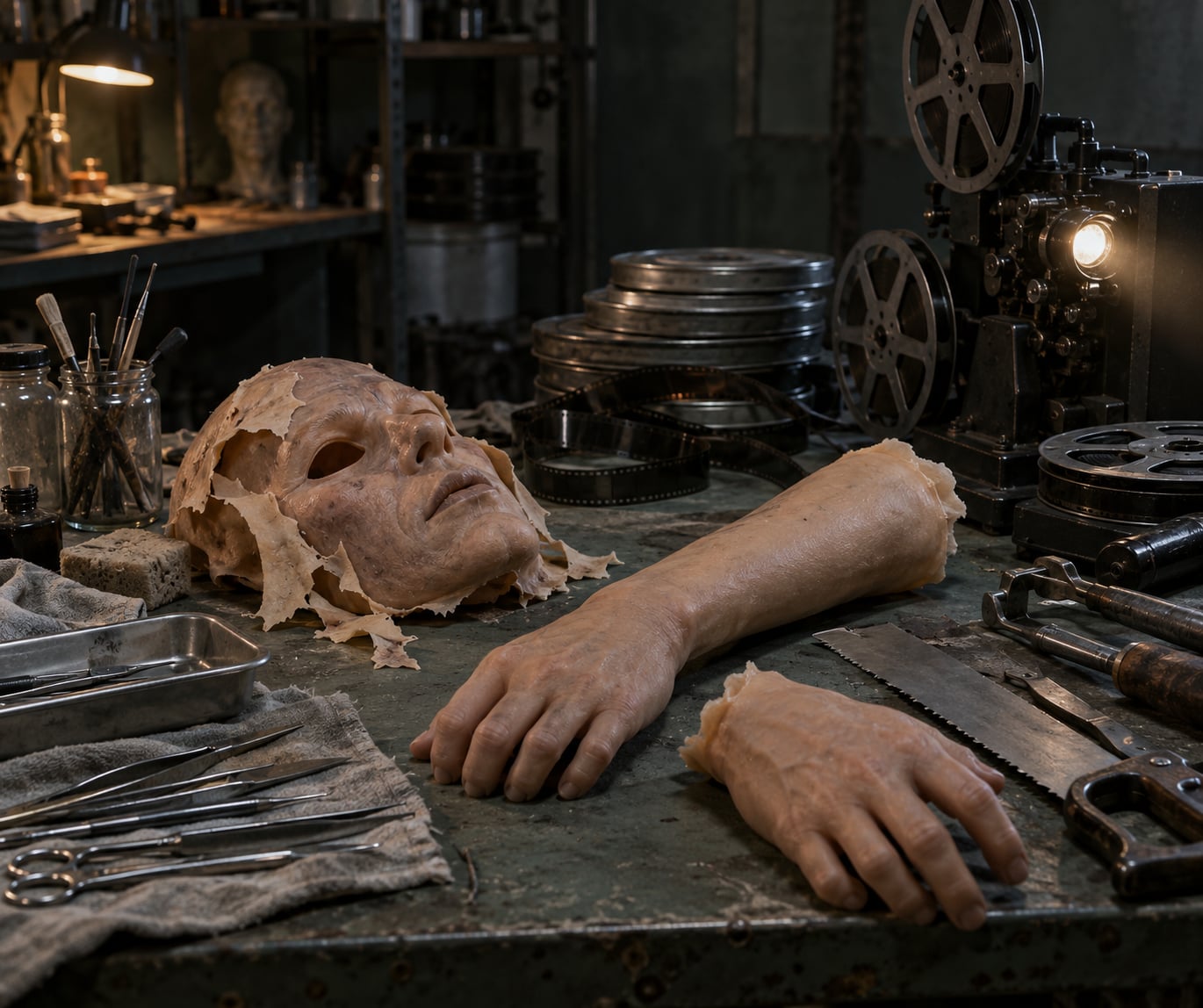
Body horror separated from horror as a whole because someone gave it a name, one filmmaker returned to it with enough consistency to make it recognisable, and a distribution channel carried it to audiences who wanted something stranger than a monster. So how body horror became its own subgenre comes down to a phrase, a body of work and a route to the audience, in that order. The phrase arrived in 1983. The work had been building since 1975.
The story is worth telling properly, because most retellings skip straight to David Cronenberg and act as though The Fly appeared out of nowhere. It did not. Body horror has roots in Gothic novels, German expressionism, 1950s science fiction and the exploitation circuit, and it only crystallised into a category once critics, filmmakers and distributors had all shown up.
Table of Contents
- What Is Body Horror?
- Where Did Body Horror Begin in Cinema?
- A dated timeline of body horror
- How Did Psycho and The Cabinet of Dr. Caligari Change the Genre?
- Why Did Practical Effects Make Body Horror Worse and Better?
- How Did David Cronenberg Define Modern Body Horror?
- How body horror became its own subgenre: the three conditions
- How Did Body Horror Expand Across Film and Television?
- What Makes Body Horror Different from Gore?
- Why Does Body Horror Keep Feeling Relevant?
- Which Films Best Show Body Horror’s Evolution?
- The Cabinet of Dr. Caligari (1920)
- The Quatermass Xperiment (1955)
- Psycho (1960)
- Shivers (1975)
- The Brood (1979)
- The Thing (1982)
- Videodrome (1983)
- The Fly (1986)
- Tetsuo: The Iron Man (1989)
- The Substance (2024)
- Frequently Asked Questions
- What was the first body horror movie?
- Did David Cronenberg invent body horror?
- What is the difference between body horror and gore?
- Why are practical effects often scarier than digital effects in body horror?
- What is the best body horror movie for beginners?
- Conclusion
What Is Body Horror?

Body horror is a subgenre of horror fiction that intentionally showcases grotesque or visceral experiences of the human body, usually through transformation, contamination, surgery or the sudden loss of control over one’s own flesh. It is not the same as violence inflicted on a body from outside. The threat comes from within the body, or from what the body has become.
That single distinction does most of the work. A knife in a dark hallway is a slasher film. The same knife used on an operating table, in a movie where the surgeon’s hands belong to somebody else, is body horror. The audience’s dread is not only what they are seeing, it is what they realise is happening to them, because they also have a body they did not consent to being responsible for.
Four recurring forms show up in almost every film that counts:
- Physical transformation — the body becomes something other, whether through infection, experiment, surgery or slow biological drift.
- Mutilation and the surgical fragment — the body taken apart, divided or rebuilt, often with clinical framing that makes it worse.
- Contamination and infection — something enters the body and spreads, so that the victim becomes the carrier.
- Loss of bodily autonomy — the body keeps moving, speaks or wants things while the person inside it has lost the controls.
Psychologists who study the effect call it abjection, a term borrowed from Julia Kristeva. The discomfort comes from a boundary dissolving: self and other, inside and outside, human and not-human. Horror fans call the on-screen version of it squick, which is a different word but points the same way.
Not everything gruesome qualifies. A film can be extremely violent and still not be body horror, and plenty of people watching will tell you that to this day.
Where Did Body Horror Begin in Cinema?

The written version arrived long before the filmed one. Mary Shelley’s Frankenstein, published in 1818, is built around made flesh doing what its maker wanted: a body assembled from parts that never belonged together. Kafka’s The Metamorphosis, published in German in 1915, goes somewhere different and arguably stranger, since the change is not monstrous but unwanted and irreversible, and the family’s horror is mostly embarrassment.
Film inherited both. German expressionism gave cinema a way to externalise inner states: skewed sets, shadow hands, doubles. What the early studio era added was industrial. The 1930s and 1940s were full of mad doctors, transformed patients and disfigured heroes, mostly because the doctors, the labs and the monsters were cheaper than location shooting and the studios knew an audience would stay for the reveal.
The film usually credited as the first true body horror movie is The Quatermass Xperiment, released in 1955, in which a meteor fragment and a scientist’s experiment turn a man into something no longer fully recognisable as human. The 1950s creature features that followed, including The Blob and the original The Fly, pushed the same idea at drive-ins and matinees, cheap and strange and aimed at teenagers.
A dated timeline of body horror
- 1818 — Mary Shelley publishes Frankenstein, the founding text for made flesh that will not obey.
- 1915 — Kafka’s The Metamorphosis introduces transformation as a matter of shame rather than spectacle.
- 1920 — The Cabinet of Dr. Caligari brings the double and the possessed mind to the screen.
- 1955 — The Quatermass Xperiment, the first film with a complete on-screen transformation arc.
- 1958 — The Fly and The Blob turn body horror into a drive-in staple.
- 1960 — Psycho collapses the ordinary world and the boundary between personality and mask.
- 1967 — Harlan Ellison’s I Have No Mouth, and I Must Scream fuses bodily degradation with identity loss.
- 1975 — Shivers, and the beginning of a sustained body horror programme.
- 1979-1981 — The Brood, Scanners and The Evil Dead push the subgenre toward psychological and sexual territory.
- 1982 — The Thing gives contamination horror a paranoid, ensemble-scale treatment.
- 1983 — Videodrome, and Phillip Brophy names body-horror in Art & Text.
- 1986 — The Fly, the most complete statement of the theme.
- 1987-1989 — Hellraiser, Akira and Tetsuo: The Iron Man widen it beyond one filmmaker and one country.
- 2016-2020 — The Troop, The Rust Maidens and Boy Parts mark the femcore and indie wave.
- 2021-2024 — Titane, Hatching, Poor Things, Infinity Pool, Tiger Stripes, I Saw the TV Glow and The Substance.
- 2025 — The Substance’s Best Picture nomination makes the subgenre a mainstream awards conversation.
Two things are worth noticing about that list. The 1930s and 1940s entries are usually skipped in favour of a 1970s origin story, yet the conventions were already in place decades earlier. And the jump from 1989 to 2016 hides a long period of dormancy that was not really dormancy at all, since the films kept coming in Japan, in Hong Kong, in video games and on television.
How Did Psycho and The Cabinet of Dr. Caligari Change the Genre?
Both films supplied the psychological hardware that later body horror bolts onto flesh. The Cabinet of Dr. Caligari, directed by Robert Wiene and released in 1920, gives the genre three things at once: a double, an authority figure who cannot be trusted, and a reveal that reframes everything you just watched. Norman Bates gets the same three, forty years later, in a motel rather than a carnival.
Psycho, directed by Alfred Hitchcock from a script by Robert Bloch, adds what Caligari lacks, which is the sense that ordinary life is a thin skin over something terrible. A woman drives alone, wants a shower, and finds out that a familiar motel is a trap. The famous scene she never sees is not important to body horror as a spectacle. It is important because Hitchcock taught cinema that an ordinary room can be the beginning of an amputation.
That is the inheritance. Once audiences accepted that people and places could hide a secret self, body horror had somewhere to go. Mutation and infection supply the spectacle; the Caligari and Psycho lineage supplies the dread underneath it.
Why Did Practical Effects Make Body Horror Worse and Better?
The craftspeople behind the subgenre’s best-known images worked with latex, foam, resin, wires and cameras. Tom Savini built and performed the practical work on Dawn of the Dead and made the title figure of The Texas Chain Saw Massacre. Rob Bottin handled effects on The Thing and The Fly, and Steve Johnson wore the Brundlefly suit for the transformation sequence in the 1986 film.
Practical work does two things digital effects struggle to match. It gives the image physical weight, because gravity and mass are real and the camera reacts to them. And it carries texture. Makeup sits on a face, so a crease moves when the actor moves. Digital imagery can be more graphic, but it often reads as a clean surface with an effect painted on it, which is why the most grotesque digital sequences can feel oddly mild.
There was also a commercial push behind it. Body horror films were cheap, aimed at late-night drive-ins and then at the exploitation market, where exhibitors needed material nobody else was screening. The genre grew in the space between the studio system and the censor.
That space narrowed sharply in the 1980s. UK video censorship and the wider Video Nasty panic led to cuts that removed gore outright, while the MPAA ratings system, introduced in 1968, gave distributors a reason to market a film by how explicit it was. The controversy helped the subgenre gain a name and a reputation, and it pushed some of the most graphic material out of the mainstream for years.
How Did David Cronenberg Define Modern Body Horror?
Cronenberg is the reason most people use the phrase body horror the way they do today. He did not invent the idea, but he was the first director to treat the body as the actual subject of a horror film rather than the thing a monster attacks.
Shivers, his 1975 debut, already had the whole pattern: a doctor applies a medical discovery to his own patients, the neighbours go wrong, and the body becomes an unreliable place to live. Rabid followed in 1977 and turned that into a transmission story. The Brood in 1979 put trauma itself in the frame, with children shaped by a grief that has nowhere to go. Scanners in 1981 showed that the mind could be as vulnerable as the flesh, then Videodrome in 1983 pushed furthest, with a television signal that physically restructures who watches it.
That is where the phrase in the film’s most quoted line comes from. Videodrome treats mutation as an upgrade, not a punishment, and its antagonist argues for the new flesh with something close to conviction. Naked Lunch in 1991 pushed the same idea into drug, bureaucracy and sex, with the body dissolved and reassembled as a bureaucratic instrument.
The Fly, in 1986, is the one that most people mean when they name the subgenre. A scientist’s mistake produces a slow, visible, irreversible change, and the film’s closing line makes the theme plain. The horror is not that the man turns into a monster, it is that he turns into something new and cannot go back.
How body horror became its own subgenre: the three conditions
Take any genre apart and you usually find the same three ingredients. Body horror is a clean example, and the order matters.
- A name in circulation. Phillip Brophy used the term body-horror in an essay, Horrality: The Textuality of the Contemporary Horror Film, published in Art & Text in 1983. That single coinage gave critics something sharper than grotesque horror, and a critic with a term will look for films that fit it.
- A consistent body of work. Cronenberg had been making the same film in different costumes since 1975. A motif repeated with intention by one filmmaker reads as a signature, and a signature becomes an author, and an author becomes a category.
- A distribution channel. Exploitation houses, drive-ins, repertory theatres, then home video and finally streaming and festival prestige. Without somewhere to show these films they stay curiosities. With one, an audience forms around them and names itself.
Give a subgenre a name, a repeatable signature and a route to the audience, and you have a subgenre. Everything after 1983, including the twenty-first-century revival, followed from those three conditions being met at roughly the same time.
How Did Body Horror Expand Across Film and Television?
Once Cronenberg proved the ground was open, other filmmakers walked onto it, usually with different preoccupations rather than a copy of his approach. Brian Yuzna and Stuart Gordon built a lineage from the same reanimation idea, giving it comic-book energy and gore that earned the films a place in the Video Nasty lists. Sam Raimi’s The Evil Dead pushed the same infection logic into comedy. Clive Barker’s Hellraiser in 1987 relocated the transaction from a clinic to a puzzle box and opened the subgenre to a much wider audience.
Hong Kong cinema took the surgery strand and ran hard with it. Films such as Mr. Vampire from 1985 use the vampire as a delivery mechanism for body reassembly, with effects built on practical work and a pace closer to martial arts than to Gothic. Japanese cinema took the contamination and mutation strand, with Katsuhiro Otomo’s Akira in 1988 and Shinya Tsukamoto’s Tetsuo: The Iron Man in 1989 turning the body into a site of grotesque, accelerating change.
Manga gave it a long second life. Junji Ito in particular has supplied more body horror story material than almost any single film director, working in a form where the impossible anatomy has to survive translation into ink and panel.
Television and games carried the motif furthest without calling it that. Television episodes in the 1990s and 2000s used infection and mutilation as shorthand for danger in exactly the way Cronenberg’s generation used lab accidents. Games built a whole lineage on it, where the infected or transformed body is the mechanic as well as the threat, and survival horror inherits that grammar directly.
The through-line is worth naming, because it is the answer to why this subgenre travels so well. A body that will not obey is a portable story engine. It works in any genre, any medium and any setting, which is why you can find it in a slasher film, an anime and a video game with almost no change to the underlying idea.
What Makes Body Horror Different from Gore?
This is the question readers ask most often, and the forum threads asking it are only a small sample of how often. The short version: gore is what happens to the body, body horror is what happens to the body’s control, identity or wholeness. You can have one without the other in either direction.
| Subgenre | Where the fear lands | Source of the threat | Example |
|---|---|---|---|
| Body horror | On the body as the subject | Transformation, contamination or loss of autonomy | The Fly |
| Gore and splatter | On impact and injury | Something external doing the damage | Evil Dead II |
| Slasher violence | On the threat itself | A pursuer with a weapon | Halloween |
| Torture horror | On suffering, sustained | Capture and coercion | Hostel |
| Zombie horror | On the social order | A crowd that used to be people | Night of the Living Dead |
| Medical horror | On institutional trust | The people in charge of the body | The Fly, in part |
The practical test works like this. If the body could stay whole and the story would still work, you are probably watching gore. If the body has to break, change or stop belonging to its owner for the story to exist at all, you are watching body horror.
Why Does Body Horror Keep Feeling Relevant?
The imagery is from the 1970s, but the anxieties underneath it keep refreshing, and the same mechanism that made it matter then makes it matter now. Every decade hands the subgenre a new technology to be anxious about, and the technology is rarely the point.
Medicine and medical overreach. The laboratory is the oldest engine of this genre, and it maps directly onto current anxieties about who makes decisions about our bodies and how much authority they are given. Clinical framing is what turns a transformation scene into dread instead of spectacle, because the calm professional handling a ruined body is the part nobody wants to watch.
Technology and the self. The films from Videodrome onward keep asking whether a device that alters perception can alter the person perceiving. That question is older than smartphones but lands differently now.
Reproductive and bodily autonomy. Pregnancies, fertility treatment and the surveillance of bodies are recurring sources of contemporary body horror, and so is the fear of being unable to decide what happens to one’s own body.
Ageing and appearance standards. The 2020s wave has made this unusually visible. Beauty standards, filtered images and the commercial pressure to keep looking a certain way are exactly the material the subgenre handles best.
Barbara Creed’s The Monstrous-Feminine, published in 1986, gave critics the sharpest tool for reading all of this. Creed argued that the threatening female body in horror films has always encoded anxieties about real female experience, and that the film is often criticising the prejudice it is using to scare you. That reading is now standard, and it explains something the older accounts miss: the current revival is led overwhelmingly by women and queer directors who spent years outside commercial filmmaking.
Julia Ducournau’s Titane, Coralie Fargeat’s The Substance and Rose Glass’s Saint Maud are not Cronenberg imitations. They are working from the same concerns with different hands, and the femcore literary wave that put A. K. Blakemore, Elliza Clark and others into print is the same shift in paper form. The Substance’s Best Picture nomination in 2025 was the moment the subgenre stopped being a festival speciality and became a mainstream awards conversation.
Which Films Best Show Body Horror’s Evolution?
Ten films, in order, each chosen because it changed something rather than because it is the most unpleasant to watch. Intensity notes are rough guides, not warnings, and everyone reads this differently.
The Cabinet of Dr. Caligari (1920)
The doubles and the possession, silent and black and white. Nearly a century before the subgenre had a name it supplied the psychology: the person you trust is not the person you see.
The Quatermass Xperiment (1955)
The first film where the transformation completes on screen. Slow, talky British science fiction by modern standards, and the reason the rest of the list exists.
Psycho (1960)
No transformation, no creature, and still foundational. It teaches that ordinary settings can be traps, which every later body horror film is leaning on.
Shivers (1975)
Cronenberg’s debut and the beginning of the sustained programme. Low-budget, strange, and much funnier than most people expect from the label.
The Brood (1979)
Trauma given a body. Useful for seeing that the subgenre was never only about gore, since the horror here is grief with an appetite.
The Thing (1982)
Contamination paranoia at its coldest, with the best practical effects of the period. Sets the template for distrusting everyone in the room.
Videodrome (1983)
The intellectual centre of the Cronenberg work, and the film that most directly argues for the new flesh. Slower and more abstract than the others, and the one people misjudge.
The Fly (1986)
The single best entry point. A clear arc, a body you watch change over two hours, effects that hold up, and a theme stated out loud at the end. If you watch one film from this list, watch this one.
Tetsuo: The Iron Man (1989)
Shinya Tsukamoto’s fusion of body horror, mechanics and metal, made on a small budget in a rush. A different national tradition working the same problem.
The Substance (2024)
The mainstream breakthrough, and the clearest recent argument that the subgenre is about ageing, desirability and being told what to do with a body. Difficult in places, and worth the effort.
Frequently Asked Questions
What was the first body horror movie?
The usual answer is The Quatermass Xperiment from 1955, the first film to show a complete on-screen transformation from human being to something else. Earlier films have elements, including The Cabinet of Dr. Caligari in 1920, but no sustained arc. If you mean literature rather than film, Mary Shelley’s Frankenstein from 1818 is the founding text and has no real competitor for the slot.
Did David Cronenberg invent body horror?
No. Body horror has roots in Frankenstein, Kafka, expressionism and 1950s science fiction, all of which predate him. What Cronenberg did was consolidate it. From Shivers in 1975 to The Fly in 1986 he kept returning to the same subjects with enough consistency that critics needed a word for the pattern, and that word turned a collection of films into a subgenre.
What is the difference between body horror and gore?
Gore is injury: the visual impact of a body being damaged from outside. Body horror is the body as the subject of the film, where transformation, contamination or the loss of control over your own flesh is the point. A film can be soaked in gore and not be body horror. The test is simple: if the body could stay whole and the story would still work, it is gore, not body horror.
Why are practical effects often scarier than digital effects in body horror?
Practical prosthetics have weight and texture. Makeup moves with the actor’s face, objects obey gravity, and the camera reacts to something physically present in the room. Digital imagery can push further but often reads as a clean surface with an effect sitting on it. The knowledge that a real suit was made by someone also adds a layer the audience usually feels without being able to name.
What is the best body horror movie for beginners?
Start with The Fly from 1986. It has a plain shape: one man, one mistake, one visible change over two hours. You do not need to know any genre history to follow it, and the effects still hold up decades later. If you would rather begin with less graphic material, watch Psycho in 1960 first and treat The Fly as the sequel in spirit.
Conclusion
Body horror grew out of older Gothic and exploitation traditions before practical-effects cinema gave it images worth remembering, before Psycho and Caligari gave it its psychology, and before Cronenberg turned it into a deliberate language for mutation, technology and identity. It became a subgenre when three things lined up: a name in 1983, a decade of consistent work behind it, and a distribution channel that kept finding willing audiences. Start with The Fly from 1986, then work backwards to Shivers and forwards to The Substance. That is how body horror became its own subgenre, and it is still going.