You spot a good indie horror movie by checking the credits, the runtime against the premise, and the pattern of what critics say rather than whether they liked it. Spend five minutes on that and you can usually tell within a minute of pressing play whether the evening is going to pay off.
Indie horror has never been easier to find and never been harder to filter. Recommendation feeds push the same quiet domestic dread over and over, and the aggregator scores attached to tiny titles are almost meaningless. So I built a process instead: seven checks that separate a cheap film made on purpose from a cheap film that just is what it is.
It takes about five minutes and works on any film, festival darling or streaming dump. Here’s the order I’d go in.
Table of Contents
- What You Need
- Step-by-Step
- Check Whether the Concept Fits the Runtime
- How to Spot a Good Indie Horror Movie Through Its Credits
- Look for Intentional Production Choices
- Read Reviews for Specific Patterns
- Check the Film’s Festival and Distribution History
- Watch Beyond the Marketing
- Make a Quick Value Judgment
- Common Mistakes
- Quick Tips for Horror Movie Night
- Frequently Asked Questions
- What is a good budget for an independent horror movie?
- How can I judge an indie horror film when cast reviews are scarce?
- Does winning a film festival award mean a horror movie is good?
- Why can a horror movie’s trailer be confusing even when the film works?
- How much should I trust audience ratings for unknown horror movies?
- Conclusion: Start With the Credits and Concept
What You Need
Gather these before you start, because half of the vet happens before you press play.
- Trailer access. The theatrical trailer or the full first minute. YouTube and the film’s own page will almost always have one.
- Synopsis and credit information. The distributor’s listing or the festival program page usually names the writer-director, producers and cinematographer.
- Cast and crew backgrounds. Enough to know whether this is a first feature or a director with a track record.
- Runtime and format. The exact running time, plus whether it is found footage, animation, a documentary-style frame, or shot in a single location.
- Festival or distribution history. Where it premiered, whether anyone acquired it, and how wide the release was.
- Several current reviews. Three to five from different outlets, plus whatever discussion exists on Letterboxd or a horror community.
Step-by-Step
Seven checks, in this order. The first three take about ninety seconds total and eliminate most of the duds.
Check Whether the Concept Fits the Runtime
A film’s running time is the fastest honest clue about its story. A ninety-minute runtime with one location, four characters and a single rule about the monster leaves no room for subplots, and that’s fine, because that constraint usually shows in the writing.
What kills you is a mismatch. A two-hour-and-twelve-minute runtime advertised as a lean slow burn usually means subplots nobody asked for. Under eighty minutes with a high-concept premise is usually tight and deliberate. Read the synopsis and count how many things have to happen, then compare that to the number listed.
Skip the film if the math doesn’t work. It’s the cheapest screen you’ll ever run.
How to Spot a Good Indie Horror Movie Through Its Credits
This is the signal most people skip, and it’s the one that carries the most weight. Read the opening credits or the distributor’s page and ask a simple question: is this team being run by someone who knows the job?
- Writer-director with previous work. A second or third feature, or a solid festival history, tells you the person can finish a script. A first-timer can still deliver, but you discount slightly.
- Cinematographer and editor with credits. If the same DP shot something you liked before, the visual language is probably intentional.
- A named sound designer or sound mixer. Sound design is the most praised craft in this genre and the cheapest place to fake excellence. No sound credit often means nobody was in charge of it.
- Small and continuous crew. A tight unit that has worked together before is a good sign. A crew that changes halfway through a film is not.
One more tell worth knowing: the soundtrack. One indie horror blog put it plainly, the fastest way to tell indie from mainstream is the soundtrack. Original score or silence usually means independent. Licensed pop hits mean a label had money.
Look for Intentional Production Choices
Now separate what the budget couldn’t buy from what it couldn’t excuse. Look at the trailer for framing, lighting, sound and effects, and ask whether each limitation reads as a choice.
Night-for-night lighting you can barely see in a house with no windows is a decision, and it builds dread. Grainy 16mm texture is a decision. Creatures built from practical materials that catch light badly are a decision. A flat grey grade, muddy audio, and a monster that vanishes during its own attack scene are not. Constraint and incompetence look different once you know what to look for.
The test I use: could this exact limitation be used as a scare? If yes, it’s craft. If no, it’s a budget line item.
Read Reviews for Specific Patterns
Skip the star rating and read the sentences. Three or four reviews that keep describing the same thing are telling you the truth about the film.
When reviewers repeatedly praise atmosphere, sound design, pacing and performances, you’re looking at a film where the craft landed. When they keep returning to originality, subversion or whether the third act earns its ending, be careful. Those same words can mean a film found its own idea, or that it borrowed every beat from the last three things you watched.
A one-line rave is nearly worthless. On the Blu-ray.com forum, someone recommended a film because it thrives on ambiguity, which told me far more about the experience than any star count would have.
Check the Film’s Festival and Distribution History
Festival history is the closest thing indie horror has to a paper trail. A premiere at a major festival means somebody with programming judgement watched it start to finish. An acquisition by a distributor such as Shudder or A24 means somebody put money behind it after that.
Laurels on the poster are weak evidence on their own, since any festival will accept any film. A limited theatrical run followed by a streaming drop is a stronger signal than an instant dump with no dates attached, and a film that has been sitting unreleased for years is worth a question rather than a purchase.
Unresolved distribution cuts both ways. Sometimes it means the market wasn’t ready, sometimes it means nobody could sell it.
Watch Beyond the Marketing
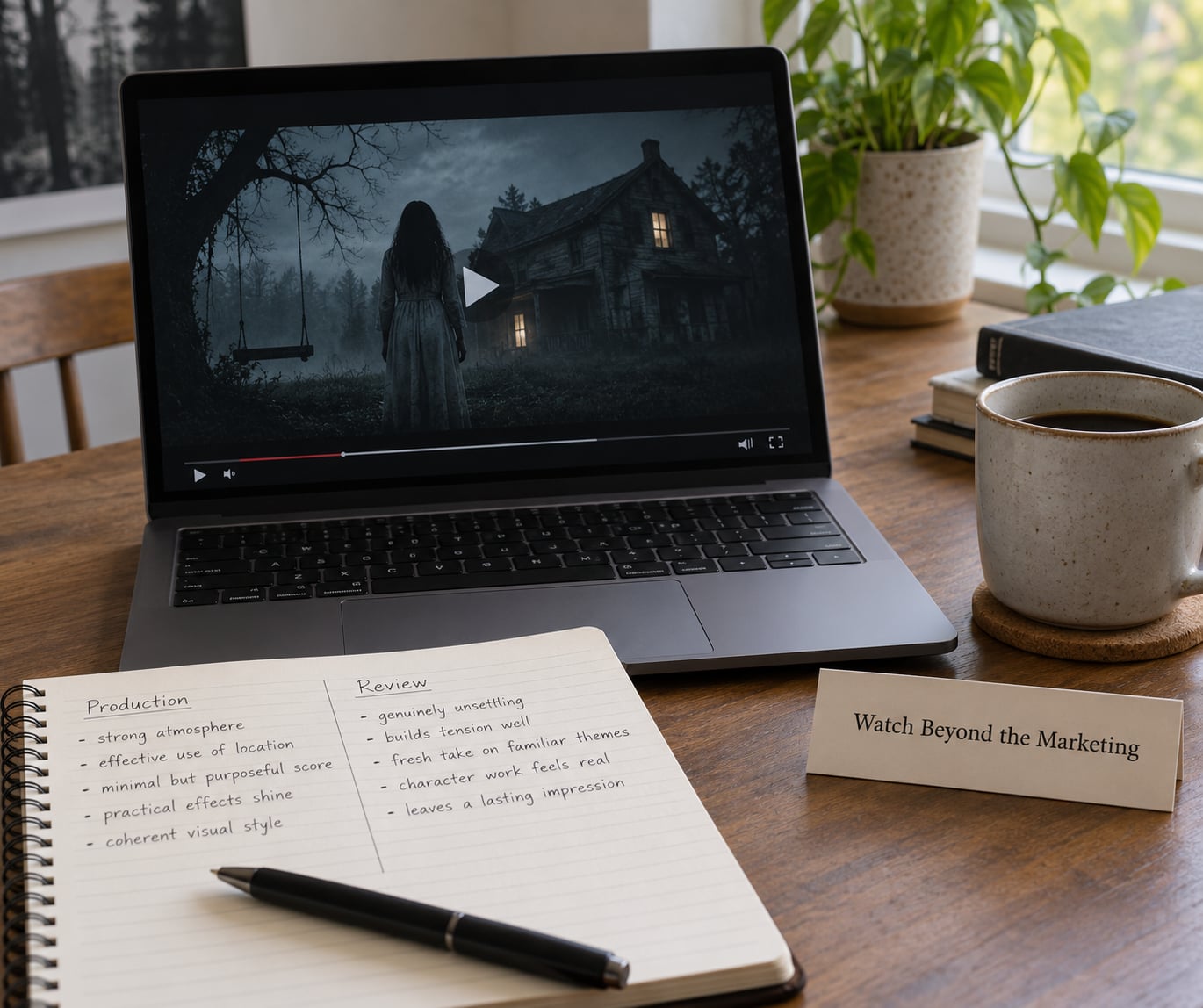
Marketing trailers for horror are built to hide the film, so look for something longer. A director’s introduction, a Q and A clip, a press screener, or even the opening ten minutes will tell you more than two minutes of stinger-heavy advertising.
What to watch for in those first minutes: how long it takes to establish a person and a place, whether the sound mix is doing work when nothing scary is happening, and whether the film repeats an idea or keeps introducing new ones. A slow open is fine. An empty open, where nothing has been established and nothing is at stake, usually means the script is thin.
Make a Quick Value Judgment
Weigh six things and decide. Premise strength, execution signals from the credits and trailer, fit with the subgenre you actually want, runtime against your evening, availability, and what it will cost you to watch.
Then pick one of three answers rather than sitting on the fence. Watch it, shortlist it for a specific mood, or skip it. Films that need a coin flip on all six usually score in the middle on all six, and middle-of-the-road horror is rarely worth an evening.
Common Mistakes
- Treating a small budget as proof of bad quality. Community consensus is blunt about this: a microbudget film can beat a studio production outright. Judge craft, not spend.
- Judging on star power. A cast of names you recognise is the most reliable sign of a film that put its budget on faces instead of atmosphere.
- Trusting one review. One enthusiastic write-up is usually a writer who liked the trailer. One scathing one is usually a writer who wanted a review.
- Confusing ambiguity with an unfinished script. An ambiguous ending answers the question it raised. A missing ending just stops. The difference shows up in whether the questions the film opens actually resolve into something.
- Treating festival buzz as quality. Awards mean the film made someone feel something once. That’s worth a look, not a commitment.
Quick Tips for Horror Movie Night
- Match the film to the time you have. Under ninety minutes changes what’s possible, so pick a shorter runtime when your evening is short.
- Check content notes first if you’re watching with guests or a non-horror friend.
- Pick a familiar subgenre. Found footage, folk horror, analog horror, body horror, possession, slow burn. Knowing the label tells you what you’re agreeing to.
- Start low-risk. For someone who doesn’t consider themselves a horror person, psychological horror and slow burns are the usual entry point, and word of mouth on those labels is remarkably consistent.
- Keep a second film ready. Two vetted candidates beat one, because the alternative to a dud is silence.
Frequently Asked Questions
What is a good budget for an independent horror movie?
There is no magic number, and the honest answer is that budget predicts almost nothing. Films made for a few thousand dollars are regularly praised for sound design and atmosphere, while expensive ones arrive with cheap-looking effects and thin sound. What budget does buy you is location access, stunt work and effects polish. Judge the line items you can see on screen instead: framing, sound mix, creature design, editing rhythm. A tight budget becomes a problem when the script also has no idea what it is doing.
How can I judge an indie horror film when cast reviews are scarce?
Stop looking for cast opinion and look for craft criticism instead. Search reviews for words like sound design, atmosphere, pacing, editing and practical effects, and for criticism of acting. Independent films rarely have large casts, so coverage focuses on construction rather than performances. The credits matter more here than they do anywhere else, because a writer-director with a real track record tells you more than a familiar face with nothing behind them.
Does winning a film festival award mean a horror movie is good?
Not by itself. An award means the film registered strongly for a programmer or jury in a specific year, often at a festival where many entries were uneven. Laurels on a poster are cheap to obtain and prove very little. A major festival premiere plus an acquisition by a distributor such as Shudder or A24 is a much stronger combination, since it means two separate groups of people committed to the film. Treat awards as permission to try it, not a verdict.
Why can a horror movie’s trailer be confusing even when the film works?
Because the trailer is a different job. Horror trailers usually sell the premise and suppress the tone, cutting out the slow stretches where the film actually builds its dread. What looks like a non sequitur in a trailer is often the setup for something that pays off an hour later. Watch a director introduction or a press clip instead of a marketing cut, since those keep the film’s real rhythm and are far better for judging it.
How much should I trust audience ratings for unknown horror movies?
Use them as a filter, never as a verdict. A high score on a small number of reviews mostly reflects early-adopter enthusiasm, and a low score on a few dozen ratings can mean a rough festival cut rather than the released film. The useful part of an aggregator is the pattern: if critics and viewers converge on the same words about atmosphere, pacing or the ending, that’s a real signal. Ignore the exact number until a title has a few hundred reviews behind it.
Conclusion: Start With the Credits and Concept
Good indie horror is a small production doing a specific thing on purpose. You can usually see that in the credits, hear it in the sound mix, and confirm it in the pattern of what several reviewers say instead of what one reviewer scored.
So do this first. Open the listing, check the runtime against the synopsis, and read the top credits. Then watch something longer than the trailer and compare what you see with the specific words critics keep repeating. Ninety seconds of that saves you an evening, which is the whole point of learning how to spot a good indie horror movie before you spend it.