To find horror movies for people who hate jump scares, filter by subgenre first (slow burn, atmospheric, folk, cosmic), then confirm each title with a jump-scare warning source, a trailer screening, and reviews that specifically mention startling moments. You end up with a shortlist of films built on sustained dread instead of a string of cheap reveals.
It takes about fifteen minutes of research per film, and the whole method works on a laptop before you commit an evening to it. Jump scares are a stylistic choice rather than a measure of quality, which is why the most-recommended films in this genre run from Rosemary’s Baby in 1968 all the way to recent titles.
Forum threads on r/horror keep circling the same complaint. Someone asks for scary movies that lean on story and suspense, and the replies describe jump scares as a cheap trick with no follow-up behind it. The complaint is rarely that the film was too frightening. It is that the film was too empty.
Table of Contents
- What You Need to Find Horror Movies for People Who Hate Jump Scares
- A way to watch films
- A warning or review source
- A written note of what you tolerate
- A place to track candidates
- Step-by-Step
- Use Search Filters to Find Horror Movies for People Who Hate Jump Scares
- Choose Horror Subgenres That Match Your Scare Limit
- Check Warnings Without Spoiling the Story
- Screen Trailers by Abrupt Sound and Images
- Compare Multiple Audience Experiences
- Make a Low-Risk Watchlist and Test the Best Match
- Common Mistakes
- Frequently Asked Questions
- What horror subgenres usually have the fewest jump scares?
- Are psychological horror movies better for viewers who hate jump scares?
- How can I tell whether a horror movie has many jump scares before watching it?
- Does horror without jump scares still count as scary?
- Should I watch horror trailers if I am sensitive to sudden scares?
- Can content-warning labels accurately predict a movie’s jump scares?
- Conclusion
What You Need to Find Horror Movies for People Who Hate Jump Scares
Four things, and none of them cost money. You need access to a movie streaming or purchasing service, somewhere to read reviews or warnings, and about ten minutes of honesty about your own limits.
A way to watch films
Any subscription or rental service works. The specific platform matters far less than the habit of checking current availability, because films rotate between services constantly and old recommendation lists go stale fast.
A warning or review source
Community jump-scare databases, parent guides, and audience review threads all work here. I like a jump-scare count database for a quick verdict, then a review thread for the texture of the answer, since a number never tells you whether the one scare lands in the first ten minutes or the finale.
A written note of what you tolerate
This is the step people skip, and it is the one that matters. Write down three lines: what you can handle, what you cannot, and what you simply dislike.
A place to track candidates
A notes app is plenty. You are keeping a title, a jump-scare level, and a one-line verdict, and later you will be comparing three films side by side.
Step-by-Step
Use Search Filters to Find Horror Movies for People Who Hate Jump Scares
Combine a subgenre term with an intensity phrase rather than searching for a generic best-of list. Searching slow burn horror no jump scares pulls a completely different result set than searching best horror movies of all time, and the second one is dominated by franchises built on startling you.
Phrases worth typing: minimal jump scares, atmospheric horror, psychological suspense, slow burn, dread not gore, and unsettling rather than startling. Adding no jump scares as an exact phrase filters out the noisy results fastest.
You will know this step worked when your search results read like descriptions of tension rather than descriptions of a monster jumping at the camera.
Choose Horror Subgenres That Match Your Scare Limit
Match the subgenre to the person in the room, not to your own tolerance. Subgenre labels are clues rather than guarantees, but they shift the odds heavily in your favor.
- Slow-burn horror escalates tension across the full runtime, so there is rarely a spare moment for a cheap reveal.
- Atmospheric horror builds fear from setting and sound design, which is exactly the material a jump scare interrupts.
- Psychological suspense keeps the threat uncertain and often leaves it mostly off-screen.
- Folk horror leans on ritual and dread, usually in daylight settings that make a startle feel out of place.
- Cosmic horror works by making the viewer feel small, which is a mood rather than a shock.
- Creature features vary widely, so screen these individually rather than trusting the label.
Single-location films deserve their own note. A film staged in one small space removes the room a jump scare needs, and r/MovieSuggestions threads repeatedly favor that kind of setup, from a coffin to a house.
Check Warnings Without Spoiling the Story
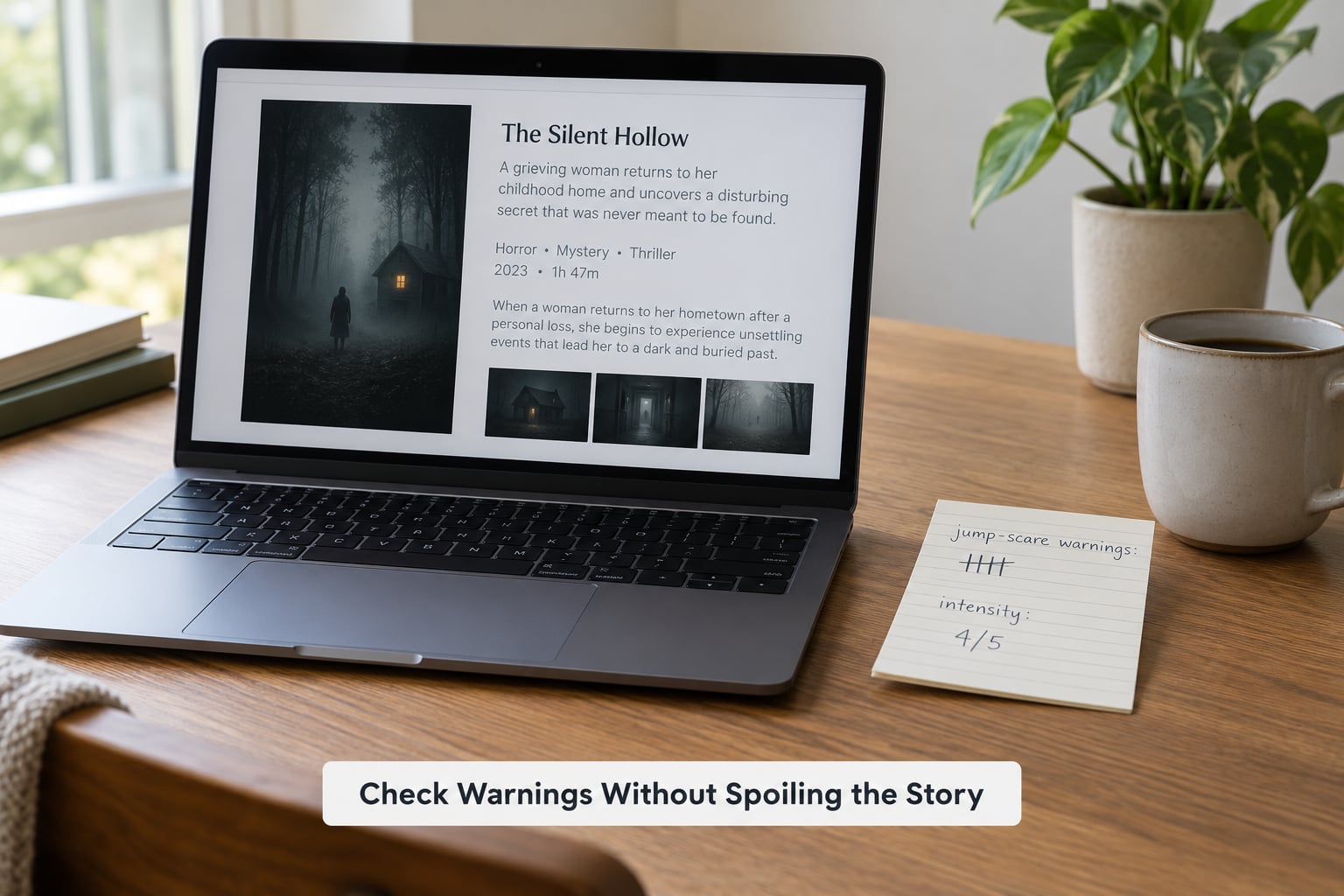
Warning sites are where you learn whether a film has one shock or forty. Look for three separate things: a jump-scare count if one is published, a trigger-warning entry that names loud or startling content, and a short audience note describing where the shocks fall.
Counts deserve skepticism. They come from volunteers, so a number is a rough signal rather than a measurement. Two independent sources agreeing matters far more than one precise figure, and a source with no data at all is a gap worth filling from reviews instead of guessing at.
If you cannot find any warning data for a film, treat it as unknown rather than safe. Unknown is the expensive case, because it is the one where you end up covering your eyes.
Screen Trailers by Abrupt Sound and Images
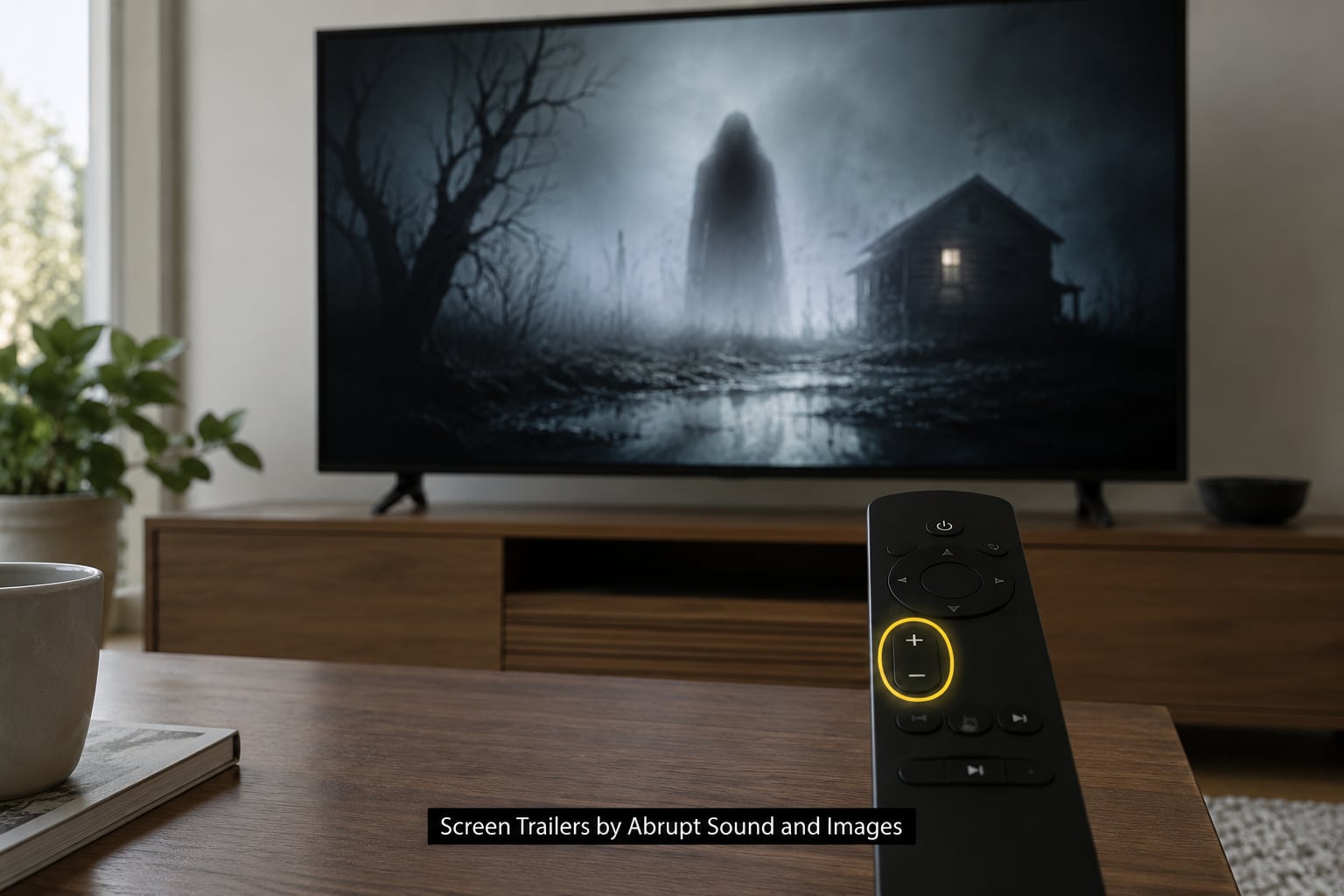
Watch the trailer once at normal volume, which is how it would play in your living room. Do not raise the volume for impact and do not skip forward. You are listening for an abrupt noise in an otherwise quiet stretch, a sudden flash or fast cut, and a threat revealed after a beat of silence.
Those three things are the trailer equivalent of a jump scare. A trailer that depends on a single shocking image tells you the film spends its best moment in the promotion, which is a bad sign for the runtime.
If a trailer spikes your startle response, skip it and rely on written descriptions instead. That is a completely reasonable trade, and several people in the r/horror threads say the trailer scaring them was worse than the film ever would have.
You will know this step worked when you can describe the film’s tone in one sentence without describing an image.
Compare Multiple Audience Experiences
General reviews tell you whether a film is good. They rarely tell you whether it will startle you. So read a mix: two broad audience sources and one source written by viewers who specifically avoid jump scares.
Search inside the reviews for specific sentences about sound, pacing, and whether the shocks interrupt the story. Concrete reporting beats adjectives, so a comment noting that the score does the work tells you more than one calling a film atmospheric.
Where the accounts disagree, look at what they disagree about. Reviewers who differ on quality but agree that a film has one scare at the halfway mark have given you a usable answer, and that shared detail is more valuable than any single rating.
Forum recommendations carry extra weight when the reasoning is specific. Lake Mungo gets praised across r/horror threads for its buildup rather than its shocks, and Funny Games gets recommended for being disturbing without being startling, which are two very different kinds of recommendation.
Make a Low-Risk Watchlist and Test the Best Match
Shortlist three films at three different intensities, then pick the gentlest one as your first test. A low-risk first watch tells you what you actually tolerate, which no review can do for you.
There is one important distinction to carry into that first pick. Hating jump scares and disliking gore are separate objections, and the forum evidence is clear that plenty of viewers happily sit through bloody films as long as nothing ambushes their ears. Saw and Misery are the standard examples of bloody but not startling.
After the first watch, decide with a rule rather than a feeling. If it worked, stay in the subgenre and look for a director with a similar approach. If it did not, you now know whether your limit is sound, gore, pacing, or subject matter, and each of those points at a different lane.
That last point is why the search matters more than the recommendation. Knowing which thing ruins horror for you is the thing you take to every other film you consider.
Common Mistakes
Treating all horror as jump-scare horror. Horror has dozens of subgenres and startling is only one technique inside a few of them. The fix is simple: search by subgenre first and treat jump-scary mainstream titles as a category you are filtering out.
Trusting a single review. One person reacting badly to a sound effect tells you almost nothing about the film. The fix is to require two independent reports on startling content before you commit an evening.
Confusing gore with fear. Blood and startling come from completely different mechanics, and this mix-up is the most common mistake in jump-scare-avoidance guides. The fix is to rate the two separately for every film on your list.
Assuming a supernatural film is automatically safe. Ghost stories can be louder and more aggressive than any slasher. The fix is to check warnings per film, never per category.
Choosing a film because its trailer looked frightening. A startling trailer usually signals a film that leans on startling moments. The fix is to weight tone descriptions and written reviews above trailer reactions.
Trusting a stale streaming list. Where a film sits changes constantly, and a two-year-old recommendation pointing at a specific service is often wrong. The fix is to search by title where you watch rather than by service name.
Frequently Asked Questions
What horror subgenres usually have the fewest jump scares?
Slow-burn horror and atmospheric horror are the safest bets, because both build fear from pacing, setting, and sound design rather than sudden reveals. Psychological suspense, folk horror, and cosmic horror are usually gentle too. Creature features and found footage vary more film by film, so screening and warning checks matter more in those lanes.
Are psychological horror movies better for viewers who hate jump scares?
Usually, yes. Psychological horror keeps the threat uncertain and often leaves it off-screen, so tension carries the runtime instead of individual reveals. The trade-off is patience: these films rely on slow escalation, and viewers who want a scare every ten minutes tend to rate them as boring rather than scary.
How can I tell whether a horror movie has many jump scares before watching it?
Check a jump-scare database, a trigger-warning page, and one audience thread, then compare the three. Look for whether reports describe a single shock or repeated loud moments, and where those moments fall in the runtime. If two sources agree and a third has no data, treat the film as unverified rather than safe.
Does horror without jump scares still count as scary?
It does, and most horror fans would argue it is scarier in the way that stays with you. Films like Rosemary’s Baby, The Shining, and Hereditary are regularly called the most frightening films ever made, and none of them depend on startling the audience. The fear shows up as dread and reflection rather than a spike of adrenaline.
Should I watch horror trailers if I am sensitive to sudden scares?
Only if you can watch at normal volume without flinching, and honestly, sometimes skipping them is fine. Trailers are edited to sell the film in seconds, so a shocking image in one often means the film spends its sharpest moment on the promotion. Written reviews and tagged warning pages carry the same information without the audio.
Can content-warning labels accurately predict a movie’s jump scares?
They are directionally useful and never exact. Warning labels are written by viewers or parents, so they catch loud audio, flashing images, and sudden reveals reliably, but they will not tell you how many there are or where they land. Always pair a label with a jump-scare count and an audience thread before you commit.
Conclusion
To find horror movies for people who hate jump scares, start inside one low-scare subgenre instead of a generic best-of list, read two independent audience reports that name the startling moments, screen the trailer once at normal volume, and put the gentlest of your three shortlisted films on first.
Rosemary’s Baby is the answer most threads come back to, and it is a fair benchmark: no tricks, no sudden noises, and an ending that stays in your head for days. The method matters more than the title, though, because it tells you which films suit you rather than which films the internet likes.