
If you have been wondering how to start a horror book club, the honest answer is that it takes less work than most people expect: pick a format, invite five to ten readers, and choose one short, accessible horror novel as the first read. Plan the first two meetings, agree on spoiler and content-warning rules, and the group runs itself from there. About an hour of setup is enough.
What makes a horror club different from a general reading group is that the reading material comes with two extra jobs. Horror spans a very wide range of intensity, from gentle haunted-house stories to novels that are genuinely unpleasant, so the group needs a way to talk about that out loud before the first pick is made. And horror readers care deeply about pacing and spoilers more than most, because the whole point is being unsettled together.
This guide walks through the whole thing in six steps, updated for 2026, with a venue breakdown, a first-meeting agenda you can copy, and answers to the questions organizers actually ask.
Table of Contents
- What You Need
- Step-by-Step: How to Start a Horror Book Club
- 1. Define the Club’s Purpose and Format
- 2. Find Members and Set Expectations
- 3. Choose the First Horror Book
- 4. Create a Simple Reading Schedule
- 5. Plan an Enjoyable First Meeting
- 6. Keep the Club Growing
- Common Mistakes
- Frequently Asked Questions
- How many people should be in a horror book club?
- Can a horror book club meet online instead of in person?
- How do you choose books for a horror book club?
- How should a horror book club handle spoilers and content warnings?
- How long should each horror book club meeting last?
- What should you do if members stop attending regularly?
- Conclusion
What You Need
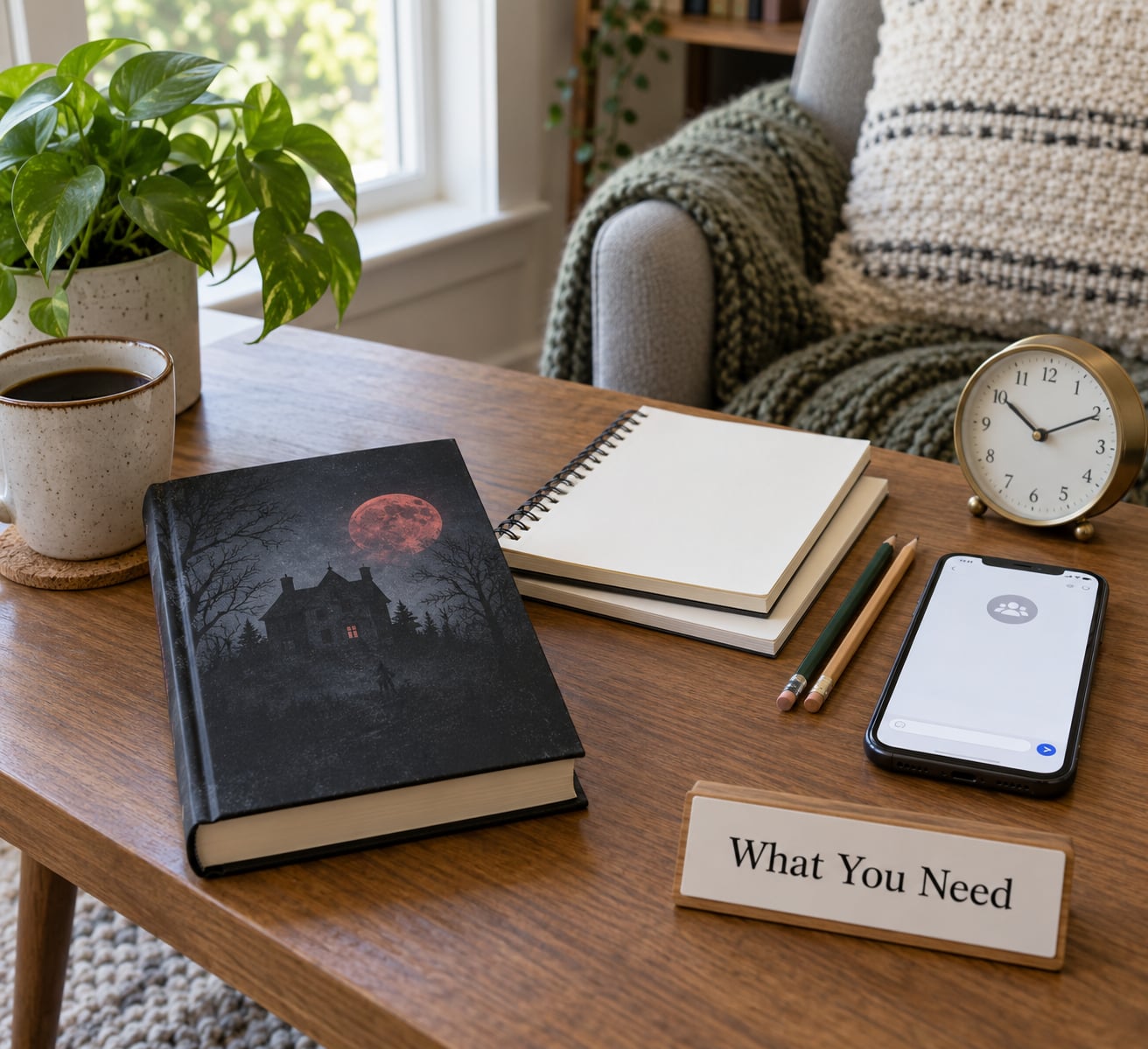
You need far less than you think. Nobody buys a club kit, and no member needs to prepare anything beyond finishing the book.
- A group chat or thread. A group text, a Discord server, a private Facebook group, or even a shared document works. This is where dates go, questions get asked, and people say something embarrassing at 2am.
- A shared reading schedule. One line that says which book, which date we discuss it, and any deadline. Put it at the top of the chat so nobody has to dig.
- A way to collect feedback. A three-question poll at the end of each meeting is plenty: best line, worst line, would you read the next one.
- Optional discussion prompts. Three or four questions prepared in advance save the host from carrying a silent room.
- A meeting format. Decide early whether you meet in person, online, or both, and how long it runs.
On the member side, the requirement is small: buy or borrow the book, read it, show up. Everything else can be learned by the group as it goes.
Step-by-Step: How to Start a Horror Book Club

The process below works for a group of friends, a Discord server, a library branch, or a workplace lunch-and-learn. Six parts, in this order, and each one builds on the last.
1. Define the Club’s Purpose and Format
Decide what kind of club you are running before you invite anyone, because it determines everything else. The four common shapes are a discussion-first club focused on writing craft and close reading, a recommendations club trading titles and talking lightly, a social club where the book is a reason to gather, or a hybrid that does most of the first three in one meeting.
Format comes next. In-person rooms have atmosphere, and horror benefits from it. Online groups reach people who cannot easily host, and they work better than people expect if you add one video call per month. Hybrid splits the difference but adds friction, so pick two and commit.
Then set size, cadence and tone. Six to ten people is the sweet spot: enough voices to fill a room, few enough that everyone speaks. Monthly on a fixed calendar date beats weekly, because horror novels are long and members have lives. Informal beats formal, because nobody signed up to attend a seminar.
2. Find Members and Set Expectations
Recruit in layers. Start with the five or six people you already know will finish a book, then invite two more from the outer edge of your circle. Horror clubs grow fastest through a specific person rather than a general call, so ask your early members to bring one friend each.
Set expectations before the first meeting, in writing, where people can reread them. Five things belong in that message:
- The recurring date and time, repeated every month.
- Reading progress. Nobody is shamed for being a few chapters behind.
- Spoiler boundaries, spelled out in specific terms.
- Content warnings, read aloud before discussion begins.
- A simple code of conduct, including what happens when someone is not shamed into participating.
Leave a door open for newcomers. Group clubs that lock the roster after month one tend to shrink, so keep a standing invitation and tell members that joining mid-year is normal. A line like bring-a-friend, always welcome is enough.
3. Choose the First Horror Book
The first pick sets the tone for everything after it, so choose for accessibility and discussion, not for scariness. Under 300 pages is the sweet spot: long enough to have real structure, short enough that busy people finish it. Avoid doorstoppers and novellas for the opener unless the group is small and committed.
Check the actual texture of the book, not just its reputation. Members can tell within ten pages whether a haunting is clearly explained or left vague, and vagueness kills conversation faster than graphic content does. Look for a defined central conflict, a strong narrator, and at least three debatable choices a character makes.
Then sort your candidate by intensity so nobody gets ambushed. Horror is not one gear, it is several.
| Tier | What it feels like | Subgenres and moods | Good first reads |
|---|---|---|---|
| Entry level | Tense and atmospheric, rarely graphic | Cozy horror, classic ghost stories, haunted house, Southern Gothic | Shirley Jackson, Neil Gaiman, Mary Stewart, genre anthologies |
| Elevated | Persistent dread, disturbing subject matter, occasional violence | Psychological horror, domestic horror, folk horror, haunted domestic spaces | Stephen King, Silvia Moreno-Garcia, Tana French, Rachel Harrison |
| Extreme | Relentless dread, graphic or bodily horror, bleak endings | Extreme psychological, splatter-adjacent, survival horror | Offer only when the whole group has opted in |
Balance the list rather than optimizing for it. One title many members already love plus one newer or less widely read option gives you a shared reference point and something fresh to argue about. Ask the group to vote a week ahead so everyone can get a copy, and let a tie be broken by the host.
If the club is running through a bookstore or library, ask about constraints first. Some venues require the pick to be a recent hardcover or a title the store carries, which rules out the deep catalog. Several public libraries also run their own event calendars, so check whether a branch already hosts a horror night before you build your own.
4. Create a Simple Reading Schedule
Divide the book into sections by chapter count, not by page count, and give each section a target date. Roughly a third of the book per week is comfortable for a monthly meeting. Add one catch-up week at the end and leave the last few days before the meeting free of assigned reading, because that is when most people actually finish.
Send one reminder per section, seven days ahead, with the page range and a single question to think about. Reading prompts posted mid-week produce far better meetings than reminders posted the night before.
Long novellas and anthologies need different handling. A novella usually fits one meeting with room to spare. An anthology splits naturally, since each story becomes its own discussion block. Books with wildly uneven chapter lengths, like some doorstoppers with a fifty-page prologue, are better handled by dates than by equal parts, so set the goal by overall percentage finished.
Decide in advance what happens when someone does not finish. The kindest and most common rule: they still come, they skip the deep-dive section, and nobody mentions it. Shaming is the fastest way to lose a member. If more than a third of the group is unfinished, the pace was wrong and you fix the pace, not the readers.
5. Plan an Enjoyable First Meeting
The first meeting sets the tone for the whole club, and it should feel welcoming rather than clever. Ninety minutes is a good target for the opener: long enough to cover a first half of the discussion, short enough that everyone can commit to the same night every month. Later meetings can drop to an hour plus thirty.
| Time block | What happens | Notes |
|---|---|---|
| 0:00-0:15 | Introductions and how the club works | Content warnings read aloud first, every time |
| 0:15-0:25 | Spoiler-safe overview | Premise only, no ending, no reveals |
| 0:25-1:00 | Discussion with prompts | Three or four prepared questions, round-robin first |
| 1:00-1:15 | Break and snacks | Keep it low-effort and allergy-aware |
| 1:15-1:30 | Recommendations and next pick vote | Confirm the next date before anyone leaves |
Discussion questions do most of the work. Questions that get past I liked it ask about structure: what the fear was doing in the story, which choice changed the outcome, what the setting contributed, and where the book slowed down for you. Round-robin helps, because quieter members set the pace for everyone after them.
On atmosphere, aim for warm and slightly eerie. Low light, a playlist set before anyone arrives, and snacks that do not require a kitchen keep the mood without making hosting a second job. Ask about allergies in advance and never run candles unattended. You are building a habit, not staging a séance.
6. Keep the Club Growing
Most clubs do not die because members dislike horror. They die from repetition and drift. Vary the format, rotate who picks and who hosts, and keep a visible calendar so nobody forgets the next date exists.
- Rotate roles. Book pick, host, and discussion leader each move every few months. It builds ownership and it stops one person from burning out.
- Seasonal rhythm. Many real horror clubs run a Halloween month, a lighter summer month, and a pick in between. A calendar shaped around the seasons gives you programming reasons without extra work.
- Occasional theme nights. Book-to-screen pairing, an author spotlight, a trivia round between picks, or a local bookseller joining for a Q and A.
- Keep the threads alive. Online groups that leave monthly threads open let latecomers and slow readers still participate. That habit alone keeps a club from resetting to zero every month.
Do not pressure members to read outside the group. That is how reading clubs turn into homework clubs, and attendance drops within two months.
Common Mistakes
Choosing the book nobody can finish. Pick under 300 pages for the opener, and split anything longer into three weekly sections. Long books are a fine third or fourth meeting, not a first one.
Letting spoilers run free. Set the rule before the club starts, not after the first incident. In person, use a signal for major reveals; online, label posts with how far into the book they go so readers can choose what to open. A stray ending reveal in month two costs you a member.
Ignoring content warnings. Horror includes real subjects, from abuse to illness to loss, and someone in the group will know it personally. Read warnings aloud at the top of every meeting and never treat opting out as a reason to explain.
Overloading the calendar. Weekly meetings plus extra events turns a social club into a commitment. Monthly with one optional extra is the version that survives a year.
Making it too formal. Agendas with rules of order and required essays do not work here. Ten minutes of structure and then talk is the right amount of formality.
Letting one voice run every meeting. Watch for it early. A round-robin question format, small breakout pairs, or a rotating discussion leader fixes it without a confrontation.
A few habits that keep meetings smooth: send the reminder seven days ahead, end while attention is still there, confirm the next date before anyone leaves, and ask one closing question so you have something to bring back.
Frequently Asked Questions
How many people should be in a horror book club?
Six to ten members keeps a horror book club conversation flowing. Below five, one absence guts the meeting and discussion feels like an interview. Above ten, quieter readers stop talking and hosts spend the whole night passing the floor around. Ten is a workable ceiling, but you can run a lively club at six.
Can a horror book club meet online instead of in person?
Yes, and online horror clubs work well when you pair persistent chat with one live call a month. Run month-long threads for reactions and theories, keep them open after the meeting so late readers can still participate, and label each post with how far into the book it gets. The live call handles the actual discussion.
How do you choose books for a horror book club?
Balance three things: length under 300 pages for early picks, a defined central conflict so discussion has something to grip, and an intensity tier everyone agreed to. Pair one familiar title with one newer or less widely read option. Vote a week ahead so members can get a copy, and break ties yourself.
How should a horror book club handle spoilers and content warnings?
Set both before the first pick. Content warnings get read aloud at the top of every meeting, covering subject matter that may hit personally, and nobody has to justify opting out of the discussion. Spoilers get gated: a signal in person, or chapter labels online, so readers decide what to open.
How long should each horror book club meeting last?
Ninety minutes for the first meeting and sixty to ninety minutes afterwards. Fifteen minutes for warnings and housekeeping, about forty for the main discussion, then a break and about fifteen minutes for recommendations and the next pick. Going past ninety minutes reliably costs you attendance next month.
What should you do if members stop attending regularly?
Ask in the chat rather than in person, and ask what got in the way rather than why they stopped coming. Common fixes are shorter meetings, a different time, and rotating the host role so the same person is not always carrying it. Expect a natural drop after a few months and re-recruit openly.
Conclusion
Three things to do this week if you want to know how to start a horror book club without overthinking it. Choose your format and write down the recurring date. Invite five or six people, then ask each of them to bring one more. Pick one short, accessible horror novel and read it yourself first, so you can lead the conversation instead of hosting it.
Everything after that is habit. Keep the meetings short, read the warnings out loud, and stay consistent. A club that runs on the same date every month for a year will still be running when the group that skipped three of those months is long gone.