How zombie fiction got started usually gets answered with three books: W. B. Seabrook’s The Magic Island (1929), which put the Haitian zombi into English print, Richard Matheson’s I Am Legend (1954), which supplied the last-survivor template, and George A. Romero’s Night of the Living Dead (1968), which invented the flesh-eating horde everyone since has copied. Before those three, the dead returned in Gothic tales and Haitian folklore. After them, zombie fiction became its own genre.
That is the short answer, and it is worth saying plainly because the long version is genuinely messy. Most origin stories jump from Haitian Vodou straight to Romero and skip a hundred and fifty years of books in between. So this guide fills the gap: where the word came from, what the folklore creature actually was, which novels built the vocabulary zombie fiction still runs on, and where a new reader should start.
I have read my way through most of this shelf twice over, and the thing that keeps surprising me is how much of the genre is borrowed rather than invented. Romero was working from Matheson. Matheson was working from vampire fiction. The vampires were working from folklore that arrived in the Americas under extremely unpleasant circumstances.
Table of Contents
- Where Did Zombies Come From?
- The Folklore Behind Modern Zombies
- When Did the Word Zombie First Appear in a Printed Story?
- What the folkloric zombi actually was
- The colonial wound nobody skips
- How Zombie Fiction Got Started in Literature
- Mary Shelley’s Frankenstein (1818)
- Poe and Bierce
- H. P. Lovecraft’s Herbert West-Reanimator (1921)
- Edgar Rice Burroughs
- The two accounts that matter most
- The Zombie Appears on the Page
- I Am Legend is a vampire novel, and that is the point
- Why everyone still calls it the first zombie novel
- How Film Made Zombies a Global Horror Icon
- What Romero actually changed
- The book-and-film split
- What Made the Modern Zombie Different?
- From spiritual to physical
- The racial shift nobody planned
- How Comics and Games Expanded the Genre
- Slow zombies kept winning in print
- Games created the fast zombie
- The Main Zombie-Fiction Traditions Today
- Where to Start Reading Zombie Fiction
- Frequently Asked Questions
- What was the first zombie novel?
- Where did the first zombie story come from?
- Who invented the first zombie concept?
- Is I Am Legend a zombie novel or a vampire novel?
- Is the concept of zombies racist?
- When did the word zombie first get used in fiction?
- What to Take Away
Where Did Zombies Come From?
A zombie is a corpse that has come back and behaves like an enemy of the living. Zombie fiction is any story built around that premise, whether it runs to 40 pages or a trilogy. The word covers a lot of ground, from Haitian thrall who can still plant sugarcane to the shambling crowd that eats a city block in Romero’s film.
It helps to separate two things people constantly blur. Older undead traditions are mostly spiritual: vampires are the undying, revenants are the wronged dead returning for justice, mummies are preserved bodies animated by ritual or curse. A zombie, as pop culture settled on the term, is a body with no will left in it and an appetite that was never there before. That difference is the reason the genre exists.
The formation ran through four stages, and the rest of this article follows them in order:
- Haitian Vodou folklore, where a zombi is a person whose soul has been taken and whose body has been made to work
- Nineteenth-century Gothic fiction, which turned the dead-returning body into a literary device
- The 1950s epidemic novel, in which a lone survivor watches a world die
- Romero’s 1968 horde, which supplied everything the modern genre still uses
Nothing about those stages is pure. Haitian practice and European literature were mixed long before anyone wrote a novel, and the mixing happened under colonial rule. Understanding that history explains a lot of why modern zombie stories are almost never about the monster.
The Folklore Behind Modern Zombies
The zombie began as a Haitian idea about power, not as a monster from a nightmare. The word itself travels a short, traceable route: from Kimbundu nzumbi in Central Angola and Kikongo zumbi, through Haitian Creole zonbi, to Haitian French zombi, which is where English picked it up.
When Did the Word Zombie First Appear in a Printed Story?
The word entered English print through Seabrook’s The Magic Island (1929), a travelogue about a voodoo ceremony in Haiti. It is not a novel, and it is not even fiction exactly. It is the account that made the term available to Western writers, which is a different and more important job.
What the folkloric zombi actually was
In Haitian belief the soul is separable from the body, which is why the living and the dead are not as separate as most Western readers assume. A bokor, a practitioner working with the spirits, can take someone’s zombi astral, the part that makes a person who they are, and use the resulting person as a servant. A houngan or mambo may be hired to undo it.
Baron Samedi, the loa of cemeteries and crossroads who shows up in a top hat and tailcoat, sits close to all of this. He is not the villain. He is the one who opens the gate between the living and the dead, and he is owed respect.
Two types get described most often. The soulless zombi is the body of someone who died and was reanimated to labour, and notably it is not described as hungry. The zombi astral is the shadow of a living person whose spirit was captured and bound to work, which is a different horror entirely. Neither one is a mindless flesh-eating monster, and neither one spreads by biting.
The colonial wound nobody skips
These beliefs did not appear in a vacuum. They formed in Haiti through four centuries of Atlantic slavery, and the zombi carried that history with it. A dead slave forced to keep working out of the sugar fields is the image at the centre, and that is why the creature has always been read as a symbol of captivity.
Wade Davis’s The Serpent and the Rainbow (1985) pushed a pharmacological version of this, arguing that Haitian zombi powder contained tetrodotoxin and a compound that suppresses the will. Anthropologists Roland Littlewood and Terence Hills pushed back hard, saying Davis overstated the chemistry and the fieldwork. The useful takeaway for a reader is that the zombi is contested even inside Haiti, and that the disagreement is as much political and cultural as scientific.
Worth knowing too: there is a long scholarly argument about when the word zombie moved from describing people to describing fictional monsters, and about how much the Hollywood version owes to the pulp magazines that picked up Seabrook and ran. The honest answer is that the English-language zombie was assembled by Americans out of Caribbean material, and then handed back to the Caribbean in a shape nobody there had described.
How Zombie Fiction Got Started in Literature
How zombie fiction got started in print means following the Gothic dead-returning corpse from 1818 forward, because that is the runway the modern zombie was built on. No single novel can be named the first zombie book, and anyone who tells you one title owns the crown is selling you something.
Mary Shelley’s Frankenstein (1818)
A dead body brought back by a scientist, unaware of what it is, and surrounded by people who recoil from it. This is the founding move: reanimation as a social catastrophe rather than a triumph. Everything the zombie later does to a community, Frankenstein’s creature does to a household first.
Poe and Bierce
Edgar Allan Poe’s work deals in premature burial and the return of what was wrongly put away, and Ambrose Bierce’s An Occurrence at Owl Creek Bridge (1891) supplies something zombie fiction uses forever after: a dead man who refuses the fact of his death. Bierce’s The Death of Halpin Frayser takes the same body and turns it over to the reader’s imagination.
H. P. Lovecraft’s Herbert West-Reanimator (1921)
The single most important zombie-adjacent story before Romero. A scientist reanimates a corpse, the corpse lurches out of the laboratory and keeps going after the scientist dies, and the horror is bureaucratic as much as physical. Lovecraft’s creature has no appetite and no mind, which is closer to Romero than most people realise.
Edgar Rice Burroughs
Burroughs added the botanical and colonial frame, and his ruined cities became a standard setting for adventure-horror. Later writers inherited the overgrown ruin as a default: Las Vegas, London, a shopping mall.
The two accounts that matter most
Seabrook’s The Magic Island (1929) is the bridge. He described what he was told about in Haiti and put it in English, which is why the word exists in the language at all. Zora Neale Hurston’s Tell My Horse (1937) is the corrective, written by a Black anthropologist from fieldwork she did herself, and it treats the zombi belief as a living religious practice rather than a curiosity to be reported back to New York.
Read those two together and you understand the whole argument about the genre in one sitting.
| Year | Work | Author | Why it mattered |
|---|---|---|---|
| 1818 | Frankenstein | Mary Shelley | Reanimation as social catastrophe |
| 1891 | An Occurrence at Owl Creek Bridge | Ambrose Bierce | The dead man who will not stay dead |
| 1921 | Herbert West-Reanimator | H. P. Lovecraft | Mindless corpse, institutional horror |
| 1929 | The Magic Island | W. B. Seabrook | Brings the word zombie into English |
| 1937 | Tell My Horse | Zora Neale Hurston | The practice from inside, not outside |
| 1938 | The Undead | Edgar Rice Burroughs | Cursed places and ruined cities |
| 1954 | I Am Legend | Richard Matheson | The last-survivor template |
| 1968 | Night of the Living Dead | George A. Romero | The flesh-eating horde |
| 1978 | Dawn of the Dead | George A. Romero | Consumerism as the real enemy |
| 1990 | Book of the Dead | John Skipp and Craig Spector | Zombie fiction named as a subgenre |
Note the gap in that table between 1938 and 1954. The word existed, the folklore was documented, and English horror fiction still spent those years looking elsewhere. That gap is why the twentieth century’s zombie gets its shape from two novels and one film rather than from a tradition.
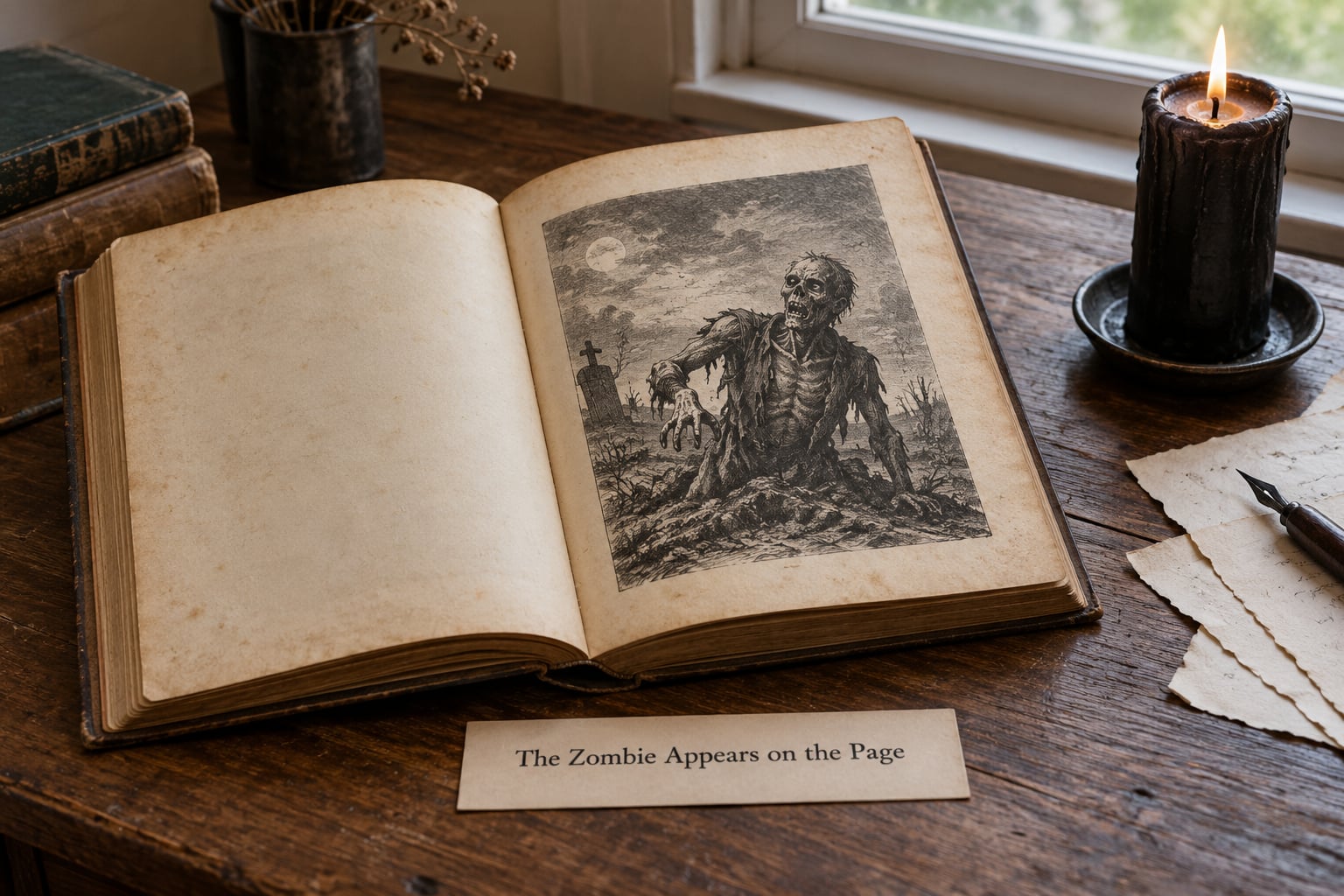
The Zombie Appears on the Page
The book that gave zombie fiction its modern plot engine was Richard Matheson’s I Am Legend (1954). Readers who call it a zombie novel are half right, because Matheson’s creatures are vampires and the resemblance is so complete that the genre forgave him decades ago.
I Am Legend is a vampire novel, and that is the point
I Am Legend is told by the sole survivor of a plague that turns the dead back into slow, mindless, blood-hungry attackers who cannot be killed except by destroying the body. He barricades himself in a flat in London, watches the streets fill every night, and writes his account. There is no answer to the problem. He dies of it.
Matheson’s plague spreads person to person, kills, revives, and creates a mindless herd. Vampires, not zombies, by any strict definition. But Matheson gave the genre four things it never gives up: the survivor who narrates, the plague as the mechanism, the protective structure, and the sense that this is about one man’s loneliness rather than about corpses.
The best line in the book is also the genre’s founding complaint: when the infected see him and come to the window, they do so without anger or recognition. That indifference is the zombie idea, stated before anyone called it one.
Why everyone still calls it the first zombie novel
Because genre writers who came up in the 1990s have said so for decades, and they were not wrong about the influence. Matheson was the only zombie-adjacent author most of them knew, and his book was forty years old by then. Robert Kirkman has named I Am Legend as a direct source for The Walking Dead, which is not a small claim.
It also gets remade constantly: The Last Man on Earth (1964), I Am Legend (2007), The Girl with All the Gifts (2014) and the Korean series Happiness all rework the same premise. The book that did the same work for Romero is called Night of the Living Dead only because the movie rights came attached.
How Film Made Zombies a Global Horror Icon
Film turned the zombie from a literary problem into an image. Romero’s Night of the Living Dead (1968) is the film that decided what a zombie looks like, and everything since is a variation on it.
What Romero actually changed
His dead had no appetite at first. They walked, they grabbed, they were dangerous through sheer mass and because they never stopped. Dawn of the Dead (1978) added the idea that the horde reflects what the living do with consumption, and The Return of the Living Dead (1985) handed down the line about eating brains. Romero had also said that he did not care whether the traditional zombie myth was Haitian or European, and that his creatures were chosen for practical reasons.
One last thing people get wrong. The word zombie never appears in the dialogue of Night of the Living Dead. His characters use the word ghoul, which he had taken from an old film, and the film was marketed as though it were about living people being overrun. The name stuck anyway, and it stuck to Romero’s version of the monster rather than to Seabrook’s.
The book-and-film split
Zombie cinema arrived decades before zombie literature did as a named subgenre. For twenty years after 1968 the interesting zombie writing was largely in screenplay form, while novels kept churning out competent horror. The crossover came in 1990 with Book of the Dead, edited by John Skipp and Craig Spector, which put genre writers into an anthology and made the subgenre visible enough to have fans.
Readers who ask this question are usually surprised by how late the literary branch is. Film is the source; the bookshelf is downstream of it.
What Made the Modern Zombie Different?
The modern zombie differs from the folkloric zombi in cause, appetite, free will, sympathy and meaning. The folkloric creature is a spiritual problem about one person; the screen creature is a physical outbreak about everyone.
| Feature | Haitian zombi | Modern screen zombie |
|---|---|---|
| Cause | Take of the zombi astral by a bokor | Contagion, toxins, experiments, unknown |
| Appetite | None described; the body works | Flesh, later brains |
| Free will | None; that is the definition | None, sometimes with exceptions |
| Spread | Does not spread | Passes on by bite |
| Who it is | Usually a victim to be pitied or freed | The threat, rarely anything else |
| Symbol | Slavery and captivity | Consumerism, conformity, grief, infection |
From spiritual to physical
Three shifts do most of the work. The threat went from spiritual to physical, so it could be filmed and fought. The scale went from one enslaved person to a whole city, which made it an epidemic story rather than a haunting. And the sympathy moved, which is the part readers argue about most.
The racial shift nobody planned
The folkloric zombi is a victim. A dead Haitian made to labour by someone who stole his soul, in a country built on stolen labour. Then White Zombie (1932) moved the victim to a white stranger, and by Night of the Living Dead the monster itself was a Black man whose crime was being in a house that white characters walked into.
Romero put race and Vietnam in the middle of that on purpose, saying the film was made to say something about racism in America. What happened on screen was that the compassion went to the survivors and the dead kept their condition. This is why people ask whether the zombie concept is racist, and it is a fair question with a complicated answer: the origin story is a story about the victims of slavery, and the monster story largely stopped telling it that way.
One point of proportion. Almost all zombie fiction, including Romero’s, is violent and has been since 1968. Romero’s diary entries for the night the film opened note people buying ticket stubs so they could be buried in costume. The fans understood exactly what they were buying.
How Comics and Games Expanded the Genre
Comics and video games did for zombie fiction in the 1990s what film did in 1968: they split it into a slow tradition and a fast one. That split is now the biggest live argument in the genre.
Slow zombies kept winning in print
The American zombie returned to comics through 1950s Eerie Publications and settled in with Robert Kirkman’s The Walking Dead from 2003, which moved a cast of ordinary people through a slow, moral collapse and became the best-known zombie story of the century. Kirkman credited Matheson, and the whole series is a last-survivor story in slow motion.
Games created the fast zombie
Resident Evil and The House of the Dead, both 1996, gave the infected speed and the genre split in two. Fast zombies turn the threat into an action problem, which means they are much better in a game than in a novel. Genre writers have argued about this for years: some see the runners as a genuine evolution, others as the loss of the menace that made the original frightening.
Film took the fast side next, with 28 Days Later (2002), Shaun of the Dead (2004) and the 28 Years Later films, while Romero’s own legacy stayed slow. Games also spread the zombie worldwide, and manga and webtoons turned it into a global form with its own conventions: school settings, food and water as currency, and the infected as a status rather than a fate.
The Main Zombie-Fiction Traditions Today
Modern zombie fiction runs in about six branches, and knowing which one you are reading tells you what the book is doing. The voodoo-inspired branch goes back to Haitian practice rather than Romero and has the strongest claim to the genre’s origins. The radioactive branch owes more to 1950s science fiction, with radiation instead of infection, and still works.
The viral outbreak branch is the biggest and the flattest, with World War Z and Cell as its most famous recent members and a great many formulaic imitators. The technological reanimation branch starts from Herbert West-Reanimator and asks what happens when the person doing the reanimating has a plan. Satirical zombie fiction uses the dead to talk about consumerism and administration, and it is the branch where the best writing tends to sit.
The sympathetic zombie branch is the newest and the most interesting for the genre’s future, with Warm Bodies, Generation Dead and iZombie all making the dead someone to grieve rather than to shoot. Outside the Western canon, Chinese jiangshi, the hopping vampire, and other non-US undead traditions have their own long histories and their own rules, and they are worth reading next.
One craft note, since forum readers ask about it constantly: good zombie fiction rarely has characters react as if the situation were impossible. The genre works on suspension, and it breaks the moment someone turns to a camera and says, this cannot be happening.
Where to Start Reading Zombie Fiction
Start with I Am Legend (1954) by Richard Matheson, knowing it is a vampire novel. It is the shortest route to every idea in the genre, and knowing what it actually is changes how the next four books read.
Next take Night of the Living Dead (1968) by George A. Romero, and treat it as the novelisation rather than the film, because it is very nearly a different book. Then read I Am a Hero (2009), a Korean graphic novel: fast, brutal, and the clearest argument for why the genre’s new centre of gravity sits in Asia. Follow it with Dawn of the Dead (1978) by George A. Romero, the one that turns the horror into a story about what people want rather than what they fear.
The last two are for when you want the arguments rather than the shocks. The Living Dead (2009), a prequel set before Kirkman’s series opens, holds up the weakest parts of that run without copying it. Book of the Dead (1990), edited by John Skipp and Craig Spector, is where the genre finds its voice and its first shelf of favourites, and it is the one book that explains why 1990 is the year the subgenre was born.
A note on content: all six carry graphic violence, and most carry body horror. Two of them are worth skimming first if gore is not your thing.
Frequently Asked Questions
What was the first zombie novel?
It depends on what you count. W. B. Seabrook’s The Magic Island (1929) brought the word into English but is a travelogue. Richard Matheson’s I Am Legend (1954) is the first modern zombie-shaped novel, though its creatures are vampires. George A. Romero’s Night of the Living Dead (1968) is the first true zombie story, and it started as a screenplay. Most readers cite any of the three.
Where did the first zombie story come from?
From Haitian Vodou folklore, shaped by four centuries of Atlantic slavery. The zombi was a person whose spirit had been taken by a bokor and whose body was made to work. That tradition reached Western print through Seabrook in 1929 and was reshaped by American pulp writing and film into a contagion-driven flesh-eating monster.
Who invented the first zombie concept?
Nobody single person did. The creature developed across Kongo and Central African spirit belief, Haitian religious practice, and nineteenth-century Gothic fiction. In English, W. B. Seabrook gave us the word in 1929. Zora Neale Hurston documented the practice from inside Haiti in Tell My Horse (1937), and George A. Romero designed the modern version in 1968.
Is I Am Legend a zombie novel or a vampire novel?
Strictly, it is a vampire novel. Matheson’s creatures revive after death, spread by a plague, and want blood, which is vampire behaviour. But the book supplies the last-survivor structure, the contagion, the mindless herd and the protective barricade that all modern zombie fiction uses, which is why it gets called the first zombie novel anyway.
Is the concept of zombies racist?
The origin story is a story about victims of slavery, so the question deserves a serious answer. What critics point to is that the sympathy shifted: White Zombie (1932) moved the victim to a white stranger, and by Night of the Living Dead the dead were mostly Black men and the survivors mostly white. Romero intended the opposite and said so, but the effect on the page was real.
When did the word zombie first get used in fiction?
The word reached English print in W. B. Seabrook’s The Magic Island (1929), an account of Haitian Vodou practice. Horror writers picked it up through the 1930s and 1940s, but it was rare on a page. It became standard usage after Night of the Living Dead (1968), a film that never uses the word itself and whose marketing pushed the title of the original novel.
What to Take Away
Zombie fiction got started in three steps: an English account of Haitian folklore in 1929, a vampire novel that supplied the plot in 1954, and a film that supplied the image in 1968. Everything after that is variation.
If you read one thing, read I Am Legend knowing what it really is. Then read Romero’s Unholy Trilogy, because everything still being published in 2026 is arguing with it. The history matters for one practical reason: it explains why these books are about us and not about the corpse.
Which question did you want answered most? I am always up for the ones about where to start, because the reading order genuinely changes how the later books land.