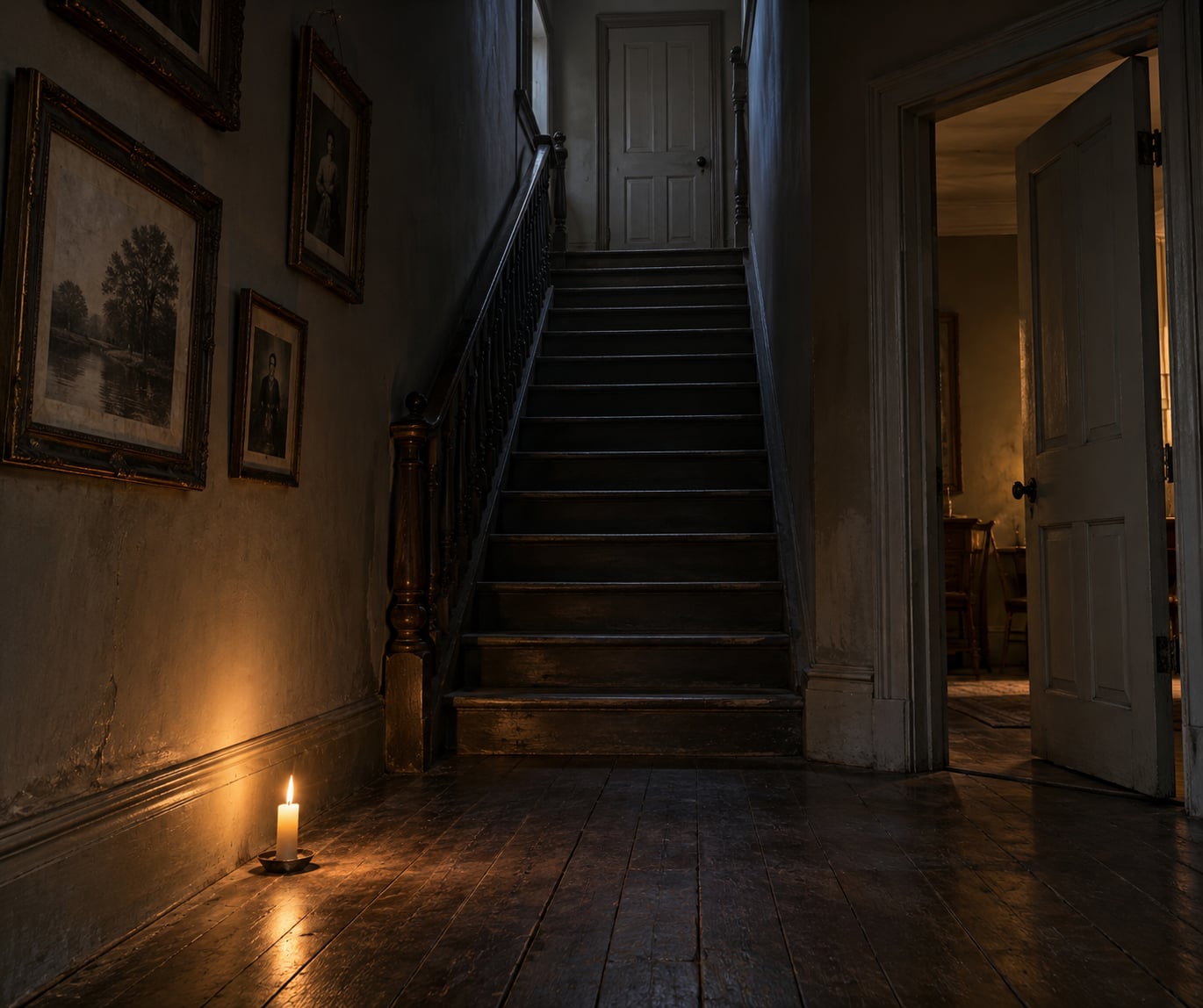
Haunted house stories still work on readers because home is the one place we are trained to feel safe. When familiar rooms, sounds and objects start behaving wrongly, the violation registers as a personal threat rather than an abstract danger, and readers supply the rest of the fear themselves.
That is the whole trick in a sentence. Everything else – the cold spots, the child on the stairs, the door left open that nobody opened – is technique layered on top of it.
Table of Contents
- Why Do Haunted House Stories Still Work on Readers?
- How Familiar Childhood Fears Create Immediate Tension
- Why Uncertainty Is Scarier Than a Confirmed Monster
- How the Uncanny Makes Ordinary Places Feel Wrong
- Why Haunted House Stories Work Because Houses Hold Memories
- How Reader Expectations Keep Haunted-House Stories Suspenseful
- What Makes a Haunted House Story Emotionally Unforgettable?
- Frequently Asked Questions
- Why do haunted house stories still frighten readers?
- Do haunted house stories need a ghost or monster?
- How do writers make a familiar house feel scary?
- Why are haunted places so popular in horror stories?
- What is the difference between suspense and surprise in haunted-house fiction?
- Is the haunted house trope a cliche?
- Conclusion: Start With a Place That Feels Familiar
Why Do Haunted House Stories Still Work on Readers?
Four things combine, and drop any one of them and the effect weakens. Remove them and you have a horror story that happens indoors, which is not the same thing at all.
- Fear of the familiar. A shark is scary precisely because it is somewhere else. A presence in the hallway upstairs is scary because the hallway is yours.
- Anticipation. Dread is sustained over pages. A monster arrives and the scene ends; a house keeps being there, waiting, for however long the author holds it.
- Uncertainty. The reader never gets a clean answer, and a mind that keeps failing to resolve a question will not stop turning it over.
- Vulnerability. Trapped characters lose the power to leave, to call for help, or to explain what is happening to anyone.
Because readers can always close the book, none of that produces actual harm. That is the appeal. Controlled fear research – including the work run out of Aarhus University’s Recreational Fear Lab – treats haunted houses, horror films and horror fiction as the same category of experience: a safe thrill that gets the body to respond without the body ever being in danger.
The same logic holds for haunted attractions. Walk into a dark room knowing the door is behind you, that nobody is holding anything, that the whole thing is built and staffed by people who do this every night, and your heart still climbs. Good haunted house stories simply deliver that on a timeline the reader controls.
How Familiar Childhood Fears Create Immediate Tension
Every haunted house story borrows from rooms readers already have feelings about. The basement with the fuse box and the storage boxes nobody opens. The attic with the boxes nobody opens. The hallway where the hallway light flickers for no reason and you told yourself it was the bulb.
Those are not invented fears. They are borrowed, and they arrive with a memory attached, which is why they need no explanation. A story does not have to convince you that the dark is frightening. It just has to put the dark where you already believed it.
Other fixtures work the same way: mirrors that show a room one second too late, a bedroom where the bed is made when you know nobody made it, a stair creak on a house that settles silently by day. Familiar space, wrong behaviour. The gap between the two is where the tension lives.
Why Uncertainty Is Scarier Than a Confirmed Monster
Suspense outlasts shock every time. A confirmed monster becomes a problem with rules, and rules can be studied. Uncertainty has no rules, so it keeps running in the background while the reader tries to decide whether it matters.
Consider a doorway at the end of a corridor. It is open by a hand’s width. Nothing walks through it for forty pages. The story has said nothing about what is on the other side, and now the reader is doing the author’s work – inventing a worse thing than the author probably planned.
Long stretches of nothing also stop readers from settling. Liminal hours get used for exactly this reason. The small hours of the night are when the house is quiet enough that any sound is the loudest sound in the world, and when the reader, like any sleeping person, is least equipped to argue with it. Why the middle of the night specifically feels worse than the middle of the afternoon is a small question with an uncomfortably large answer.
How the Uncanny Makes Ordinary Places Feel Wrong
The uncanny, a term Freud borrowed from German criticism in 1919, is the feeling that something familiar has been made strange without anything obviously changing. Not a monster in the kitchen. A kitchen that is exactly right, except.
Stories create it in cheap, reliable ways. Repetition is the strongest: a scene described twice, and the second time one detail has moved. Objects appear somewhere new. A room is remembered accurately except for one thing, which the narrator does not mention, because the narrator has stopped noticing.
The second reliable way is behaviour. Nothing supernatural is required for a house to be subtly wrong – a door that closes on its own, a light that switches off in an empty room, a routine that runs one beat longer than it should. The mind is built to predict, and a place that keeps breaking its own pattern reads as hostile before it reads as haunted.
Why Haunted House Stories Work Because Houses Hold Memories
Buildings outlive the people who use them, which gives haunted house stories a ready-made emotional charge. A house has already accumulated deaths, arguments, disappearances, inheritances and things nobody says out loud. Most of those are ordinary. Some of them are not, and a story only has to pick up the thread and pull.
That is why the best examples in the genre lean on grief rather than gore. Poe’s The Fall of the House of Usher is about a family whose history is the building, and Daphne du Maurier’s Rebecca is about a death nobody in the house has finished grieving. Shirley Jackson’s The Haunting of Hill House hangs the same weight on a dead girl and the house raised over her, and Richard Matheson’s Hell House dresses the same shape in a haunted-house attraction rather than a mansion.
So the haunting is rarely only about a monster. It is about inheritance – who is owed what, who was wronged, who is quietly paying for a decision made before they were born. Readers recognise that material instantly, because most of them are living inside it too.
How Reader Expectations Keep Haunted-House Stories Suspenseful
A reader who has read the genre arrives with a set of expectations already loaded: something bad happened here, a wall is wrong, somebody is missing, the child appears in the same place twice. Those expectations are not a problem to overcome. They are the instrument the story plays.
Genre convention works like a contract with the reader. The book promises a haunted place and a reason for it. The contract can be honoured – the haunting is real, explained, and the explanation is worse than the ambiguity was – or it can be broken deliberately, by changing what the threat is or who it belongs to. Either way the reader knows what they are reading.
Surprise alone will not carry a story. A shock in chapter one is spent; a promise the book keeps making good on for two hundred pages is what readers describe afterwards as dread. A writer who only wants to startle has nothing after page ten.
What Makes a Haunted House Story Emotionally Unforgettable?
Fear fades fast. What lingers is feeling. The stories readers still recommend years later usually do something to the characters rather than to the reader’s pulse: sympathy for whoever died in the house, complicity in something the living characters did not stop, guilt that arrives too late to fix anything.
Moral ambiguity helps most here. A ghost that wants something reasonable is more disturbing than one that wants to kill, because the reader starts arguing with it. Isolation does the rest of the work – one house, one road out, no phone signal, no witnesses to contradict what happens next.
Then there is the ending, and it is where reader trust is won or lost. Recommendation threads on r/horrorlit and AbsoluteWrite keep returning to the same complaint: a haunting that resolves into something rational feels like a bait-and-switch. Not because supernatural horror is more frightening in itself, but because the reader was made to commit to a world and then told the commitment was naive.
A fairer contract exists. A story can be psychological from the opening line, as long as it never pretends otherwise. The anger is aimed at the mismatch, not the mechanism.
Frequently Asked Questions
Why do haunted house stories still frighten readers?
Because the threat arrives in a place readers already trust. Home carries a lifetime of safety, so a room behaving wrongly feels like a personal violation rather than an abstract danger. The anticipation also lasts far longer than a shock would, which keeps a reader turning pages through discomfort they chose to enter.
Do haunted house stories need a ghost or monster?
No. The haunted house trope only requires that the setting be the source of the threat. That threat can be a poltergeist, a repeating pattern, a family curse, a building that resists its occupants, or something psychological that was never hidden. What readers object to is not the absence of a ghost but being misled about which one they are reading.
How do writers make a familiar house feel scary?
They change one detail in a room the reader has already stabilised. A door found open. A photograph with someone missing from it. A creak on a stair that settles silently by day. The mind predicts and compares constantly, so a single broken prediction registers as threat far more strongly than an unfamiliar and obviously dangerous place would.
Why are haunted places so popular in horror stories?
A house concentrates fear in one contained setting. You cannot outrun a building, you cannot reason your way out of it once the walls are involved, and the same room can carry decades of accumulated tragedy that a story can draw on. That makes it an efficient way to layer trappedness, guilt and the uncanny into a single place.
What is the difference between suspense and surprise in haunted-house fiction?
Suspense comes from uncertainty and lasts as long as the question stays open. Surprise is a single jolt that resolves the instant it lands. Haunted house stories run on suspense because the house stays present across the whole narrative, while surprise is spent in about a second and leaves the writer with nothing to hold the reader afterwards.
Is the haunted house trope a cliche?
It is a trope, which is not the same as a defect – readers defend it in horror forums the way they defend vampires in urban fantasy. What wears thin is imitation: the same cast, the same rules, the same reveal. Change the house, the people trapped in it, or what the haunting wants, and the formula reads fresh again.
Conclusion: Start With a Place That Feels Familiar
Haunted house stories keep working because they take the safest place a reader knows and make it unreliable, then give the reader all the time they need to notice. The trick is portable: pick an ordinary location, attach it to a private fear or an unresolved memory, and leave one thing unexplained. The house does the rest.