To create a monster for your own story, work through eight stages in order: the fear it embodies, its job in the plot, its silhouette, its anatomical rules, what it wants, where it came from, how it fits the setting, and the scene where the reader finally sees it. Give it rules instead of adjectives, and the frightening part takes care of itself.
Most weak monsters are a list of features. Six eyes, grey skin, teeth everywhere. Read them aloud and you can swap the name for any other and nobody would notice. What holds a creature in a reader’s head for years is different: it is one fear, one rule, one thing it cannot do.
This guide takes about an hour the first time and much less once the pattern sticks. You need no drawing skill, no design software and nothing special at all. If you have ever felt the pull to write something genuinely frightening, this is the process I use when a creature feels thin.
Jump to the eight-step process or read straight through.
Table of Contents
- What You Need
- How to Create a Monster for Your Own Story Step by Step
- 1. Find the Monster’s Central Fear
- 2. Give the Monster a Clear Function
- 3. Build Its Unmistakable Silhouette
- 4. Design Anatomy and Physical Rules
- 5. Decide What It Wants
- 6. Create a History or Origin
- 7. Connect It to the Setting
- 8. Write a Scene That Reveals the Monster
- Common Mistakes
- Frequently Asked Questions
- How do I make a monster original instead of just a combination of other creatures?
- How can I make my monster frightening without using graphic gore?
- What makes a fictional monster feel physically believable?
- How do I give a monster personality without making it talk too much?
- How many important details should a monster have before it appears in the story?
- How do I create a monster that can stay important throughout a series?
- Conclusion
What You Need
Four things, and three of them are free. First, a notebook or writing app. Paper suits a monster sketch, because you will want to draw circles and arrows, while a note app suits the rule list. Either works, so stop shopping for the right tool and start writing badly on purpose.
Second, reference notes. An animal you find unsettling is more useful than ten pages of mythology you skimmed once. Mantis shrimp, the anglerfish, the cow that stares at you in a field, the neighbour who never comes home before dark. Write down what actually unsettled you, not what you think should be unsettling.
Third, a character or a setting you already have. A monster designed before the protagonist exists has nothing to push against. If your cast is not settled, settle your protagonist first, because the monster exists in relation to that person’s specific vulnerability.
Fourth, optional visual and audio research. Fifteen seconds of the wrong number of legs, a bat detector sweep, a deep-sea anglerfish video watched at night with the lights off. Visual writers work from images and sound-minded writers work from recordings, and both get better creature results than pure imagination. That is research, not cheating.
No artistic or technical skill is required. If you can describe a shape and name a fear, you can do this.
How to Create a Monster for Your Own Story Step by Step
The process runs from abstract to concrete: fear first, rules second, scene last. Every stage below answers one question, and the answer to each one constrains the next. Skip ahead and you get a creature that could be dropped into any of a thousand stories. Work in order and the creature could only exist in yours.
1. Find the Monster’s Central Fear
A monster becomes frightening when readers recognise what it stands for. Pick one central fear and write it in a single sentence using “of”: the fear of being left while everyone else leaves, the fear of being watched by something that has no face, the fear of being known and not liked, the fear of a body that has stopped obeying you.
Then attach that fear to your protagonist. If your protagonist is someone whose whole defence is control, the monster should embody chaos or loss of control specifically, not darkness in general. The connection is what makes the creature feel like it was built for this story rather than borrowed from another one.
Choosing one fear also prevents bloat. Every extra fear you add fights the first one, and a creature built on three emotions reads as confused rather than deep. One fear, stated plainly, is also the thing you will test the finished monster against.
2. Give the Monster a Clear Function
Decide the creature’s job in the plot before you decide its looks. An antagonist blocks the goal and must be overcome. A catalyst forces the protagonist to act and could be removed afterwards. A hunter tracks and closes distance. A trickster misleads and profits from confusion. A guardian blocks access to something. An unintended consequence of someone else’s decision needs no motive at all, only a process.
The function sets the suspense. An antagonist creates the pressure of the obstacle, so the question is how the protagonist gets past it. A trickster creates pressure of uncertainty, so the question is which of its statements is true. A guardian changes the questions entirely, because the monster is not the danger, the thing it protects is.
It also changes what the creature chooses to do. A hunter ignores bait and follows the warmest trail. A trickster answers a direct question with a lie and a sideways one with truth, because that is what keeps it safe. Consistency of method is what readers find creepy, far more than size or number of teeth.
One test: read three scenes where your monster appears and ask what it wanted in each. If the answers do not match its function, you have a plot problem, not a design problem.
3. Build Its Unmistakable Silhouette
Before detail, decide shape, scale, posture and movement, then add one or two features exaggerated far past normal. Silhouette is what readers recognise in a dark frame, on a poster, or through a doorway with the creature cut off at the waist. If your monster needs lighting to be understood, the shape is failing.
Posture tells the reader what kind of creature it is before a single word of motive arrives. Something that stands upright is negotiating with the world. Something built from horizontal planes is made for speed or for staying low. Long limbs and a small body read as fast and fragile; a low, wide mass reads as heavy and immovable.
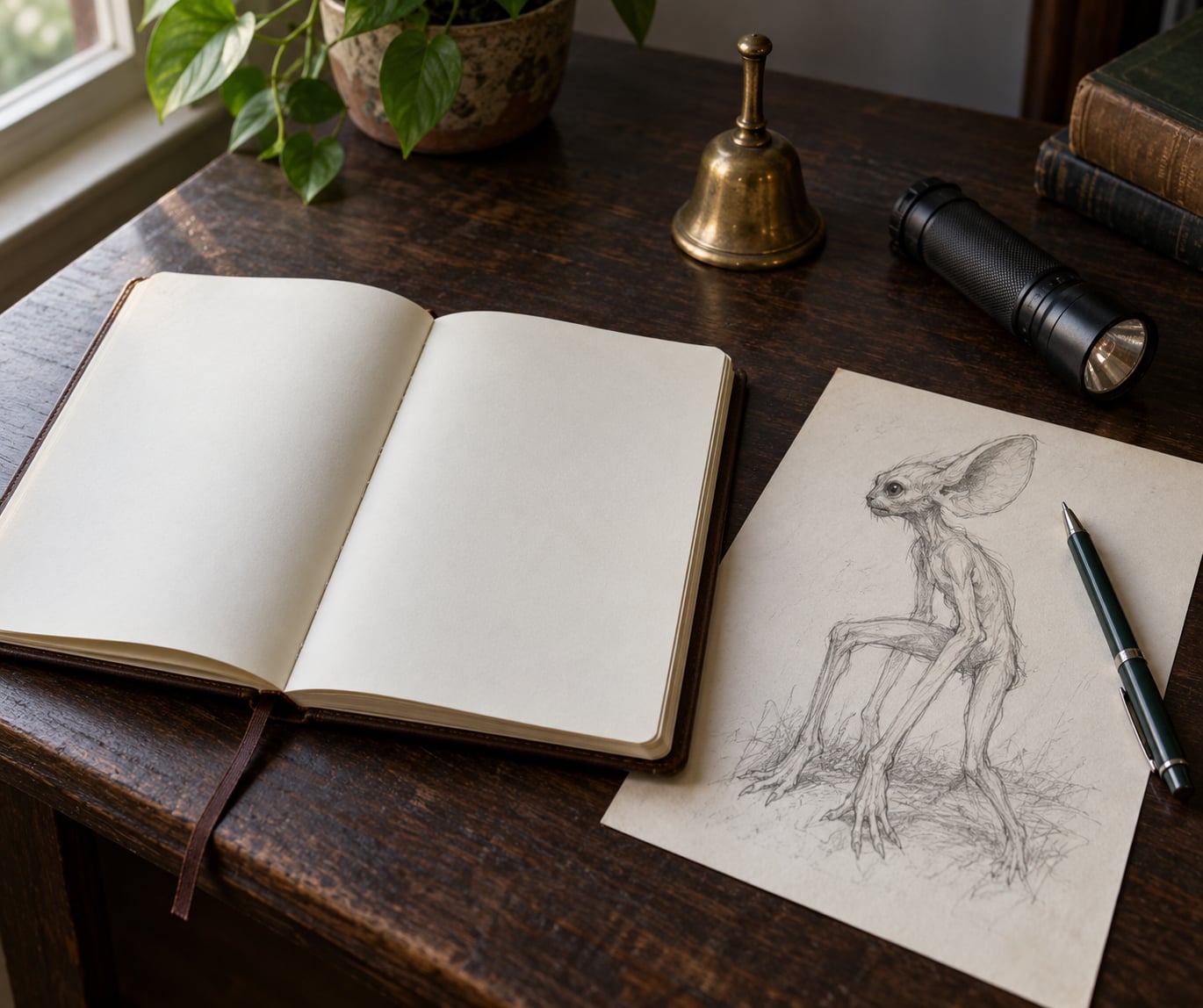
Example: a drowned farm-dog shape at the scale of a bull, all forward weight and a back that curves like a bow, with one enormous ear it uses like a hand. Test it in a sentence: “A bull-sized dog shape with one ear it reaches with.” If that sentence makes the image in your head, the silhouette works. If it needs a second sentence, cut or reshape until it does not.
Keep the description to what the reader can see from where your viewpoint character stands. Everything else belongs in your notes, not on the page.
4. Design Anatomy and Physical Rules
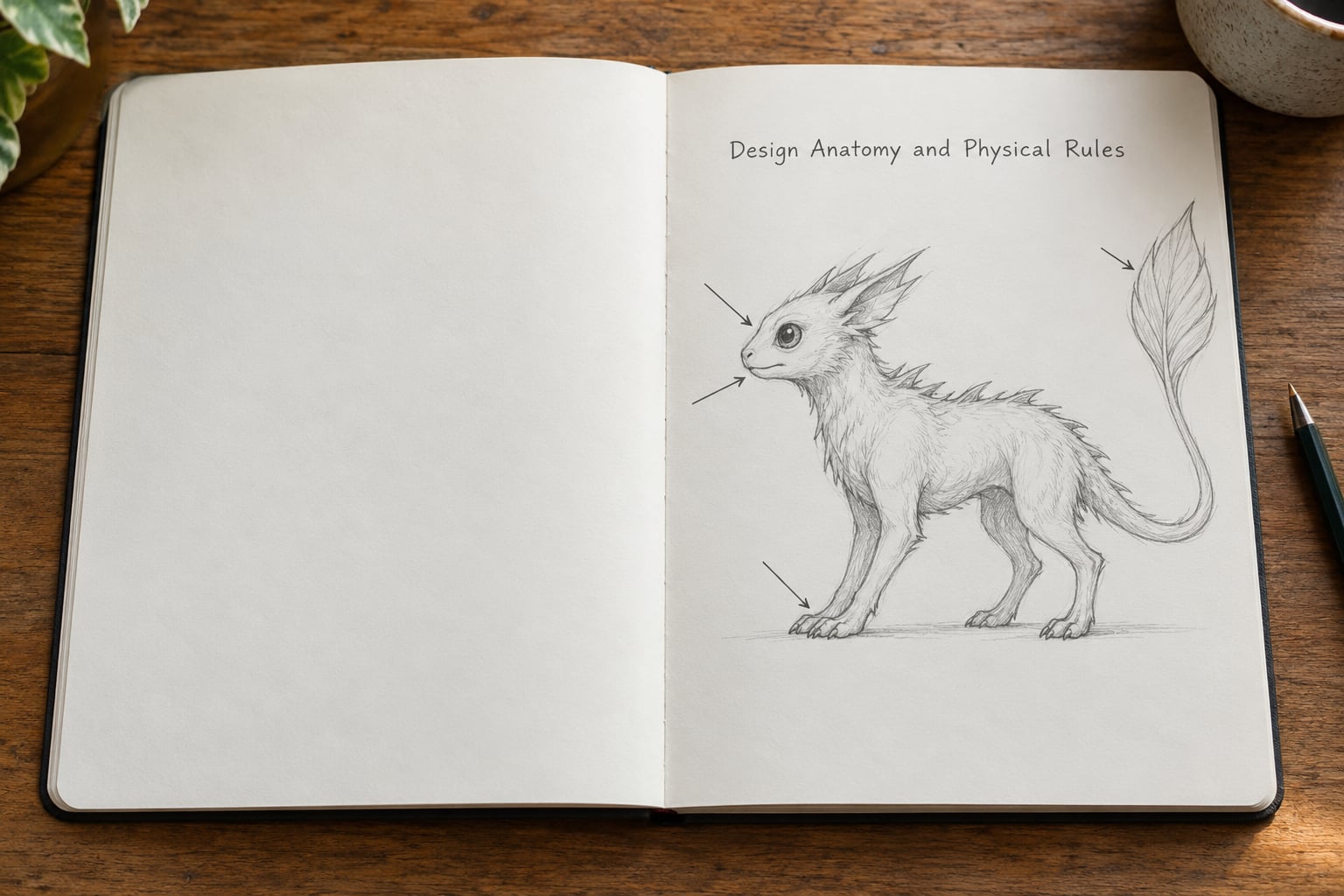
Give the creature a body plan, its senses, its needs, its limits, and at least one genuine weakness. Rules are what make a monster credible, and credibility is what lets a protagonist outsmart it. A creature with no constraints gives the reader nothing to solve, and the climax collapses into luck.
Real animal biology is the fastest shortcut to believability. Look at how the real thing solves a problem: an animal that hunts in darkness has oversized eyes or a different sense entirely, and an animal that ambushes has a skull built for that grip. Then change one thing. That single departure from nature is where your monster becomes yours instead of a documentary.
Make limits physical rather than magical. It cannot process rapid movement, it must stay damp to keep its skin intact, it cannot cross running water, its hearing is superb but its vision fails in a still reflection. A physical limit is something a character can observe, test, and later exploit, which makes the discovery feel earned instead of handed over.
Three to six rules is plenty. Ten is a spreadsheet, and a spreadsheet is not scary.
5. Decide What It Wants
Give the creature an objective that is not simply hurting people. Hunger is fine but thin. Hunger for a specific thing is better: it wants the sound of the church bell, it wants to be seen, it wants to finish a task someone abandoned, it believes it is the only one of its kind and is looking for a mate. Wants also explain odd behaviour, since a creature with a goal will tolerate strange costs to reach it.
Two conflicting wants make it unpredictable without making it random. A creature that must feed but must also avoid being named will hesitate exactly when the protagonist can use that. Predict the monster’s decision from its wants and the scene writes itself.
Whether a monster should talk is worth arguing about, but the useful answer is narrow: give it communication without giving it a personality that explains it away. One call it makes, one behaviour it repeats, one sound it produces in a specific circumstance. Readers will do the rest, and the rest is more frightening than anything you would write for them.
6. Create a History or Origin
Write an origin in a paragraph, not a chapter. It has to do a specific job: explain why the creature’s body looks the way it does, explain the limits you set in step four, and account for why it is in the story now. Everything else is optional.
Pick one of five flavours. Natural, where the creature is an evolved or migrated animal pushed into a niche. Supernatural, where something broke a rule and left the creature as residue. Scientific, where an experiment, a parasite, or an engineered organism got out of control. Folklore-inspired, where you borrow the shape and logic of something already documented and change its motive. Unexplained, where you deliberately leave the cause unknown and make that absence part of the threat.
A stitched figure from a familiar novel works because the method explains the seams. Do the same. If your creature has three injuries and cannot cross salt water, the origin had better put those two facts in the same room.
7. Connect It to the Setting
A monster native to its world is built from that world. Use geography, weather, architecture, food sources, local belief and social history. A thing that nests in cathedral bell towers has no business wandering a wheat field. A coastal creature carries salt in its behaviour, hunts at the wrong tide for no obvious reason, and frightens a village whose whole economy depends on the thing it eats.
Here is the test I like: take your finished concept and move it to a different setting, keeping everything the same except the environment. A plague-bearer that started in a medieval fishing port becomes something else entirely when placed in a modern hospital corridor, or in a generation ship, or in a retirement home. The body stays, the origin stays, but the limits and the behaviour change because the world applies different pressure. If the move changes nothing, the setting is wallpaper.
One question settles most of it: what counts as a monster in this world? If the ordinary animals look like cats and horses, the answer is usually something the locals have a name for and no explanation for.
8. Write a Scene That Reveals the Monster
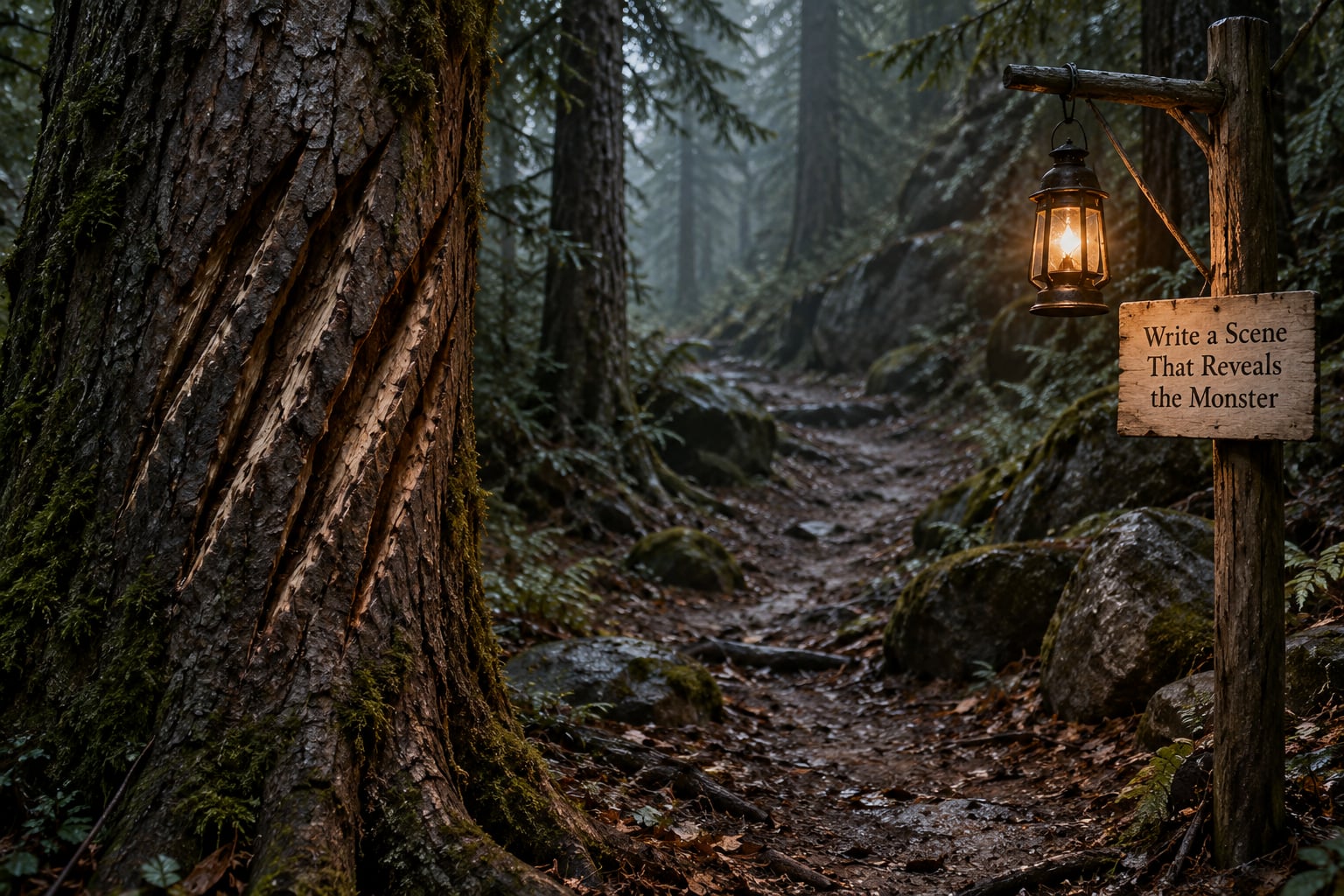
Stage the reveal from one viewpoint, through partial evidence, before the full body arrives. Give sound first, then evidence, then one decisive sensory detail the reader will keep. The order matters: sound makes the reader look up, evidence makes them doubt, and the single sharp detail is the thing they describe to a friend the next morning.
A practical way to test the scene: after the reveal, ask what changed. If nothing about the characters’ understanding, choices or situation has changed, you delivered exposition with a monster in it. A good reveal costs someone something.
Keep the anatomy off the page during the reveal. One detail that does not fit anything else is worth more than a paragraph of measurements, and it will not cost you the mystery you spent the book building.
Common Mistakes
Overcomplicated anatomy. If you need a glossary, the design has stalled. Fix: keep the five rules that matter and move the rest to a worldbuilding document.
Feature overload. Extra eyes, extra limbs, extra orifices added for effect fight each other and the creature stops being a shape. Fix: pick one feature and exaggerate it past comfort. One extreme reads as design, five read as noise.
Unexplained invulnerability. If nothing can hurt it, the protagonist has no options and the story has no climax. Fix: give it one hard physical limit and let the characters find it themselves.
Inconsistent behaviour. It ignores bait in chapter three and chases it in chapter nine with no reason given. Fix: write down its two or three wants before drafting scenes, then predict each decision from them.
Instant answers. A narrator who explains the creature fully on first appearance spends the reader’s imagination for them. Fix: design far more than you show and release it in pieces across the plot.
Using it only as a monster. A creature that exists to be killed in chapter twelve has no presence in the middle of the book. Fix: let it change at least one character’s behaviour, economy, belief or routine before it dies. Ask what the village does differently the year after.
Testing it against the theme. Take your one-line theme and ask whether the monster contradicts it or carries it. If your story is about grief and your monster is a pure predator with no relationship to loss, you have two stories stapled together.
Frequently Asked Questions
How do I make a monster original instead of just a combination of other creatures?
Originality usually comes from changing one variable rather than stacking traits. Take a creature you admire, keep its overall role in the plot, and alter its motive, its sensory system, or the limit that stops it. A shape you have seen with a motive nobody has used reads as designed, while a fresh pile of features reads as a remix. Test your version by writing its silhouette in one sentence and asking whether it could belong to any other book on your shelf.
How can I make my monster frightening without using graphic gore?
Fear survives on anticipation and consequence rather than injury. Show what the creature does to the environment, the silence it leaves, and how other people change their behaviour around it. Then show one character who knows exactly what is coming and cannot say it. The gap between what the reader knows and what the protagonist is told does more work than any wound description, and it keeps the scene readable for younger audiences too.
What makes a fictional monster feel physically believable?
Believability comes from internal consistency more than realism. Real animal biology is a good shortcut, because readers already trust bodies that solve problems in sensible ways. Then break exactly one thing and let your change have consequences the creature lives with. A rule you can state in a sentence, that characters can observe and test, is what makes the design feel real to a reader.
How do I give a monster personality without making it talk too much?
Show the decision instead of the speech. Give the creature a preference, a ritual and a habit, then write scenes where those three things appear without explanation. A pattern a reader notices on their own is far more unsettling than a villain explaining their plan, because the reader feels they have worked something out. Save the rare spoken line for a moment where hearing it changes what your character does next.
How many important details should a monster have before it appears in the story?
Fix three to six hard details before the first on-page appearance: one silhouette feature, one sensory signature, one physical limit, one want, and its origin in a single line. Anything more belongs in your private notes until the plot needs it. Holding most of the design back is what gives you mystery, and mystery is what people remember about the creatures they read at fifteen.
How do I create a monster that can stay important throughout a series?
Give it an unresolved want and a setting that keeps producing reasons to act. A finished goal retires the creature after one book, while an unfinished one lets each volume change its circumstances without changing its nature. Add a rule that survives every escalation, and a cost the creature pays each time it uses its ability, so its later appearances carry history rather than just bigger numbers.
Conclusion
Start tonight with three lines and nothing else: the single fear your monster embodies, its job in the plot, and one physical rule that limits it. Everything after that, the silhouette, the origin, the setting, the reveal scene, grows out of those three decisions rather than sitting on top of them.
When you think you have it, read your one-sentence silhouette out loud. If it could belong to a different book, change the fear or the limit, not the adjectives. That single revision is usually the whole difference between a monster and a costume.