Found footage horror movies are made by filming staged, performed events on consumer-grade or disguised cameras, lighting them like available light, and editing the result to look like a recording someone found rather than a sequence a cinematographer designed. Everything you see was planned, including the moment things went wrong.
The style borrows its name from a film-production term. A director shooting behind the scenes gathers unused footage from cameras that were not part of the main shoot. Horror filmmakers inverted that idea: the useless footage becomes the entire movie, framed as evidence handed to an investigator or recovered from a missing camera.
Because the fiction is that nobody is directing, the crew has to do the opposite of what a normal production does. Instead of hiding the process, they build a machine that fakes an amateur process. The camera wobbles because a rig is rigged to wobble. The lighting is bad because a real camcorder would have produced bad light. Actors hesitate because a real person filming something frightening hesitates.
Table of Contents
- How Found Footage Horror Movies Are Made
- What Makes Found Footage Feel Real?
- How Do Filmmakers Plan the Scares?
- What Equipment Does a Found Footage Movie Use?
- How Is Sound Designed for Found Footage Horror?
- How Does Editing Create the Chaos?
- How Do Filmmakers Keep the Story Believable?
- Frequently Asked Questions
- Is the footage in found footage real?
- Do actors know when the scares will happen?
- What editing software do found footage filmmakers use?
- What film technique was used in The Blair Witch Project?
- How do you write a found footage script with a coherent plot?
- How do you end a found footage film without frustrating viewers?
- Conclusion
How Found Footage Horror Movies Are Made
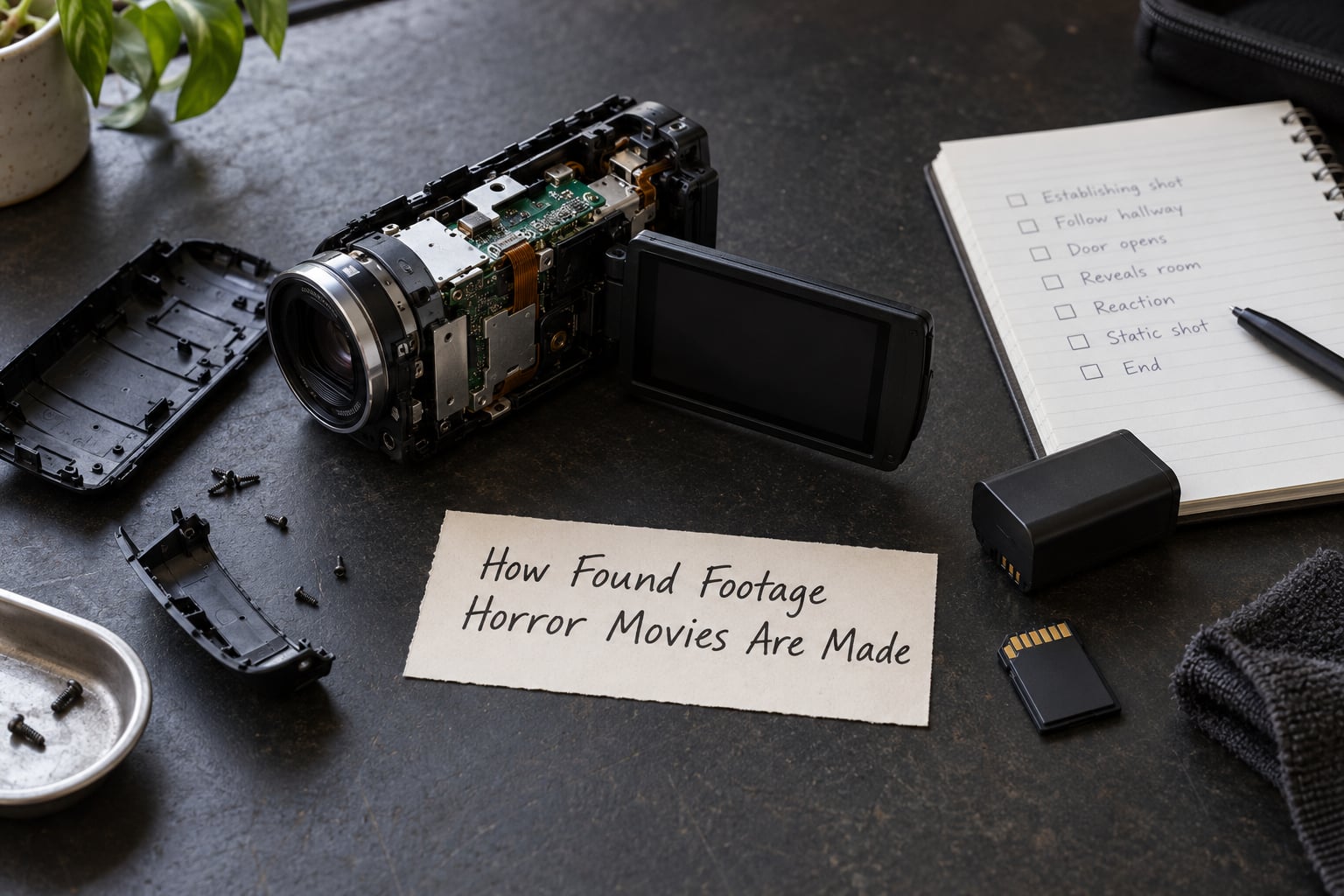
Four working parts do almost all of the work: a camera disguised as something a character would actually own, situations performed for the lens, lighting that reacts rather than dominates, and an edit full of small flaws. Remove any one of them and the footage starts looking like a movie about a person filming.
The first decision is the camera fiction. A security officer has a body camera, a student has a camcorder, a teenager has a phone, a contractor has a hard hat cam. That choice determines the aspect ratio, the audio quality, the file naming, and how often the recording can plausibly stop. A phone dies at 92 percent. A hard hat cam has no screen to check, so the character cannot review what they just shot.
The second is performance. Scenes are staged and rehearsed, but played loosely. Dialogue gets rewritten on the night when the filmed situation produces something better than the plan. The crew knows roughly where the scare lands. The actor does not always know the exact frame it will arrive on.
The third is the look. Footage is usually underexposed and slightly soft, because that is what a cheap sensor records in a basement at 2 a.m. Colour stays muddy and inconsistent, and the auto settings drift between shots so white balance shifts when someone walks past a lamp.
The fourth is the edit. Clips are cut the way a real person cuts files: starts late, ends abruptly, sometimes jumps forward to a different angle with no transition. The result should feel assembled by someone in a hurry who thought they were making a diary.
What Makes Found Footage Feel Real?
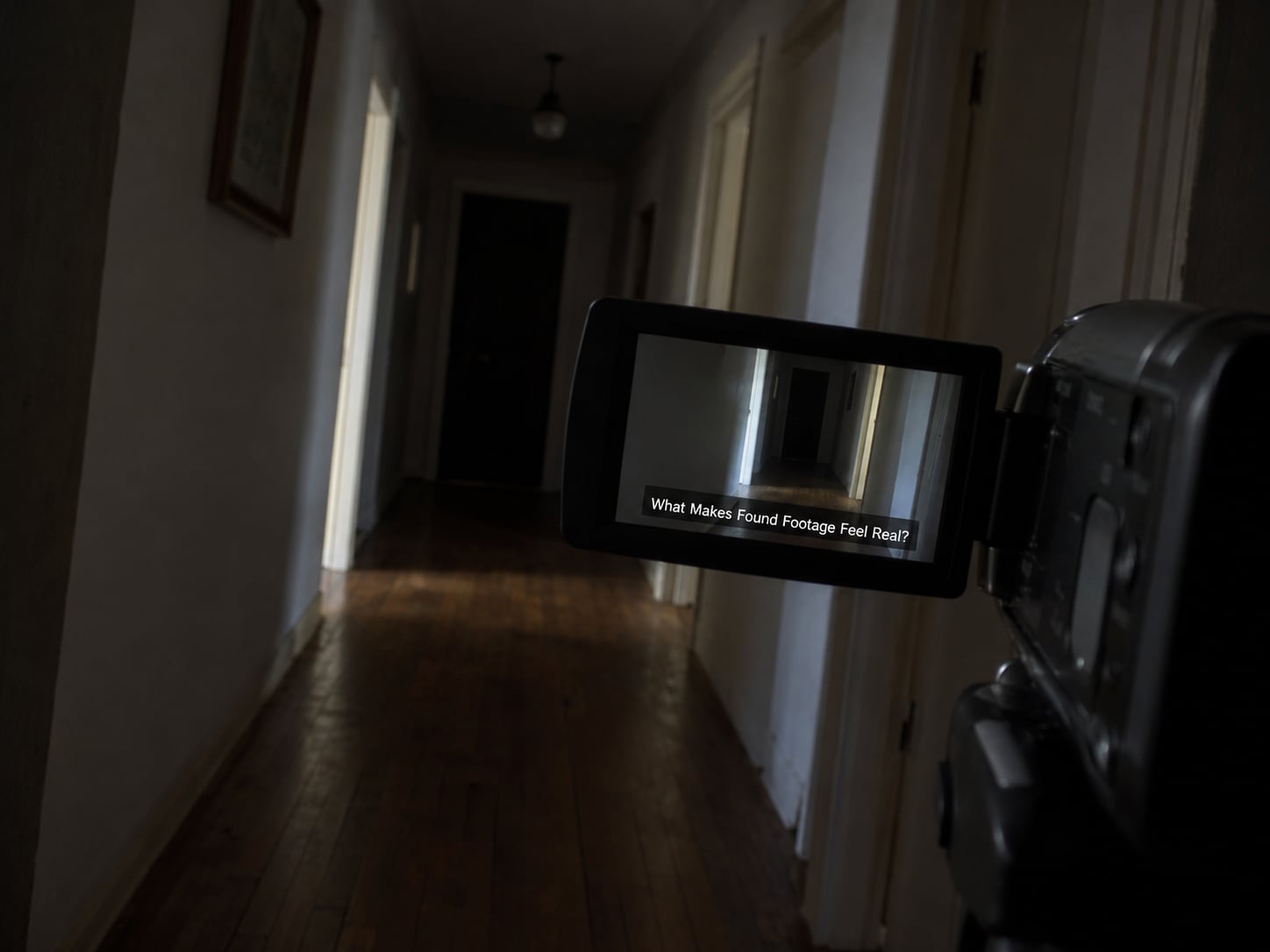
Real found footage footage looks bad in specific ways, and the difference between convincing and fake is almost entirely about which flaws you reproduce. Amateur video is not randomly ugly. It has patterns: the operator loses focus when they move fast, the frame drifts to one side during a moment of tension, the audio clips when someone raises their voice.
Shaky movement only works when it has a reason. A hand-held camera held by a frightened person shakes differently from one held by a calm person, and the audience reads the difference within a second. Choreograph the shake to the character’s state rather than adding it uniformly across the scene.
Framing should be slightly wrong. Heads get cropped. Doorways sit half out of frame. The operator forgets to level the shot after putting the camera down. Perfect composition is the fastest way to break the illusion, because almost nobody frames a shot while terrified.
Information should arrive late. The audience should learn what the characters saw after the characters learned it, which means cutting away at the wrong moment and returning later. A missing stretch of footage is more unsettling than a monster shown clearly, because the viewer fills the gap with something worse than what you could afford.
Behaviour sells the format more than any filter. People in real footage hesitate before they move, repeat themselves when they are shaken, ask questions nobody answers, and film the same corner twice because the first take did not look right. Actors who react with hesitation rather than instant panic are what separate good found footage from loud found footage.
How Do Filmmakers Plan the Scares?
Scares are mapped before they are filmed, then released to the actors in controlled doses. A typical plan names the location, the trigger, the sound cue, and how the camera behaves before and after. What stays unrehearsed is the exact instant of contact.
Control movement instead of chasing reactions. Give a performer a clear path and a mark to stop at, then let the scare happen in the corridor they have to walk down whether they know it or not. Staging entrances matters just as much: a door that opens on cue feels like a set, and a door someone opens by accident feels real.
Rehearse the technical parts until they are dull. Autofocus hunts, frame rate drops, a file name changes format, the camera tilts and nobody fixes it. Actors can then perform freely in the moment while the crew guarantees the technical failures land where they were placed.
Leave room for accidents. Something always goes slightly wrong on a shoot, and the best takes are usually the ones where the crew forgot a cue. Plan so that a failure does not damage the story, then be willing to use the ruined take.
What Equipment Does a Found Footage Movie Use?
Most found footage films are shot on gear that looks unremarkable on purpose. The strongest kit is the one whose flaws match the character and the location, so choose the camera by asking what a person in the story would have been holding when they walked into trouble.
A camcorder gives you visible tape or card folders, a chunky body a character can grip with two hands, and settings that visibly struggle in the dark. A small action camera survives things a camcorder will not and mounts somewhere a person would not expect, which suits helmet or chest-mounted points of view. A smartphone is the cheapest credible option and adds one specific problem you may want: storage limits and a battery that dies.
Fixed cameras change the fiction. A ceiling camera in a hallway cannot react, cannot follow anyone, and cannot flinch, so the tension comes from what it captures rather than from how it moves. That is a harder film to write and a much more distinctive one.
Lighting is usually limited to what exists in the location plus a small amount of motivated light. Practicals, phone screens, and flashlights are all diegetic, meaning they exist inside the story world. A crew that floods a basement with studio light loses the illusion before the first scare.
Here is a practical kit breakdown by tier, using no budget figures.
| Tier | Camera | Audio | Lighting and support |
|---|---|---|---|
| Starter | An older camcorder or a phone in airplane mode | Lav mic into the camera, or phone audio kept deliberately rough | Practicals only, plus a clamp light dressed as a fixture |
| Working | Camcorder plus an action camera for body-mounted shots | Shotgun on a short boom or handle, backed up to a recorder | Battery LED bulbs inside lamps, bounce off ceiling, gaffer tape everywhere |
| Serious | Two matched bodies so different angles can be cut together | Radio mics with a sound recordist riding along | Dimmable practicals, a small haze unit, and a monitor in darkness |
One extra note on old gear. Students on filmmaking forums often reach for an early-2000s camcorder to get real grain and colour decay rather than faking it. The authentic version costs nothing and cannot be corrected in software, which is exactly the point.
How Is Sound Designed for Found Footage Horror?
Sound is where the illusion either holds or breaks, because audio is the element a viewer never consciously questions. A clean, wide, cinematic mix reads as a film. Bad, clipped, close, and slightly reverberant audio reads as a device held near a mouth.
Record the production track properly first. A shotgun microphone on a short handle above the camera gets you a direct, intimate sound with a little room on it, which is exactly right. Run a backup recorder on the talent if you can afford to, because a night shoot outdoors can lose a take to wind alone.
Layer in what the camera could not catch. Footsteps on leaves, a door hinge, a fridge cycling, wind against the mic, and the low hum of a device charging. These sounds sell a space the image only half shows.
Then use silence. A three-second rule helps: when a scare lands, cut the audio at the moment of contact rather than adding a loud hit. The absence of sound after an impact feels more alarming than a scream, and an abrupt interruption of room tone is the signature move of the genre.
Keep reactions natural. A scream that starts on the exact frame is a sound effect. A gasp a half-beat late, followed by someone pretending nothing happened, is a performance.
How Does Editing Create the Chaos?
The edit sells found footage by making the assembly feel like evidence handling rather than storytelling. Clips are stitched, time codes appear between takes, and the film jumps forward without warning to a different angle or a later hour. What you withhold matters more than what you show.
Start clips late. A cut that enters an action two seconds after it began tells the viewer they missed something, which is how real recovered footage behaves. End clips early, especially at the important moments. A recording that stops right as something enters the frame is far worse than showing it.
Drop a clip occasionally. Cutting away and returning later implies that footage exists which the audience will not see. Keep the drop short, and place it somewhere it creates a question rather than a gap.
Mix aspect ratios to signal multiple sources. A widescreen security view cutting to a vertical phone clip makes the story feel assembled from different cameras by someone with limited time.
Here is the balance to watch. Pure chaos frustrates viewers because they lose the thread and stop being scared. The genre only works when the audience can still map where everyone is, when the last thing they saw before the cut explains the next thing they see. Plan the geography before you plan the scares.
Plan for the screen the film will meet. Viewers in 2026 mostly see these films on phones and laptops, so check vertical crops and subtitle legibility before delivery.
How Do Filmmakers Keep the Story Believable?
Believability comes down to one question that filmmakers on community forums ask constantly: why is anyone filming this? A believable reason is not decoration. It is the reason the camera is in the room, and it decides what the audience is allowed to see.
Good camera motivation tends to be dull and practical. Documenting a survey for work. Proving a haunting to a sceptic. Recording evidence of an abusive landlord. A student assembling a final-year project. Anything that requires a person to keep the camera pointed at danger for no cinematic reason at all.
Practical limitations then do the storytelling for you. No tripod means the frame tilts. Low battery means the picture degrades near the end. A character who cannot see the screen cannot review footage. Write the limitations into the script and the production stops fighting the format.
Continuity matters even when the dialogue is improvised. Note where each camera is, who is holding it, and what has already been established about each room. Improvised scenes drift, and a viewer who notices that the broken lamp has moved mid-crisis stops believing anything.
Keep escalation restrained: unease first, then dread, then terror. Films that jump to the loudest scare in the opening minute have nothing left to spend. Let the quiet passages carry the dread so the loud ones land.
On the practical side, sort the paperwork before the shoot. Signed appearance releases, location permission, and a plan for anyone underage or working nights are the boring things that stop a production. Agree on a safety word before you film anything difficult. On set, actors and crew use a specific word to break a scene instantly, and found footage sets often use a food-related word so it fits naturally in an improvised take.
Two formats are worth knowing about before you plan. Screenlife uses computer screens instead of filmed spaces, which removes camera problems entirely and replaces them with typing speed, cursor behaviour, and interface sound. Analog horror imitates degraded tape, dropped frames, and tracking errors, and it works best when the distortion carries meaning rather than decoration.
Frequently Asked Questions
Is the footage in found footage real?
No. Every found footage horror film is fiction, shot by a crew and performed by actors. The realism comes from production choices, not from events. Filmmakers use consumer cameras, underexposure, drifting autofocus, improvised dialogue, and an edit that looks like recovered evidence. Some films add disclosure screens or final reports to reinforce the idea, but the last shot of a creature is as staged as any other frame.
Do actors know when the scares will happen?
Usually they know a scene is coming but not the exact moment. Crews map every scare in advance, then rehearse the technical parts so the autofocus hunt or the dropped frame lands where it should. Performers are given a path and a mark and are left to react inside it. That balance keeps the tension real for the actors without producing the stiff, counted reactions that make found footage look staged.
What editing software do found footage filmmakers use?
Any editor that can handle multiple camera formats and a lot of trimming will do. Free options such as DaVinci Resolve, Shotcut, and Kdenlive cover cutting, timecode, grain, and the basic glitch work these films need. Professional productions add tracking distortion and tape damage in After Effects or Resolve Fusion. The expensive part is not the software, it is the hours spent making each clip look damaged in a slightly different way.
What film technique was used in The Blair Witch Project?
The film used guerrilla production: improvised dialogue from a thin outline, handheld consumer cameras, a small crew, and a short shoot in real locations. The cast were told to genuinely investigate the woods rather than act out a route, and the crew was instructed to abandon them and clean up if they came back without footage. The marketing then presented the film as a real recovery effort, which no audience had seen before.
How do you write a found footage script with a coherent plot?
Keep the plot in the audio and cut the plot out of the image. Give each character a reason to be recording, a route through the location, and one piece of information that only they have. Write the beats as timestamps and camera positions rather than dialogue, then let performers fill in the words. When a scene gets confusing on the day, check that the audience knows where everyone is before you worry about what they said.
How do you end a found footage film without frustrating viewers?
Give the audience a conclusion inside the framing device. Common endings include the recording cutting out mid-event, a recovered body camera that finally stops, or a final tape played after the characters are gone, which closes the loop and explains why anyone is watching. What frustrates people is pure absence, with no signal about whether the characters survived or what was found.
Conclusion
Start with the camera fiction. Decide who is holding the device, why they keep it pointed at danger, and what that device physically cannot do, then let every later choice follow from those limits.
Next, build your imperfections on purpose rather than hoping they appear. Light badly on purpose, frame badly on purpose, cut late on purpose. Write one map of the location so the audience always knows where they are, then remove only the moments that would explain the threat too early.
Finally, treat silence as your sharpest effect. A found footage film that does almost nothing while a character hesitates is more disturbing than one stacked with reveals, and that patience is what makes the format worth choosing.