If you’re trying to work out how to tell cosmic horror from supernatural horror, the answer sits in one question: where does the fear come from? In supernatural horror it comes from an agent, a ghost or demon or witch who can be named, reasoned about, and sometimes fought or appeased. In cosmic horror it comes from a condition, the scale of things and the smallness of people, which cannot be reasoned away.
That single distinction settles most arguments, including the ones that circle forever on book forums. Once you can answer that question about a story, you can place it: house at the top, universe at the bottom, and a big pile of hybrids in the middle. Updated for October 2026, this guide gives you the definitions, a side-by-side table, five tests you can apply to anything, and a starter list for each flavour.
It takes about a minute per story. The hardest part is admitting that most good horror refuses to sit neatly in a single bucket.
Table of Contents
- How to Tell Cosmic Horror from Supernatural Horror at a Glance
- What Is Cosmic Horror?
- Does cosmic horror require aliens or outer space?
- Why cosmic horror feels so much worse
- What Is Supernatural Horror?
- The third category people mix in: spiritual horror
- Compare the Source of Fear
- Compare the Setting and Scale
- Compare the Villain and the Monster
- Compare Themes and Human Consequences
- Examples of Cosmic Horror
- Examples of Supernatural Horror
- What About Stories That Mix Both Subgenres?
- How do you tell cosmic horror from supernatural horror when a story has both?
- Which Should You Choose?
- Frequently Asked Questions
- Does cosmic horror require aliens or outer space?
- What category does Cthulhu fall under?
- Is Stephen King a cosmic horror writer or a supernatural horror writer?
- Can a story be both cosmic and supernatural horror?
- Why is cosmic horror so terrifying compared with other horror?
- What is the difference between horror and cosmic horror?
- Bottom Line
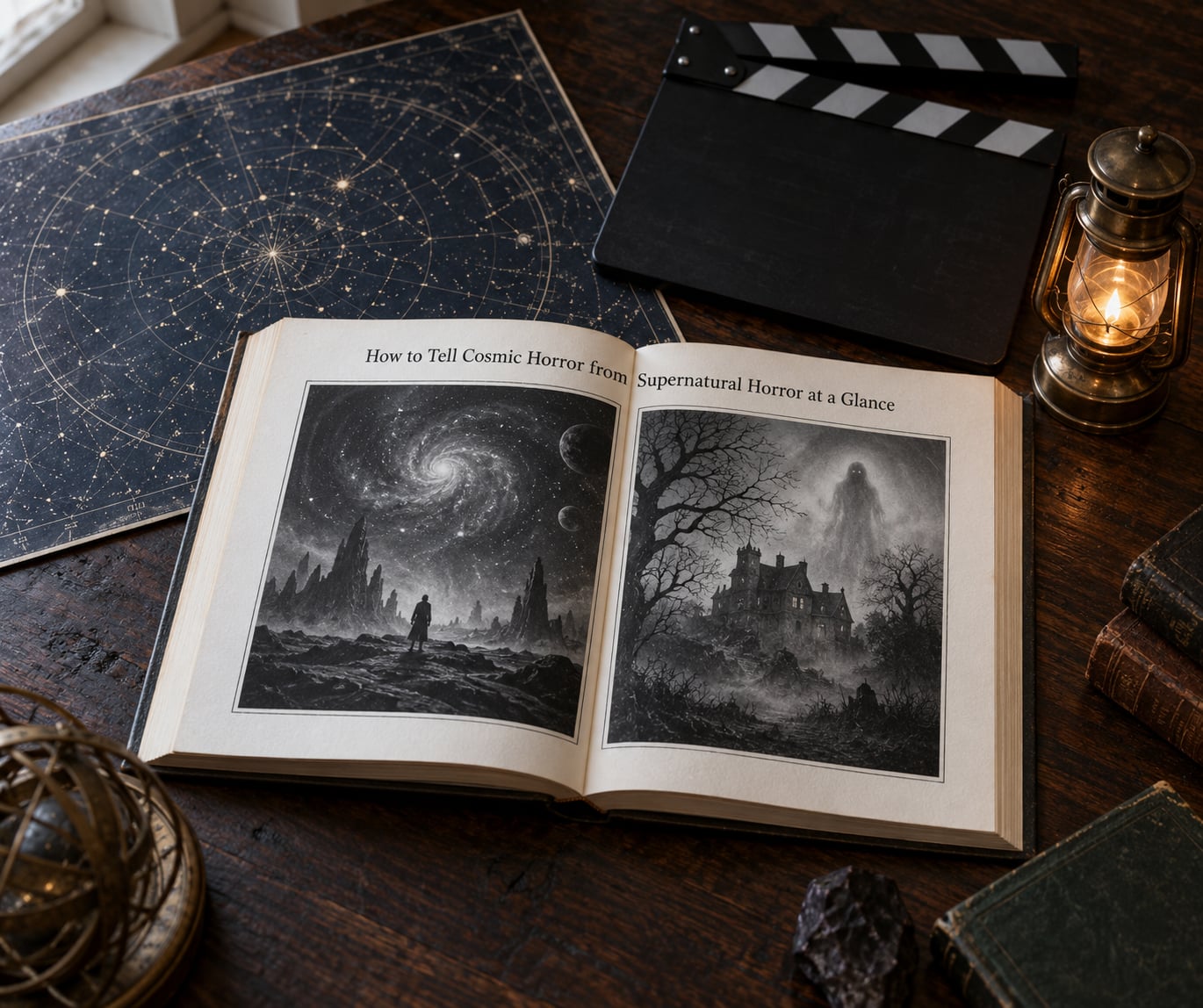
How to Tell Cosmic Horror from Supernatural Horror at a Glance
| Question | Cosmic horror | Supernatural horror |
|---|---|---|
| Source of the fear | A condition of reality: scale, deep time, the indifference of the universe | An agent: a ghost, demon, witch, spirit, curse or vengeful dead |
| Scale of the threat | Civilisation-scale, geological, planetary or larger | House-scale, street-scale, village-scale |
| Can it be defeated? | No. Escape is possible; victory is not | Sometimes, if the rules can be found and respected |
| Does the monster want anything? | Usually not. Humanity is not on its list | Almost always: it wants in, wants revenge, wants a body |
| Does humanity matter? | Not in the cosmic sense. People are noise | Very much so. People are the target and the prize |
| Role of knowledge | Learning the truth damages the mind that holds it | Knowledge is the tool. Research the haunting, learn the ritual, find the name |
| Tone of the ending | Escape with a cost. Nothing was fixed | Confrontation. A door closes, a body is freed, a wrong is answered |
| Religious framing | Materialist or atheistic. No creator, no special status | Deeply theistic: sin, judgement, damnation, violated boundaries |
| Signature works | The Call of Cthulhu (1928), Solaris (1961), Annihilation (2014) | The Turn of the Screw (1898), The Haunting of Hill House (1959), The Exorcist (1971) |
Read the first two rows first. Everything else in the table is downstream of them.
What Is Cosmic Horror?
Cosmic horror is a subgenre of weird fiction in which human beings encounter forces so vast, so old, or so fundamentally alien that they cannot be understood, and those forces do not care whether humanity survives. The dread comes from the size of the gap between what a person can hold in their head and what is actually out there.
H. P. Lovecraft built the template in the 1920s and 1930s, mostly in the pages of Weird Tales, and set down his reasoning in a 1927 essay called Supernatural Horror in Literature. His version was explicitly anti-geocentric. Earth is not the centre, the species is not privileged, and the universe is not answerable to anybody’s prayers. Writers who followed him, from Ramsey Campbell to modern authors like Jeff VanderMeer and Laird Barron, kept the scale and dropped some of the period’s tone.
Cosmicism is the philosophy underneath it, and it is worth separating from the genre label. Lovecraft’s belief was that the cosmos is indifferent rather than hostile, which sounds like a small difference and changes the emotional result completely. A hostile universe gives you an enemy. An indifferent one gives you nothing at all, and that is worse.
Does cosmic horror require aliens or outer space?
No. This is the most argued question in the genre and the answer is settled. Cosmic horror needs something alien at the core of the story world, but that something does not have to be extraterrestrial, and it does not have to have a spaceship in it.
Deep time does the job perfectly well. Set a story against billions of years and human history shrinks to a blink, with no spacecraft anywhere. A buried civilisation older than the dinosaurs on a mountainside achieves the same effect on foot. Even a house on a hill can carry it, if the thing the characters uncover is old enough and the comprehension is impossible, which is much of what Blackwood and Campbell were doing in the same decade as Lovecraft.
What does not work is a threat that stays human-scaled, is fully understood by the end, and can be punched. That is a different genre, whatever else you call it.
Why cosmic horror feels so much worse
Three reasons, and they compound. First, no victory is available. You can run, hide, or go mad, and the story will not offer a prize for endurance. Second, knowledge is contamination. The astronomer who understands what he found is worse off than the sailor who saw a shape and turned away. Third, there is no moral order to appeal to. Nothing was done wrong and nothing can be put right.
Supernatural horror borrows dread from a different place. The threat breaks rules, and the relief comes from learning the rules well enough to stay inside them.
What Is Supernatural Horror?
Supernatural horror is horror rooted in agents that exist inside the story world and operate there: ghosts, spirits, demons, witches, the undead, cursed objects, haunted places, the occult, magic. The horror comes from an agent with a will, and usually with a grievance.
It is the oldest of the branches. Ghost fiction, folk tales about vampires and haunted houses, and church literature about judgement and damnation all feed straight into it. A vampire is supernatural horror even when the vampire is merely a very old man, because the blood and the stake and the sunrise are rules, and the rules are the whole pleasure of the story.
This is the part that separates it most sharply from cosmic horror. A ghost wants something. It wants to be heard, it wants a body, it wants a wrong answered, or it wants a house kept empty. Cosmic entities are not in a hurry about you at all.
The third category people mix in: spiritual horror
There is a distinct middle position that readers argue about at length, and it deserves its own name. Spiritual or theistic horror is supernatural in mechanism but cosmic in scale, because the agent behind it is a god, and the stakes are not your life but your soul.
Writers working in this lane include Thomas Ligotti, Flannery O’Connor, and Laird Barron’s more religious material. The appeal is that non-existence is not the worst outcome, judgement is. That fear sits closer to cosmic horror in its size and closer to supernatural horror in its structure, and telling the two apart is mostly a question of whether the power cares about individuals one at a time.
Compare the Source of Fear
Cosmic horror presents a condition. The universe is like this, has always been like this, and will be long after you. Supernatural horror presents an agent. Something is in the house, and it has a reason.
There is a compact way to put it: the fear has a face in one case and has no address in the other. A ghost can be described. It is tall, it is cold, it walks the corridor at 3am. The thing in the Cthulhu Mythos cannot be described, and the story spends pages failing to describe it on purpose.
Comprehension is the dividing line. In supernatural horror, understanding the threat is progress. In cosmic horror, understanding is the damage, which is why a character who reads the wrong manuscript or runs a wrong experiment tends to come out of the story diminished. The test in practice is whether the characters end up finding that the universe works in a way fundamentally different from what they expected, with no version of the truth that makes it comfortable again.
Compare the Setting and Scale
Cosmic horror widens the frame. It uses space, deep time, buried history, and the edge of the map. A story that begins with two researchers on a dig and ends with the shape of something that predates the Atlantic is doing cosmic work, and it does not need a single alien to do it.
Supernatural horror narrows it. Haunted houses, family estates, churches, small towns, a specific folklore attached to a specific place. The setting is usually a real community with real rules, which is exactly why a haunting can feel credible in a way an eldritch abomination cannot.
Scale is the easiest thing to misjudge because big settings are also a preference. A huge house is not cosmic scale. What matters is not the size of the place but the size of the question. Chernobyl, for instance, has no monster and no ghost, and readers argue about it constantly. Seen one way it is a straightforward disaster thriller, and seen another the accident is a comprehension event, a situation where a system that was believed safe turned out to be neither safe nor fully understood. That is a cosmic story shape with no eldritch anything in it.
Compare the Villain and the Monster
Cosmic horror rarely has a villain. It has a force, and the difference is not cosmetic. A villain is opposed to you, which means it recognises you. A cosmic force is not opposed to you, because you did not register.
One reframe is useful here: the test is not whether Earth matters but whether humans matter. Nyarlathotep is the rare Great Old One that takes conscious notice of the species, and its response is to play with people the way a child plays with an anthill. That is the most nightmarish version of the cosmic idea, because being noticed does not make you safe. It makes you interesting.
Supernatural horror has a monster in the ordinary sense: a body, a method, a weakness. The ghost, the demon, the thing under the bed. It behaves consistently, and consistency is what the audience is really tracking, because the horror lives in the pattern and the moment the pattern breaks.
Compare Themes and Human Consequences
Cosmic horror is usually about certainty. Characters start with a working model of the world, and the story removes it. The end state is not a monster slain but a person sitting on the floor of a library knowing too much, and the world outside having not changed at all.
Supernatural horror is usually about boundaries. A door that should stay shut gets opened. A marriage, a body, a grave, a sacrament. The recurring stake is whether something crosses a line, and the ending is usually about whether it gets back.
Themes map cleanly. Cosmic: insignificance, the failure of religion as an answer, deep time as a destroyer of meaning, madness as contamination. Supernatural: possession, sin, inherited guilt, vengeance, the price of curiosity, community as protection. Spiritual horror takes the supernatural mechanics and keeps the cosmic scale, so a failed ritual might let in something that regards the whole planet as a trivial item on its schedule.
Examples of Cosmic Horror
These are not a ranking. They are works where the fear mechanism is a condition rather than an agent, which is the whole test.
The Call of Cthulhu (1928) and At the Mountains of Madness (1931), both by H. P. Lovecraft, are the origin points. The first makes a statue the proof of an invasion already in progress, and the second puts a party face to face with something history has been burying on purpose. Neither can be resolved, and both leave the reader with knowledge instead of an answer.
Solaris (1961) by Stanislaw Lem is the strongest argument that the subgenre needs no monster at all. The ocean on Solaris is materialised grief, and the crew’s real problem is that they cannot make sense of a mind unlike theirs.
The Who Goes There? (1938) by John W. Campbell, adapted as The Thing from Another World (1951) and remade as The Thing (1982), keeps an alien agent but makes the real horror the suspicion that the thing wearing a face is not the friend. The 1982 version is cosmic with a very convincing supernatural surface.
Annihilation (2014) and the rest of Jeff VanderMeer’s Southern Reach Trilogy do the modern version best. There is no antagonist. The zone is a border between ordinary physics and something else, and the characters end up doing what cosmic horror characters always do, standing in the doorway and describing what they see.
Starry Wisdom (1971) by Laird Barron, The Imago Sequence (2005) by the same author, and The Willows (1907) by Algernon Blackwood are good picks for readers who want the tradition without the Lovecraft pastiche. Barron especially works well as a starting point because the prose is modern and the dread is patient.
Examples of Supernatural Horror
The same test, run the other way. Each of these has an agent with a motive and rules that can be learned.
The Turn of the Screw (1898) by Henry James is the template for ghosts that only the children can see, and the ambiguity about whether the haunting is real is the point. Carmilla (1872) and Uncle Silas (1864) by Sheridan Le Fanu do something different with the same agent, making the threat social and intimate rather than spectral.
The Haunting of Hill House (1959) by Shirley Jackson is a house that is itself the antagonist, and it qualifies because the house is an agent with intent. The Lottery (1948) by the same author pushes toward folk horror, where the agent is a community rather than a ghost, and the rules are handed down rather than written down.
The Exorcist (1971) by William Peter Blatty is possession with a clear antagonist and a clear ritual answer. The Shining (1977) and Pet Sematary (1983) by Stephen King sit firmly here too, the first because the hotel wants, the second because there is a place to bury things that should not be buried.
On screen, The Innocents (1961), The Conjuring (2013), and Ari Aster’s Hereditary (2018) all follow the same structure. An agent enters a family, the family investigates, and the outcome depends on the rules.
What About Stories That Mix Both Subgenres?
Most of what people argue about lives in the overlap, and forcing hybrids into one bucket is where genre arguments go to die. Two rules sort them out. Find the dominant fear mechanism, then ask which genre the ending belongs to.
How do you tell cosmic horror from supernatural horror when a story has both?
Ask two questions. Is the threat an agent that wants something, or a condition that exists? And at the end, does the protagonist win, escape at a cost, or come apart? If the monster is an agent and the ending is a confrontation, it is supernatural horror with cosmic texture. If the monster is barely an agent and the ending leaves the world unchanged and the character damaged, it is cosmic horror with a supernatural costume.
It (1986) and its 2017 adaptation are supernatural with cosmic dressing. Pennywise is an agent, it feeds on fear, it can be hurt, and the Losers beat it by choosing not to be afraid. The clown is a shape, not a worldview.
The Thing (1982) runs the other way, as a human-scale agent in a story whose horror is that the world contains something that thinks nothing of us. Alien (1979) sits between them, an agent with rules and a design that is far older than the crew. Midsommar (2019) is supernatural in mechanism and cosmic in conclusion, since the community turns out to be one cell in something much larger.
Lovecraft’s own work is permanently hybrid, which is a useful reminder that the line was never a law. He preached materialism in 1927 and wrote a pantheon of gods and witches while doing it. The distinction is a reading tool, not a filing rule.
Which Should You Choose?
Pick by what you want to feel. Cosmic horror gives you dread with nowhere to put it, the sensation of finding a door and seeing how far back the room goes. Supernatural horror gives you dread with an address, a pursuer, and a set of rules you can hold in your hands and use.
Start with cosmic horror if you like slow build-ups, knowledge as the enemy, and stories where nobody gets a clean win. Read The Call of Cthulhu, then Solaris, then Annihilation. That trio covers the three flavours: the classic, the philosophical, and the modern.
Start with supernatural horror if you want tension, a real antagonist, and the satisfaction of a haunting that gets resolved. Read The Turn of the Screw, then The Haunting of Hill House, then The Exorcist, then put on The Conjuring on a dark evening. A book club that wants a clean conversation will get further with these than with the Cthulhu Mythos.
Go for hybrids when you want both, and The Thing is the one to try first. If you want the third flavour, spiritual horror, begin with Ligotti, and treat the cosmic sections as preparation.
If your real interest is the crossover into games, Elden Ring is a cosmic horror story wearing an action game as a coat. The cosmology of the Lands Between, the fractured order of the divine, and the slow discovery that the world you are in was built out of somebody else’s discarded idea put all the right cosmic checks in place, even though the threat has a moveset.
Frequently Asked Questions
Does cosmic horror require aliens or outer space?
No. Cosmic horror needs something alien at the core of the story world, but it does not have to be extraterrestrial or involve space travel. Deep time, buried history, and comprehension events on an ordinary planet do the work just as well. The real requirement is a threat that cannot be understood or defeated, not a spaceship. That is why stories set entirely in houses and libraries still count.
What category does Cthulhu fall under?
Cthulhu is the signature cosmic horror entity, and the novels built on it stay in the category because the threat is a condition rather than a character. It sleeps, it is spread by belief and dreams, and it does not know the people dreaming it. The horror in those stories is that the invasion is already under way and cannot be stopped, not that there is a monster with a motive you could bargain with.
Is Stephen King a cosmic horror writer or a supernatural horror writer?
Mostly supernatural, and it matters that people mix this up. King runs on agents with motives: haunted hotels, buried objects, curses, sadistic entities that want in. His books usually supply rules and a way to fight back. The Dark Tower reaches further out into cosmic scale, but the practical answer for a reader building a shelf is that King belongs on the supernatural side, and the Mythos belongs on the other.
Can a story be both cosmic and supernatural horror?
Yes, and most memorable ones are. Judge a hybrid by its dominant fear mechanism and by which genre the ending belongs to. It is an agent with rules and the protagonist wins, so it is supernatural horror. The agent barely registers and the world ends unchanged while the character comes apart, so it is cosmic horror. It, The Thing, Alien, and Midsommar all sit deliberately in the overlap.
Why is cosmic horror so terrifying compared with other horror?
Three reasons compound. No victory is available, because escape is possible but victory is not. Knowledge contaminates rather than empowers, so the character who understands the threat ends up worse off than the one who looked away. And there is no moral order to appeal to, because nothing was done wrong and nothing can be put right. A ghost can be named, researched, and outwitted. A condition like that cannot.
What is the difference between horror and cosmic horror?
Horror is the whole category: anything built to frighten, from a slasher film to a haunted house novel. Cosmic horror is a subgenre inside it, defined by the source of the fear. Where most horror puts a threat in opposition to the protagonists, cosmic horror makes the threat a property of reality itself, indifferent to the people inside it. So cosmic horror is a specific flavour, not a larger or better version of the same thing.
Bottom Line
Ask where the horror comes from. If it comes from a ghost, a demon, a witch, a curse, or a vengeful spirit acting inside the story world, with rules you could learn and a motive you could name, you are reading supernatural horror. If it comes from a reality that is too large, too old, or too strange for a person to hold, and the story never offers a clean win, you are reading cosmic horror.
When both are present, follow the ending. Whichever genre gets the last shot is the one the story is really about.