Scarecrows became a fall symbol because for centuries they were the most visible human-shaped thing standing in a harvest field, and because when real farm work faded the figure did not disappear with it — it moved into yards, porches and Halloween displays. That is the short version of how scarecrows became a fall symbol, but the interesting part is the handoff between those two lives.
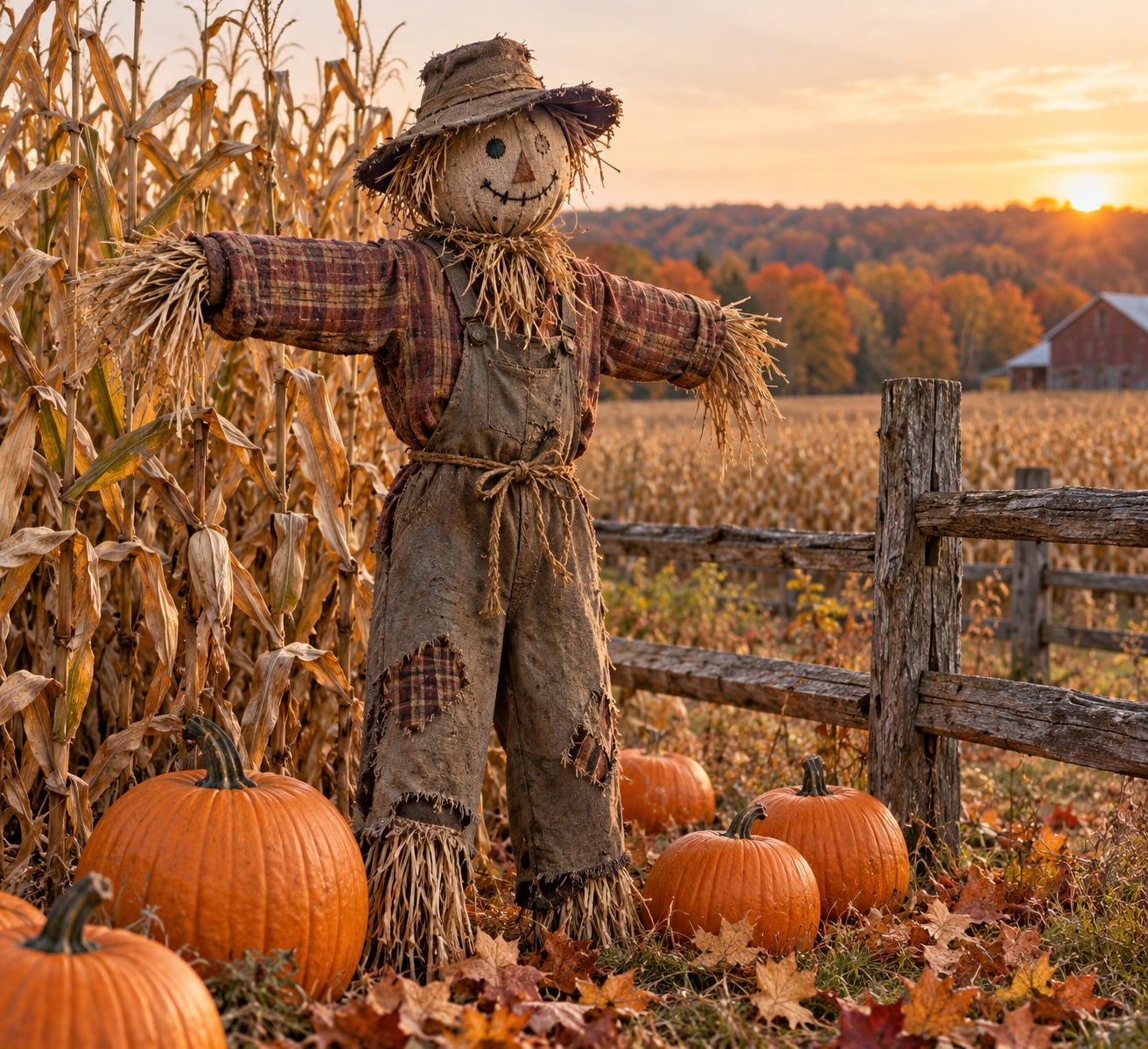
A scarecrow standing in October corn is doing two jobs at once. It carries the harvest calendar, with its straw, burlap and faded work clothes, and it carries the part of the figure that refuses to settle down, because a motionless person left alone in a field is just strange enough to worry a bird or a passerby. Autumn decorating leaned into the first job, and Halloween leaned into the second.
Table of Contents
- How Scarecrows Became a Fall Symbol
- What Did People Use Before Scarecrows?
- How Are Modern Scarecrows Connected to Harvest Work?
- When Did the Straw Figure Become a Scary Story Figure?
- Did Julia Bradstreet Invent the American Scarecrow?
- How Did The Wizard of Oz Make the Scarecrow Famous?
- How Did Scarecrows Become Symbols in Art, Film, and Literature?
- How Did the Famous Halloween Broadcast Shape Their Image?
- Why Do People See Scarecrows in Fall Decorations Today?
- How Does Your Own Scarecrow Become a Halloween Tradition?
- Frequently Asked Questions
- Are scarecrows older than Halloween?
- What country are scarecrows associated with?
- Did scarecrows really guard medieval fields?
- Why is the Halloween scarecrow wearing a sackcloth face?
- What is the difference between a field scarecrow and a Halloween scarecrow?
- Why are scarecrows more popular in autumn than at other times of year?
- Conclusion
How Scarecrows Became a Fall Symbol
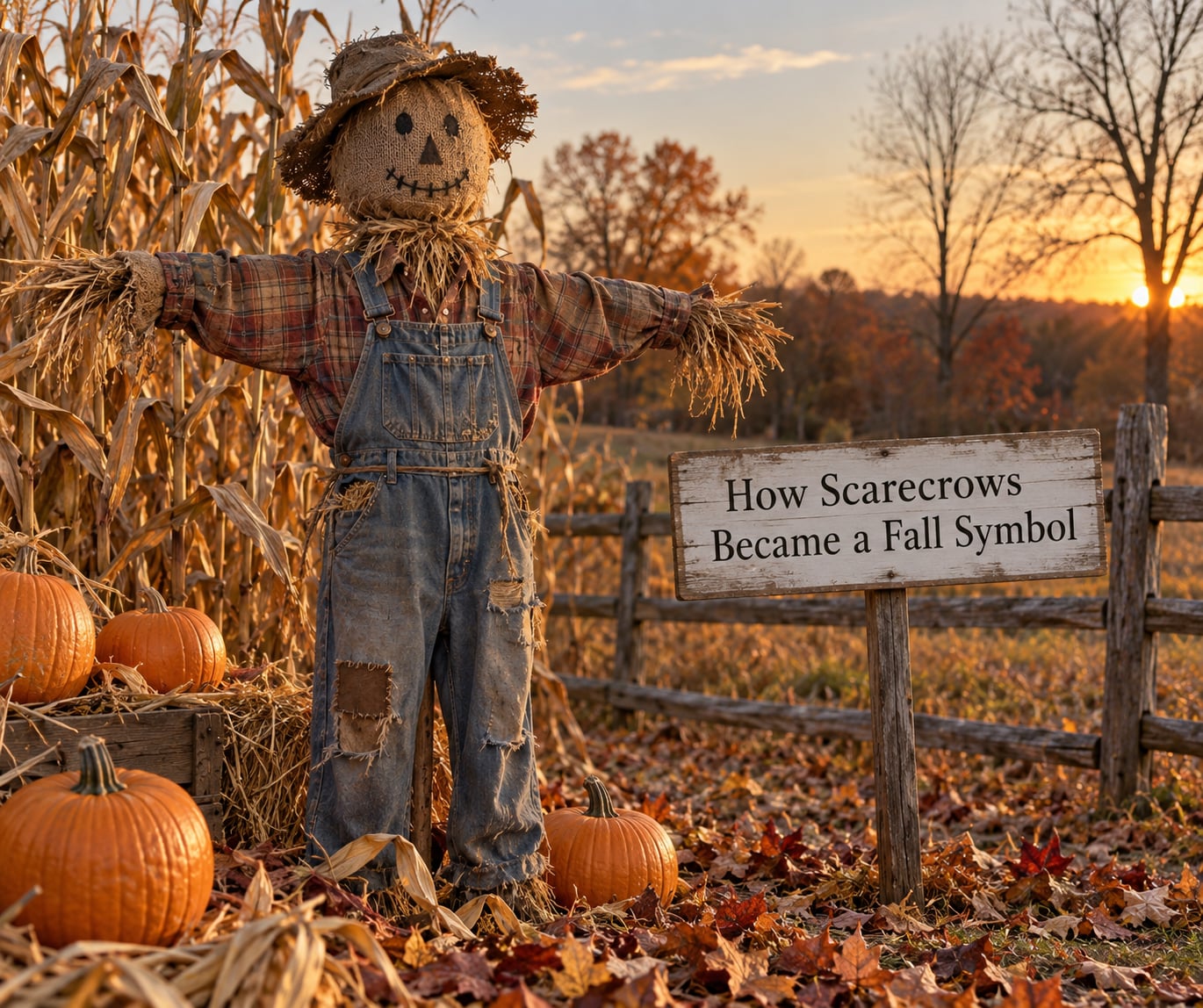
How scarecrows became a fall symbol comes down to three things lining up: a season with a visible end, a figure that already looked like a person, and a shift in who buys decorations.
- The calendar. Straw, corn shocks, pumpkins and leaf color all ripen and get harvested on the same schedule. Anything associated with them borrows that timing automatically.
- The silhouette. A scarecrow reads as a human shape from a long way off. Human shapes carry story, and a story that stands alone in a field has nowhere good to go.
- The buyer. When the work moved indoors or onto trucks and netting, the figure stayed behind as a decoration. People stopped needing it and started wanting it.
That third step is the one most accounts skip. Scarecrows did not become lawn ornaments because people found them charming. They became lawn ornaments because the job disappeared, and by then the shape had forty centuries of meaning attached to it.
What Did People Use Before Scarecrows?
Farmers have been trying to move birds off crops for as long as they have been growing crops. Field guardians predate straw figures in several forms, and most were not the direct ancestor of the modern scarecrow.
Ancient Egyptian paintings from the Nile valley show wooden frames covered with netting used against quail descending on the grain, a technique historians describe in tomb imagery rather than guesswork. Greek and Roman growers placed figures such as the fertility god Priapus in gardens and fields, more as a promise of good growth than a bird deterrent.
Medieval European farmers relied on whatever was cheap and immediate: clappers and noisy devices, reflective scraps, netting, trained birds of prey, and simply moving through the rows often enough. Scarecrows appear in English records from the late medieval period onward, and one straw effigy with a human skull face found preserved in a bog in Galloway, Scotland, is generally dated to the thirteenth century.
How Are Modern Scarecrows Connected to Harvest Work?
The connection is still direct for a few growers. Market gardens, u-pick pumpkin patches, corn mazes and vineyards put figures in rows to move birds off ripening fruit, and farmers who use them say plainly that a moving target works better than a static one.
Most growers abandoned them anyway, and the reasons are worth stating because they explain the decorative takeover. Birds learn. A scarecrow that never changes stops being a threat after a season or two, and the species that cause real damage eat seed rather than stalk. Netting is more reliable and increasingly affordable, sound and moving deterrents spread further than a pole, and a figure left in a field collects weather damage and occasionally gets knocked over by a curious animal.
Pull those threads together and the shape of the story gets clear: the scarecrow is a harvest object first and a Halloween object second, its folklore says it absorbs bad luck rather than creates it, and its move into seasonal decorating happened after the agricultural use faded.
When Did the Straw Figure Become a Scary Story Figure?
The scary half of the scarecrow grew out of how farmers disposed of it. Most rural traditions treated the end-of-season figure as something that had absorbed the field’s bad luck, which meant it could not simply be left standing or thrown in a compost pile.
Across Britain and Ireland the disposal customs were specific. A straw figure was burned at the year’s end, sometimes on a bonfire lit at the harvest festival, sometimes with a piece of the last sheaf. In parts of England and Scotland it was burned with the hat, the field’s weeds and a handful of salt. Elsewhere it was buried face-down, or left on the field gate for the current farmer to clear away and take the accumulated misfortune with it.
Ritual use ran deeper than disposal. Straw figures were built to hold a spirit or trap a witch, and the idea was sympathetic magic: the thing made of the crop absorbs whatever is sent into it. Russia had its own version with the Domovoi, a household spirit said to hide in the last sheaf of grain, which had to be threshed with care or ritually coaxed out. In Japan, farmers worried less about the straw figure itself than about the field kami it displaced, so the rice-field scarecrow known as the kakashi was given a face and sometimes a joke wig, partly to keep a god amused.
So the ominous reading was there long before any costume aisle. A straw person that collects misfortune, stands facing the road, and looks more attentive than the person who built it was always going to unsettle somebody.
Did Julia Bradstreet Invent the American Scarecrow?
The name behind the American scarecrow legend is Julia Bradstreet, and the honest answer is that her role is documented in outline but overstated in most retellings.
Bradstreet is recorded as exhibiting a scarecrow-like figure of her own construction in Boston in the middle of the nineteenth century, presenting it as an invention, and that public exhibition is usually cited as the moment an American-made straw figure entered public view. What happened afterward is where the myth grew. Later accounts had her travelling the country demonstrating her design, and that part is much harder to source. Museum and historical material generally treats the wider story as tradition layered on a real event.
The claim is worth repeating with its hedge attached, because it is a good example of how folk history works: a real person, a real exhibit, and a national origin story attached after the fact. Scarecrows were already in American fields before any individual inventor, imported or invented independently as farmers found them useful.
How Did The Wizard of Oz Make the Scarecrow Famous?
The 1900 novel by L. Frank Baum did something no scarecrow story had managed before, and it is the opposite of frightening on purpose. His Scarecrow wants a brain. He is clever, kind, cowardly in the way of anyone who has never been anywhere, and he is wanted and accepted by the people he meets rather than avoided.
That version changed what the figure could carry. Before Oz, a scarecrow was a static object or a nasty piece of ritual. After it, the scarecrow was a sympathetic character, a figure the audience roots for, and the silhouette became friendly and familiar at exactly the same time it became famous.
The screen version made that permanent. The 1939 film adaptation put Ray Bolger’s Scarecrow in a Technicolor Kansas, singing while he works and dancing with farm girls in a sequence that audiences still quote. Nearly a century on, the odds are that the image most people carry in their head of a scarecrow is closer to that film than to anything in a real field.
How Did Scarecrows Become Symbols in Art, Film, and Literature?
Once the figure could hold meaning, writers and filmmakers used the same trait repeatedly: it is a person-shaped thing that does not quite count as a person.
In American poetry and seasonal writing, the scarecrow shows up as a stand-in for the farmer who is absent, the field without labor in it, or the harvest standing in for time running out. In horror and gothic fiction the same shape flips negative, because a figure that resembles a person but never moves correctly is exactly the wrong kind of almost-human.
The 1964 film The Night of the Hunter is the cleanest example. Its two conjoined villains set a scarecrow on a farmhouse porch with a woman’s head and hands, and the image works precisely because the audience can still read a field guardian underneath the horror. Halloween culture runs on that same trick, which is why the creature is scarier than a ghost: a ghost is a dead person, while a scarecrow is a job with nobody in it.
Costumes followed the same line. The Oz scarecrow has been a school play and trick-or-treat staple for decades, and outdoor seasonal retailers sell the wide-brim hat, burlap head and floppy clothing as a set. Halloween masks and animatronic yard props arrived later, usually leaning on the version where the figure has come alive, but the costume tradition itself goes back to a friendly literary character.
How Did the Famous Halloween Broadcast Shape Their Image?
The broadcast everyone remembers happened on October 30, 1939, when CBS radio aired a performance of The Wizard of Oz shortly before Halloween. It was an advertisement for Ovaltine, which is the part that gets forgotten, and it was widely reprinted in newspapers.
Listeners who tuned in and then tuned out because a doctor was advertising produced the legend that the broadcast caused a national panic, which turned out decades later to be a newspaper story that ran without anyone checking who actually wrote it. The story is a good example of a Halloween-adjacent myth that gets repeated because it is a better story than the truth.
The broadcast still mattered for a different reason. Sam Winkler introduced it as “Timid Soul,” a character addressing the audience in a hazy, faraway register, and the show left an enormous audience imagining a made-up land right before the gates of candy houses opened. A friendly, disembodied voice describing a scarecrow, delivered in the week before Halloween, is a reasonable way for the figure to get filed in the spooky drawer.
Modern streaming and cable rebroadcasts of the 1939 film each October have kept doing the same work for three decades, which means the Halloween association gets reinforced annually whether or not anyone is thinking about 1939.
Why Do People See Scarecrows in Fall Decorations Today?
Scarecrows work in fall decorating for practical visual reasons as much as sentimental ones.
- Texture. Straw, burlap and twine read as autumn without any color at all, so the figure works in a neutral palette.
- Color match. Tan, ochre and rust sit inside the same palette as dried corn, wheat sheaves, gourds and leaf litter.
- Place. A scarecrow only makes sense outdoors in a field or a garden, and that limitation is exactly the charm for a porch or a farm stand.
- Scale. It is a life-size human form made of nothing valuable, so it reads as nostalgic rather than expensive.
- Restraint. Compared with a ghost, a skeleton or anything gory, a straw figure gives a yard a Halloween mood without the mess or the shock.
Community events keep the tradition participatory rather than purely decorative. Scarecrow festivals in places like Schuck, Nebraska and Shelby Township, Missouri let towns build, judge and then parade figures through town, sometimes with a themed category such as best pun or best historical character. Those events sit closer to a harvest festival than to a haunted house, which is a useful reminder that this is a harvest object first.
How Does Your Own Scarecrow Become a Halloween Tradition?
Build the figure the way a farmer would, then decide how much menace to add. Doing it in that order is what separates a scarecrow from a generic Halloween prop.
- Make the frame real. Two lengths of timber crossed and lashed at the top, or a single heavy post with a crosspiece. A free-standing wooden frame lasts better than a wire one if a gust catches the shirt.
- Add the stuffing. Bunched straw tied to the crossbar and arms gives the shape before the clothes go on, so the figure hangs rather than looks packed.
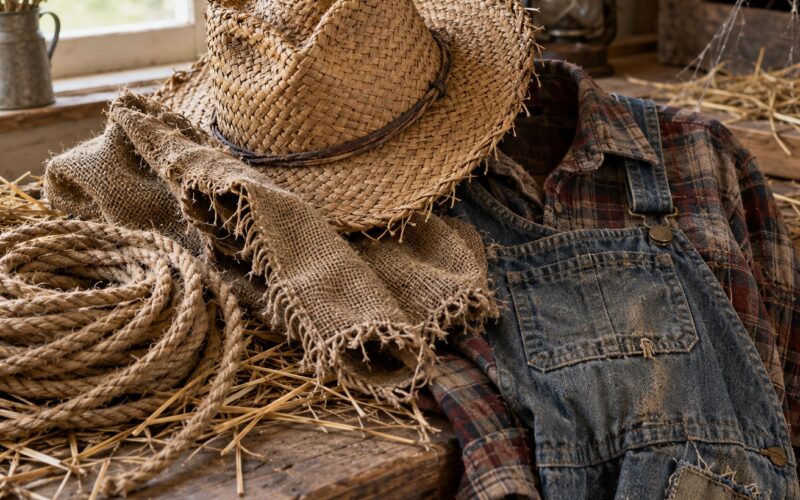
- Dress it in work clothes. Faded overalls, a worn button-down, boots and a straw or cloth hat. Real workwear carries the harvest association on its own, and worn clothing also looks better when the wind moves it.
- Get the head right. A burlap sack with stitched features is the traditional route. If you want the grinning pumpkin head, that is a Halloween update rather than a harvest one, and it is a bigger jump than most people expect.
- Give it one unsettling detail, not five. A single turned head, a coat hanging from one hand, or a face angled toward the path works better than blood, gore and a whole haunted backstory combined.
- Light it from below. A warm porch light or a covered lantern at the base changes the read from cheerful to watchful. Battery candles are safer around straw and clothing.
Anchor it properly, since wind is usually what topples a scarecrow, and keep it clear of any heat source or open flame. If a dog, cat or neighborhood child is likely to reach it, check it over before it goes out.
Frequently Asked Questions
Are scarecrows older than Halloween?
Yes. Straw figures in European fields are documented from the medieval period onward, and an effigy dated to the thirteenth century was recovered preserved from a bog in Scotland. Modern Halloween developed much later, largely from twentieth-century North American culture, though it drew on older European seasonal festivals such as Samhain. The scarecrow was already doing its job in fields centuries before anything called Halloween existed.
What country are scarecrows associated with?
You will find them almost everywhere crops are grown, but the form most people picture, a straw-stuffed frame in worn clothing standing in a cornfield, is strongly associated with the United States and Western Europe. Japan has the kakashi in rice fields, Korea has its own straw field figures, and parts of West Africa use them as well. The underlying job of moving birds off a ripening crop is universal.
Did scarecrows really guard medieval fields?
Yes, though usually alongside noisier and cheaper methods. Medieval European farmers used clappers, reflective materials, netting and frequent movement, and straw figures appear in English records from the late medieval period. Archaeology backs the record: a straw effigy with a human skull face, dressed in a hooded tunic, was recovered from a bog in Galloway, Scotland. It was a working tool first and a symbol much later.
Why is the Halloween scarecrow wearing a sackcloth face?
The sackcloth head is practical history rather than spooky invention. Burlap sacks were cheap, available and tough enough to stuff with straw, so generations of farm figures ended up with heads made from them. Halloween decoration borrowed that look wholesale, which is why the grinning sack head now shows up in costumes and yard displays that have nothing to do with farming. The exaggerated stitched smile is the modern addition.
What is the difference between a field scarecrow and a Halloween scarecrow?
A field scarecrow is built to work: a simple frame, loose straw, whatever clothing is worn out, and usually no more than painted features. A Halloween scarecrow is built to be seen at night, so it tends to use a manufactured body, a fixed expression, lighting and a setting chosen for a walkway or porch. The field version is a farm tool with an autumn look, while the Halloween version is a character, and that is the whole difference in one sentence.
Why are scarecrows more popular in autumn than at other times of year?
Because almost everything about a scarecrow belongs to the harvest calendar: straw, burlap, dried corn, pumpkins and the end of the growing season all arrive together. That timing is reinforced commercially every autumn, so shoppers see the same figure year after year at the moment they are already decorating. Outside fall it has no seasonal job to do, which is why the Halloween and porch versions essentially disappear by January.
Conclusion
Scarecrows came into fall symbol status because the harvest season gave them the calendar and a strange human shape gave them the story, then the loss of farm work handed them to decorators who wanted a Halloween mood they could put on a porch. Start from a real harvest figure when you build your own: a timber frame, loose straw, faded work clothes. Add exactly one unsettling detail and light it from below, and you get the entire history in a single yard.