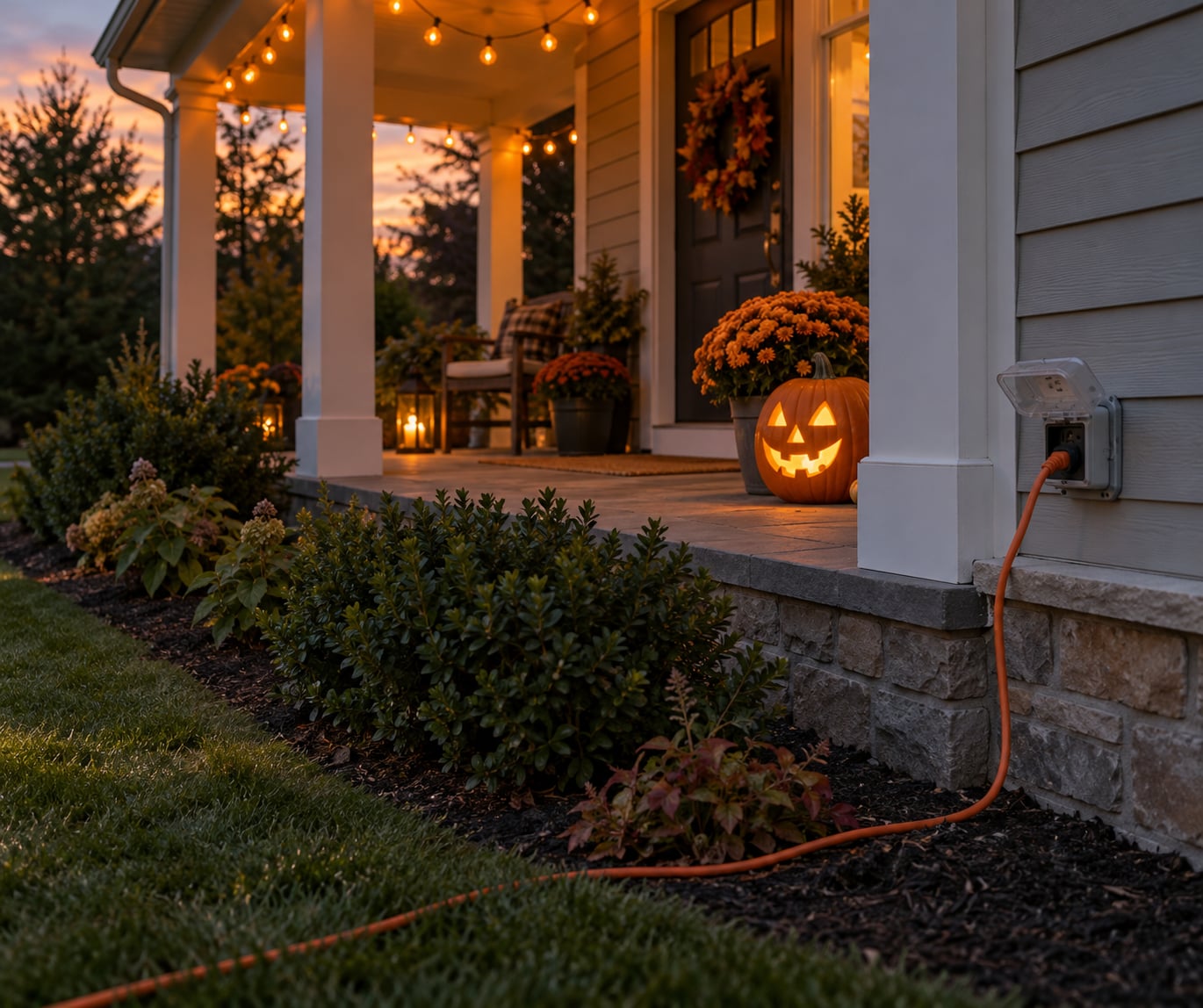
Most display problems in October are power problems. A yard full of lights, inflatables and animatronics that draws more current than one 15-amp circuit can carry, cords crossed with garden hose plugs, and a plug connection sitting in a puddle will turn a good Halloween setup into a bad night. Learning how to power outdoor Halloween decorations safely takes about an hour of planning and an afternoon of setup, and it is well within reach for anyone comfortable with a drill and a tape measure.
This guide walks through the whole setup: planning the load, choosing gear you can verify, building a GFCI-protected power source, running cords, protecting them from rain, and testing the finished display. It also covers the mistakes that show up every year, and the handful of jobs where you should stop and call an electrician instead.
Decorations tend to sit plugged in for weeks. CPSC and NFPA holiday decoration guidance both hammer the same point: most decoration-related fires and shocks trace back to damaged cords, improper connections and overloaded circuits, not to anything exotic. Fix those three things and the rest is routing and aesthetics.
Table of Contents
- What You Need
- Step-by-Step: How to Power Outdoor Halloween Decorations Safely
- 1. Plan the Layout and Electrical Load
- 2. Choose Outdoor-Rated Lights and Decorations
- 3. Set Up a GFCI-Protected Power Source
- 4. Connect Extension Cords Safely
- 5. Protect Cords, Plugs and Decorations from Weather
- 6. Test the Display and Turn It Off Safely
- Common Mistakes
- When to Call an Electrician
- Frequently Asked Questions
- Can I use indoor Halloween lights outside?
- How do I safely power multiple outdoor Halloween decorations?
- Do outdoor Halloween lights need a GFCI outlet?
- Can I connect several outdoor extension cords together?
- Is it safe to leave outdoor Halloween lights on in the rain?
- How do I stop an outdoor extension cord from becoming a trip hazard?
- Conclusion
What You Need
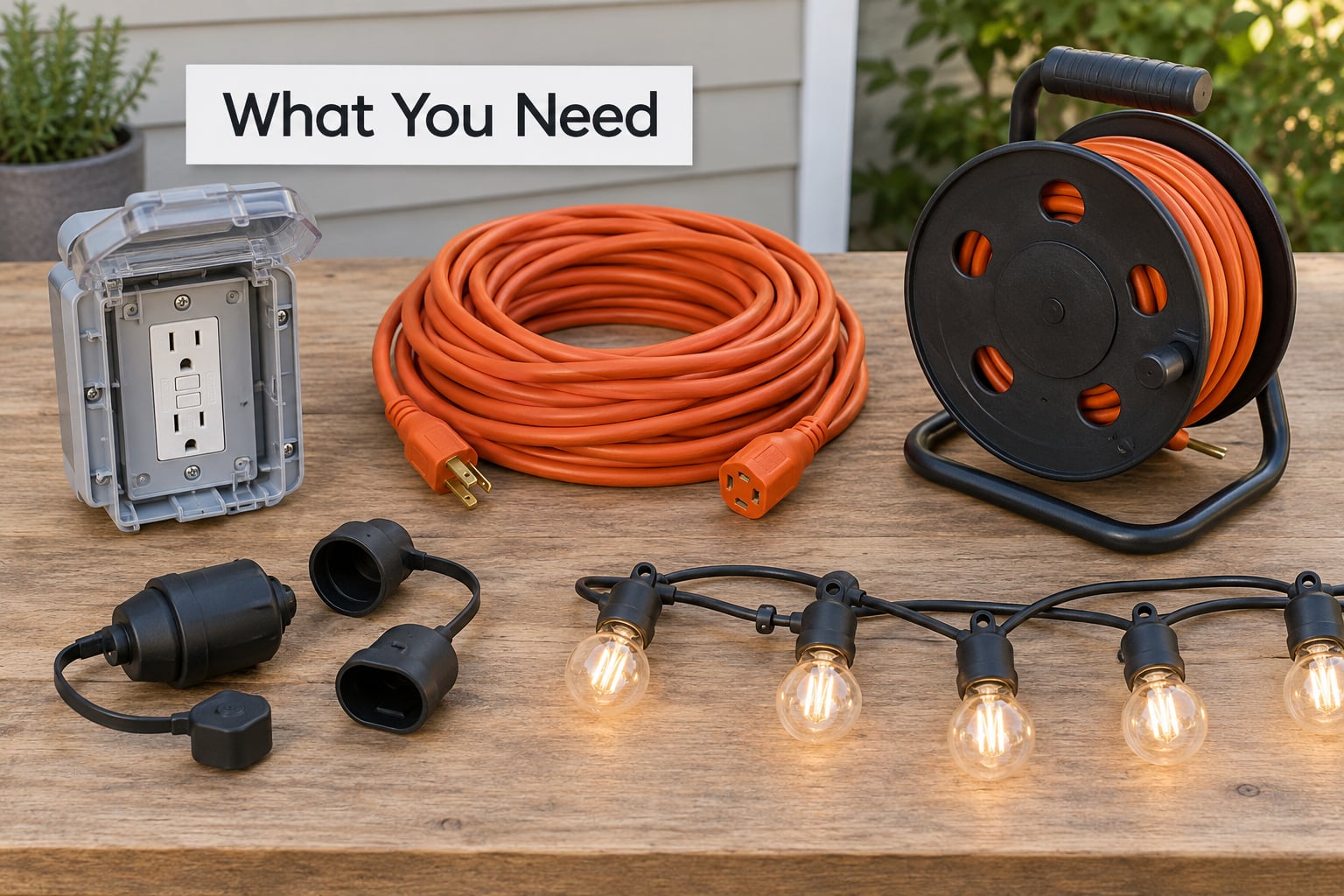
Gather everything before the first string goes up. Grabbing for the wrong cord at dusk is how displays end up running on indoor wire.
- A grounded exterior receptacle with a test button. Look for the two buttons and the little TEST/RESET wording molded into the face. If the outlet has no GFCI, stop at step 3.
- Outdoor-rated extension cords. The jacket lettering should include a W (SJTW or SJEW). Twelve-gauge for long runs or heavy props, 14-gauge for short string-light runs.
- A distribution point. Either a multi-outlet extension cord with spaced taps, or a dedicated outdoor power stake that gives you a ground connection far from the house.
- Weatherproof connection covers. The domed in-use covers that screw over a receptacle are for the outlet. For plug-to-plug joints you need rubber covers or a lidded weatherproof box.
- Routing hardware. Cord covers or cable ramps for walkways, clips and stakes for running along edges, and a few rocks or mulch for pinning cords to the ground.
- A photocell timer or smart plug. Both cut power automatically, which removes the single most common display mistake: forgetting to shut things down.
Step-by-Step: How to Power Outdoor Halloween Decorations Safely
1. Plan the Layout and Electrical Load
Walk the yard with a tape measure before you unpack anything. Divide it into zones — path, porch, left fence, far corner — and note where an exterior outlet can reach each zone.
A standard 15-amp household circuit carries about 1,440 watts, but continuous loads should stay at 80 percent, roughly 1,150 watts. A 20-amp circuit gives you about 1,800 watts and about 1,440 watts at the same 80 percent level.
Add up the wattage of everything in a zone. String light packaging states it, and LED strands sit so far below incandescent that you can usually add more of them before the number matters. You will know the math worked when the breaker stays put for a full evening of switching lights on and off.
2. Choose Outdoor-Rated Lights and Decorations
Every powered item in the yard needs a label that says outdoor use. Read the cord jacket, not the packaging: SJTW means the outer insulation is rated for wet and outdoor locations, and the W is the letter that matters.
A UL or ETL mark means an independent lab tested the cord to a safety standard. A three-prong plug means the cord is grounded. If any of those three signals is missing, that cord stays in the garage.
Favor LED over incandescent. LEDs run cooler, draw a fraction of the power and tolerate the October temperature swings better. Bulbs that get warm enough to melt a prop’s fabric or dry out its internal wiring are the ones people regret in November.
3. Set Up a GFCI-Protected Power Source
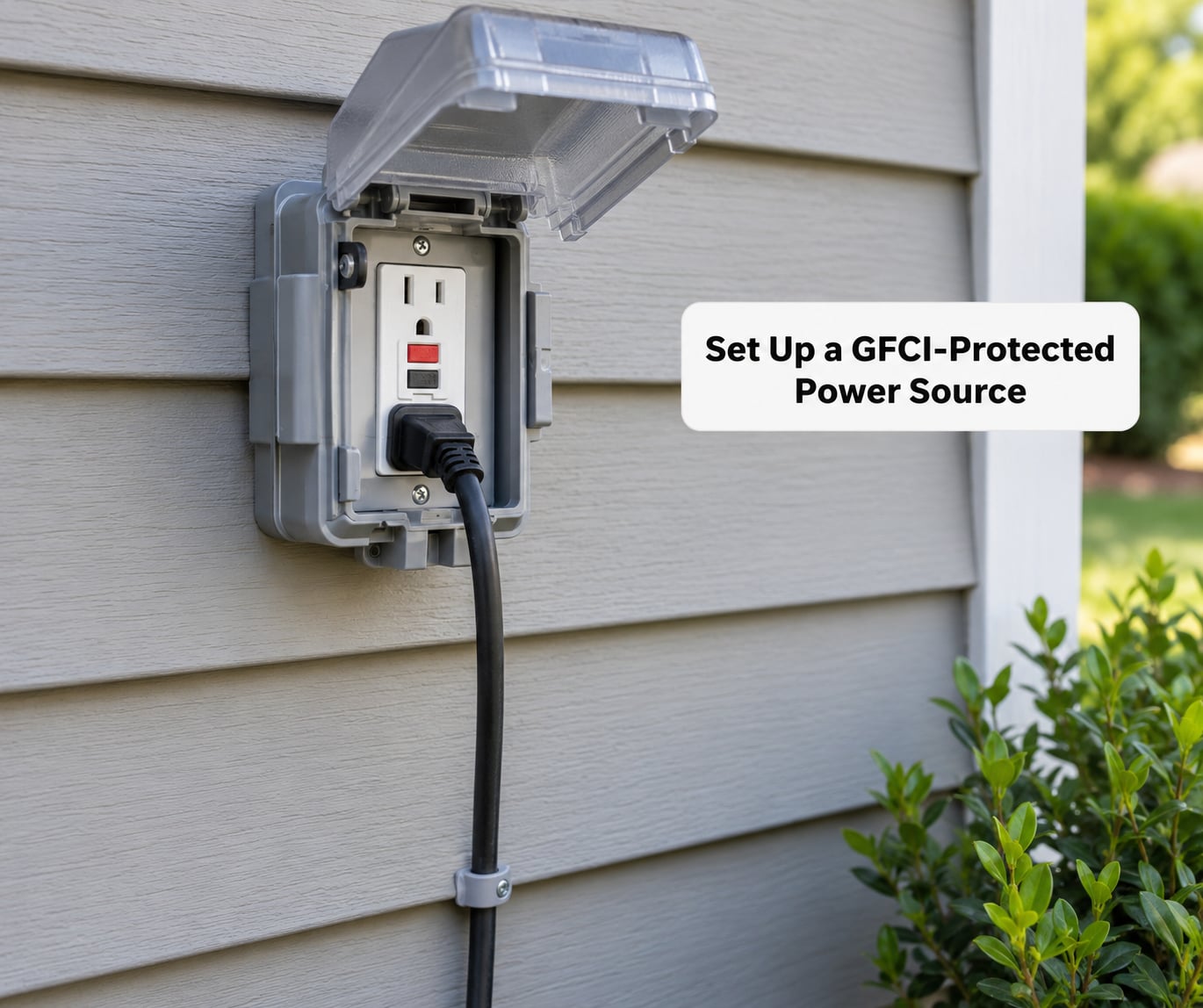
GFCI protection is required at outdoor receptacles under the National Electrical Code, and its job is to trip in milliseconds if water makes contact with the live parts. Press TEST on the outlet and watch the indicator. If it does not trip, or the outlet has no test button at all, you have a problem that an outdoor-rated cord will not solve.
Fit the weatherproof in-use cover so it seals around the plug body rather than pressing against the cord. Anything plugged in is considered exposed to weather, so a plain flip lid is not enough.
Start one display. If every light comes on and the GFCI holds, the source is good and you can build out from there.
4. Connect Extension Cords Safely
How to power outdoor Halloween decorations safely depends on keeping every joint grounded, dry and above ground. Plug your first outdoor-rated cord into the GFCI receptacle, then run it to your distribution point.
At the distribution point, connect short outdoor-rated cords to each decoration. A multi-outlet cord with spaced taps is the tool large-display builders reach for, and hobbyists on halloweenforum.com use ground stakes driven into the yard as distribution points specifically so power can travel past the reach of a single long cord. That approach works because it keeps each run short, which means less voltage drop and less heat in the wire.
Never daisy-chain cords, meaning plugging an extension cord into another extension cord’s female end. The connections warm up, and a warm connection is a failing connection.
Keep two or three devices on any one receptacle. You will know a distribution point is sized correctly when you can unplug a single strand without the rest of the zone blinking.
5. Protect Cords, Plugs and Decorations from Weather
Raise every plug-to-plug joint off the ground. A cord lying in wet grass works like a wick, drawing moisture into the connection. Thirty seconds on a stake or a piece of rigid conduit is enough.
Slip a rubber weatherproof cover over each joint, or drop the junction into a lidded weatherproof box. Orientation matters too: the opening faces down or sideways, never straight up.
Route cords along fence lines and bed edges rather than straight across the lawn. Where a cord must cross a walkway, run it through a cord cover or cable ramp, and keep the walkway itself at least three feet wide. Brown or green cords are worth the trip to the hardware store — people on r/halloween swear they vanish against grass and mulch.
Secure cords where a gust cannot lift them and where a trick-or-treater cannot hook a shoelace on one. When severe weather is forecast, unplug the display and bring the electrical gear in. A soaked inflatable that keeps inflating is a burst waiting to happen.
6. Test the Display and Turn It Off Safely
Set the photocell timer or smart plug to switch everything off around 1 a.m., then watch the display run for ten minutes from where you can see the whole yard. Look for flicker, dim sections and any outlet cover or plug that feels warm.
Check every bulb seat, every cord along the house and every connection in the grass. A smell like burnt plastic or a breaker that trips when the animatronic starts means you have a load or connection fault, not a bad bulb.
Shut down in reverse: kill the smart plug or timer, unplug each decoration at its own plug rather than yanking the main cord, then coil cords loosely and store them dry. You will know shutdown worked when the yard is dark, the breaker panel is quiet and nothing is left wet in a storage bin.
Common Mistakes
Almost every display fault I hear about traces back to one of these, and each has a straightforward fix.
Using indoor-rated cords outside. Indoor cord jackets are paper-thin insulation that absorbs water and stays conductive. The fix is simple and non-negotiable: swap to SJTW or another W-rated cord before anything gets plugged in.
Daisy-chaining extension cords. Stacking cords creates stacked connections that heat up under load. Run one cord from the outlet to a distribution point, then short cords off that point.
Overloading one outlet. Six props on one receptacle is the standard beginner mistake, and it shows up as a tripped breaker or flickering lights. Split the display across circuits and keep to two or three devices per receptacle.
Leaving plug-to-plug joints on the grass. Wet grass plus a partly open connector is a shock waiting for the first trick-or-treater who grabs it. Raise the joint and cover it.
Using a standard indoor power strip outdoors. The housing is not weatherproof and the outlets are uncovered. Use an outdoor-rated power strip with covers, or better, a multi-outlet outdoor cord.
Running cords across walkways uncovered. This is how someone breaks an ankle in the dark. Cord covers, ramps or a rerouted path fix it in a few minutes.
Forgetting to shut down. Displays left running for weeks waste power and cook adapters that were never meant for that duty. A photocell timer costs almost nothing to add and removes the problem entirely.
Skipping the inspection. A bulb with a cracked socket or a cord with a soft spot under the insulation will fail at the worst moment. Check each string in daylight before it goes up.
When to Call an Electrician
Some jobs are not a weekend project. Call a licensed electrician, and do not work around the problem yourself, if any of these apply.
- You need a new exterior circuit, or the outlet you want to use is an indoor receptacle on a porch wall.
- No GFCI protection exists at the outlet, and adding a GFCI receptacle means new wiring rather than a swap.
- The breaker trips repeatedly, or trips as soon as you plug the display in.
- Outlets, plugs or cord ends show scorching, melting or a burnt smell.
- You are unsure whether a circuit is 15-amp or 20-amp and you plan to load it near capacity.
- You want to hardwire lighting, add a subpanel, or run power to a detached structure or commercial-scale haunt.
For authoritative guidance, the CPSC and NFPA holiday decoration safety resources and the Electrical Safety Foundation International all publish plain-language material on cords, GFCIs and load limits. None of it replaces a licensed electrician when the wiring itself needs to change.
Frequently Asked Questions
Can I use indoor Halloween lights outside?
Only if the light string itself carries an outdoor-use label. Indoor strands usually say indoor use only on the packaging and their cord jacket lacks the W in SJTW. That insulation absorbs rain and keeps conducting, which turns a decorative strand into a shock hazard. Check the cord jacket lettering and look for a UL or ETL mark before anything leaves the garage, regardless of what the box promises.
How do I safely power multiple outdoor Halloween decorations?
Run one outdoor-rated extension cord from a GFCI-protected exterior receptacle to a distribution point, then branch short cords off that point. A multi-outlet cord with spaced taps or a ground stake with several outlets keeps every run short, which cuts voltage drop and heat. Keep two or three devices per receptacle and spread the display across separate circuits so no single load approaches the 1,150 watt ceiling.
Do outdoor Halloween lights need a GFCI outlet?
Yes. The National Electrical Code requires GFCI protection at outdoor receptacles, and it is the single most important safety feature in a wet display. Press the test button on the outlet and confirm the indicator trips. A GFCI outlet protects people, not your cords, so you still need outdoor-rated wire and weatherproof covers on every connection.
Can I connect several outdoor extension cords together?
Do not daisy-chain them, meaning plugging a cord into the socket of another cord. Each joint adds resistance, and resistance under load turns into heat in a connector that is already exposed to rain. Instead, run one cord to a multi-outlet cord or outdoor power stake, then plug each decoration into its own outlet. Cord-to-cord connections always need weatherproof covers.
Is it safe to leave outdoor Halloween lights on in the rain?
Outdoor-rated strings and GFCI protection make wet weather display operation normal. Connections are the weak point, so keep every plug-to-plug joint above ground, covered and angled downward rather than up. Unplug the display during severe thunderstorms, and bring inflatables inside rather than letting them run wet for days. Never leave a standard indoor power strip in the rain.
How do I stop an outdoor extension cord from becoming a trip hazard?
Route cords along fence lines, bed edges and the base of the house instead of across open lawn or walking paths. Wherever a cord must cross a walkway, put it in a cord cover or cable ramp rated for outdoor use. Keep paths at least three feet wide, pin cords to the ground with stakes or mulch, and choose brown or green jackets that disappear against grass.
Conclusion
Start with two things: confirm the exterior outlet has working GFCI protection, and add up the wattage of your display against the 1,150 watt safe ceiling for a 15-amp circuit. Everything after that is gear and routing.
Use only W-rated cords with a UL or ETL mark, keep every connection above ground under a weatherproof cover, and put a photocell timer on the whole display so it powers down on its own. Run the setup for a full evening before the night of the big event, and pull it all in when the weather turns.