The short answer: wear closed-toe shoes with grip, dark clothing you do not mind ruining, and layers you can peel off in a warm queue. If you want a costume, pick something built from close-fitting, flexible pieces rather than robes, capes and hard masks. Haunted houses are dark, cramped and often muddy, so comfort decides how much fun you have.
Most commercial haunts do not require a costume, though plenty of guests dress up anyway. Check your venue’s policy page before you commit to a look, because the rules about props, masks and bags are stricter than most people expect.
Table of Contents
- What to Wear to a Haunted House: Costume Ideas at a Glance
- 1. The Classic Scream Queen
- What to wear to a haunted house when you want the classic horror look
- 2. The Urban Ghost
- 3. The Undead Undertaker
- 4. The Masked Mad Scientist
- 5. The Vintage Haunted Doll
- 6. The Final Girl in Red
- 7. The Cryptid Camper
- 8. The Victorian Mourner
- 9. The Post-Apocalyptic Survivor
- 10. The Mischievous Witch
- 11. The Possessed Patient
- 12. The Black-and-White Living Dead
- Frequently Asked Questions
- Can I wear a realistic blood or wound costume to a haunted house?
- Are costumes with masks or face paint allowed at haunted houses?
- What costume props can I bring into a haunted attraction?
- What should I wear to a haunted house in cold weather?
- Should my haunted-house costume be scary or wearable?
- Can I bring a flashlight or take photos inside a haunted house?
- Conclusion
What to Wear to a Haunted House: Costume Ideas at a Glance
Every idea below works, but they are not interchangeable. This table matches each costume concept to the venue type it actually suits.
| Costume concept | Best venue | Comfort | Weather | Reason to choose it |
|---|---|---|---|---|
| Classic Scream Queen | Indoor walk-through | High | Any, with a removable coat | Reads instantly in photos and needs no props |
| Urban Ghost | Indoor walk-through | High | Cool nights only | Soft layers move quietly and photograph well |
| Undead Undertaker | Indoor haunt or graveyards | High | Any | Timeless, formal and easy to tailor |
| Masked Mad Scientist | Indoor haunt | Medium | Indoor only | Character sells it even without face paint |
| Vintage Haunted Doll | Indoor haunt | Medium | Cool nights | Simple pieces, strong silhouette |
| Final Girl in Red | Any venue | High | Any | One colour does all the work |
| Cryptid Camper | Outdoor trail | High | Cold and wet | Warm, rugged, good for long queues |
| Victorian Mourner | Outdoor trail or hayride | Medium | Cool nights | Elegant period look with layered warmth |
| Post-Apocalyptic Survivor | Outdoor trail | High | Cold, muddy | Built for dirt and weather |
| Mischievous Witch | Indoor haunt | Medium | Any | Fun at a party and on camera |
| Possessed Patient | Indoor haunt | Medium | Any | Every piece comes from a thrift store |
| Black-and-White Living Dead | Any venue | High | Any | Cheapest option on this list |
Comfort here means you can walk a queue, climb stairs and turn around quickly without thinking about your outfit. Weather suitability is about outdoor queues and hayrides, where cold and mud are the deciding factors.
1. The Classic Scream Queen
A fitted dress in a dark or red shade, a sheer or deliberately torn jacket over it, and flat closed-toe shoes. The blood-splatter detail comes from cheap theatrical blood squeezed onto a torn hem or sprayed across one shoulder.
What to wear to a haunted house when you want the classic horror look
Concrete version: a dark red slip-style dress, pale makeup with darkened eyes, and a long dark coat that you can shrug off indoors. The coat is the trick. It reads as a character outdoors and becomes a layer you carry once the building heats up.
Keep the shoes boring. Nobody has ever complimented a haunted house costume on its footwear, and everyone notices when a heel catches on a chain in a dark corridor.
2. The Urban Ghost
Start with a white or cream blouse and go downward: long black skirt or straight black trousers, flat boots or sneakers. Gray or pale makeup and hair covered with a light scarf finish the look.
Make it look lived-in rather than new. Break up a shirt hem, wash a piece in strong tea and coffee so it browns unevenly, and rub dirt into the cuffs. That aging takes an evening and costs nothing.
One warning on volume. Long flowing fabric reads beautifully in a photo and snags on the netting most haunts hang along dark corridors. Keep skirts below the knee or wear trousers instead.
3. The Undead Undertaker
A black suit, white shirt, narrow black tie, dark gloves and shoes that suit the ground you are walking on. Add a pocket watch chain, wide-brim hat or thin black band at the collar, and stop there.
Why this one works so often: it is formal clothing with a colour shift. Most people own black trousers and a white shirt already, so the whole look can come from a thrift rack in a single afternoon.
It suits hayrides and graveyards as well as indoor haunts, because a suit reads clearly even in dim lighting. Just avoid a tall top hat indoors; the ceilings in a lot of haunt rooms are low and sightlines matter.
4. The Masked Mad Scientist
A clean white lab coat over dark clothing, rubber gloves, and goggles pushed up on your forehead or worn over a simple half-mask. A stiff white streak of hair at the front does more for the character than any amount of face paint.
Skip the beakers. Many haunts prohibit handheld items at the door, so anything you carry becomes a trip back to your vehicle. The 13th Floor Haunted House Chicago publishes a flat no-prop, no-handheld-item policy, and other venues run similar rules.
Also remember that the coat gets warm. Indoor haunts pack rooms with bodies and no ventilation worth relying on, so a lab coat over a t-shirt beats one over a thick sweater.
5. The Vintage Haunted Doll
A plain black dress, dark stockings, ribbon trim or suspenders at the waist, and one soft accessory: a ribboned bonnet, a small doll, or ribbon-tied hair. Keep the palette limited to black, white and one pale accent.
The detail that sells this concept is stillness rather than fabric. Costume makers talk about posture: stand straight, move slowly, let your hands hang. A doll costume on someone who behaves like a doll is unsettling. The same costume on someone jogging to a hayride is just a dress.
Two practical notes. Avoid heavy eye-obstructing masks, since you will be navigating dark rooms with actors close by, and pin any skirt length above the knee so it stays put.
6. The Final Girl in Red
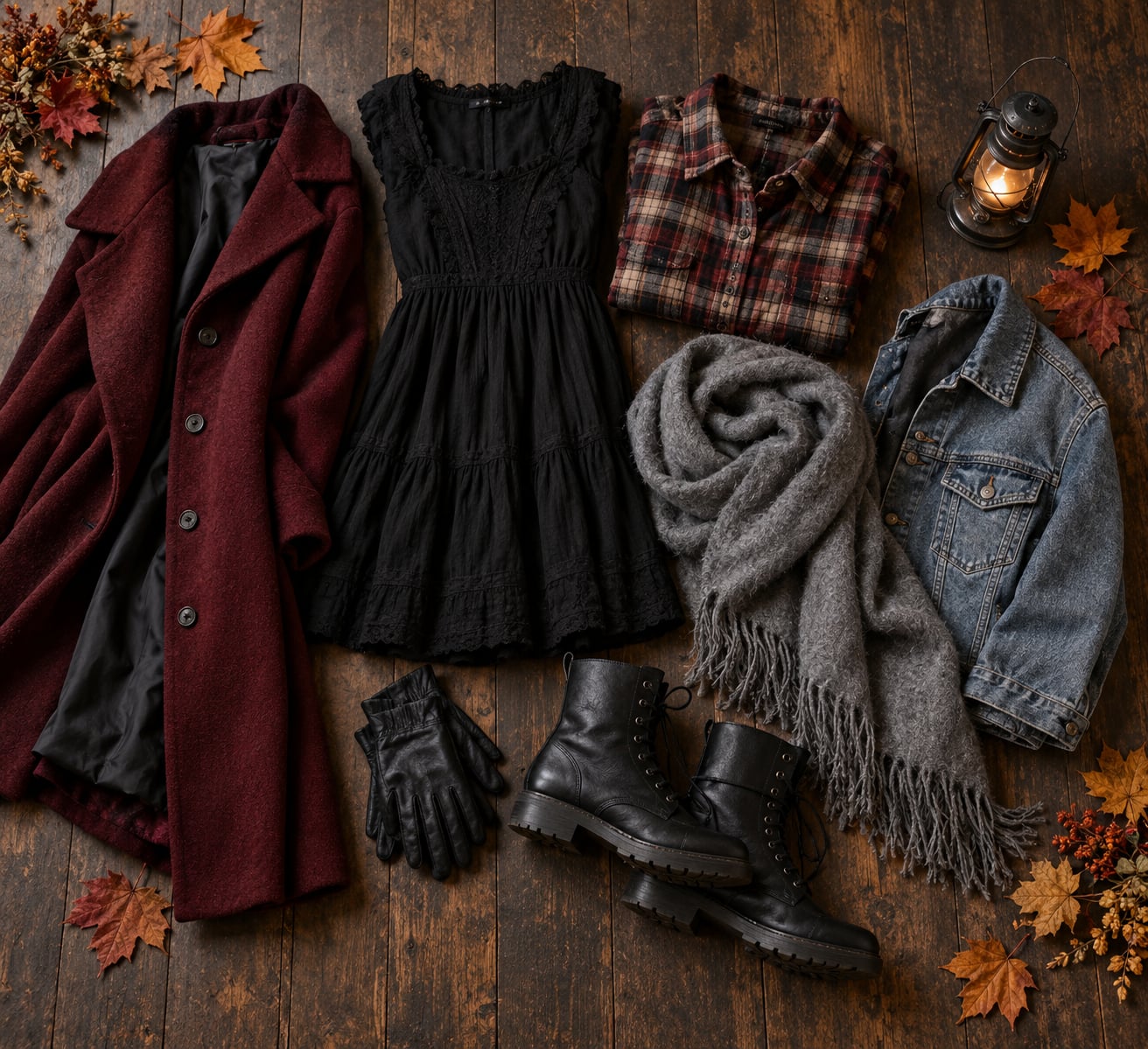
A red dress with a white shirt and a denim jacket, finished with sturdy boots. It borrows from classic slasher heroines, and the reason it photographs so well is simple: one bright colour against a dark background is instantly readable.
You do not need the whole costume to be red. A red dress with everything else dark works, and so does an all-black outfit with one red detail, like a scarf or a pair of shoes.
This is the easiest look on the list to put together for a date or a group, because everyone can wear one red piece. Nobody has to explain their outfit to anybody.
7. The Cryptid Camper
Flannel shirt, dark jeans, a utility vest with pockets, hiking boots and a backpack covered in patches. A Bigfoot camper reads clearly from a distance, and the whole thing is warm enough for an outdoor trail in October.
This is the costume to build if your haunt is outside. Trail conditions run to dirt, gravel and mud, and a pair of sneakers will look ruined by the second hayride. Boots survive that.
Add reflective tape to the backpack if the trail is unlit. A patch of light-reflective strip costs a few dollars and makes your group visible on a path with no lamps at all.
8. The Victorian Mourner
A long black or charcoal dress with a high collar, a shawl over the shoulders, dark gloves and one lace or brooch detail at the throat. Period mourning clothing is elegant, forgiving and mostly found second-hand.
Keep the accessory count low. A shawl is plenty; add a hat with a wide brim and you are back to worrying about low ceilings and coat check. One lace detail, gloves and closed shoes is a complete outfit.
Charcoal reads better than pure black outdoors. On an unlit trail, black disappears into the dark and a friend walking beside you stops being visible. Slightly lighter tones keep the silhouette readable.
9. The Post-Apocalyptic Survivor
Distressed neutral layers: work pants, a torn henley or thermal top, gloves, boots and goggles pushed up on your forehead. Washable dirt effects and frayed seams do most of the work, and all of it comes from a closet or a thrift store.
Two rules matter here. No sharp debris attached to the costume, and nothing loose like cords or dangling straps. Anything hard can hurt you or someone else when the actors move through a crowd.
Realistic wounds are the part to leave at home. Anything that reads as an actual injury creates an unnecessary problem for you, your group and the staff who have to decide whether to stop the show.
10. The Mischievous Witch
A dark dress, a shawl, costume jewelry and flat boots or low wedges. The witch hat is optional, and a floppy felt hat reads better than a structured pointed one.
Check the sightline before you commit. A structured brim can block your view of a step in a dark room, which is exactly the moment you need to see it. Test the hat by walking up and down stairs in it at home.
Skip the broom. A long pole carried through a queue is a hazard for you and for everyone behind you, and most venues will ask you to put it in your vehicle before you enter.
11. The Possessed Patient
Neutral layers in grey, blue or pale tones, an open coat or cardigan, washable stain effects and a few pinned medical-style details. Anything sewn on rather than carried keeps the hands free.
Before you commit to makeup or props, check the venue’s rules. Some operators restrict costume makeup because guests in heavy face paint are sometimes treated as performers rather than audience, and that is an uncomfortable thing to discover mid-queue.
Keep stains washable and low-contrast. A haunted attraction does not inspect clothing, but you will meet grass, dirt and hay at an outdoor one, and anything that does not wash out is a bad bet.
12. The Black-and-White Living Dead
A torn or distressed black top, black trousers, pale makeup and dark shoes. It is the cheapest concept here and the one that survives the most conditions, because every piece is something you already own.
The face covering question is worth asking. Many venues restrict masks and anything that obscures the face, and some operators go further and ask guests to skip heavy makeup entirely. One quick check of the policy page avoids an awkward conversation at the entrance.
Add dirt along the hairline and dark circles under the eyes rather than full prosthetic wounds. It reads well in dim light, costs almost nothing and comes off in the shower.
Frequently Asked Questions
Can I wear a realistic blood or wound costume to a haunted house?
Theatre blood and fabric stains are usually fine. Prosthetic wounds that read as real injuries are a different matter, because staff cannot always tell and some venues restrict them outright. The 13th Floor Haunted House Chicago publishes a no-prop, no-handheld-item policy, so anything attached to your body travels with you while anything you carry does not. Check your venue’s costume page before you buy.
Are costumes with masks or face paint allowed at haunted houses?
Often not, and the reason is practical rather than aesthetic. Haunt operators have reported that guests in heavy makeup or full masks get treated as performers, which puts them inside the show instead of in the audience. Many venues restrict masks and anything covering the face. A character that works through clothing and silhouette avoids the entire problem.
What costume props can I bring into a haunted attraction?
Assume none. Props and handheld items are the most commonly restricted category at haunted attractions, so wands, axes, brooms, fake weapons and stuffed animals usually end up in your vehicle. Worn accessories such as a pocket watch chain, ribbon or brooch are far safer. If you are unsure, email the venue a photo of the item before the night rather than finding out at the door.
What should I wear to a haunted house in cold weather?
Layer for the queue, not the scare. A warm base layer, a flannel or sweater you can remove, and a coat that fits in a bag or over your arm keeps you comfortable standing outside for an hour. For outdoor trails add boots with grip, because trail ground runs to mud and gravel. Nightmare Forest advises wearing comfortable clothes you do not mind getting dirty.
Should my haunted-house costume be scary or wearable?
Wearable, always. Every rule that matters comes down to movement: closed-toe shoes, close-fitting layers, nothing loose to snag on netting or chains, and a clear view of the floor in front of you. A costume you can run in beats a more impressive one you are thinking about the whole time. Nightmare Forest runs an indoor attraction with a scare factor above 8 out of 10, so effort goes into movement.
Can I bring a flashlight or take photos inside a haunted house?
Photography policies vary, but most venues ban flash and recording inside the attraction, and a flashlight ruins the show for everyone behind you. Phones generally stay in your pocket or a small bag. Venues often invite you to take photos outside with the monsters, so save your shots for the entrance queue and the car park, where the lighting is worth using.
Conclusion
Start with the venue’s rules page and the night’s forecast, in that order. Props, masks and bags are the three things that get people turned away, and the weather decides whether you need boots or sneakers.
Then pick the concept that matches your venue and how active the night is. Indoor walk-through, dark and packed: go for the Scream Queen or Final Girl in Red, both light and photo-friendly. Outdoor trail or hayride: the Cryptid Camper and Post-Apocalyptic Survivor are warm, muddy-proof and easy to walk in.
Whatever you choose, closed-toe shoes with grip decide how the night feels. That single item matters more than the entire rest of the costume.