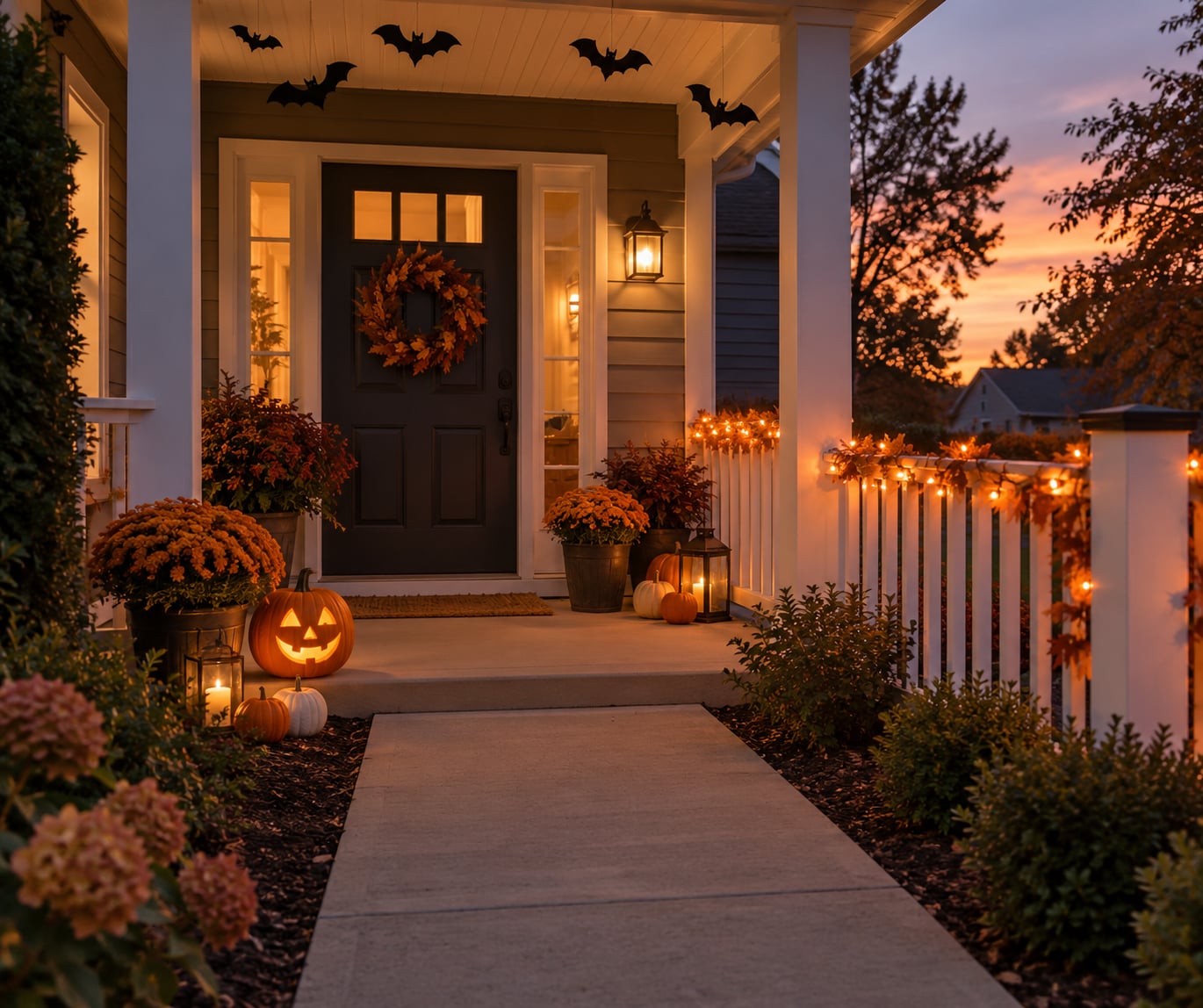
To make a Halloween display without scaring small kids, keep four things out of it: gore, realistic human-like faces, sudden or motion-triggered movement, and startling loud sound. Everything else can stay. Pumpkins, ghosts, bats, friendly skeletons and warm string lights look Halloween to an adult and read as costume props to a two-year-old, which is the whole trick.
You can build most of this in an afternoon, and the pieces are ordinary craft supplies plus a few lights. It matters more than it sounds: the fear response is about surprise and realism, not about Halloween symbols. A toddler who cannot yet tell a real person from a mannequin will react to a moving skeleton exactly the way they would react to a stranger in the dark.
Table of Contents
- What You Need for a Kid-Friendly Halloween Display
- How to Make a Halloween Display Without Scaring Small Kids: Step-by-Step
- 1. Choose a Playful Instead of Frightening Theme
- 2. Keep Props Low, Stable, and Out of Walkways
- 3. Use Gentle Lighting and Distant Sounds
- 4. Make the Display Interactive and Inviting
- 5. Test the Display Before Halloween Night
- Common Mistakes That Can Startle Small Kids
- Frequently Asked Questions
- What Halloween decorations are least likely to scare toddlers?
- How can I make an outdoor Halloween display safe for small children?
- Are animated Halloween decorations okay around young kids?
- How do I keep Halloween lights and cords from creating a tripping hazard?
- What should I do if a child seems frightened by a decoration?
- Can I make a Halloween display scary without using realistic faces?
- Create a Spooky Display That Still Feels Welcoming
What You Need for a Kid-Friendly Halloween Display
Start with a two-word theme, because it stops you buying random pieces that fight each other. Ghost and pumpkin, woodland creatures, or cartoon monsters all work. Write it on a scrap of paper and tape it to your shopping list.
For the build itself, most families end up with:
- No-carve pumpkins, or paper and foam pumpkins for indoor pieces
- Cold orange or warm white string lights, plus battery-powered LED lanterns
- White sheets or muslin fabric for bedsheet ghosts, and glue or mounting strips
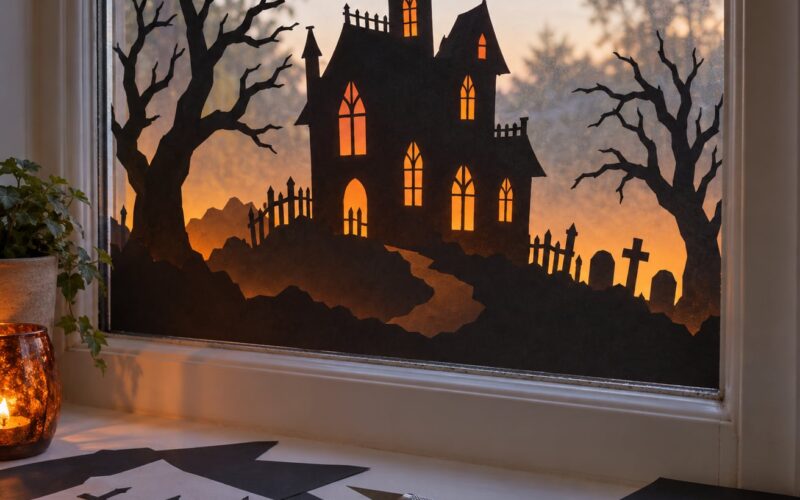
- Cardstock for bats, spiders and cut-out monsters
- A tape measure and a step stool for checking sightlines before you hang anything
- Command strips or stakes for anchoring anything that could tip
Skip the real candles. Battery LED pumpkins give you the glow with none of the burn risk, and in most places they look identical from the walkway.
How to Make a Halloween Display Without Scaring Small Kids: Step-by-Step
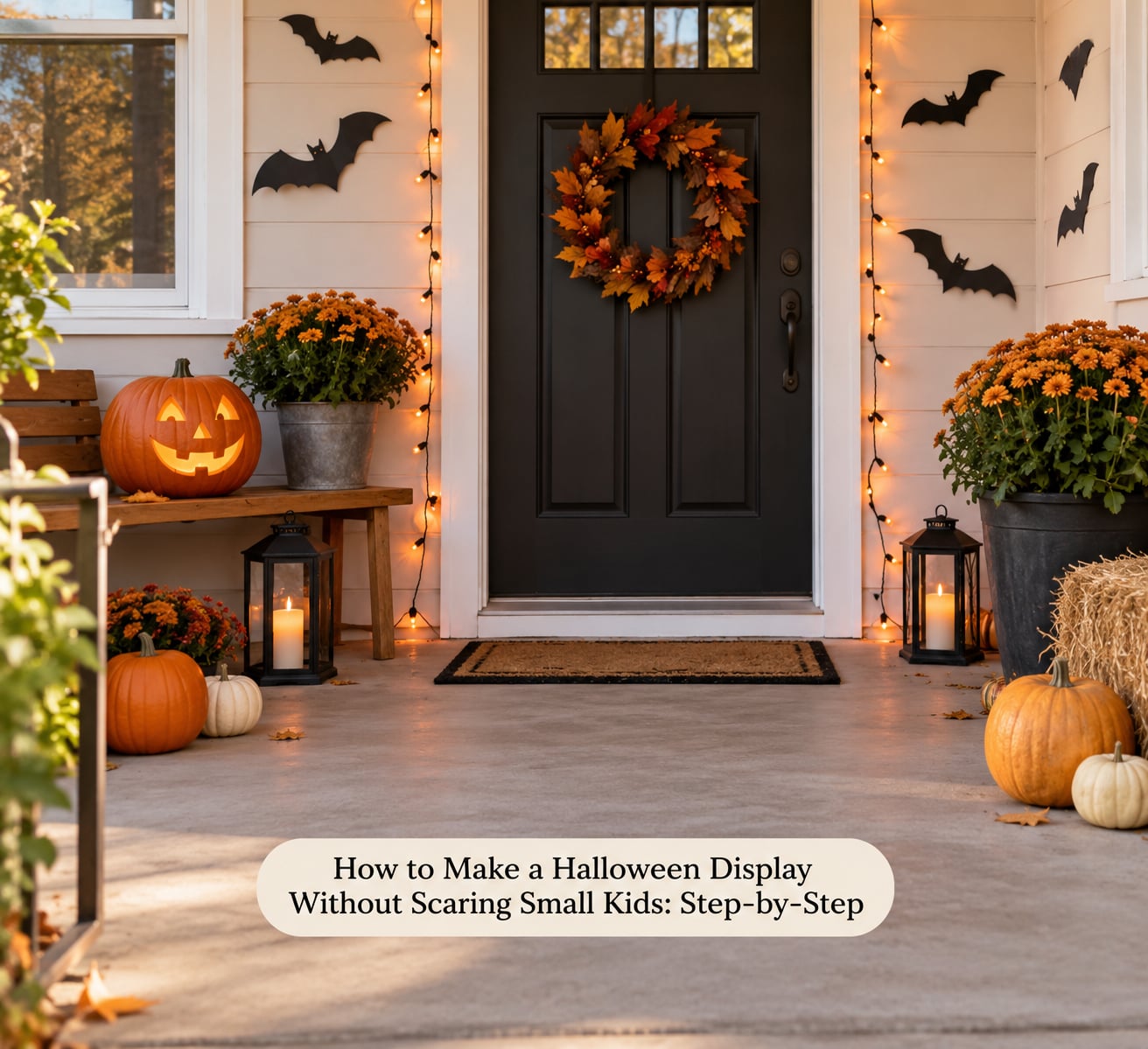
1. Choose a Playful Instead of Frightening Theme
The fastest way to soften a display is to change the art style, not the colours. Cartoonish faces, rounded shapes and bright paint read as a costume. Textured latex skin and hollow eye sockets read as a body, and that is where the trouble starts.
Themes that work well for small children include friendly ghosts with painted smiles, jack-o’-lanterns with round eyes instead of jagged ones, woodland creatures like owls and foxes, and cartoon monsters with big googly eyes. All four keep the Halloween vocabulary that makes adults happy.
Leave out realistic masks, anything with blood or torn flesh, exposed-looking bone, and life-size human figures. On the r/halloween forum, parents who rate their own displays on a one-to-ten scare scale put plain plastic arms and legs around four out of ten with no blood or guts, and treat that as the safe ceiling for a household with toddlers.
2. Keep Props Low, Stable, and Out of Walkways
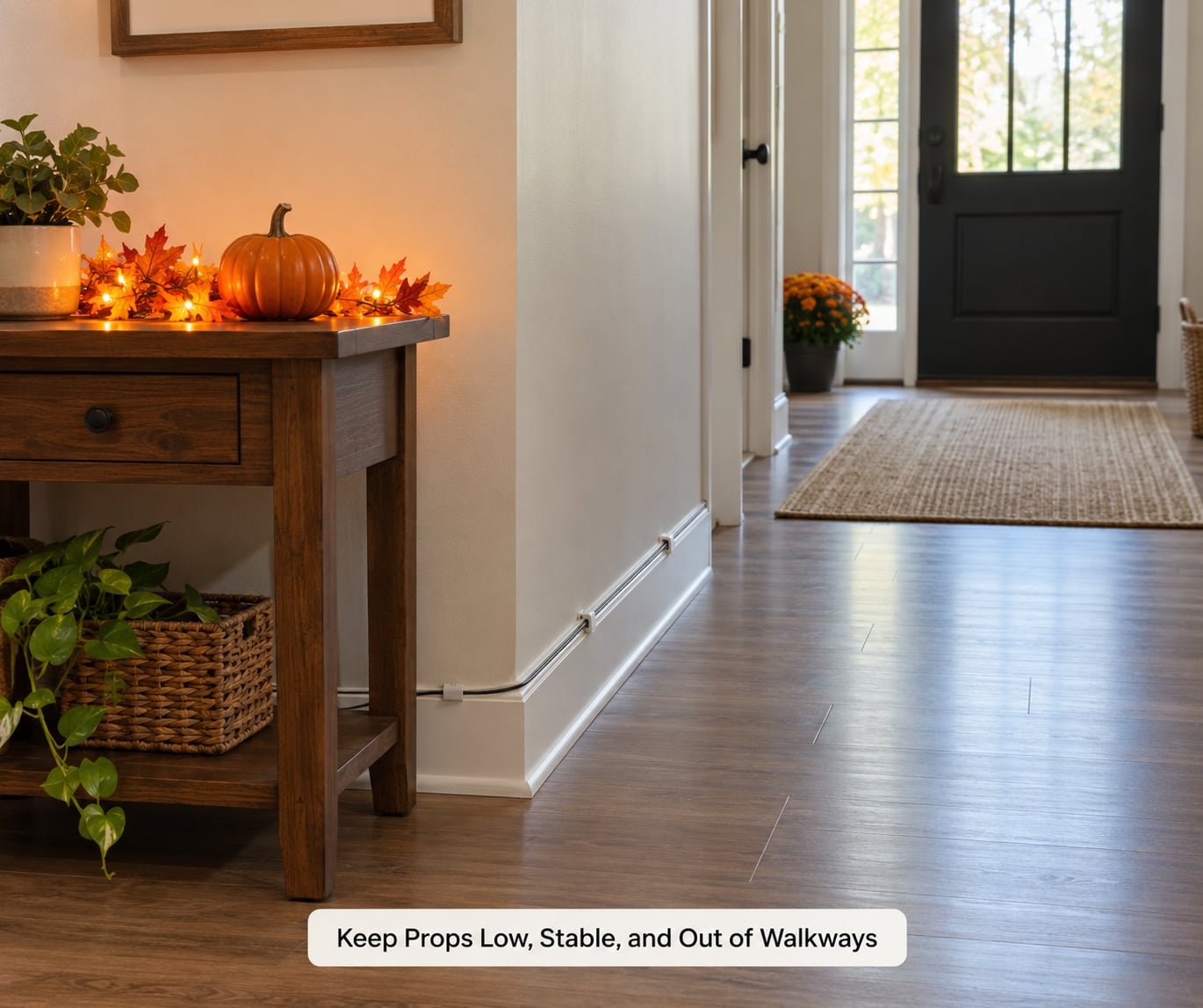
Small children walk through displays, not past them. Lay out the walking route first, from the sidewalk to the front door, and treat that route as a corridor you refuse to fill.
Put the tallest and strangest pieces beside the path or behind a railing, where a child walking straight at the door never has them filling their whole field of vision. Set lighter decorations on tables, shelves or windowsills rather than on the ground, where they get kicked, sat on and pulled apart.
Anything with a base — inflatables, statues, wooden cutouts — gets two anchors minimum. A single stake tips the moment a toddler grabs it, and a toppled metal stand can land on a foot. Keep the walkway itself at least as wide as a stroller, and check it at dusk rather than in daylight, because shadows do half the frightening at night.
3. Use Gentle Lighting and Distant Sounds
Steady light is kinder than flashing light. Orange, purple and warm white string lights give you atmosphere without the strobe effect, which is genuinely uncomfortable for sensory-sensitive children and hard on younger eyes.
If you do want sound, put the speaker somewhere it washes over the yard rather than beside the door, keep the volume at a level where you can talk over it, and start it after the first trick-or-treaters arrive. A slow creak or a low howl reads as atmosphere; a shriek timed to a child’s footstep reads as a jump scare, because that is exactly what it is.
4. Make the Display Interactive and Inviting
The best fix for fear is giving a child something to do. A small table at the edge of the display with a bowl of wrapped treats, a craft corner with paper bats and glue sticks, or chalk monster footprints on the sidewalk all turn a passive scene into a destination.
These projects do not need to be clever. Paper plate ghosts with googly eyes, painted sticks for a corner arrangement, painted rocks that line a step, and no-carve pumpkins stacked in a pyramid all take under an hour, and children old enough to help are usually far less afraid of a thing they made.
If you want one activity to end the season with, a monster egg hunt in the yard or a backyard movie with glow sticks and blankets gives you a reason to keep the lights up without escalating them.
5. Test the Display Before Halloween Night
Do your own walk-through after dark the night before. Crouch to about a three-year-old’s height and look down the route from the sidewalk. Anything that hides the door, blocks the path or appears at face level will be much bigger from down there.
Then check the mechanics. Tug each prop, look for cords crossing the walkway, confirm nothing swings when brushed, and make sure the exit to the door stays clear for a group of kids moving at once.
Last step, and the one most people skip: ask your child which specific piece feels bad and move that one first. Children often cannot explain the whole picture, but they reliably name the object. Parents report the fear concentrates hard at first sighting and eases within a day or two, so the display you test now usually settles by trick-or-treat night.
Common Mistakes That Can Startle Small Kids
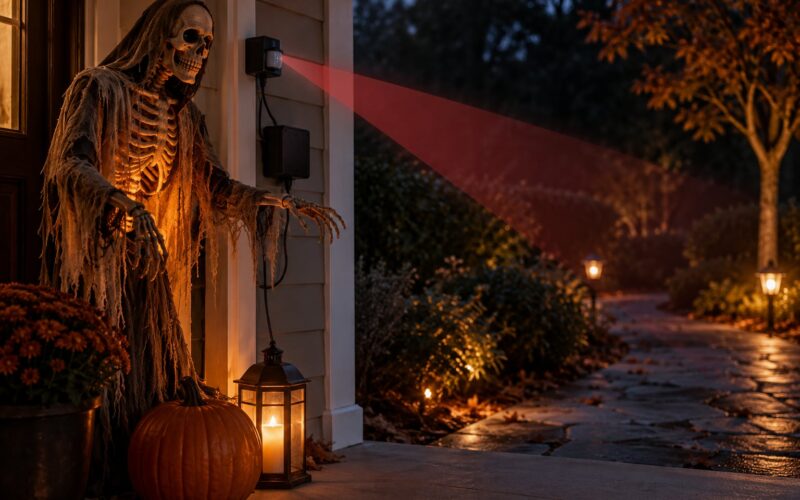
A motion-activated prop pointed at the front door. This is the most-complained-about trigger on neighbourhood forums, for the obvious reason. If you keep one, angle it across the yard so it triggers only from the sidewalk, never from the path to the door.
A life-size figure standing at eye level. The problem is scale, not the concept. A skeleton the height of your knee is friendly; the same skeleton at adult height with a moving head is a body-shaped thing at a child’s face. Shrink it, lower it or move it to the side.
Dark unlit corners along the path. Nothing causes a startle like not seeing the step. Add a low-voltage stake light or a battery lantern at every turn so the route is visible end to end.
Audio that is louder than you expect. Sound carries further at night than when you set it up in daylight. Test it from the sidewalk, then from inside the house with the door open.
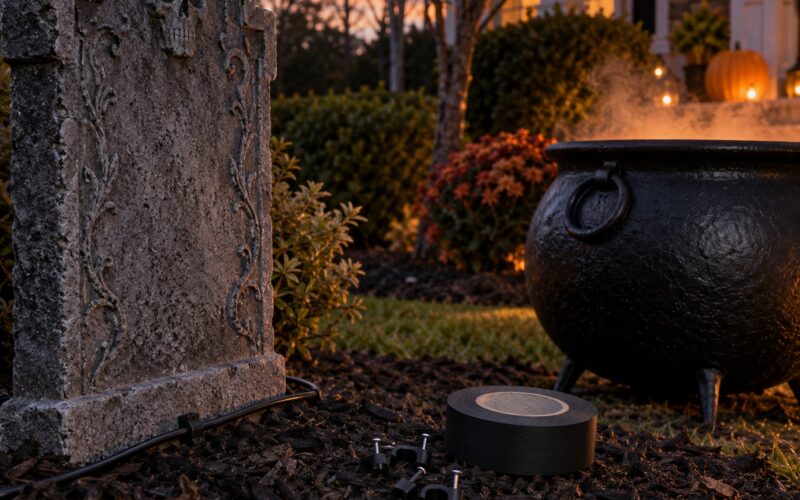
Cords and extension leads across the walkway. Run them along the wall, under a rug, or through conduit covers. A cord at shin height is a trip hazard for adults and a head-height tangle for a running four-year-old.
Unstable props. Lightweight is not the same as safe. Anchor inflatables and anything tall with two points, and never leave a metal stand unsupported where children pass.
Decorating at a child’s face level. Masks, hanging ghosts and dangling spiders at door height are the ones that land hardest. Move them above adult head height or below waist height, which puts them out of a small child’s line of sight entirely.
Shared entrances and hallways. In apartments, you cannot control the walkway. If someone else’s display lines up with a hall you must use, the polite fix is a short knock and a specific ask: mention your child’s age, point at the prop, and ask them to angle it away from the entrance. Most people adjust once you give them something concrete to move.
Frequently Asked Questions
What Halloween decorations are least likely to scare toddlers?
Static, brightly coloured decorations read as costume props rather than threats. Bedsheet ghosts with painted smiles, round-eyed jack-o’-lanterns, paper bats, friendly cartoon monsters, painted sticks and no-carve pumpkins are the safest options. Skip anything that moves on its own, looks textured like skin, or shows blood. Warm steady string lights add atmosphere without the strobing effect that bothers sensory-sensitive children.
How can I make an outdoor Halloween display safe for small children?
Work outward from the walking route. Keep the path from sidewalk to door as wide as a stroller and free of cords, then place the strangest pieces beside it rather than in it. Anchor every inflatable, statue or wooden cut-out with at least two points so a toddler cannot tip it. Light the whole route at a low level, avoid real candles, and check the layout after dark from a crouch, which is roughly a three-year-old’s eye level.
Are animated Halloween decorations okay around young kids?
They can be, if you control when they trigger. Motion sensors aimed at the front door are the most commonly complained-about Halloween decoration on neighbourhood forums, because a child walking toward the door triggers a scare they never saw coming. Aim sensors across the yard instead, keep any movement slow and repetitive rather than sudden, and put the unit where a child cannot reach it. If a piece only works as a surprise, it works better in a spot children never walk through.
How do I keep Halloween lights and cords from creating a tripping hazard?
Never run a cord across the walkway or the steps. Follow the wall with extension leads, tape them down at regular intervals, or use outdoor-rated cord covers where a cord has to cross. Choose battery-powered LED string lights and battery lanterns so most of your lighting needs no cable at all. Check the whole route in the dark with a flashlight before guests arrive, since shadows hide cords that are obvious in daylight.
What should I do if a child seems frightened by a decoration?
Acknowledge the fear rather than dismissing it, then give the child control of the distance. You can say it plainly, that it is a skeleton costume and you will turn it off, and name what it is out loud so the mystery leaves. Many parents find it helps to move the piece rather than argue the child out of the fear. Gentle repeated exposure at a pace the child chooses tends to work better than avoiding the display for three weeks.
Can I make a Halloween display scary without using realistic faces?
Yes, and the fear usually comes from scale, motion and lighting rather than artwork. A life-size figure with a realistic face is much harder for a young child than a cartoon ghost, a giant grinning pumpkin or a shadow cast on a wall. Push the atmosphere through steady coloured light, layered depth, sound placed far from the door and motion that is slow and repetitive. Keep the forms oversized or toy-like and most of the fear trigger disappears while the display still feels properly Halloween.
Create a Spooky Display That Still Feels Welcoming
Five things to do first, in order. Choose a theme built from cartoon ghosts, round-eyed pumpkins and friendly skeletons rather than realistic faces. Clear the walking route from sidewalk to door and move anything large or strange to the side of it. Anchor every prop with two points and run all cords along the wall. Swap strobing lights and door-facing motion sensors for steady string lights and battery LEDs. Then walk the whole thing after dark at a child’s eye level and move whatever one piece they flinch at.
Keep the Halloween vocabulary. Spiders, webs, bats, ravens and candlelight all still work for adults, and none of them need a face that looks human. The display does not get watered down, it just stops putting surprises in a toddler’s path.