A Halloween party playlist that flows is not built by finding spooky songs, it is built by ordering them. The hosts whose floors stay full all night are the ones who split the evening into phases, give each phase one tempo and one sonic character, and queue everything in advance so nothing gets skipped by accident. The rest is detail: buffer extra runtime, keep the order off shuffle, and match tempo at each handoff. Plan is updated for 2026, and the whole thing takes about an hour from a phone.
The part most guides leave out is the boring middle, and it is the part that decides how to make a Halloween party playlist that flows. A list of 150 Halloween songs gives you a library, not a soundtrack. Sequencing is what turns that library into music that carries a party from the door to the last song.
Table of Contents
- What You Need
- How to Make a Halloween Party Playlist That Flows
- Start With the Party Arc
- Choose a Cohesive Halloween Sound
- Set Tracks by Energy, BPM, and Mood
- Build Smooth Transitions
- Test the Full Playlist
- Common Mistakes
- Frequently Asked Questions
- How long should a Halloween party playlist be?
- What songs make a good Halloween party playlist?
- Should I crossfade between Halloween songs?
- How do I keep the playlist from getting too intense?
- How can I make a Halloween playlist work for mixed ages?
- Can I use a Halloween playlist for a dinner party?
- Conclusion
What You Need
You need less gear than most hosts buy, and one decision made before you open any music app: how long the party runs. Everything else is a service you already pay for or a note in your phone.
- A music service you can queue into. Spotify, Apple Music, or YouTube Music all let you build a custom ordered list. Free tiers are fine for this.
- A playback device that will not die. A phone plugged in, or a laptop with the charger running. Battery death at hour two is the most common playlist failure.
- One speaker for the room, two if you have two spaces. A small indoor speaker plus a cheap outdoor one lets trick-or-treaters get ambience while the dance floor gets something louder.
- A timer. A phone alarm set for each phase transition is enough. If you have to be the DJ and the host, you cannot also be watching the clock.
- The party length in writing. Doors open to last call, in hours. This single number drives every song-count decision later.
- Your theme constraint. Haunted house, 1980s slasher, monster mash, or a general haunted affair. Constraint is what makes a list feel designed instead of scavenged.
- The guest age range. Under-tens arrive early and leave early. Teens peak late. Adults arrive late and dance late. All three want different music in the same room.
- A short list of non-negotiable songs. Five to eight tracks that must play no matter what. Write them down before you start browsing, or the algorithm will talk you out of them.
That is the whole kit. Notice what is missing: no DJ, no special software, no expensive speakers. Flow comes from decisions, not equipment.
How to Make a Halloween Party Playlist That Flows
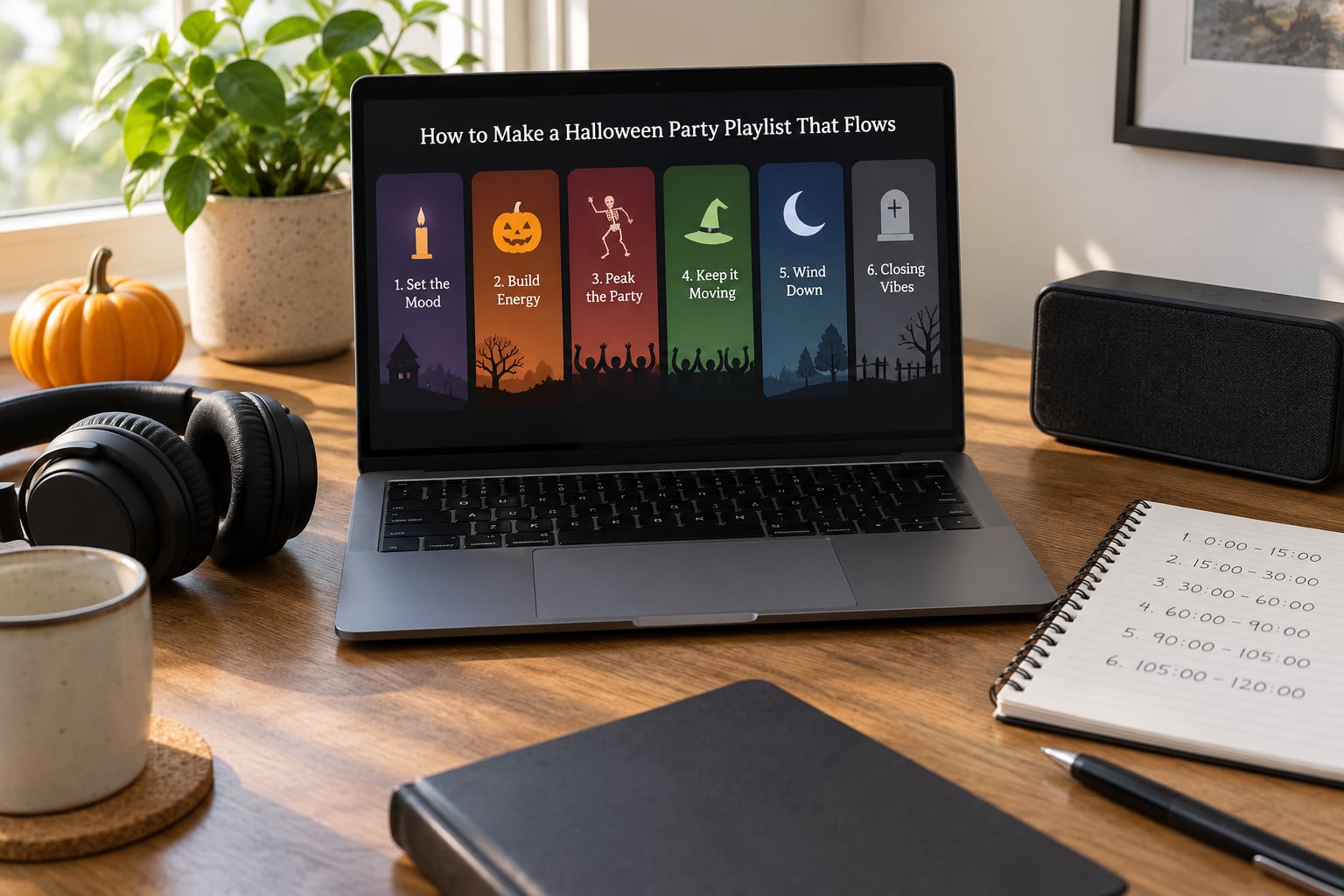
You make a playlist flow by dividing the party into phases and giving each phase exactly one tempo and one sonic character, then ordering the tracks inside each phase so the energy moves in one direction. Six phases cover almost every Halloween party: arrival, early exploration, active mingling, treats, dance, and finale. Give each one a job and the awkward gaps where music fights itself disappear.
Start With the Party Arc
Map the timeline before you pick a single song, and decide which energy rises or falls at each transition. Arrival music should be atmospheric and low-commitment, because guests are at the door, in coats, handing over candy, not dancing. Early exploration warms up. Active mingling is where most hosts lose the room, because nothing in the first hour has a beat anybody can commit to.
Treats and dinner are the natural energy dip. If you planned the arc, that dip is a deliberate valley between two hills. If you didn’t, it reads as the music dying.
Then the dance block, which should be the longest sustained high-energy stretch of the night, and a finale that’s short and deliberate rather than a slow taper into background noise.
Build enough music to cover twice the party. Average tracks run about three and a half minutes, and hosts consistently report that a two-times buffer is the minimum that survives a real party.
| Party length | Songs needed | Queue this much music |
|---|---|---|
| 2 hours | About 34 | 70 songs |
| 3 hours | About 51 | 100 songs |
| 4 hours | About 69 | 140 songs |
Extra tracks cost nothing and they are not all going to play. They cover the song that flops, the guest who arrives late, and the hour after you thought the party was over.
Choose a Cohesive Halloween Sound
A Halloween palette works best as four or five buckets rather than one genre, because a night with only one genre gets boring by hour three. Mix instrumentals with vocals, and let the eras differ so both parents and teens recognize something.
Film scores and eerie ambience cover the arrival and exploration phases. Instrumental horror cues have low lyric density and no chorus to sing, which makes them safe under conversation. Gothic and darkwave rock handles the mid-tempo middle. Psychobilly and industrial bring the driving percussion for mingling and dance. Novelty Halloween songs are the sing-along material, and that includes the classics people mock and then loudly request.
Add danceable tracks that are horror-adjacent rather than horror-labeled. A song with a monster in the title and a tempo under 100 BPM is atmosphere, not a floor filler. The dance phase needs the big beat, recognizable chorus, and steady four-on-the-floor pulse that guests actually move to.
The test I use: if a track has no chorus, or no pulse, it is not a dance track no matter how spooky it sounds.
Set Tracks by Energy, BPM, and Mood
Order inside each phase by energy, and use BPM as the sorting mechanism. BPM means beats per minute, which is simply how many beats hit each minute and a decent stand-in for how fast a track feels. It is the one technical idea that most improves a home playlist, and you only need it roughly.
Sort your pool into four tiers: ambient and slow, mid-tempo, upbeat, and peak. Then inside each phase, walk the tiers upward instead of jumping around. Arrival runs your slowest material. Mingling holds the mid band. The dance block starts at the top of the upbeat tier and stays there for thirty to forty minutes before you go higher.
When you hit a jump between two songs, aim for a tempo step of roughly ten BPM or less. A 100 BPM track into a 128 BPM track is a jolt. A 118 BPM track into a 126 BPM track is a lift, which is exactly what you want going into the peak.
Also keep about 80 percent of the list familiar. Guests want to recognize what is playing. A deep cut every five or six tracks works as a change of pace; a run of them empties the floor fast. Track order built this way is what makes a playlist that flows feel intentional rather than accidental.
Build Smooth Transitions
Smooth transitions come from a few repeatable moves, not from software. Set your service to crossfade for six to eight seconds, which is long enough to blur an outro into the next intro without turning the next song into a wash. Ambient and instrumental passages tolerate longer crossfades. Peak dance tracks want shorter ones, closer to three or four seconds, so the beat keeps its punch.
Use instrumental interludes as bridges between mood changes. A minute of eerie underscore between the arrival phase and the exploration phase covers the worst possible handoff, because nobody minds a brief instrumental if they are still arriving.
The bridge-track technique solves the song everyone loves but nobody can dance to. A slow, beloved Halloween ballad gets a rousing danceable track on both sides, so the dip reads as a deliberate valley instead of a mistake. Keep the ballad. Frame it.
Repeat a motif at the end. Running a familiar hook or a signature sound across the last three tracks makes the finale feel like an arrival instead of a random stop, and it lets you drop the volume at the end without anyone noticing the handoff.
Test the Full Playlist
Play the whole thing once in real time before the party, at the speed you will actually use. Skim-testing does not catch anything useful. What you are listening for is the forty seconds after each song ends, because that is where a bad order announces itself.
Mark every track where the floor would empty: an ambient piece longer than two minutes in a dance phase, a slow song right after a fast one, a deep cut with no beat. Cut or move those. Then check three specific things: the first ninety seconds set the tone properly, the peak block sustains, and the last track does not fade into nothing.
Test the speaker at party volume too, not desk volume. Loudspeakers distort when pushed, and a distorted low end is what makes a dance floor empty faster than a bad song choice. Set the volume to what you want and back off to about 80 percent of that on the device, which usually gives you cleaner output at the same perceived loudness.
Finally, build a shorter backup version. A forty-five to sixty minute cut of your strongest tracks matters for two reasons: it covers a playlist that gets interrupted, and it gives you a version for the trick-or-treating window or a quiet second room.
Common Mistakes
Most bad Halloween playlists fail in the same seven ways, and all seven have quick fixes.
- Saving every favorite. Fix: cut your list to about 60 percent of what you saved. Songs you love and never play are why your queue runs out at midnight.
- Changing the mood too quickly. Fix: one phase, one character. If the last four songs each feel like a different party, the room never settles.
- Choosing songs that are too obscure. Fix: keep the 80/20 ratio. If nobody can name the artist, it is atmosphere, and atmosphere does not get people onto a floor.
- Making the playlist too short. Fix: build for twice the party length. Running out of music at 1am is the single most reported failure.
- Leaving abrupt endings. Fix: crossfade on, and choose a final track with a definite ending rather than a long fade. Nobody wants to hear a speaker hiss through the last verse.
- Ignoring guests and volume. Fix: pick the volume once at the start and leave it. Constantly adjusting music is exhausting for the host and reads as distracted to everyone else. Check neighbors early if you are outdoors.
- Forgetting the party timing. Fix: set an alarm at each phase boundary. Hosts who run the clock stop babysitting the queue and start hosting.
One last tip: build the kids’ early hour and the adults’ later block as two separate lists in the same playlist file, with a hard marker between them. A visible split is much easier to find at 7pm than trying to remember where you stopped.
Frequently Asked Questions
How long should a Halloween party playlist be?
Build enough queued music to cover roughly twice your party length. A three-hour party needs about 51 songs to cover the actual hours, so queue around 100 tracks. Extra tracks are cheap and cover the song that flops, the guests who arrive late, and the stretch after you thought the night was ending.
What songs make a good Halloween party playlist?
A good Halloween party playlist mixes film scores and eerie ambience for arrival, gothic and darkwave for the mid-tempo middle, psychobilly and industrial for driving percussion, and recognizable novelty songs for sing-alongs. Keep about 80 percent familiar tracks and place deeper cuts every five or six songs so the floor never empties.
Should I crossfade between Halloween songs?
Yes, with a length that matches the phase. Use six to eight seconds across ambient and moody material so the handoff blurs, and shorten it to three or four seconds between peak dance tracks so the beat keeps its punch. Crossfade is what removes the jarring gap of silence between two songs.
How do I keep the playlist from getting too intense?
Plan deliberate dips. Treats and dinner work as a natural valley between the mingling and dance phases, and use an instrumental horror cue as a bridge back up. If a slow, beloved ballad has to stay, bracket it with a rousing danceable track on both sides so the drop reads as planned.
How can I make a Halloween playlist work for mixed ages?
Split it in two. Build a kid-friendly first hour with novelty songs and familiar film tracks, then switch to the darker material once the adult crowd arrives. Keep your non-negotiable songs spread across both halves so every age bracket hears something it recognizes, and avoid explicit tracks while younger guests are in the room.
Can I use a Halloween playlist for a dinner party?
Yes, but do not run the full party arc. Start with film scores and low-volume ambience, move to mid-tempo gothic during the meal, and hold the loud blocks until people are on their feet rather than seated. Keep the peak tracks for after dinner so conversation survives the first two hours.
Conclusion
A Halloween party playlist that flows is the result of six short decisions made before the night starts: map the phases, pick one sound per phase, sort by energy and BPM, keep it mostly familiar, build twice the runtime you need, and test the order in real time. Everything after that is just pressing play and letting the arc do its job.
Start right now with the three steps that take twenty minutes. Write down your party phases with start and end times, choose one anchor song for each phase, and queue roughly twice the runtime. Everything else can be decided the week before.