People carve pumpkins at Halloween because a glowing face on a doorstep marks the night as special, and the custom grew out of older European traditions of lighting hollowed vegetables to frighten off spirits. Modern pumpkin carving is roughly 150 to 200 years old and American in its current form.
That is the short version. The longer version involves an Irish folktale, a miser who tricked the Devil, a vegetable most Americans would not eat, and a wave of immigration that swapped one root crop for another. Here is what actually happened.
Table of Contents
- The Short Answer: Why Do We Carve Pumpkins for Halloween?
- Where Did Pumpkin Carving Begin?
- How Did the Irish Make Halloween Lanterns?
- What Does a Jack-o’-Lantern Traditionally Represent?
- The legend of Stingy Jack, told in five beats
- Did the lantern scare spirits away or guide them home?
- Why Did Pumpkins Replace Turnips in the United States?
- How Did Irish Immigrants Bring Carving to America?
- What Is the History of Modern Halloween Pumpkin Carving?
- What people repeat that the record does not support
- Why Do People Still Carve Pumpkins Today?
- How Does the Tradition Differ Around the World?
- Frequently Asked Questions
- Is Stingy Jack a real legend?
- Is it true that jack-o’-lanterns are named after a man called Jack?
- Is it okay for Christians to carve pumpkins?
- What is the spiritual meaning of the jack-o’-lantern?
- Why don’t ladies cut the pumpkin?
- How long will a pumpkin stay good after carving?
- The Tradition Starts with a Single Pumpkin
The Short Answer: Why Do We Carve Pumpkins for Halloween?
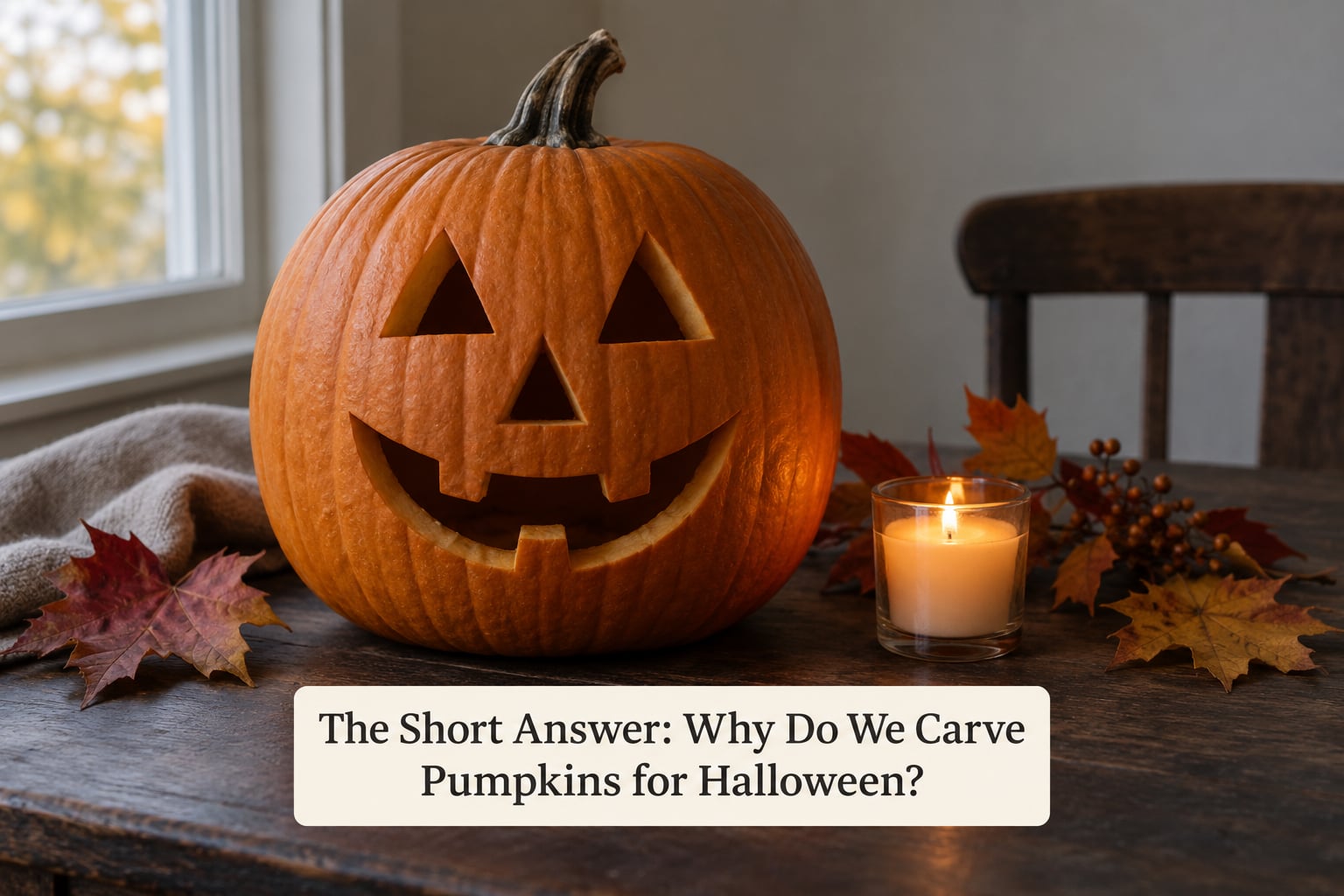
We carve pumpkins at Halloween because a glowing, grinning face on a porch sends one clear message: this household is taking part in the night. The practice traces back to Irish and Scottish families who hollowed out turnips and lit them as lanterns, and it grew into its pumpkin form in America within the last two centuries.
If you want the version that fits on a napkin, here it is:
- Carved faces were meant to frighten away wandering spirits, or to guide welcome ones home.
- The name comes from the Irish folktale of Stingy Jack, who tricked the Devil and was refused entry to both heaven and hell.
- Irish and Scottish immigrants arrived in the 1800s carrying the lantern custom with them.
- Pumpkins replaced turnips in America because they were bigger, easier to hollow and far more plentiful.
One thing worth clearing up right away: this is not an ancient pagan ritual that survived untouched. The jack-o’-lantern as we know it is a documented 19th-century tradition with an older folk story attached to it.
Where Did Pumpkin Carving Begin?
The practice did not begin with pumpkins. It began with a season. Samhain, the Gaelic harvest festival that falls at the end of October, was a time when the boundary between the living and the dead was thought to thin. Whether spirits were dangerous or merely lost is a question historians still argue about, but the important part for carving is that the dead were believed to be walking about.
Another Gaelic custom was guising: going out in disguise, often with faces hidden by masks or soot, to visit neighbours and receive food in exchange for a performance. That is the ancestor of trick-or-treating. When Christian missionaries arrived in Ireland in the 8th century, the festival of All Saints Day was set on November 1, and the night before it became known as All Hallows Eve.
Here is roughly how the pieces fit together over time.
| Period | What happened |
|---|---|
| Ancient Ireland | Samhain, harvest feasts, guising, and beliefs that the dead returned to the world |
| 8th century onward | All Saints Day observed on November 1, turning October 31 into All Hallows Eve |
| 19th century Ireland and Scotland | Root vegetables hollowed, carved and lit as lanterns on windowsills and doorsteps |
| 1840s to 1870s | Large numbers of Irish and Scottish immigrants arrive in North America with the custom |
| Late 1800s | American pumpkins become the standard carving vegetable in New England and beyond |
| 1950s onward | Trick-or-treat boom, school carving parties, pumpkin festivals and porch decorating |
So the timeline matters. Pumpkin carving as a Halloween custom is young by folklore standards. Most of what feels ancient about it is actually about 150 to 200 years of continuous practice.
How Did the Irish Make Halloween Lanterns?
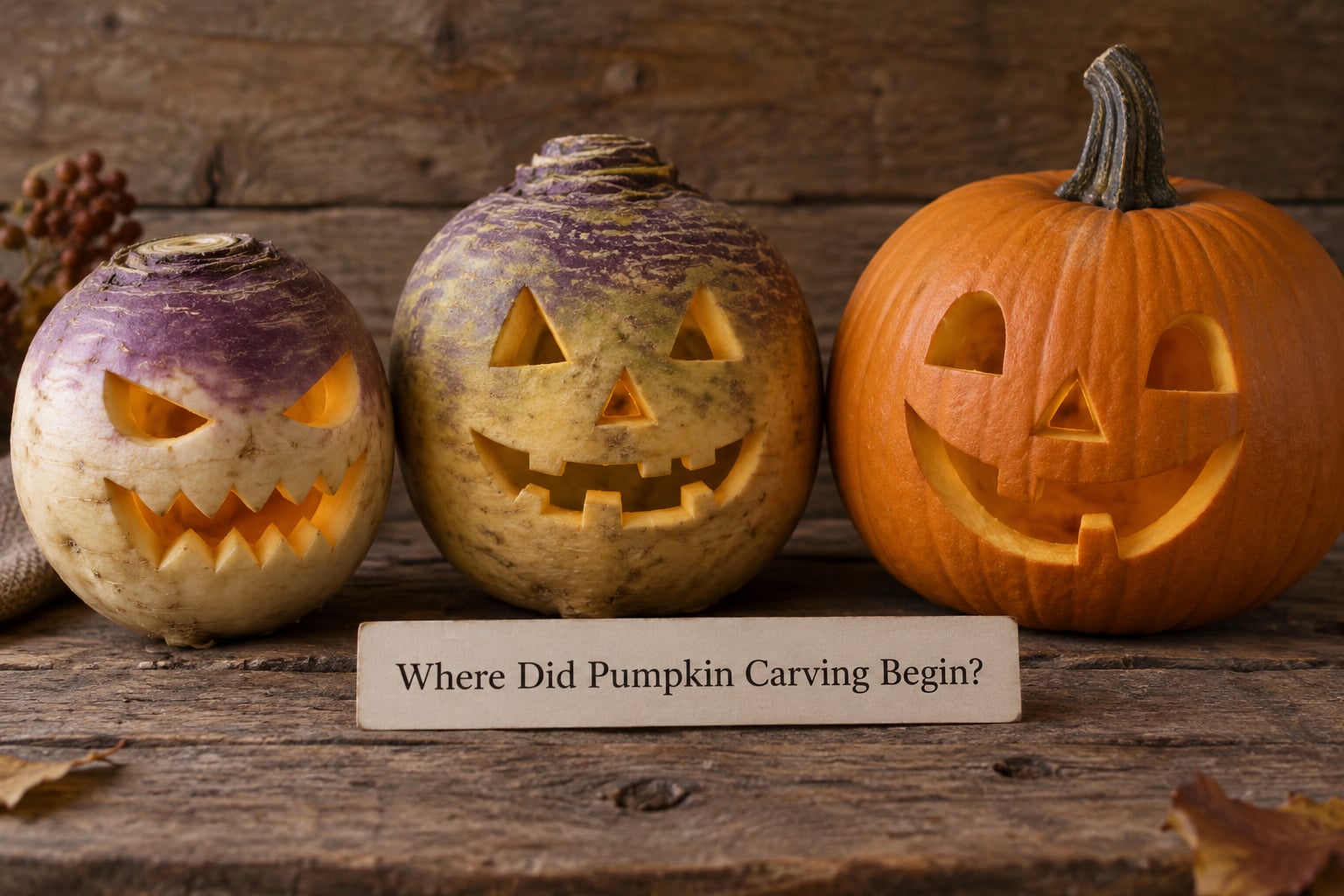
Before pumpkins, Irish households worked with whatever grew in the cold, wet soil. Turnips were the common one. Rutabagas and beets showed up in some regions, and in Scotland and northern England you will hear mangelwurzel named alongside them.
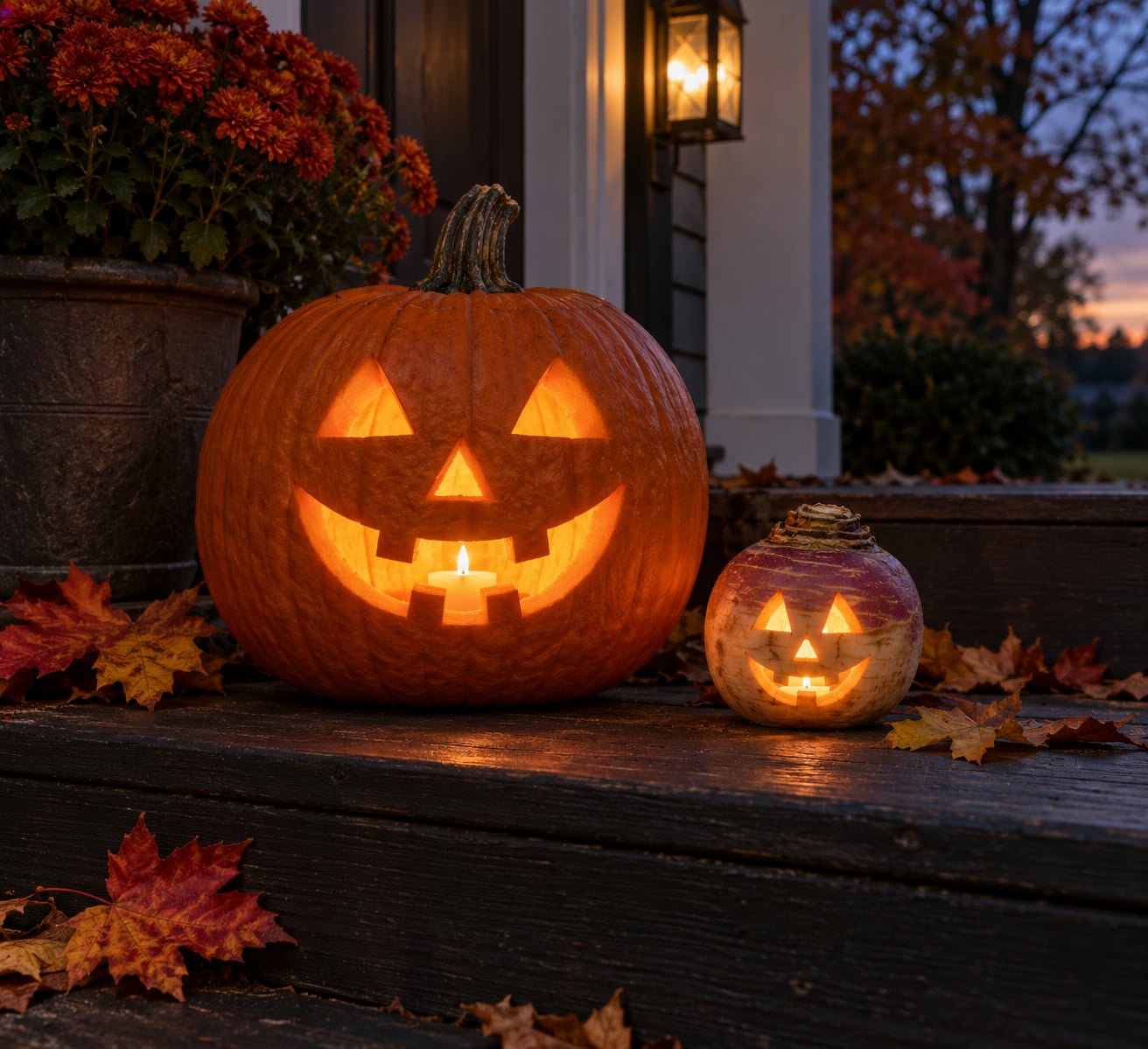
The method was the same across those vegetables: cut the top, hollow out the middle, carve a face or simple pattern into the wall, then drop a candle or a burning coal inside and set it on a windowsill or by the door. People who did this in Ireland and Scotland remember it as an ordinary childhood activity rather than a rare relic, though the vegetables were genuinely harder to carve than a pumpkin because the flesh is dense and the roots are awkward to peel.
The vegetables themselves were not a Halloween special. They were dinner. That is the part many retellings leave out: a carved turnip lantern sat on the table at a meal, and the family ate the rest of it.
| Vegetable | Size | Carving difficulty | Where the custom shows up now |
|---|---|---|---|
| Turnip | Small to medium | Dense flesh, thin walls, needs patience | Ireland and Scotland, in demonstrations and heritage displays |
| Rutabaga | Medium | Similar to turnip, slightly larger | Ireland and parts of Britain |
| Beet | Small | Easy to cut, colour bleeds onto everything | England and Scotland |
| Mangelwurzel | Large and long | Tedious, but big enough for bold faces | Historically northern England and Scotland |
| Pumpkin | Large | Soft interior, thick skin, simple cuts | Everywhere in North America |
Sources disagree on which vegetable was used most, and the honest answer is that it varied by region. Ask ten people and you will get turnip, rutabaga, potato and beet in the same breath.
What Does a Jack-o’-Lantern Traditionally Represent?
The face is the point. A glowing gourd on a doorstep is a warning sign, and the folklore gives us two slightly different explanations for what it is warning against.
The legend of Stingy Jack, told in five beats
The story behind the name is a 19th-century Irish folktale. It has no single fixed version, because it was told out loud for generations before anyone wrote it down, but the beats are consistent.
- Stingy Jack, a miser known for his cleverness and his coin, invites the Devil for a drink and somehow gets the Devil to pay for it.
- The trick is repeated. Jack has the Devil wait in a fruit tree while he collects coins from a neighbour, then calls the Devil up into the branches.
- Jack dies and goes up to heaven, where he is refused entry because of how he lived.
- The Devil keeps his promise and refuses him hell as well.
- Left wandering with neither heaven nor hell, Jack is given a burning coal to light his way, and he roams the earth with it until judgement day.
Irish families carved their own lantern vegetables with grim faces because they did not want Jack’s spirit drawn to their door. The nickname “Jack of the Lantern” became “jack-o’-lantern” as it crossed the Atlantic and settled in ordinary speech.
Did the lantern scare spirits away or guide them home?
Both readings exist and historians do not fully settle between them. One school of thought holds that the light repelled evil spirits and kept the household safe. The other holds that the light was a kindness: a visible marker that the living had put food out for wandering souls on the night they were most likely to visit.
There is also a competing explanation for the name. Some folklorists connect “jack-o’-the-lantern” to the will-o’-the-wisp, the flickering light said to lead travellers off their path. On that reading, the lantern is a warning light, not a welcoming one.
What none of these accounts explain is the face itself. The earliest tellings describe a plain lantern with a coal in it, not a grinning head. The carved face appears later, in the versions that reached American newspapers and schoolrooms. The face was an addition, and a popular one.
Why Did Pumpkins Replace Turnips in the United States?
Practical reasons, mostly. American settlers arriving in the mid-1800s found pumpkins growing in New England in enormous quantities, and pumpkins are simply a better canvas.
They are bigger, which allows bold features. The skin is thick enough to survive a few days on a porch. The inside is soft and hollows out quickly with a kitchen spoon. A turnip, by comparison, is a long evening with a dull knife and a lot of broken fingernails.
There is one piece of the standard story worth correcting. The usual line is that Irish immigrants arrived and discovered pumpkins. True enough as far as it goes, but pumpkins were not waiting for anyone. They had been cultivated in North America for centuries, and squash of several kinds was already a major food crop grown and used by Indigenous peoples in the Americas.
The careful version is this: Indigenous peoples cultivated, stored and cooked with these crops long before Halloween existed in North America, and none of that history was a Halloween practice. European immigrants arriving in the 1800s met an abundant crop that happened to suit a custom they already had. Two separate histories met in the same field.
How Did Irish Immigrants Bring Carving to America?
Millions of Irish and Scottish immigrants arrived in North America between the 1840s and the 1870s, many fleeing famine and economic hardship. They brought festivals, songs, food, guising, and a habit of lighting carved root vegetables on Halloween night.
New England was the ideal landing place for this particular tradition. The region had a massive pumpkin harvest, a large population of new arrivals, and communities where holiday customs blended fast. By the end of the 19th century, newspapers across the region were printing carved pumpkin images and calling them jack-o’-lanterns, which gave the custom a name and a shape that spread outward.
Schools helped too. Autumn craft sessions and “pumpkin parties” turned carving into something children learned rather than something they inherited, and that is the real reason the tradition outlived the immigrant generation that brought it here.
What Is the History of Modern Halloween Pumpkin Carving?
The dark, hostile faces of the original lanterns are still the popular image, but the actual practice drifted toward decoration and self-expression. Cats, monsters, puns, sports logos, political candidates and movie villains all showed up once carving became an activity rather than a protection.
With the spread came contests. Pumpkin festivals, county fairs and school competitions turned the carved gourd into something people compete over, photograph and put on display. Pumpkin-carving kits, the safe candle that stays lit inside a plastic jack-o’-lantern, and the electric light all arrived in the 20th century, each one making the tradition easier and longer-lasting.
What people repeat that the record does not support
- The Devil gave Jack the coal as a gift. In common tellings the Devil has to keep his promise, which is why he refuses Jack a real light. A gift would contradict the story’s logic.
- Samhain was a pumpkin festival. It was a seasonal observance with feasting and guising. Carved pumpkins arrived in North America long afterwards.
- Pumpkin carving is ancient pagan practice. The specific custom is recent. It borrowed an older harvest season and an older lantern habit, and its present shape is modern.
- Stingy Jack is documented ancient history. The earliest printed versions date to the 19th century, and they differ from one another in meaningful ways.
Why Do People Still Carve Pumpkins Today?
Most of the reasons have nothing to do with warding off spirits.
It is a family ritual with a fixed date, which makes it one of the easiest traditions to keep. It is a creative outlet that most people can finish in an evening with a spoon and a small knife. It is decorating, porch lighting and neighbour competition rolled into one activity. And for a lot of families it is food: the seeds get toasted, the flesh goes into pie, soup or bread.
On the practical side, a carved pumpkin lasts about three to five days on a porch before it softens, sags and grows fuzzy. If you want it to hold longer, cut a smaller lid, scoop the seeds and pulp thoroughly, and refrigerate the pumpkin when it is not on display.
A tealight or battery light is safer than an open flame on a dry porch, keeps children and pets away from fire, and means the pumpkin can sit out longer without a babysit.
There is one bit of folklore that never gets an answer: the joke that the man of the house carves the pumpkin and the woman of the house is not allowed to touch the knife, or he will not be able to carve the next one. It shows up in family banter all over Ireland and Britain. There is no documented historical basis for it, and it is best treated as a running joke rather than a tradition with a date on it.
How Does the Tradition Differ Around the World?
Halloween is celebrated differently everywhere, and the carving follows the local crops rather than a global template.
In Mexico, carved pumpkins sit alongside calaveras, the sugar skulls made for Día de los Muertos. The skulls are decorated rather than ghoulish, and they are built for the days surrounding November 1 rather than a single night in October.
In Ireland and Scotland, turnip lanterns are still carved, usually for heritage events and school demonstrations rather than on every doorstep. People who grew up with them describe them as harder, colder work than carving a pumpkin.
Across much of Europe, Halloween is a comparatively muted affair, and pumpkin lanterns appear mostly as decoration borrowed from American popular culture. A few places have carved pumpkin festivals of their own, usually tied to an autumn harvest event rather than to spirits.
The common thread is a crop that is plentiful in the autumn harvest, hollowed, lit and put outside. The face and the date change; the habit does not.
Frequently Asked Questions
Is Stingy Jack a real legend?
Stingy Jack is a real folktale, but a documented one rather than an ancient one. The earliest printed versions appear in 19th-century Irish material, and the details shift between tellings, which is the mark of an oral story recorded late. Historians treat it as folklore that entered print during the 1800s, not as preserved pagan ritual.
Is it true that jack-o’-lanterns are named after a man called Jack?
Partly. The name does come from the figure called Jack of the Lantern in the Irish folktale of Stingy Jack. Some folklorists argue for a different origin, linking jack-o’-the-lantern to the will-o’-the-wisp, the flickering light said to lead travellers astray. Both explanations are in circulation and neither is fully settled.
Is it okay for Christians to carve pumpkins?
This comes up because Halloween began as a Christian holy day. All Saints Day falls on November 1, and the night before it is All Hallows Eve, which is where the name Halloween comes from. Carrying a lantern on that evening started as a way of marking the holy day’s eve. For most Christian families today it is simply an autumn harvest tradition with spooky decoration.
What is the spiritual meaning of the jack-o’-lantern?
The carved lantern served two purposes in folklore, and sources disagree about which came first. One reading is protective: a fierce face on the doorstep frightens away wandering spirits. The other is generous: a lit lantern welcomes spirits home on the one night they were thought to visit. The will-o’-the-wisp explanation adds a third idea, a warning light on a dangerous path.
Why don’t ladies cut the pumpkin?
This is a joke that circulates in Irish and British families, usually aimed at a man who hands over the knife and then blames the woman for the mess. There is no documented historical basis for the rule, and no record of it being a real prohibition. Treat it as family banter rather than an old tradition, though it has certainly been repeated for generations.
How long will a pumpkin stay good after carving?
A carved pumpkin usually holds up for three to five days on a porch before the flesh softens and the whole thing slumps. Scooping out all the seeds and pulp, cutting a smaller lid and refrigerating the pumpkin between displays all add time. A battery light also helps, since it avoids the heat of a flame drying the interior out faster.
The Tradition Starts with a Single Pumpkin
The takeaway is not that we carve pumpkins to ward off spirits, because the honest historical record does not support a single clean answer. It is that the jack-o’-lantern is a recent American form of a much older habit: putting a light in a hollowed vegetable and setting it outside when the year turns dark.
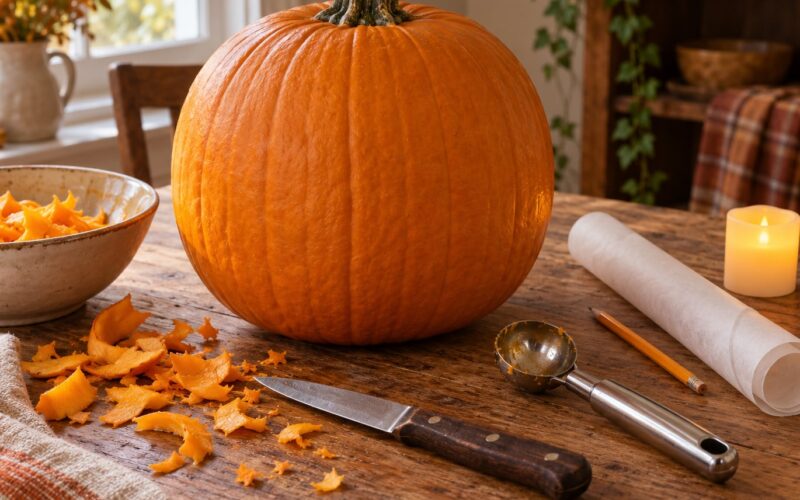
Start where the Irish started and take the next step. Pick a pumpkin with a stem that feels solid, cut the lid and scoop out every bit of seed and pulp, then carve a face that scares rather than a face that just grins.
Light it, put it on the step, and you are continuing a chain that runs from a turnip lantern on an Irish windowsill to the ones we have now.