Pick one theme, choose four to six films that share it, order them from the lightest scare to the heaviest, and keep each one close to the two-hour mark. That is really all there is to how to pick movies for a horror movie marathon, plus one boring but crucial step: confirming everyone can access every title before the night starts.
The reason this matters is dull and well documented. An unthemed, badly ordered lineup burns the group out by the third film, and phones come out. People on r/horror have been running this as a formal game for years, and the community rule is tight: four to six movies, every one tied together by a common theme, creativity counts for points.
Below is the process I use, broken into six steps, with the runtime math worked out for a four-hour, six-hour and eight-hour window. Grab a piece of paper, because you will be writing numbers down in step one.
Table of Contents
- What You Need
- Step-by-Step: How to Pick Movies for a Horror Movie Marathon
- Step 1: Set the Marathon Length and Format
- Step 2: Choose a Loose Theme
- Step 3: Match Intensity and Content Comfort
- Step 4: Balance Familiar Favorites and New Picks
- Step 5: Pace the Run Time and Add Breaks
- Step 6: Test the Lineup and Make a Backup Plan
- A Worked Example for an Overnight Marathon
- Common Mistakes
- Frequently Asked Questions
- How many movies should I plan for a horror movie marathon?
- How do I choose horror movies for a group with different scares?
- What is a good theme for a horror movie marathon?
- How should I plan breaks during an overnight horror marathon?
- What should I do if a movie is not available for streaming?
- Conclusion
What You Need
Six things, and most people already have five of them somewhere in the house.
- A confirmed headcount. Two people can take risks with an experimental film. Ten people cannot.
- A hard start time and a hard finish time. Both, written down, and both agreed to by everyone in the room.
- Each person’s horror ceiling. Not their taste, their limit. Someone who will not sit through graphic body horror needs to say so before you build a lineup, not halfway through film two.
- A list of what the group has already seen. The most-repeated question on marathon threads is simply what people have watched before. Ask it in the group chat a week ahead.
- Access confirmed. A subscription or rental for each title, checked on the device you will actually use.
- A way to track runtimes. Your phone notes app is fine. Write each film’s runtime next to its name as you pick it.
If you only do one thing from that list, ask about horror limits. Everything else on it is recoverable during the night; a wrong film in front of a partner who was talked into this is not.
Step-by-Step: How to Pick Movies for a Horror Movie Marathon
Step 1: Set the Marathon Length and Format
Do the math before you name a single film. Subtract about fifteen minutes between each movie for bathroom and stretching, plus one thirty-minute food break, and that is your real viewing budget.
| Window | Films | Target average runtime | Format |
|---|---|---|---|
| 4 hours | 2 | 95 minutes | Double feature |
| 6 hours | 3 | 100 minutes | Evening session |
| 8 hours | 4 | 100 minutes | All-nighter |
| 31 nights of October | 31 | Any | One film per night |
Four hours and two films is the most common and the hardest to fill well, because two films need two very different textures or the night feels thin. Six hours with three films is the sweet spot for most living rooms. Four films is where fatigue shows up, so schedule a real break after the second one rather than pretending it will not happen.
Step 2: Choose a Loose Theme
The theme is the reason each film deserves its slot, not a gimmick you announce at the door. Loose works better than strict, because strict themes run out of films after two.
Some that hold up: classic slashers from the late seventies and early eighties, supernatural and ghost stories, folk horror set in remote places, modern indie gems from the last few years, creature features, holiday-specific horror for December, or one director’s filmography.
Runners on r/horror and r/CreepyBonfire keep asking for the same tired answer every October, usually Halloween and Friday the 13th and nothing else. Fine for one slot, terrible as a whole lineup. Pick a theme nobody expects from you, then slip one classic in as the crowd-pleaser rather than as the organizing idea.
Step 3: Match Intensity and Content Comfort
Rate every candidate one to five, where one is atmospheric and nearly harmless and five is relentless. The scale is not about quality, it is about group tolerance, and it works for any genre you want to marathon later.
Then set a ceiling from the least enthusiastic person in the room. If someone says two, the whole night stays at two or below with maybe one three. Sort the lineup low to high, and put your single highest-rated film last, because ending on the heaviest film gives the night a finish line rather than a slow fade.
Say the uncomfortable part out loud: graphic violence, body horror, animal harm, self-harm, themes involving children, loud sustained shrieking that can trigger migraines. Nobody minds hearing it in advance. People mind being ambushed.
Step 4: Balance Familiar Favorites and New Picks
A workable six-hour lineup is roughly half familiar and half new. Films the group has already seen work as an anchor early on, when attention is high and nobody is testing whether they still like horror. New material goes in the middle slots.
Give every new pick a second pair of eyes. Post the shortlist in the group chat with the runtime and intensity rating beside each title and ask for vetoes, not for suggestions, because suggestions turn into an eighteen-film argument.
Step 5: Pace the Run Time and Add Breaks
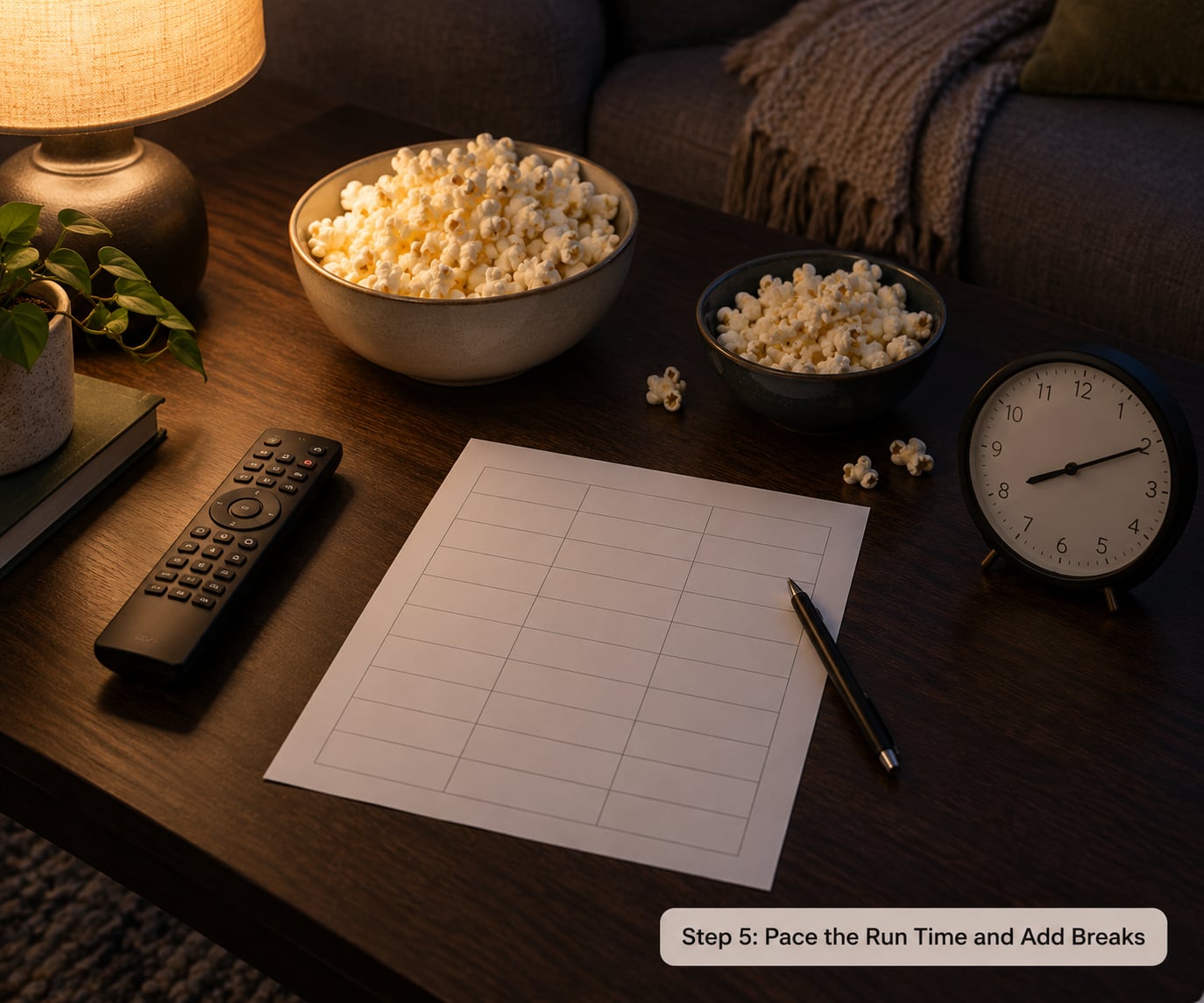
Write the running order on paper with start times, not just film names. Nine o’clock, ten past nine, and so on. Start times turn an argument about the order into a fact.
Put the heaviest films in the last two slots with a fifteen-minute gap before them, and take a proper thirty-minute food break after film two rather than between films one and two. People refill their drink and check their phone during a snack; they rarely do it during the opening twenty minutes of something they chose.
Protect the credits, too. Someone always skips the end of the last film and talks over it. Set a rule that the finale runs to the actual end, and put a comedy horror film after the scare-heaviest one if you have room, since laughter is the cheapest way to bring a room back down to a normal volume.
Step 6: Test the Lineup and Make a Backup Plan
The night before, open each title for two minutes on the real device and the real app. Streaming titles vanish constantly, and the worst possible moment to discover that is at midnight in front of eight people. Horror Movie Maven’s warning about a disc or stream freezing mid-film still applies to everything we watch now.
Keep two backups per slot, already downloaded if possible, and write them under the running order. If a film drops, swap rather than search, because searching at one in the morning with a half-asleep group is how marathons end early.
A Worked Example for an Overnight Marathon
Say eight hours, four people, mixed tolerance with a ceiling of three. Start at seven, break after film two, finish around one.
Film one is a light, funny horror picture to establish that the night is not going to hurt anyone. Film two is a slow-building ghost story, ninety minutes, mostly atmosphere. Break. Film three is a modern indie with a reputation for being genuinely unsettling rather than gory. Film four closes the night with the heaviest title the group agreed to, which is why nobody else volunteers to play anything after it.
Nobody has to be talked into anything after film one, and the final film has a clear reason to be final.
Common Mistakes
Choosing five similar films. Five slashers in a row is one movie with breaks. Fix: no more than two films from the same subgenre, and never two back to back.
Ignoring runtimes. Three two-hour films and a ninety-minute film is a seven-hour commitment, not a night out. Fix: write runtimes beside every title before committing, and delete anything over two hours fifteen minutes for a short window.
Front-loading the frightening films. The heaviest scare in hour one feels weaker because the group has hours of tolerance built up around it. Fix: order low to high, always.
Choosing titles nobody can find. Fix: test access the day before and carry backups per slot.
Ignoring content limits. Fix: ask for hard limits, not preferences, and honor them without debate.
Recommending films the group already saw. Fix: the “what have you seen” message goes out a week ahead, and it changes the lineup more than any other step.
Before anyone arrives, run a quick final test. Read the running order out loud and ask one question: does any film here make someone want to leave early? If a title survives that test and access is confirmed, the lineup is done. Stop tweaking it.
Frequently Asked Questions
How many movies should I plan for a horror movie marathon?
Four to six films for a single night, and fewer if the group is large or anyone is easily fatigued. Three films in roughly six hours is the most reliable format, because it leaves room for a food break and a reset. Two films works well for a double feature evening. Go above six only if the group has done this before, since attention starts drifting around film four.
How do I choose horror movies for a group with different scares?
Ask everyone for their hard limit rather than their taste, then take the lowest number in the room as your ceiling. Rate every candidate one to five, where one is atmospheric and five is relentless, and discard anything above the ceiling except possibly one film at the very end. Separating graphic content from scary content helps too, since many people are fine with tension and not with gore.
What is a good theme for a horror movie marathon?
Themes work best when they connect films by era, subgenre, director or a repeated motif: classic slashers, supernatural and ghost stories, folk horror, creature features, modern indie horror, or holiday-specific films for December. Keep the rule loose, four to six titles maximum, and add one familiar film so nobody feels bait-and-switched. The point of a theme is that each film has a reason to sit beside the others.
How should I plan breaks during an overnight horror marathon?
Take one thirty-minute food break after the second film rather than short breaks between every film, and a fifteen-minute pause before each of the two heaviest titles so the room can settle. Write actual start times on the running order, including the break. Keep the finale running to its real ending so the night closes properly instead of trailing off into conversation.
What should I do if a movie is not available for streaming?
Do not search for it live with the group waiting. Carry two backups per slot, chosen and tested in advance, and swap them in without a vote if the primary title has vanished. Streaming availability changes constantly, so part of learning how to pick movies for a horror movie marathon is treating the backup list as part of the lineup, not an afterthought.
Conclusion
Start with the duration, then the group’s limits, then the theme, then the order. Put one well-known film in the first slot so everyone relaxes, save the heaviest film for last, and write the running order down with start times and backups.
That is the whole method. The films are the easy part.