Mold on a stored costume is almost always a moisture problem, not a fabric problem. The way to store Halloween costumes so they do not get moldy is simple: clean every piece, dry it until no cool or heavy spot remains, give it a breathable container rather than a sealed bag, and keep the whole thing in a cool, dry room with a moisture absorber. Budget about 30 minutes per costume the afternoon after Halloween, and the whole season’s storage takes an hour or two.
I have packed away enough costumes to know which ones come back smelling like a damp basement and which ones look new the next September. The difference is never the fabric quality. It is whether moisture went in with the costume or found its way in afterward.
This guide covers the whole process, including what to do when a costume already smells musty, how to handle latex masks and foam armor, and how to keep electronics from corroding in a closed bin.
Table of Contents
- What You Need to Store Halloween Costumes Without Mold
- Step-by-Step
- 1. Check Each Costume for Dampness or Mold
- 2. Clean According to the Costume Materials
- 3. Dry the Costume Completely
- 4. Choose the Right Storage Method for Each Piece
- 5. Pack Costumes Without Trapping Moisture
- 6. Store in a Cool, Dry, Stable Environment
- 7. Check Stored Costumes Periodically
- Common Mistakes
- Storing Costumes While They Are Still Damp
- Using Airtight Plastic and Vacuum Sealing
- Cramming Costumes Into Small Bins
- Hanging Heavy or Padded Costumes on Wire Hangers
- Packing Damp Items Alongside Dry Ones
- Using Mothballs Near Costumes, Food or Children
- Leaving Costumes in Attics and Unheated Garages
- Forgetting Electronics and Batteries
- Sunlight Through Clear Bins
- Skipping Labels and Repairs
- Storing for Years Without a Refold
- Vacuum-Sealing Foam Armor and Latex
- Long-Term Costume Storage Tips
- Frequently Asked Questions
- Can I wash a Halloween costume to prevent mold?
- How do I remove mold from a costume before storing it?
- Are plastic storage bins safe for Halloween costumes?
- How should I store wigs, masks, and costume accessories?
- Will Halloween costumes get moldy in a basement or garage?
- Conclusion
What You Need to Store Halloween Costumes Without Mold
None of this needs to be expensive, and most of it probably lives in a closet already. What matters is having it ready on the night you pack away, because the wrong container chosen in a hurry is what causes trouble.
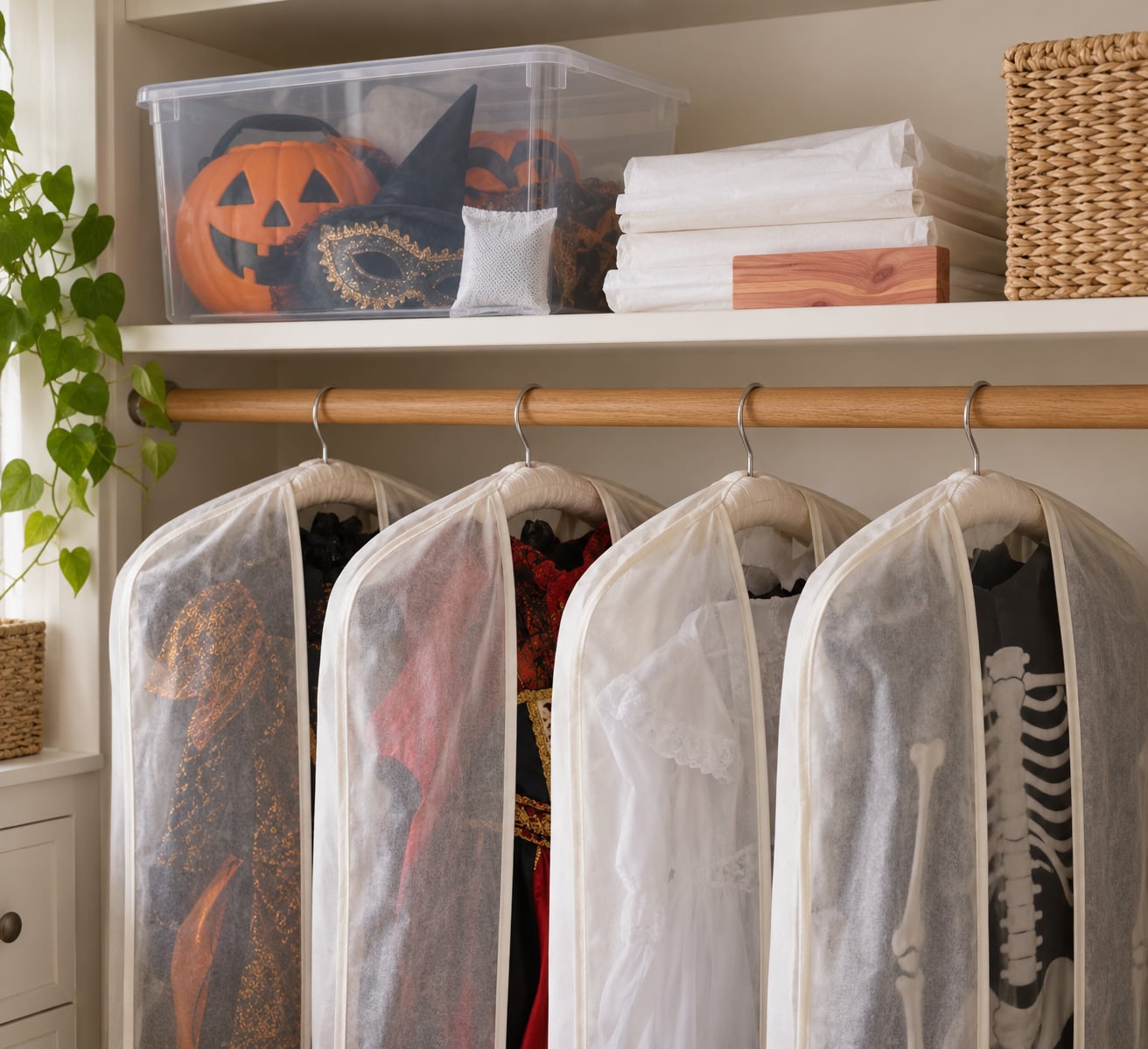
- Breathable garment bags in cotton or nonwoven fabric. These let moisture escape and keep dust off. Avoid vinyl and plastic covers for long storage.
- Acid-free tissue paper for folding delicate pieces, lining shoeboxes and wrapping masks.
- Clear bins with loose-fitting lids. A lid that snaps down tight and never opens again is the enemy of mold prevention.
- Padded or cedar hangers for structured garments. Wire hangers stretch shoulders and can leave permanent creases in costume fabric.
- Silica gel packets with a color indicator. The indicator turns pink or green when the gel is saturated, so you can tell when it needs baking out.
- Clean cotton towels for rolling and separating garments.
- Liquid laundry detergent and a soft brush, plus whatever cleaner suits the materials you own.
- Labels or masking tape and a marker, ideally with a photo taped to the front of each bin.
Two optional items go a long way if you store in a humid region or a basement. A small rechargeable dehumidifier set on its lowest setting protects a whole closet, and cedar blocks or lavender sachets discourage moths in wool and felt.
Step-by-Step
1. Check Each Costume for Dampness or Mold
Start before anything goes into a container. Hang each costume up or spread it on a towel and look at it under good light. Sweat, rain, spilled punch and a costume worn under a coat all leave damp patches that you cannot see while it is folded.
The warning signs are a musty or sour smell, dark grey or green spots that do not brush off, fabric that feels cooler or heavier than the rest of the garment, and a slightly sticky surface. Any of those means the costume stays out of storage until it is dealt with.
If you suspect active growth, isolate that piece on a towel outdoors or in a well-ventilated room. Do not brush it indoors, where spores go straight into the air you breathe, and never seal an affected costume in an airtight bin, because you would be storing the mold along with it.
2. Clean According to the Costume Materials
Mold feeds on the body oils and sweat a costume picks up while you wear it, even when the fabric looks clean. Anything worn against skin gets cleaned before storage. Follow the care label first, and when there is no label, test your cleaning method on a hidden seam.
- Machine-washable poly and cotton: gentle cycle, cold water, mild detergent, inside a mesh laundry bag if the garment has trim or embellishment.
- Painted, glued or glued-on trim: spot clean with a damp cloth and a soft brush. Skip the machine; it dissolves glue and cracks paint.
- Wigs: wash on a wig stand or in cool water with wig shampoo, then dry on a shaped stand away from direct heat.
- Masks: wipe the inside with a damp cloth, disinfect the skin-contact surface with a wipe safe for that finish, and dry the whole thing face-down on a towel.
- Footwear and costume shoes: remove insoles and laces so the inside can air out, wipe them down, and dry them apart from the garments.
You will know cleaning worked when the costume smells like laundry soap instead of last night’s party and there are no visible marks left from wear.
3. Dry the Costume Completely
Drying is the step people rush, and it is the step that decides whether the costume survives the year. Wet fabric packed into a bin will smell musty within weeks.
Air-dry everything, inside out, spread across hangers or a drying rack with space between each piece. Turn padded bodices, sleeves and skirts right side out partway through to let the hidden side dry too. Reshape foam padding, feathers and structured shoulders while the fabric is still damp, because damp fabric sets into whatever shape you leave it in.
Masks dry face-down on a towel so moisture drains away from the foam rather than pooling at the chin. Shoes dry unlaced and separated. Wigs dry on a stand, not folded into a bin.
Hold the fabric against your wrist for a few seconds before you pack it. If it feels cool, it is still damp. Cool is the last thing to go and the thing that starts mildew.
4. Choose the Right Storage Method for Each Piece
There is no single correct answer, because costumes are made of different stuff and the containers fight different problems. Match the method to the garment rather than forcing everything into one bin.
| Method | Best for | Watch out for |
|---|---|---|
| Padded or cedar hanger in a breathable garment bag | Structured gowns, robes, armor sets, long wigs | Bag must not be vinyl; shoulders need padding |
| Loose fold with acid-free tissue | Soft knits, jackets, onesies, leggings | Refold every few months so crease lines do not set |
| Boxed with tissue and cedar | Hats, shoes, jewelry, belts, small props | Cardboard alone attracts pests; line the box |
| Loose-lidded bin with a desiccant | Accessories, make-up kits, electronics, seasonal sets | Never vacuum-seal; never cram it full |
Latex and silicone masks want their own flat box, laid the way they sit when worn, with tissue between the face and anything resting against it. Two masks never share a surface; they stick and then tear.
Foam armor should be stored in its own box and never vacuum-sealed, because the compression deforms it. LED and battery-powered costumes need their batteries pulled out before the bin closes, since a corroding cell will ruin the fabric around it.
You will know the method is right when you can lift the piece out without a musty puff of air escaping and nothing has shifted or creased since you packed it.
5. Pack Costumes Without Trapping Moisture
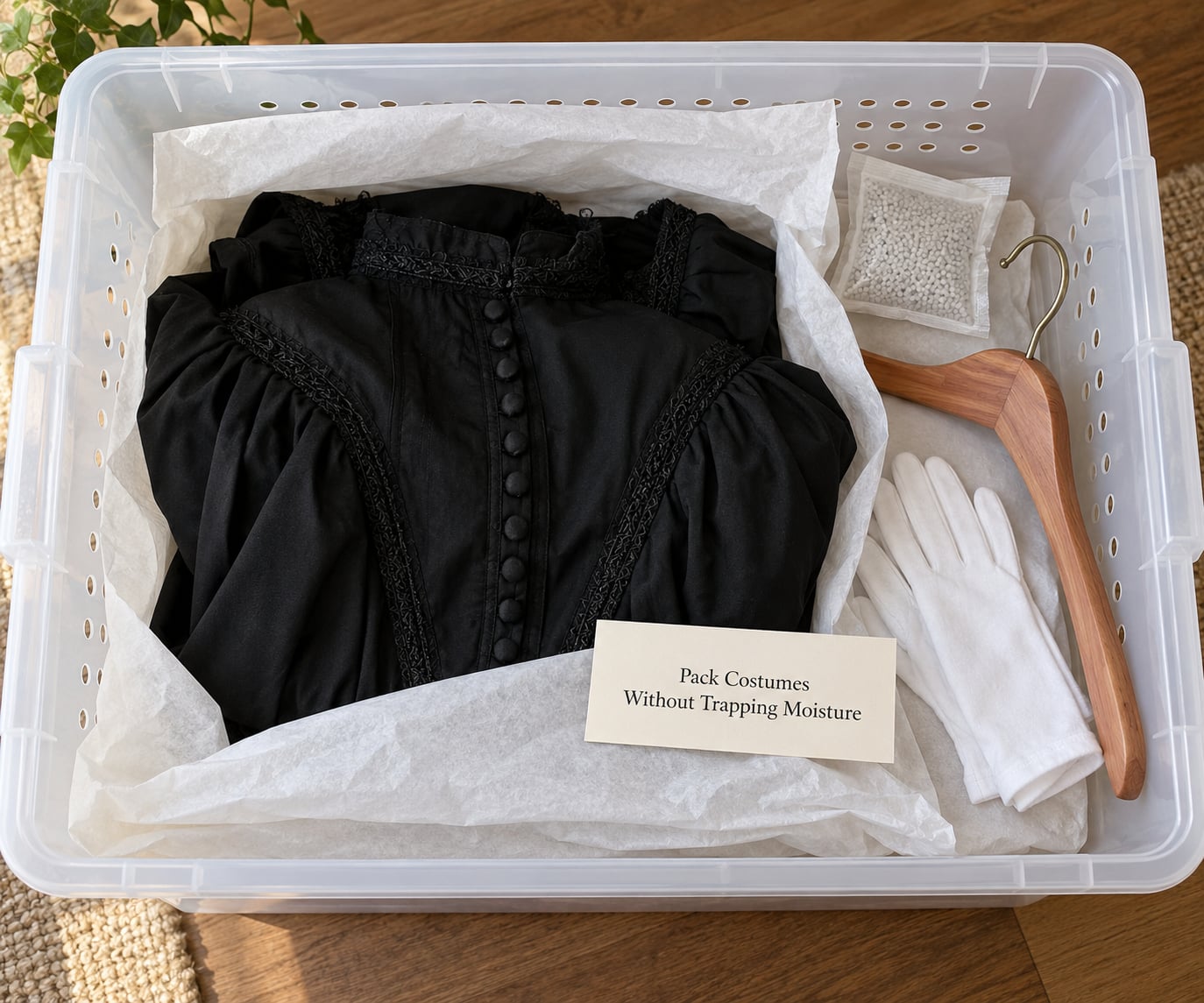
Fold loosely, not tightly. Wrinkles hold air against the fabric and give mold a foothold, while tight rolls in a small bin crush volume but also trap whatever humidity is present.
Line the bottom of the bin with a clean towel, wrap delicate pieces in acid-free tissue, and leave a silica gel packet in each lidded bin. Breathe through it: leave the lid resting rather than snapped shut, or leave the bin slightly ajar for the first week.
Avoid three things in particular. Plastic dry-cleaning bags and shrink wrap trap the moisture that already left the fabric. Vacuum-sealed bags are useful for flat, sturdy textiles like capes and banners, but they are wrong for foam, latex, feathered pieces and anything with electronics. Scented dryer sheets and potpourri near fabric can discolor light-colored costumes, so keep them out of the container.
Label every bin with the costume name, the year, and who owns it. Tape a photo to the front and you will find things in ten seconds next October instead of emptying three bins in the dark.
6. Store in a Cool, Dry, Stable Environment
The container matters less than the room. Mold grows readily when relative humidity stays above roughly 60 percent, and indoor closets in coastal, southern and southwestern states can sit near that for weeks in summer. Aim for a range around 30 to 50 percent if you have a hygrometer or a cheap one to put on your list.
A bedroom closet on an interior wall is the best spot in most homes. Interior walls buffer outdoor temperature swings, and steady cool temperatures matter as much as low humidity because condensation forms whenever warm damp air meets a cold surface.
Basements are workable if they stay dry and the bins sit off the floor on a shelf or pallet. Attics and unheated garages are the worst option: temperature swings are large, and roof or wall leaks show up as musty smells inside cardboard long before anyone sees water. If the attic is your only space, use sealed plastic totes with gasketed lids rather than cardboard, and still expect to inspect them more often.
Add a rechargeable dehumidifier in humid climates, and replace silica gel roughly every six months, or sooner if the color indicator shows it saturated. Forum threads about costume storage come back to the same two answers again and again: breathable bags plus a working desiccant.
One more thing for collectors storing off-site: choose a climate-controlled unit, and tell someone who has a key where everything is. Floods and pipe leaks take out a season of storage in a single afternoon.
7. Check Stored Costumes Periodically
Set two dates a year on your calendar. Six months out is the useful one, and it is what collectors on costume forums tend to settle on.
During the check, open every bin and lift the top layer. Look for four things: a musty smell, discoloration or spotting that was not there at packing, condensation or damp patches on the container wall, and small holes or shifted folds that suggest pests.
You will know the storage is working when a bin smells like clean fabric when you open it, the pieces are in the folds you left them in, and the silica indicator is still blue rather than pink.
Common Mistakes
Storing Costumes While They Are Still Damp
Warm, damp fabric packed into a closed bin has everything mold needs. Fix: hold each piece against your wrist after drying and wait until it feels neutral to slightly warm.
Using Airtight Plastic and Vacuum Sealing
Sealed packaging is the most common mistake because it feels protective. It locks in residual humidity and gives mildew a warm, dark, wet environment. Fix: breathable garment bags for hanging pieces, loose-lidded bins for accessories, vacuum bags only for flat sturdy textiles.
Cramming Costumes Into Small Bins
Compression plus trapped air equals both bad creases and damp spots. Fix: fewer costumes per bin, folded loosely with tissue, and a bigger bin rather than a tighter pack.
Hanging Heavy or Padded Costumes on Wire Hangers
Wire hangers stretch the shoulders of a costume and push creases into the bodice that never wash out. Fix: padded or wide wooden hangers, and never hang anything heavy for a full year from a thin wire hook.
Packing Damp Items Alongside Dry Ones
One sweaty cape ruins the costume next to it. Fix: air everything out first, and keep footwear separate from garments until both are fully dry.
Using Mothballs Near Costumes, Food or Children
Mothball fumes are toxic, and the pellets get into fabric. Fix: use cedar blocks or lavender sachets for light pest deterrence, keep them from touching the costume so the scent does not transfer, and handle mothballs only as their label directs in a sealed, ventilated space.
Leaving Costumes in Attics and Unheated Garages
Heat and cold cycles push condensation into cardboard and fabric. Fix: move to an interior closet, or to gasketed plastic totes if the garage is truly the only space, and check that spot twice a year instead of once.
Forgetting Electronics and Batteries
Batteries left inside an LED costume or a fog machine can leak and corrode the fabric and the wiring. Fix: remove every battery and pack, and photograph which pack goes where.
Sunlight Through Clear Bins
Clear bins near a window fade fabric and yellow costume colors over a single season. Fix: store them against an interior wall or inside a closet, out of direct light.
Skipping Labels and Repairs
A missing snap on a costume is what gets sewn or glued back in February, and repairs are easier to do while the costume is in front of you. Fix: fix small damage before it goes in the bin, note what you fixed on the label, and keep spare accessories in the same labeled container as the set they belong to.
Storing for Years Without a Refold
Folds left alone for two or three seasons set into the fabric. Fix: during your six-month check, lift and refold anything folded, and add cedar blocks or a fresh desiccant.
Vacuum-Sealing Foam Armor and Latex
Suction crushes foam and can curl or crack latex edges. Fix: box those pieces with tissue padding and store them flat or upright as designed.
Long-Term Costume Storage Tips
For anyone storing costumes across many seasons rather than one, a few habits pay off more than any single product. Label every container with the name, the year and the owner. Keep every part of a set together, and put small extras in a labeled pouch inside the same bin.
Avoid unnecessary compression across multiple years, since a costume that keeps its shape will still look good when you pull it out. Photograph each costume before it goes in and note any repairs you make in a simple list, so you are not guessing next season. Once a year, air everything out on hangers for a few hours, refold, replace the desiccant and write down what you found. That single hour is what separates collectors with intact collections from collectors with musty boxes.
Frequently Asked Questions
Can I wash a Halloween costume to prevent mold?
Yes, cleaning is the single most effective thing you can do. Body oils and sweat left in fabric give mold something to feed on once the costume sits in a closed bin. Machine-wash what the care label allows on a gentle cold cycle, spot clean anything painted, glued or decorated, and hand-wash masks and footwear. Always let the costume dry completely before storage.
How do I remove mold from a costume before storing it?
Isolate the item outdoors or in a well-ventilated room so spores do not spread indoors, then remove visible growth with a soft brush and a cloth dampened with a diluted bleach solution, working outside. Rinse or wipe the area with plain water, let it dry fully in moving air, and re-clean the whole garment by hand. Anything you cannot treat should be stored breathable, never sealed, until you can replace it.
Are plastic storage bins safe for Halloween costumes?
Only when they are not airtight. Clear plastic bins are useful for dust protection and small accessories, but a snapped-shut bin traps humidity, which is exactly what mold needs. Leave the lid loose or slightly ajar, add a silica gel packet, and keep the bin off the basement floor. For garments on hangers, a breathable cotton garment bag beats plastic every time.
How should I store wigs, masks, and costume accessories?
Wigs go on a shaped stand or a wide hanger inside a breathable bag, never folded into a bin, since folding tangles and creases the fiber. Store masks flat in their own box with tissue between the face and any surface, and never let two masks touch. Small accessories, jewelry and make-up kits go in compartmented bins or labeled pouches with cedar blocks nearby.
Will Halloween costumes get moldy in a basement or garage?
They can, and the risk is measurable by humidity rather than by the room itself. Basements are workable if the air stays dry and bins sit on a shelf off the floor; run a dehumidifier if you see condensation on walls. Unheated garages and attics are riskier because heat swings drive humidity into cardboard and fabric. Whichever space you choose, inspect twice a year and keep a desiccant in every sealed container.
Conclusion
Do one thing this week, before the costumes come out again: pull them all out, clean anything that touched skin, and let every piece dry until no part of it feels cool to your wrist. Then pick a breathable container for each piece, add a silica gel packet to every lidded bin, put them in a cool room away from sunlight, and set your first check date six months out. That is the whole routine, and it is what keeps a costume wearable for years instead of one season.