To make a group costume for four people, pick one theme that splits naturally into four roles, give everyone the same base color and one shared accessory, then let each person add the piece that identifies their character. Most of the work happens in one or two evenings, and no sewing is required.
The hard part is not the crafting. It is getting four separate people to agree on something, then making four different bodies look like one idea in a photograph. Fix that first and the costume itself takes an afternoon.
Here is the method we use, in order.
Table of Contents
- What You Need
- Planning and decision kit
- Shared base kit (bought once for all four)
- Tools and craft supplies
- Safety and comfort items
- Shortcuts worth taking
- Step-by-Step: How to Make a Group Costume for Four People
- Step 1: Choose a Theme That Works for Everyone
- Step 2: Assign Four Connected Costume Roles
- Step 3: Set the Budget and Make a Parts List
- Step 4: Build the DIY or Purchased Costume Pieces
- Step 5: Add Color Coordination and Group Details
- Step 6: Test the Costumes for Comfort and Visibility
- Common Mistakes and How to Fix Them
- Frequently Asked Questions
- What is a good group costume idea for four people?
- How can four people match costumes without wearing identical outfits?
- What is the easiest way to make a group costume on a budget?
- Can children and adults wear a coordinated four-person costume together?
- How do you make a group costume look better in photos?
- What should we do if we only have one day to prepare?
- Conclusion
What You Need
Split the list into four buckets. Everything in the first two is bought or found once for the whole group, which is what keeps the cost and the effort down.
Planning and decision kit
- A group chat with a hard deadline written in it
- A photo of each person’s measurements: chest, waist, and height
- Two or three shortlisted themes with a “who wears what” sketch
- A shared folder where finished pieces and fabric swatches get posted
Shared base kit (bought once for all four)
- Four plain tops in one color, or one dyeable color family
- Four pairs of black bottoms as a neutral base
- One repeated accessory: caps, bandanas, suspenders, sashes, or gloves
- Two or three rolls of one accent color for stripes, trim, or lettering
- Letter stencils, fabric paint, or iron-on numbers
Tools and craft supplies
- Hot glue gun and spare sticks
- Cardboard, cardstock, and a utility knife for signs and props
- Foam board for wide masks and hat brims
- Scissors, measuring tape, and safety pins
- Needle, thread, and fabric glue if anyone is sewing
- White base coat and a sponge for anyone doing body paint
Safety and comfort items
- Ventilated, well-fitting masks with room to breathe
- Reflective tape if you will be walking on a street after dark
- Soft, broken-in shoes chosen a week ahead, not on the night
- Hair ties, safety pins, and double-sided tape for emergency fixes
Shortcuts worth taking
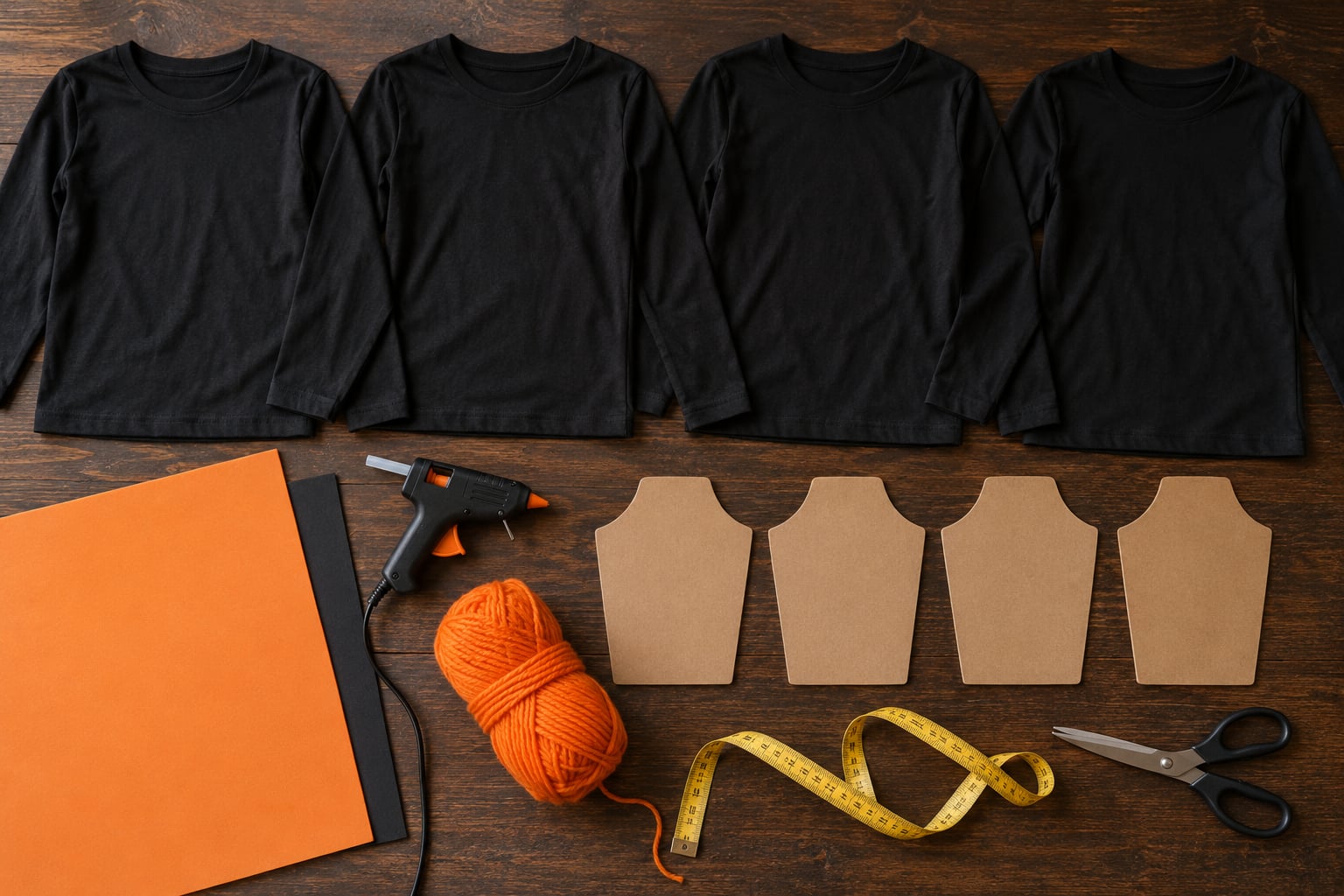
Borrow rather than buy, and swap pieces instead of buying new ones. A group of four can do a lot with four thrift shirts, one glue gun, and a cardboard box cut into four identical shapes.
Step-by-Step: How to Make a Group Costume for Four People
Six steps, in this order. If you have only a few days, skip ahead to the fallback column in the timeline below and cut the parts you cannot finish.
| When | What has to be done | If you are behind |
|---|---|---|
| Three weeks out | Vote on three themes. Agree a deadline and stick to it. | Run a 24-hour vote in the group chat and take the majority. |
| Two weeks out | Assign four roles and post measurements. | Assign roles from the theme’s natural four, not from who volunteered first. |
| One week out | Source the shared base: same color top, one accessory type. | Use four tops in one color from whatever wardrobe you already have. |
| Two to four days out | Build the shared piece and the four signature pieces. | Drop the signature pieces and let the shared color and accessory carry the theme. |
| 48 hours out | Full dress rehearsal with all four. Fix fit, fasteners, and makeup. | Do a ten-minute fit in costume tops only, then sleep. |
| Day of | Photograph the group before anyone leaves the house. | One portrait against a plain wall beats no photo at all. |
Step 1: Choose a Theme That Works for Everyone
Choose a theme that already has exactly four members, or that can be built from four identical objects. Four-character sets such as the Fantastic Four, the Ninja Turtles, the Power Rangers, the Scooby-Doo gang, Ghostbusters, Mario, or a Peter Pan and Wendy and Tinkerbell and Captain Hook set give you instant role structure, which removes most of the arguing.
Post three options in the group chat and give everyone 48 hours to object, not to invent. The person who suggests the theme loses the right to veto, which sounds petty and works extremely well.
Check the constraints before you vote, not after. Someone who works with young children needs a costume that survives a school day, someone with a mobility limit needs nothing heavy or bulky, and anyone wearing contacts or glasses needs a hat that fits over them. A theme that fails one hard constraint is out.
Step 2: Assign Four Connected Costume Roles
Assign roles so each person has a distinct silhouette but the same underlying build. Identical outfits on four different bodies never photograph well; four clearly different outfits with no shared thread never look like a group either.
Use the 3-match rule: one shared base color, one shared silhouette element that all four repeat, and one distinct character accessory each. The repeated pieces do the grouping. The different pieces do the storytelling.
| Person | Base layer | Shared element | Signature piece |
|---|---|---|---|
| Person 1 | White long-sleeve top | Tan shorts and a neckerchief | Sunglasses and a rubber-hose pipe |
| Person 2 | White long-sleeve top | Tan shorts and a neckerchief | Boxy shoulder pad and a grainy scarf |
| Person 3 | White long-sleeve top | Tan shorts and a neckerchief | Shaggy wig and a held phone |
| Person 4 | White long-sleeve top | Tan shorts and a neckerchief | Burly build and a rolled-up map |
That table is the whole costume. Four plain tops, four pairs of shorts, four scarves, and whatever wig, glasses, and padding each person already owns.
Step 3: Set the Budget and Make a Parts List
Write down a per-person ceiling before anyone buys anything, and include materials you already have. A realistic figure for a full DIY theme runs to a couple of hours of work and a modest parts cost per person; thrift-flip themes cost close to nothing and just cost more time.
Prioritize by visibility. Anything above the waist that faces a camera earns money first, then footwear, then the base layer, and props last. Nobody in the photographs will notice the belt you agonized over.
Split the parts list into shared and individual. Shared items are bought once in a quantity of four; individual items are bought one at a time. Doing this split out loud stops four people from buying four separate costume sets for the same theme, which is the most common way a group budget disappears.
Step 4: Build the DIY or Purchased Costume Pieces
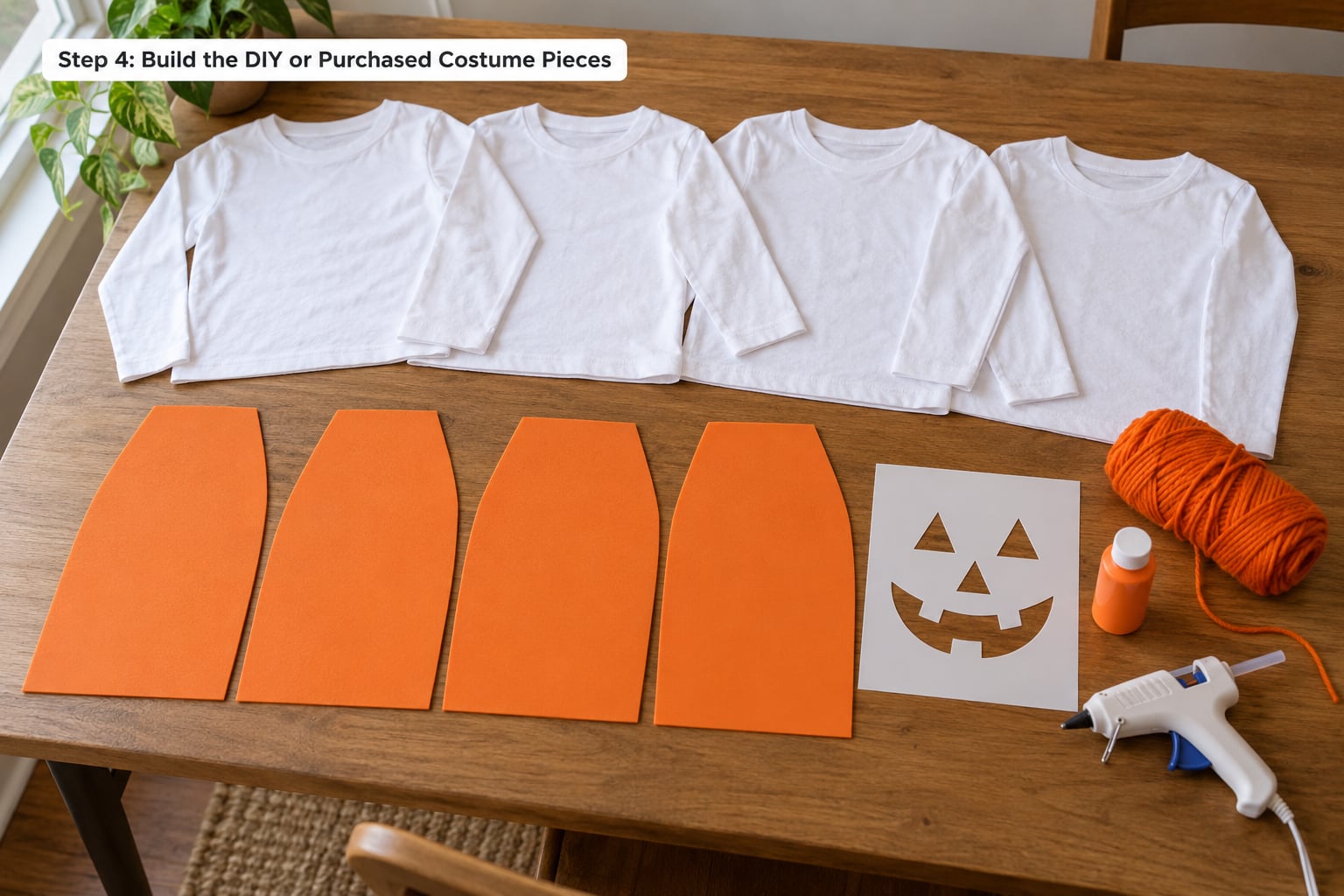
This is where you make a group costume for four people, and it is mostly cutting and gluing. Paint stripes on plain tees with fabric paint and a stencil, or iron on pre-cut shapes. Build wide brims and signs from foam board and cardstock. Everything can come out of a single cardboard box if you cut four identical panels.
Match the four pieces by making them from the same sheet, or by tracing one master piece four times. Identical cuts are what make a DIY group costume read as deliberate rather than assembled from whatever was left over.
Use removable methods wherever you can: elastic waistbands instead of tailoring, safety pins instead of permanent stitching, fabric glue instead of needle and thread. Nothing has to survive the washing machine, but it does have to survive eight hours of wear.
For makeup, keep it to two things per person and use the same two ideas across the group. A stripe, a bruise, a lip color, a white base. Coordinated makeup reads as a group faster than anything you glue on.
Step 5: Add Color Coordination and Group Details
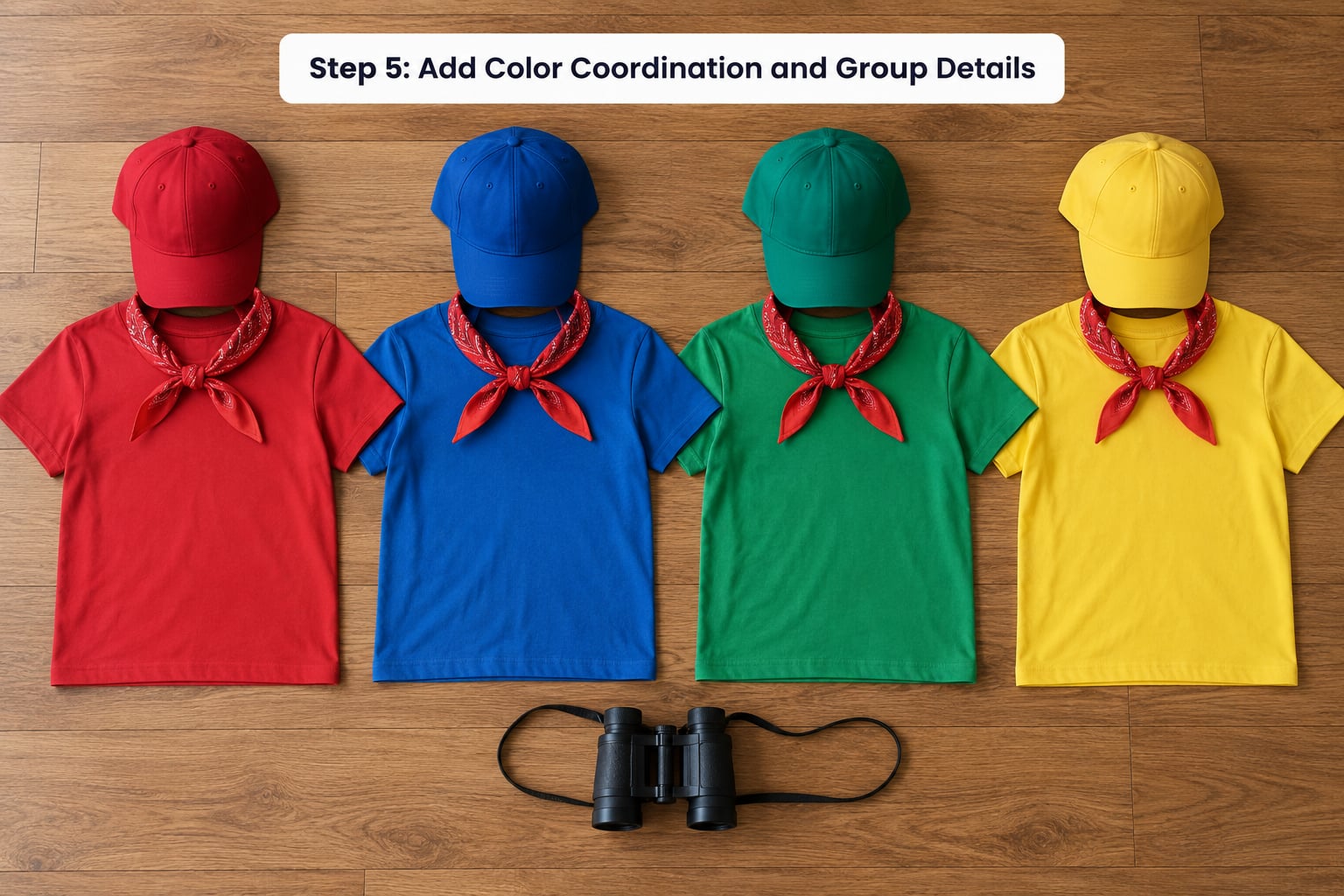
Pull every piece onto one floor, stand in a line, and photograph from ten feet away. Anything that reads as a different color under that light gets swapped. This is the cheapest and fastest way to fix a theme that looked fine in the bedroom and terrible in a hallway.
Repeat two things and stop. Two repeated colors plus one shared accessory is usually enough; more than that and you turn four people into a logo. Pick the accent color once, for the whole group, and hold it.
Add one group item that all four carry: matching tote bags, a shared prop held together in the photo, lanterns, flashlights, or matching socks visible above the shoes. It is the detail strangers comment on most.
Step 6: Test the Costumes for Comfort and Visibility
Everyone wears the full costume for 30 minutes indoors before the night of. You are checking six things: that shoulders and elbows move, that nobody gets hot, that fasteners hold, that shoes do not rub, that nobody is looking at the floor to see where they are going, and that props are soft or light enough to carry safely.
Test in a hallway with the lights you will actually have. A costume that reads great in a dark party can be invisible on a sidewalk, so add reflective tape anywhere it shows.
Then take the group photograph. Stand everyone shoulder to shoulder with the tallest in the middle, tallest and second tallest at the ends, and make the four signature pieces all face the camera. Shoot two meters back so nobody crops a wig off the top.
Common Mistakes and How to Fix Them
Four unrelated outfits with no shared color. Everyone assumed the theme was in their head. Fix it by adding one repeated item to each person the night before, even if it is only a strip of colored tape on a sleeve.
One person is still undecided on day ten. Give that person one specific job with a deadline, or drop them into the wildcard role. A group of three with a matching trio look beats four people where one is in a baseball jersey.
Overcomplicated DIY projects. Foam carving, electronics, and anything requiring a heat gun on a deadline do not happen. If a piece took more than an hour and does not read from ten feet, simplify it or cut it.
Four separate shopping carts, four separate palettes. Nominate one person to place shared orders and one to hold the paint and fabric paint. Budget stops being a problem the moment four people stop buying independently.
Costumes that look good and feel miserable. Everything heavy sits at the shoulders and everything tight sits at the waist. Move bulk to the torso, leave elbows and hips loose, and test with a coat on if it will be cold.
Unsafe props. Foam or cardboard weapons only, sharpened stakes banned, and nothing flammable near a candle or a heat gun. Carry a prop you could bump into a stranger without apologising.
No plan for a late drop-out. Design the fifth spot from the start. Add a wildcard character who owns nothing but a costume, so removing one person leaves a working group rather than a gap.
Frequently Asked Questions
What is a good group costume idea for four people?
Sets with four natural members work best because the roles already exist: the Fantastic Four, the Ninja Turtles, Power Rangers, Ghostbusters, the Scooby-Doo gang, Mario, or Peter Pan with Wendy, Tinkerbell and Captain Hook. Non-fiction options like condiment bottles, colored candies, or teletubbies scale to any group size. Pick the one where all four roles are doable with what you already own.
How can four people match costumes without wearing identical outfits?
Use the 3-match rule: one shared base color on all four, one repeated silhouette element such as a hat, sash or stripe, and one distinct character accessory each. Identical outfits fit four different bodies badly and photograph poorly. Shared repeated pieces pull the group together, while the different accessories tell people who is who without anyone blending into the background.
What is the easiest way to make a group costume on a budget?
Build a color-first theme. Buy four plain tops in one color, then spend only on the one or two pieces that name the theme, like matching caps or lettered stencils. Thrift flips work well for wigs and colored jeans. Keep props cardboard or foam and skip anything needing a sewing machine. Most of the coordination cost is people buying four separate costume sets instead of one shared kit.
Can children and adults wear a coordinated four-person costume together?
Yes, if you build from the shared base outward. Use adjustable elastic waistbands, ties, and neck scarves instead of fitted clothing, so one piece fits a seven-year-old and an adult. Kids usually take the shorter or padded roles and adults take the roles with wigs or coats. Keep the accent color identical across all four and the sizes will not fight each other.
How do you make a group costume look better in photos?
Shoot from further away than feels right, roughly two meters back, so the full silhouette fits the frame. Put the tallest person in the middle and second tallest at one end, stand everyone shoulder to shoulder, and turn the four signature accessories toward the camera. A plain wall, bright even light, and no flash in a dark hallway will do more than any extra detail on the costume.
What should we do if we only have one day to prepare?
Cut the theme down to a shared color, a repeated accessory, and a word or letter on each person. Skip masks, capes, wigs and anything glued. Ten minutes at a thrift store or a dollar store for four matching tops, plus an hour to add stencils and color, will out-photograph a half-finished full costume. Do a quick ten-minute fit and get it done early rather than starting something ambitious you cannot finish.
Conclusion
Start tonight with the vote and a 48-hour deadline. That decision is what most group costumes fail on, and it costs nothing. Once the theme is locked, buy the shared color first, agree the four roles second, and only then make anything individual. Repeat two colors and one shared accessory, and four people will photograph as a single costume without a single seam.
Updated for October 2026.