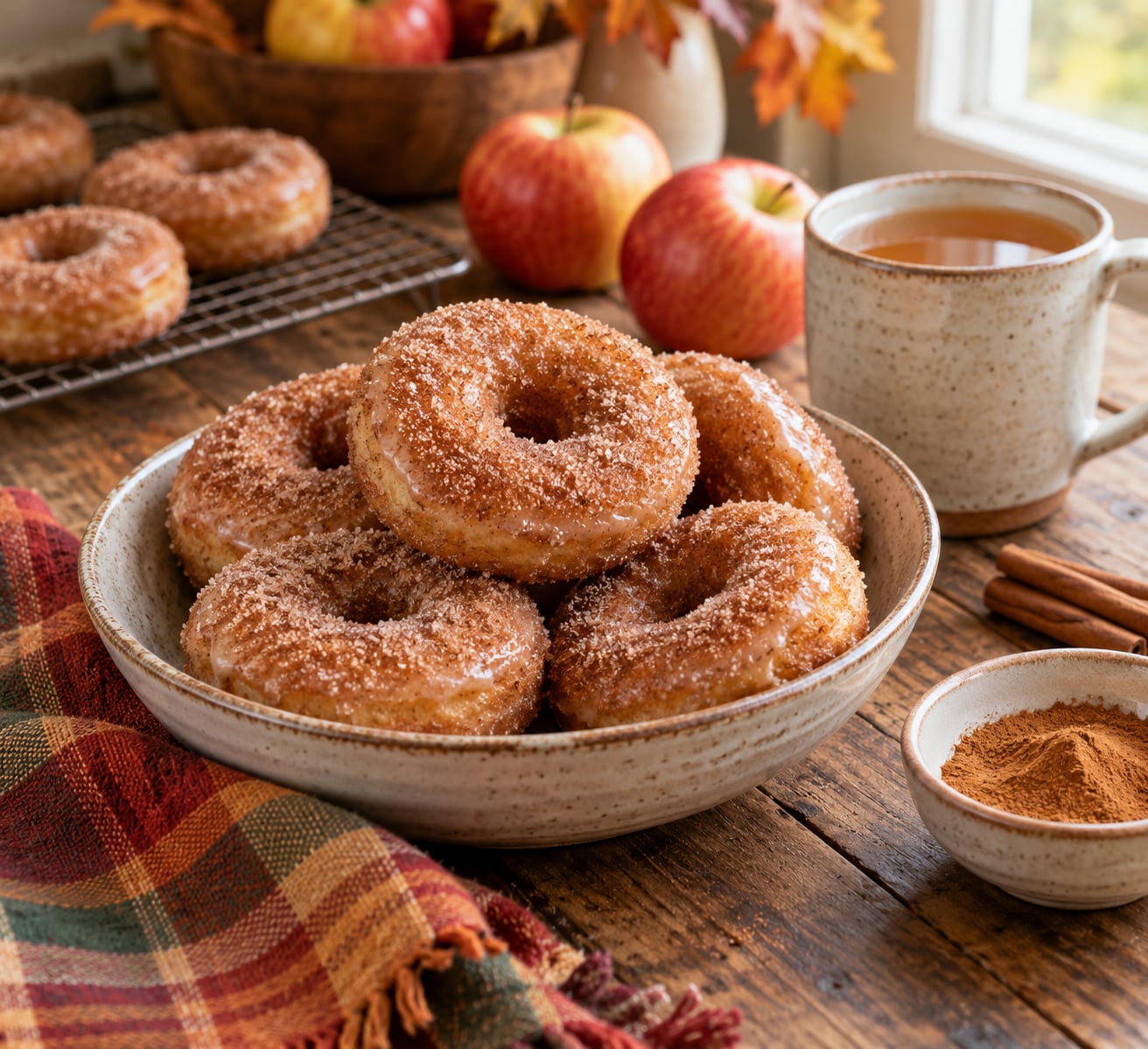
To make apple cider donuts at home, you warm a cup of apple cider to about 110°F, mix it into a yeasted dough with flour, sugar, egg, butter and warm spices, let the dough rise until doubled, cut it into rings, and fry the rings in oil held at 350–365°F. While they are still warm, you dip each one in melted butter, roll it in cinnamon sugar, and finish with a thin apple-cider glaze. The whole job takes roughly two and a half hours, and most of that is the dough sitting still.
This is a yeasted dough rather than the cake-style batter most grocery-store cider donuts use, so the crumb comes out a little chewier and the fried edges a little crisper. It is also the version that holds up to a plate of cider, which matters if you are feeding a crowd on a fall Saturday.
Fresh cider matters more than anything else on the ingredient list. Pressed cider from a local orchard tastes sweeter and less acidic than grocery jug cider, and that difference survives the dough. Do not reach for apple cider vinegar or a sour cider here; if your jug smells sharp enough to make you wince, it is too sharp for the dough.
Table of Contents
- What You Need
- Step-by-Step: How to Make Apple Cider Donuts at Home
- Step 1: Activate the Yeast and Mix the Dough
- Step 2: Knead and Let the Dough Rise
- Step 3: Shape the Apple Cider Donut Dough
- Step 4: Fry the Donuts Until Golden
- Step 5: Coat and Glaze the Warm Donuts
- Common Mistakes
- Frequently Asked Questions
- Do apple cider donuts need to rise before frying?
- Can I bake apple cider donuts instead of frying them?
- What temperature should I fry apple cider donuts at?
- How long do homemade apple cider donuts stay fresh?
- Can I make the dough ahead of time?
- Why are my apple cider donuts greasy?
- Conclusion
What You Need
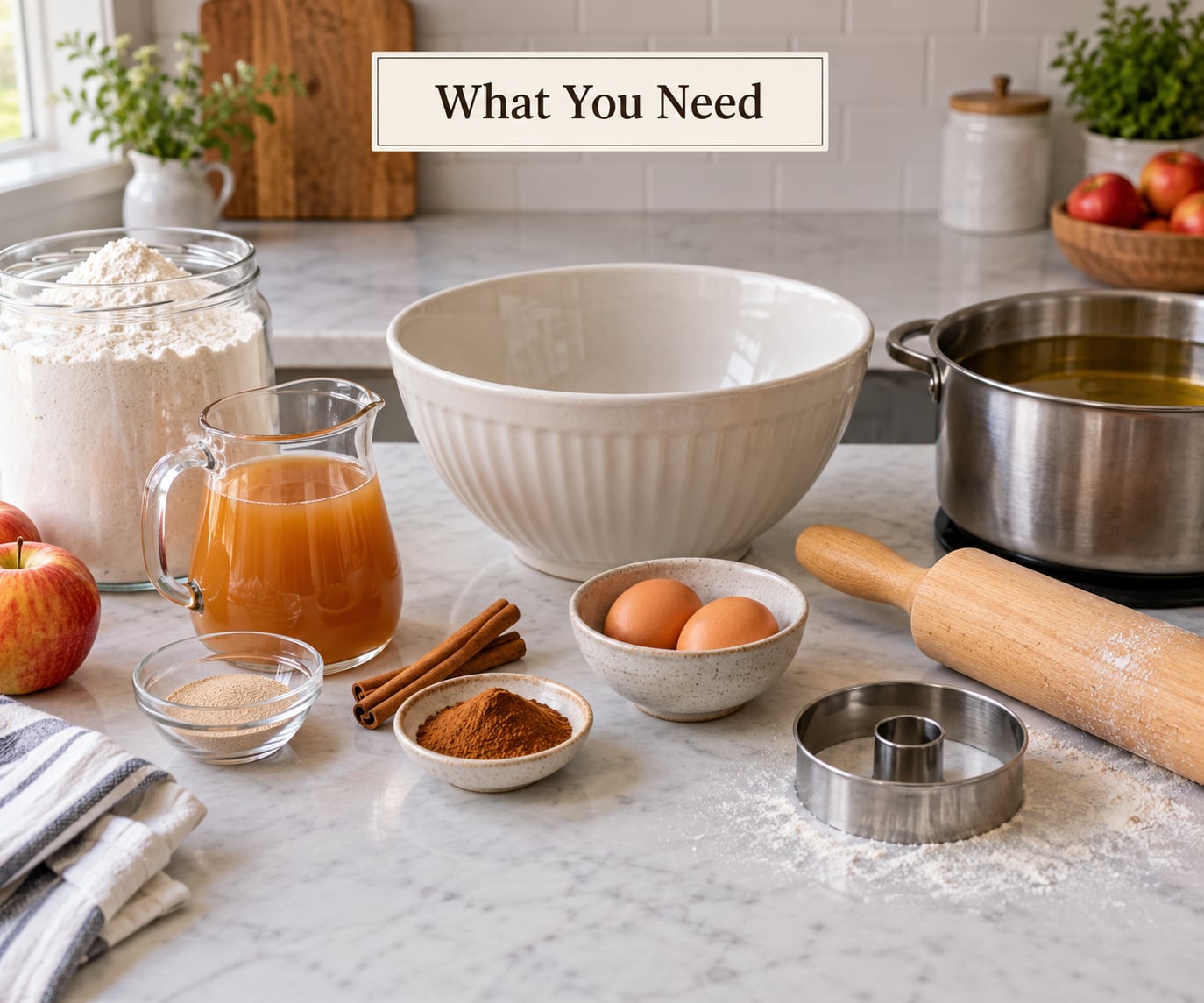
For the dough:
- 1 cup apple cider, plus another half cup for brushing and glazing
- 3 cups bread flour or all-purpose flour, plus extra for dusting
- 1/4 cup granulated sugar
- 2 1/4 teaspoons instant yeast (one 1/4-ounce packet)
- 1 teaspoon fine salt
- 1 large egg, room temperature
- 3 tablespoons unsalted butter, melted and cooled a few minutes
- 1 teaspoon ground cinnamon
- 1/2 teaspoon ground nutmeg
- 1/4 teaspoon ground cloves
For frying and coating:
- 2 cups of a neutral oil with a high smoke point, such as canola, peanut or vegetable
- 6 tablespoons unsalted butter for dipping
- 3/4 cup granulated sugar mixed with 2 tablespoons cinnamon and 1/2 teaspoon nutmeg
- 1 cup powdered sugar, 2 tablespoons apple cider and 1/2 teaspoon vanilla for the glaze
You also want a 3-inch doughnut cutter, a rolling pin, a wire cooling rack set over a sheet pan, a medium saucepan or Dutch oven with 2 inches of oil, and an instant-read thermometer. The thermometer is the single most useful tool in this recipe. Oil that is too cool gives you greasy rings, and oil that is too hot gives you a dark crust with a raw center, and neither mistake is obvious until the donut is already ruined.
Step-by-Step: How to Make Apple Cider Donuts at Home
Step 1: Activate the Yeast and Mix the Dough
Warm 1 cup of apple cider in a saucepan over medium heat until an instant-read thermometer reads 110°F. If you do not have a thermometer, the cider should feel like warm bathwater, not hot. Yeast starts to die somewhere above 120°F, and cider that is too hot will leave you wondering why the dough never rose. Set it aside and cool for five minutes if it feels close to hot.
In a large bowl, whisk together the flour, sugar, instant yeast, salt, cinnamon, nutmeg and cloves. Pour in the warm cider, the melted butter and the egg, and stir with a wooden spoon for about a minute. The dough should come together into a shaggy, sticky mass with no dry pockets of flour left at the bottom of the bowl. If you find one or two, stir them in rather than reaching for more liquid.
Step 2: Knead and Let the Dough Rise
Turn the dough out onto a lightly floured surface and knead for 6 to 8 minutes. You are looking for a smooth, slightly tacky ball that springs back slowly when you press a floured finger into it and leave a light dent. Scratching a patch of dough from the bowl without tearing it usually means the gluten is underdeveloped, and that shows up later as dense, tough rings.
Put the dough in a lightly greased bowl, turn it to coat, and cover with a damp towel or plastic wrap. Let it rise in a warm spot for 60 to 90 minutes, until the dough has roughly doubled and feels puffy and full of air. Use the poke test: press a floured finger in about half an inch. If the dent springs back fast, give it another 20 minutes. If it springs back slowly and leaves a soft dent, it is ready.
Step 3: Shape the Apple Cider Donut Dough
Punch the dough down, turn it onto a floured surface, and roll it to about 1/2 inch thick. Keep rolling in the same direction, and dust with a little flour if it starts to stick. Cut out as many 3-inch rounds as you can, then cut a small hole from the center of each round for the doughnut holes, or save the little centers as one-bite donuts.
Scraps can be gathered and rerolled once, but past that the gluten gets worked hard and the rerolled pieces come out tough. I set the second-round scraps aside and bake them as cookielike bites so nothing goes to waste without hurting the main batch. Let the cut rounds sit for about 10 minutes so the gluten relaxes. If they spring back and shrink the moment you lift them, they need another few minutes, not more kneading.
Step 4: Fry the Donuts Until Golden
Heat 2 inches of oil in a heavy pot to 350°F and let it climb to about 360°F. The oil should be shimmering and a small scrap of dough should sizzle steadily rather than sit still. Lower in four or five donuts at a time with a spider or slotted spoon, and keep the temperature between 350 and 365°F by turning the heat down or off if it climbs.
Fry for 2 to 3 minutes on the first side until the underside is deep golden brown, then flip and fry 1 to 2 minutes more. Bubbles should be steady the whole time. When the bubbles slow to lazy pops, the moisture is leaving the dough and the donut is finishing. Drain on the rack, not on a plate, so steam escapes the bottom instead of soaking into it.
Step 5: Coat and Glaze the Warm Donuts
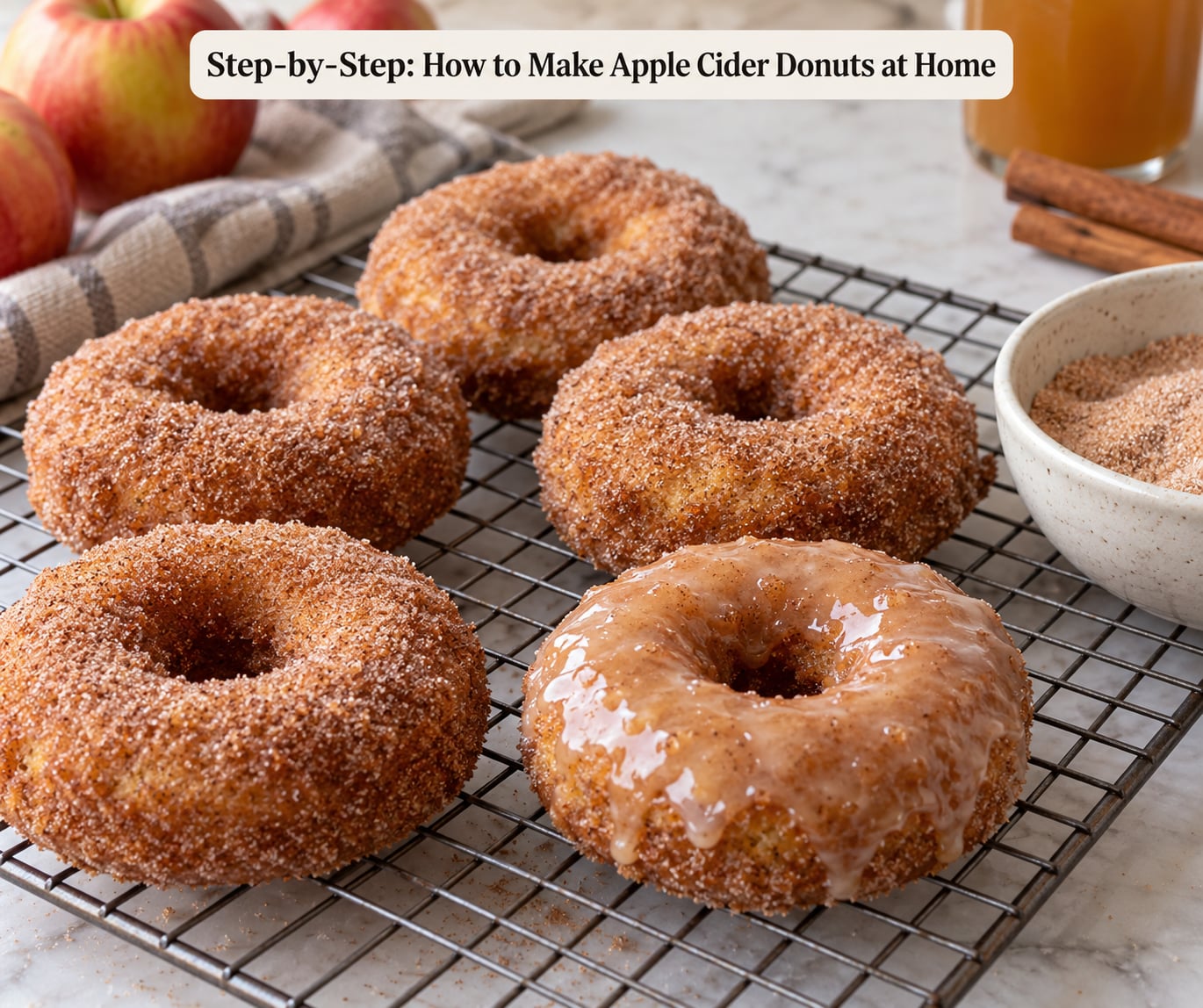
Dip each donut in melted butter, then roll it in the cinnamon sugar until the surface is fully covered. Do this while the donuts are still hot, about 2 minutes out of the oil, because the butter needs to melt against the crust to stick. The sugar will feel loose at first and set into a crunchy shell as it cools. For a glaze, whisk the powdered sugar, 2 tablespoons of the reserved cider and the vanilla, then drizzle or dip the still-warm donuts and let them sit for about 10 minutes before moving them.
Leftover dough can be shaped, covered and refrigerated for up to 24 hours before it rises again in a cool place, or frozen and thawed overnight. For the baked version, a 400°F oven works in a pinch, but fried is what an orchard stand makes, and the ten minutes of frying are the whole point.
Common Mistakes
- Cider that is too hot. It kills the yeast and you get a dense dough that spreads instead of puffing. Warm to 110°F and cool it a few minutes before it meets the flour.
- Overproofing. A dough risen for three hours collapses when you handle it and the rings come out tough. Watch the poke test rather than the clock.
- Overmixing or overworking the dough. Cider dough is wet, and the instinct is to add flour. Use a shaggy dough and trust the kneading; dense rings are almost always too much flour or too much handling.
- Crowding the pot. Too many donuts at once drops the oil temperature fast, and the donuts soak it up as they cook. Four or five at a time is plenty.
- Frying at the wrong temperature. Cooler than 345°F means greasy, hotter than 370°F means burnt outside and raw inside. Use the thermometer and adjust the heat, not the frying time.
- Glazing while the donuts are hot. The glaze melts off and runs onto the rack. Let them cool for a few minutes first, and glaze while still warm, not hot.
- Cinnamon sugar that will not stick. It only adheres to melted butter on a warm donut. Skip the dip and the coating slides right off.
Freshly fried donuts are best the same day. They stay good covered at room temperature for about two days, and unglazed and uncoated donuts freeze for up to two months. Thaw them at room temperature, then dip in butter and coat right before serving, which keeps the sugar crunchy instead of stale.
Frequently Asked Questions
Do apple cider donuts need to rise before frying?
Yes, the dough needs a full first rise before you cut it. A yeasted cider dough that has not risen has no gas to expand, so the rings come out dense, heavy and greasy in the oil. Give it 60 to 90 minutes in a warm spot until the poke test leaves a slow-returning dent, then cut and fry. If your kitchen is cold, the rise can take closer to two hours.
Can I bake apple cider donuts instead of frying them?
You can, and the results are lighter and less messy. Bake the same rings at 400°F for 9 to 11 minutes on a parchment-lined sheet until golden and springy, then brush with melted butter and coat in cinnamon sugar while warm. Baked donuts are softer and cakier, with less of the crisp, slightly chewy fried edge that makes a cider donut taste like an orchard stand.
What temperature should I fry apple cider donuts at?
Aim for 350 to 365°F in a heavy pot with 2 inches of oil. Below 345°F the donuts drink oil and turn greasy, and above 370°F the outside darkens before the center cooks through. Start at 360°F, fry four or five at a time, and adjust the burner if the reading drifts. Bubbles should sizzle steadily the whole time a donut is in the pot.
How long do homemade apple cider donuts stay fresh?
Eat them the day you fry them if you can, because that is when the crust is at its best. Covered at room temperature they stay good for about two days, though the exterior softens. Uncoated and unglazed donuts freeze for up to two months. Thaw at room temperature, then dip in melted butter and roll in cinnamon sugar right before eating.
Can I make the dough ahead of time?
Yes. After the first rise, cover the dough and refrigerate it for up to 24 hours. Cold dough ferments very slowly, so take it out about 90 minutes before you plan to roll and cut it, and check the poke test before you start. The same dough can be shaped, frozen on a parchment-lined tray, and baked or fried from frozen the next morning with a few extra minutes.
Why are my apple cider donuts greasy?
Three things cause greasy donuts: oil that was cooler than 345°F, too many donuts in the pot at once, and a long wait on a plate where steam soaks the crust. Use an instant-read thermometer, keep the batches to four or five, and drain on a wire rack so air reaches the bottom of each donut. Frying until the bubbles slow to lazy pops also keeps oil out of the crumb.
Conclusion
Start with the cider temperature, because that one mistake costs you the batch and everything else in this recipe is easy to correct as you go. Warm it to 110°F, take your rise seriously, keep the oil between 350 and 365°F, and coat the donuts while they are still warm enough for the butter to melt.
Serve them with a mug of hot cider and a spoon of the cinnamon sugar on the side for anyone who wants more. They also disappear fast on a Halloween party table, and they hold up to a stack of shortbread, salted caramel apples and a pot of coffee.