A Halloween scavenger hunt for kids is a chain of clues that leads from one spot to the next and ends at a prize. To make one, pick a theme, decide how many stops fit your children’s ages, write each clue so it names the next hiding place, then hide the cards in reverse order starting at the prize. Setup takes about twenty minutes for six to eight clues, and the hunt itself runs ten to fifteen.
That reverse-order hiding trick is the whole game. If you hide the first clue first, you end up hiding the last clue at the place where you started, and a six-year-old notices immediately.
This guide covers the whole build, from what to put on the table to what to say when a child stalls at clue four. Everything here works indoors, in a yard, or on a trick-or-treat walk, and none of it needs a decorated neighborhood.
Table of Contents
- What You Need
- Step-by-Step
- How to Make a Halloween Scavenger Hunt for Kids
- Write Age-Appropriate Clues
- Make the Clues and Set Up Checkpoints
- Add a Small Prize or Final Surprise
- Test the Full Hunt
- Run the Scavenger Hunt
- Make It Easier, Harder, or More Frightening
- Common Mistakes
- Frequently Asked Questions
- What is the best age for a Halloween scavenger hunt?
- How long should a Halloween scavenger hunt last for kids?
- Can you do a Halloween scavenger hunt outdoors?
- How do you make a scavenger hunt work for multiple children?
- What is a good Halloween scavenger hunt for small spaces?
- Conclusion
What You Need
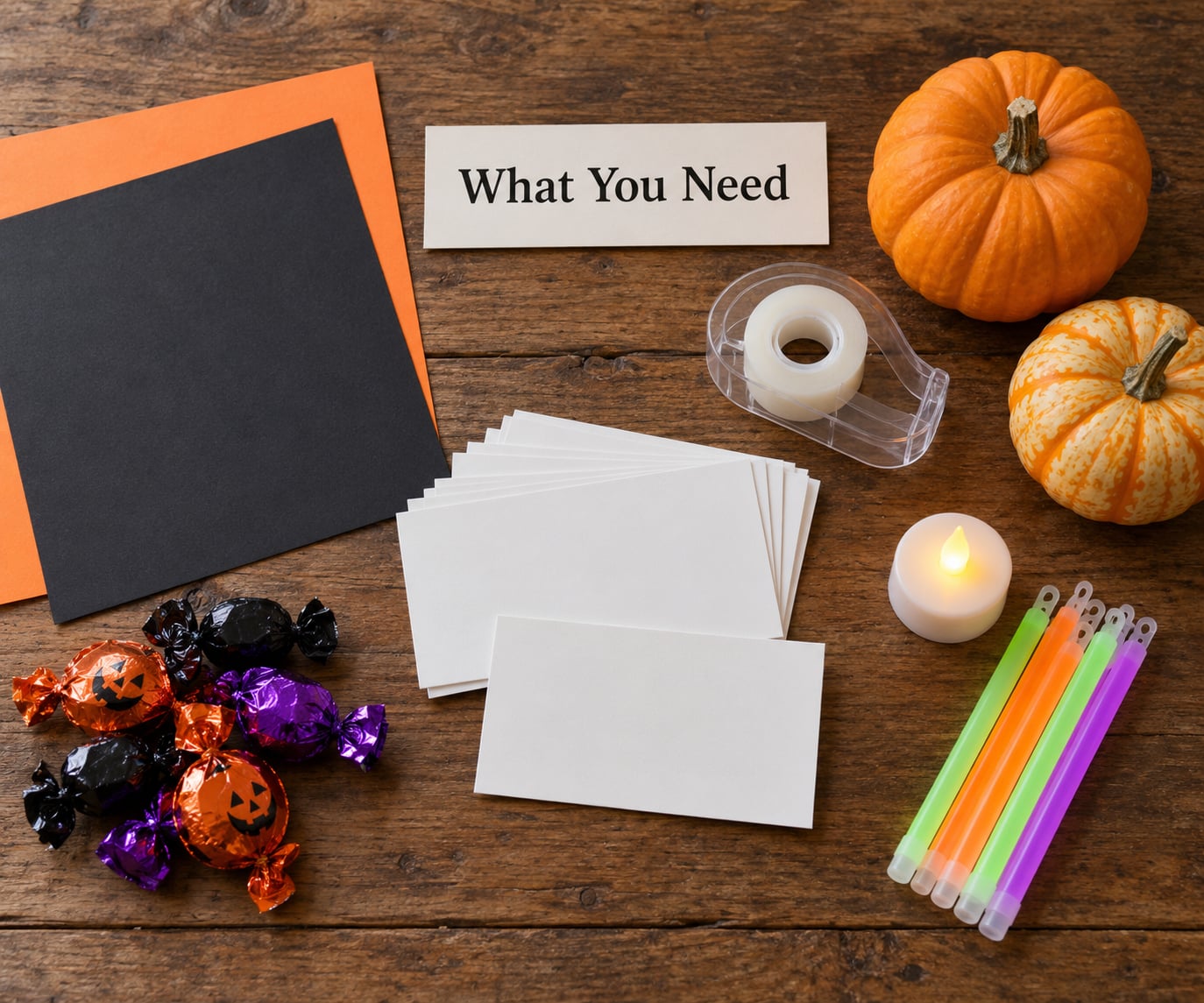
You need very little. Most of this list is paper, and the rest is optional.
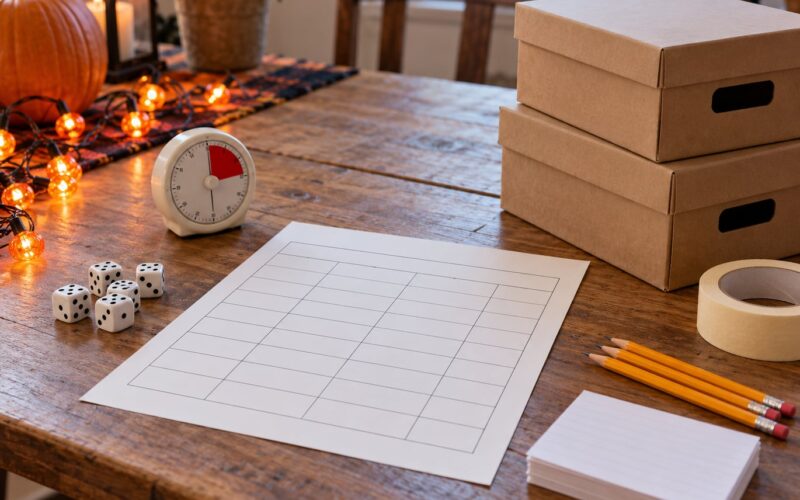
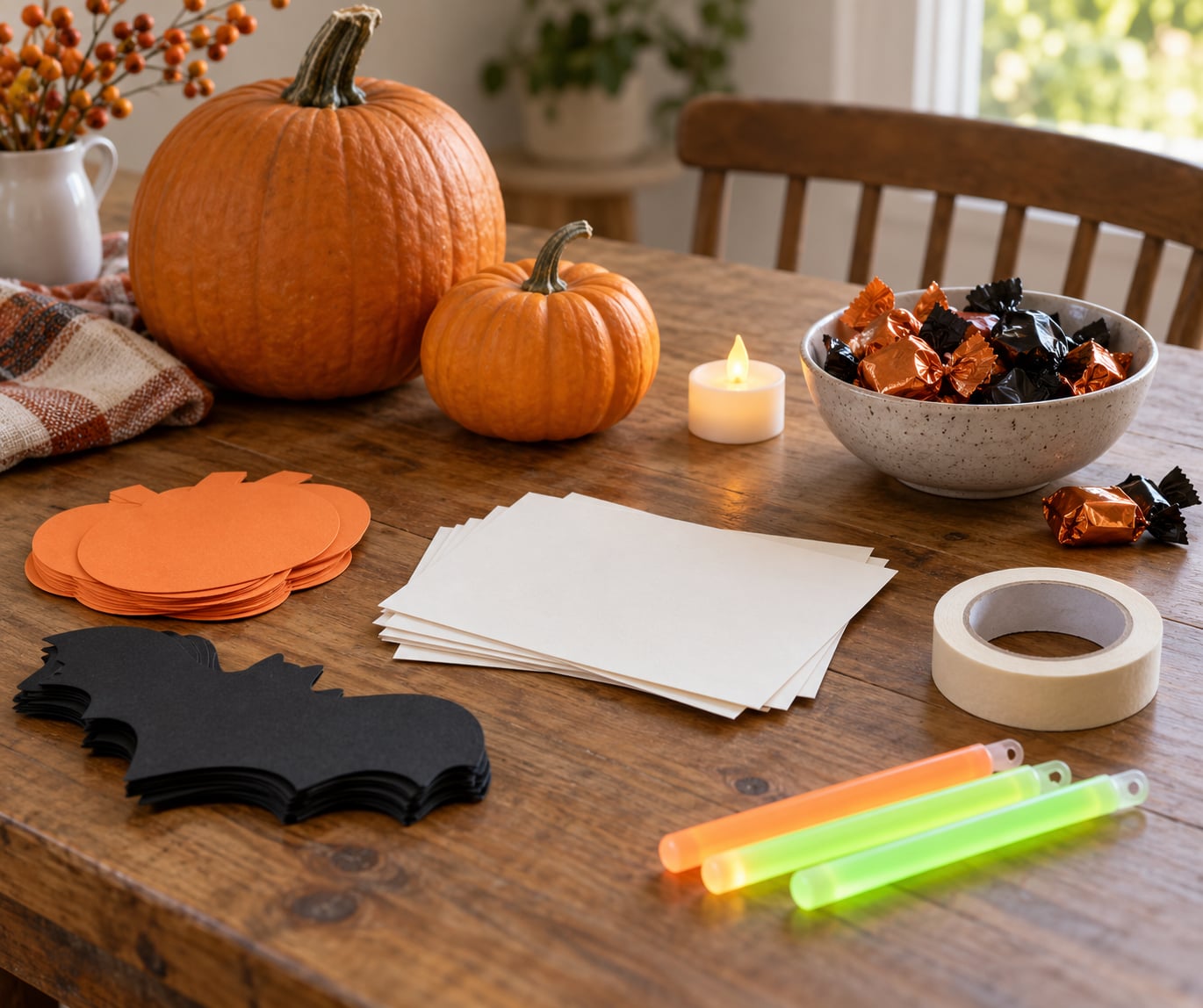
- Clue cards. Index cards, plain paper cut into quarters, or one sheet of cardstock printed and cut up. Cardstock survives damp hands and a dropped flashlight better than regular printer paper.
- A pen or pencil per child. This matters for list hunts, where kids tick items off as they find them.
- Tape. Masking tape on a lamp or a door frame is easier to remove later than Scotch tape, which leaves a mark on paint.
- A small prize. Anything from stickers to a wrapped chocolate bar. Keep it modest and the hunt stays fun for the group.
- Something that glows, optional. Glow sticks or battery tea lights make checkpoints findable in a dark hallway without a flashlight in every hand.
- A marker or stickers, optional. For numbering cards and labeling hiding spots so you can find them again.
The one rule for planning the route: move from one safe, lit, reachable spot to the next. No clue should send a child under a car, up a tree, into a dark garage, or behind a locked gate. Walking speed, not running, is the pace you are designing for.
One parent described the version that works best for the youngest kids: printed Halloween pictures taped around the house with a simple sheet to tick off. The delight is in the searching, not in the treats, and that is true at every age.
Step-by-Step
How to Make a Halloween Scavenger Hunt for Kids
Start by choosing one theme and one age group, then pick the number of clues. Six to eight clues suits most families; more than ten and children lose track of the sequence.
Pick a theme that gives you an obvious hiding place in each room. A witch theme points at the kitchen counter, a pirate theme at the bookshelf, a monster theme at the washing machine. Try this way of making a Halloween scavenger hunt for kids: name five places in your home first, then write a theme that fits those places rather than forcing locations to match a theme you picked in advance.
For younger children, make the route visual. Draw or print a small picture of the object they need to find on each card, so a pre-reader can solve the hunt without adult narration. For children aged eight and up, keep the words and drop the pictures.
Write Age-Appropriate Clues
Write short clues that use only the words a child in your house already reads. Every clue has one answer and one location, and if you can read it twice and still wonder where it points, rewrite it.
The four-line template that works for most rhymes:
- Line one sets the scene with a spooky image.
- Line two narrows it to a room or outdoor spot.
- Line three names the object without naming it outright.
- Line four adds a small action word like look, peek or lift.
Here are ten ready-to-use clues with the answer in brackets. Swap any of them for a place in your own house.
- Brew for the witches, steam on the pot. [kettle or stove]
- I have two eyes but never weep, a yellow face and a grin so deep. [pumpkin]
- Peel my skin, I am not afraid, chop me up and I am made. [pumpkin]
- I sit on your shoulder all day, but when the sun goes down I stay. [coat hook or coat]
- Cold and silver, long and thin, water makes me dance within. [kitchen or bathroom sink]
- Ten little fingers, hold the phone, rings when someone is not alone. [telephone]
- Open me up and look inside, socks and shirts of every kind. [sock drawer or linen closet]
- My mouth is wide, my stomach is round, I wait for kids to come and pound. [front door mat or porch step]
- I have a hundred keys but never a lock, and books sit quiet on my back. [bookshelf]
- I spin when pushed and roll on the floor, a round little rider kids push out the door. [scooter, wagon or skateboard]
One parent on r/Preschoolers reported that her six-year-old called a set of small finds a Halloween scavenger hunt all on his own. The finds did not need to be valuable for that to happen, which is a good sign for anyone planning this on a tight budget.
Make the Clues and Set Up Checkpoints
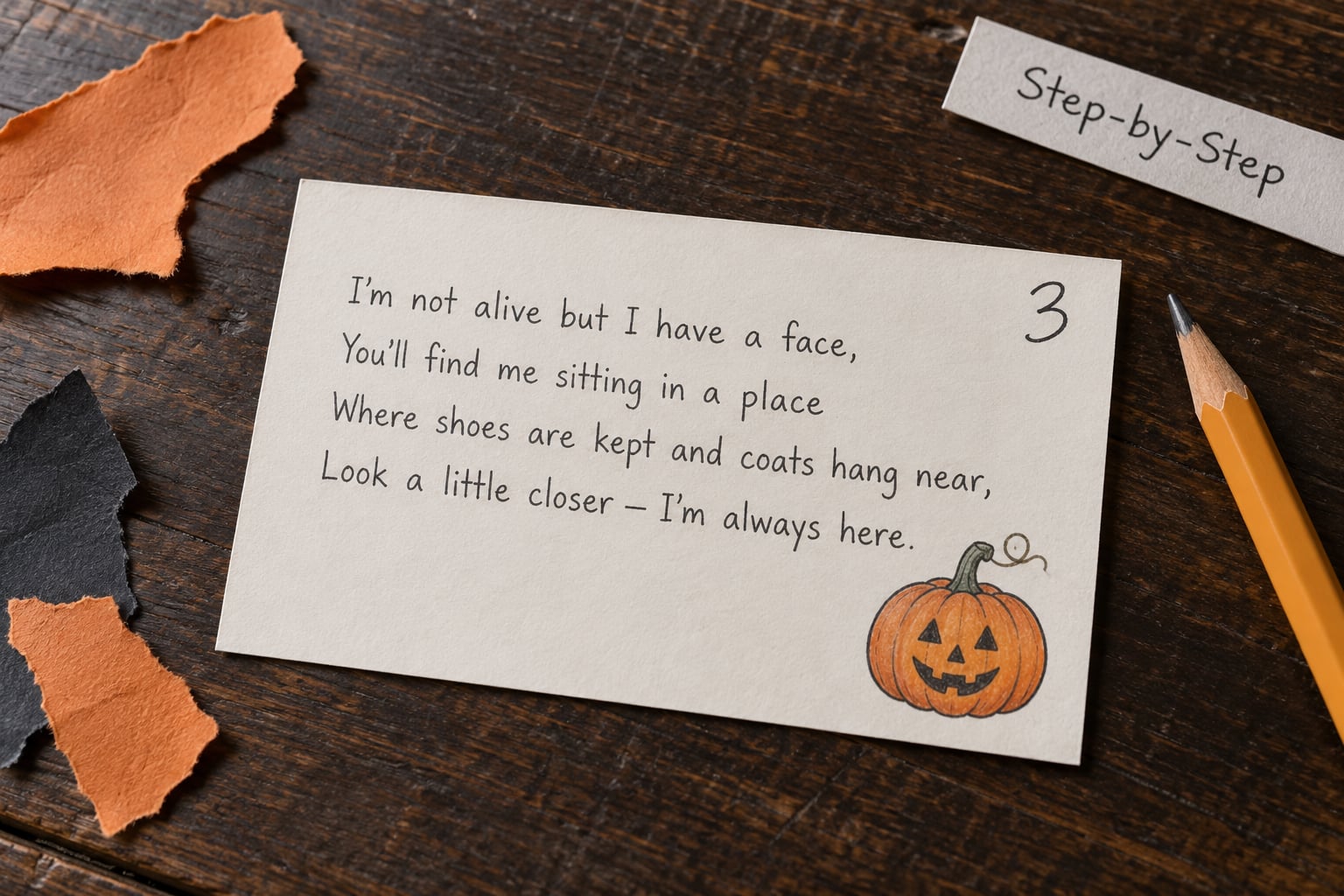
Write each clue on its own card, number every card in order, and add a small pumpkin or skull in one corner so the set looks like a set. Then hide the cards backwards, starting with the final card at the prize location and working toward the spot where the hunt will begin.
Here is a hiding list that has never failed me, with the last spots separated out:
- Inside a clean laundry basket, tucked under a folded towel
- Behind the cushions on the sofa
- On top of the refrigerator, reached with a step stool
- Inside an open kitchen drawer, under the big serving spoons
- Under the bathroom sink mat
- In a coat pocket still hanging by the door
- Tucked into the pages of a book on the shelf
- Inside a shoe in the closet
- Behind the watering can on the porch
- Under a patio chair, not where it tips back
- Inside a garden tool shed or against the fence, only if you are staying outside
- At the base of a mailbox or a step in sight from a window
Tape a small piece of orange paper or a glow stick near each checkpoint. It is not a hint for the children, it is a marker for you, and it stops the ten-minute panic search at dusk.
Add a Small Prize or Final Surprise
Match the prize to the child’s age and interests, and place it at the final location along with the last clue card. The final card should not name the prize. Let them open it themselves.
Ages two to four enjoy a sticker sheet, a small toy figure or a cookie. Ages five to seven usually care more about the search than the object, so a sticker or a small chocolate bar works. Older children respond to anything tied to what they are already into, a new book, a Lego set or a movie night vote.
For a group, hand every child something small so nobody watches someone else open a better prize. A handful of stickers per child costs nothing and settles that in seconds.
Test the Full Hunt
Have another adult walk the route in order before any child starts. Confirm that every object named in a clue is actually there, that each clue has one clear answer, and that the numbers run in a sensible order.
Write the tester’s honest reaction next to each clue. Where they hesitated, add one more concrete noun: change stand near the lamp to stand on the table under the lamp. Where they sailed through without thinking, remove a word.
Set a timer during the dry run. A hunt that takes under five minutes needs more stops, and one that drags past twenty needs fewer or easier clues.
Run the Scavenger Hunt
Give children clear boundaries before they begin, in one short sentence. Point to the area they are allowed to use, tell them not to open drawers they would not normally open alone, and set the end time out loud so nobody asks mid-hunt.
Then hand over clue one and step back. Do not narrate, do not hint unless asked, and do not confirm a guess, because a yes or no turns the search into a quiz.
Stay within earshot. Most of the work is supervision, not hiding: one adult in the same room or on the same porch as the hunt is plenty, and for anything after dark or outdoors, keep children in sight rather than at a distance.
Run the hunt earlier in the evening than you are tempted to. A hunt that starts at dusk on a school night ends with one crying child and one parent regretting it.
Make It Easier, Harder, or More Frightening
Adjust three things at most: the number of clues, how much reading is required, and how spooky the wording gets. Changing all three at once usually breaks the hunt. These settings are the ones that work per age group:
- Ages 2-4: picture list hunt with an adult close by. Six clues, about 15 minutes of setup and 10 minutes of play.
- Ages 5-7: rhyming riddles, one room at a time. Seven clues, about 20 minutes of setup and 15 minutes of play.
- Ages 8-10: decoder or puzzle clues. Eight clues, about 30 minutes of setup and 20 minutes of play.
- Ages 11 and up: cipher clues with a photo task at the end. Eight clues, about 40 minutes of setup and 25 minutes of play.
For a mixed-age group, run two versions at once and hide them in different places. The younger children follow the picture hunt, the older ones follow the cipher hunt, and neither group waits for the other. A consolation sticker for anyone who finds the prize box early keeps the finish calm.
For a neighborhood hunt, skip decorations entirely and hunt for things that are always there: a mailbox, a porch light, a fire hydrant, a garden gnome, a parked bicycle. Parents on r/daddit point to local parades and pumpkin patches as the reliable fallback when a street does not decorate, and a find-this list works just as well on a drive.
For children who find Halloween sensory, keep the same hunt and change the feel. Use warm words like cozy, glow and lantern instead of creepy, haunt and corpse. Skip dry ice, fog machines, flashing lights and any rubber spider that jumps.
Common Mistakes
A scavenger hunt usually fails in one of seven predictable ways, and each has a fix that takes under a minute.
- Clues that fit more than one spot. If two rooms could answer the clue, add a distinguishing word and rewrite it.
- Too many stops. A six-year-old who reaches clue nine has usually lost the thread. Cut to six clues.
- Hiding places kids cannot enter safely. Skip garages, sheds with locks, crawl spaces, rooftops and anywhere dark and isolated.
- Reading level above the child. Say the clue out loud to the youngest player. If it needs an adult to narrate every line, switch to pictures.
- Mixed-up numbering. Number the cards before hiding and hide in reverse. A missing number stalls the whole group.
- Too much decoration. Glow markers at each checkpoint are enough. Heavy Halloween props create trip hazards and hide the clue cards.
- A prize big enough to end the evening. Keep the reward small so the hunt stays the event, not the present.
Two hosting tips that smooth everything out. Start the whole group together with the same first clue, and end with something short: one song, one story, or the prize opened at the same moment. Kids remember the shape of an evening far more than they remember individual clues.
If your children finish in four minutes, add a bonus clue to a place they have already passed. That re-runs the hunt rather than ending it early, and the extra clue can be as simple as a sticker taped under a chair.
Frequently Asked Questions
What is the best age for a Halloween scavenger hunt?
Most children from age two upward can enjoy some version of it, with the format changing sharply by age. Ages two to four do best with a picture list and a nearby adult reading the clues aloud. Ages five to seven handle short rhyming riddles and enjoy choosing the hiding spots. Ages eight and up stay interested when the clues require decoding a word, solving a small puzzle or completing a task at the end.
How long should a Halloween scavenger hunt last for kids?
Plan for ten to fifteen minutes of play for children under seven and twenty to twenty-five for older kids. Six to eight clues fits that window well. More than ten clues usually outlasts a young child’s attention, and a hunt that drags past twenty minutes loses them. Set an end time out loud before you start so the finish feels planned rather than cut short.
Can you do a Halloween scavenger hunt outdoors?
Yes, and outdoor hunts work well for a yard, a driveway, a porch or a short trick-or-treat walk. The lighting matters more than the decoration. Use glow markers or battery tea lights at each checkpoint, keep every stop within sight of a window or a well-lit path, and stay in the same outdoor area rather than sending children down the street alone. Dry days and early evening are kinder than dusk on a cold night.
How do you make a scavenger hunt work for multiple children?
Run two versions at the same time and hide them in different places. Younger children follow a picture list, older children follow riddle or cipher clues, and the prize goes out to everyone. Cap the group at about six per route, because past that the rooms get crowded and cards get found by the wrong team. Give every child a small prize so nobody watches someone else open a better one.
What is a good Halloween scavenger hunt for small spaces?
An apartment or a small house works because the hunt follows objects rather than rooms. Six clues pointing at a mailbox on a wall, a bookshelf, a kitchen drawer, a coat pocket, a laundry basket and the bathroom sink gives you plenty of room. Skip floor hiding spots in small homes, since they invite crawling and slow everyone down, and use the hallway as the running route so the whole hunt fits in a strip of space.
Conclusion
Start with one thing: choose the age group, pick a route of six spots you can walk in a few minutes, and write the first clue. Do that tonight and the rest of the setup is twenty minutes of hiding cards in reverse order.
Add a second format, a prize and the decorations only after the first hunt works. Most of what makes these games memorable is the searching itself, and that part costs nothing.