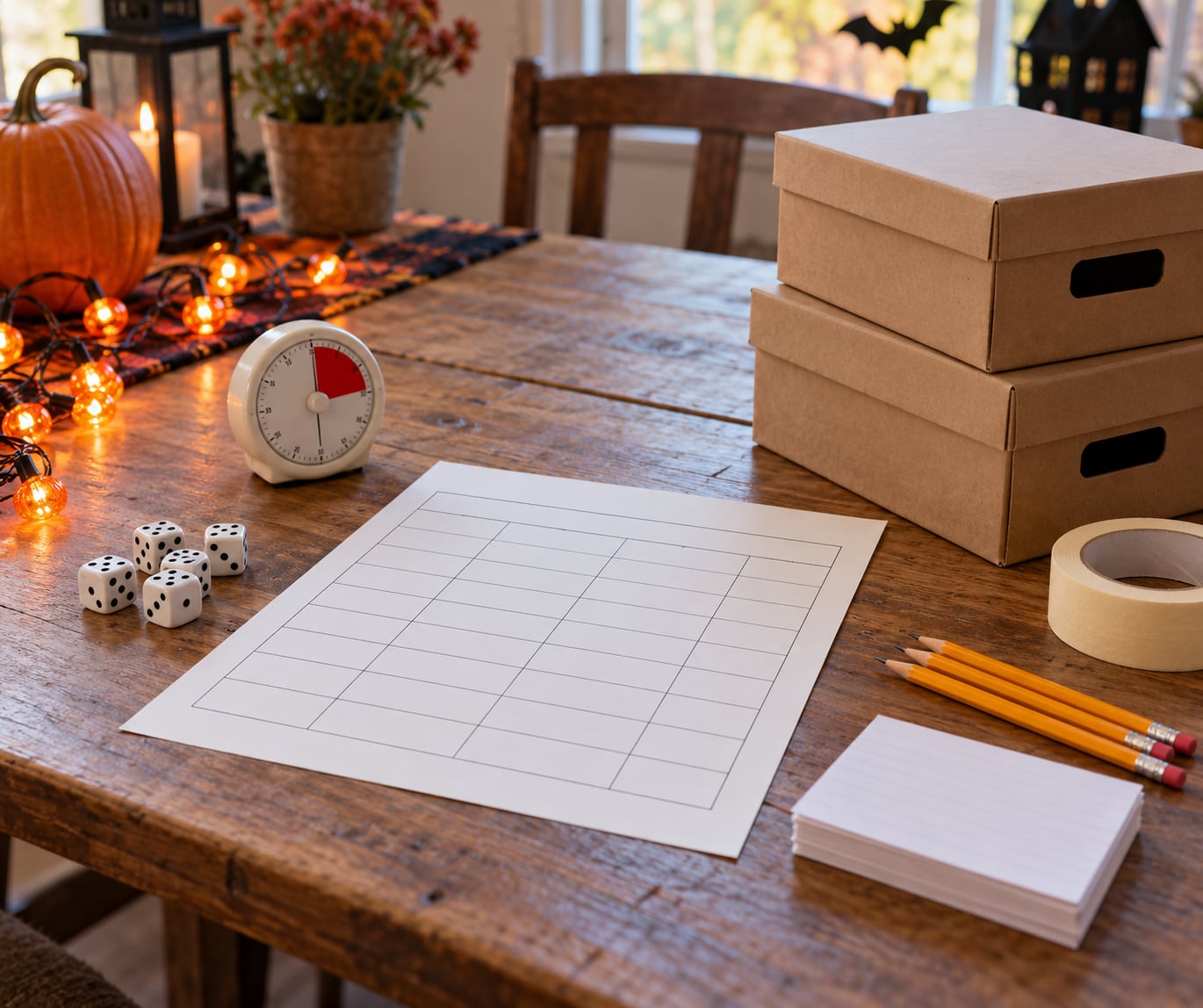
Teens play competitive games with real stakes, short rounds, and room for a bit of trash talk: trivia in a Family Feud format, Halloween charades, a whisper game, a home escape-room puzzle, or a short murder mystery. Add a console setup and a horror movie marathon and you are close. Knowing how to plan halloween party games for teens is mostly about choosing three or four of those, not fifteen.
Most parties stall in the same two places. The first twenty minutes, while guests trickle in and everyone stands around holding a cup. And the half hour after dinner, when the snacks are gone and nobody has decided what happens next. A lineup fixes both, and it takes about forty minutes of planning.
The goal is a party that does not read as a kid’s party with teenagers dragged along. That fear is the number one reason hosts over-plan with twenty games and it still falls flat.
Table of Contents
- What You Need
- Step-by-Step: How to Plan Halloween Party Games for Teens
- 1. Set the Party Format and Guest Count
- 2. Choose a Halloween Theme
- 3. Build a Mix of Game Styles
- 4. Select Games Everyone Can Understand
- 5. Plan Setup, Transitions, and Food Breaks
- 6. Create a Simple Scoring and Winner System
- 7. Test the Plan Before Party Day
- Common Mistakes and Easy Fixes
- Tips for Keeping Teen Guests Engaged
- Frequently Asked Questions
- What games do teenagers actually play at Halloween parties?
- How many games should I plan for a teen Halloween party?
- What are good Halloween party games for middle schoolers?
- What Halloween party games work for a large group of teens?
- How do I make a Halloween party more fun for teenagers?
- What prizes work at a teen Halloween party?
- Conclusion
What You Need
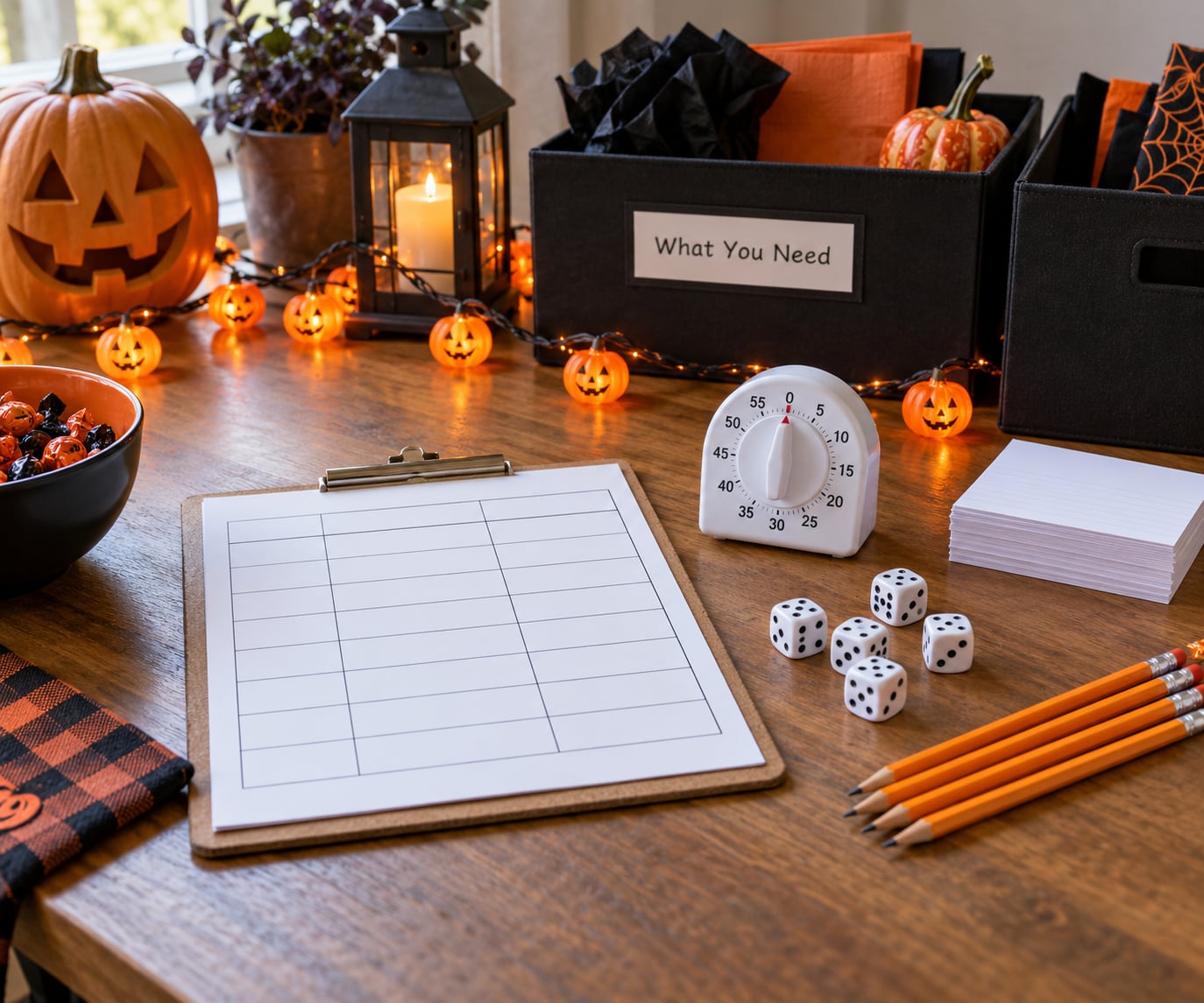
You need far less than the party supply lists suggest. The games themselves are a small part of it; the planning tools are what keep the night on schedule.
- A written run of show. One page with the start time, dinner time, and each game slot with a start and end. Write it by hand or in a notes app, but write it down. Memory is worse than paper at 9pm on a party night.
- A guest count. Confirm it 48 hours ahead and text the group again the morning of the party. Every other decision scales from this number.
- A timer or a phone alarm for every round. Games with open-ended timing are the ones that run long and flatten the rest of the night.
- Index cards, a marker, and tape. Clue cards, trivia questions, team names, and station labels all come from these.
- One bin per game. Label each with the game name. When you need to reset a station mid-party, you are grabbing one box instead of searching a kitchen drawer.
- A scorekeeping method. A whiteboard, a sheet of paper taped to the wall, or a shared notes file. It should be visible from every station.
- Prizes. Two or three small ones, plus a few spare candy packets to use as stakes.
- A backup activity. Something that needs no setup and no emcee, in case a game collapses or the rain plan kicks in.
Space matters more than supply. A party in one living room runs very differently from a party with a driveway, a yard, and a kitchen. Count your stations before you pick games, since a deduction game in a packed room is a dead game.
On safety: skip games with live animals, raw eggs broken onto skin, or hard objects thrown at people. The messier the game, the more it needs a check with the adults in the room first. Any game using candy needs a non-food alternative for kids with allergies, and small loose candies are a choking risk for younger siblings who sometimes turn up at the party too.
Step-by-Step: How to Plan Halloween Party Games for Teens
Seven steps, in order. Most hosts skip the first two and land on step four with too many games and no schedule.
1. Set the Party Format and Guest Count
Lock down four things before anything else: how long the party runs, how guests arrive, how many are coming, and what ages are in the room.
A three-hour party and a five-hour party need completely different lineups. For three hours, plan three active games plus one arrival activity. For five hours, plan five and add a longer middle section. The game count formula that works: active games = party hours multiplied by 2.5, rounded down, plus one passive arrival activity.
Arrival style changes the plan too. A drop-in open house needs self-running stations. A closed-door party with a set start and end lets you run an emcee-led main event after dinner. Know which one you are hosting before you choose a single game.
2. Choose a Halloween Theme
A theme turns a pile of games into an event, and it takes about fifteen minutes to pick.
Four options work well for teens. Horror movie night leans on a trivia round, a genre quiz, and a marathon block. Monster games gives you loud physical challenges and relay races. Haunted mystery turns one murder mystery or escape-room puzzle into the centerpiece. Retro Halloween goes back to carnival and fright-show framing with pumpkins, darts at balloons, and candy dice games.
Pick the theme, then check that at least three of your games fit it. If two games only work in one theme, swap them out now rather than at minute 40.
3. Build a Mix of Game Styles
A lineup of four identical games kills a party by the third round. Mix the styles instead.
Run of a typical mix: one active game, one quiet thinking game, one loud social game, one main event. The active one burns energy. The thinking one gives the competitive kids something to win. The social one works when people are tired and would rather talk than sprint. The main event is the thing everyone remembers.
For a group of four to eight close friends, drop the active game entirely. Small groups get loud fast and a deduction puzzle or a murder mystery plays better when everyone is close enough to see the cards.
4. Select Games Everyone Can Understand
Pick games whose rules fit in one sentence. If you need more than a minute of explaining, the room is already losing interest.
Reliable choices include Halloween trivia in a Family Feud format, escape-room clues solved in teams, a flashlight scavenger hunt, and the whisper game. Console or screen gaming is worth a lane if one guest can bring a console and two to four controllers. Send one message in the group chat asking what they would rather play, and build around the answers, because the lineup you pick is not always the lineup they want.
Run a difficulty check: can a 13-year-old join in without feeling patronized, and can an 18-year-old stay interested? Games with two difficulty tracks, like trivia with easy and hard rounds, solve that most of the time.
5. Plan Setup, Transitions, and Food Breaks
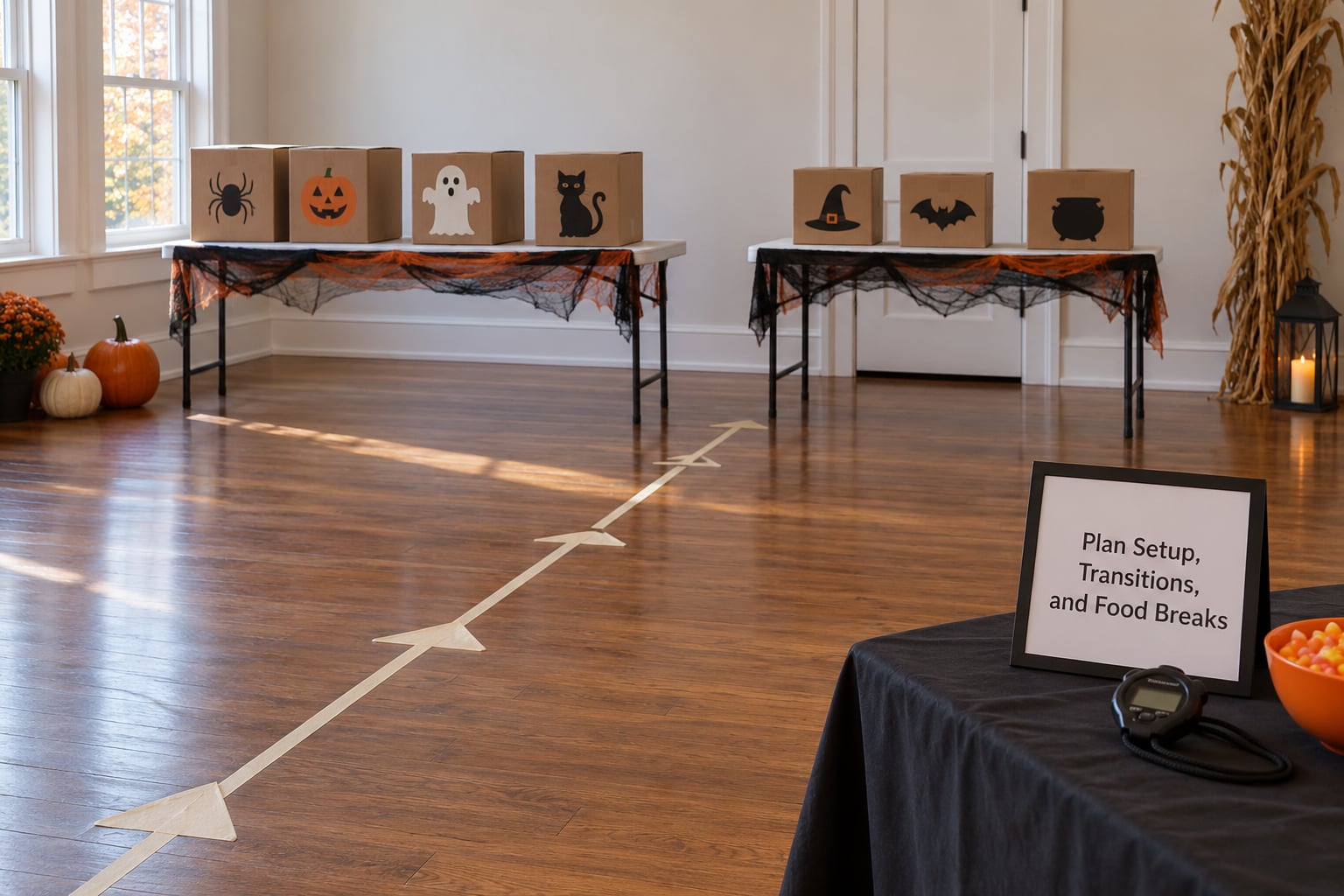
Write the night as a timeline with minutes attached, then leave ten-minute gaps between games. Here is a run of show for a three-hour party starting at 7pm:
- 7:00 to 7:20 — arrival. A passive activity guests can wander into: a mingle bingo with spooky prompts, a costume prize vote jar, or a two-truths-and-a-lie card at each seat.
- 7:20 to 7:40 — short active game. Candy dice game, pumpkin bowling, or a mummy-wrap relay.
- 7:40 to 8:10 — dinner. Pizza, taco bar, or a snack board. Put the food out yourself so nobody has to ask.
- 8:10 to 8:35 — thinking game. Trivia or a deduction puzzle while people are still settling from dinner.
- 8:35 to 9:15 — main event. The murder mystery, escape room, or console tournament.
- 9:15 to 9:30 — wind-down and prizes. Announce winners, hand out prizes, let the room soften.
Move stations in one direction. If two games are in different rooms, put the room change between a food break and a game, never in the middle of a round.
6. Create a Simple Scoring and Winner System
Score in teams, not individuals, once the group passes about twelve people. Individual scoring in a group of strangers turns games into a popularity contest.
Keep it on the wall where everyone can see it. Written scores that stay up all night do more for engagement than any game does. Award the top team, the winning individual for the main event, and one fun award like best costume or worst pun, so nobody walks away empty-handed.
Candy works as a stake. Losing players hand over a few pieces, winning players keep them. It raises the stakes without buying anything.
7. Test the Plan Before Party Day
Read your own instructions out loud and time them. If explaining a game takes longer than playing it, the rules are too complicated.
Then do a supply check against your list, and confirm every game has a fallback if the room is too crowded. Identify the two games most likely to run long and shorten them.
Finally, decide your late-arrival plan. If half the group shows up at minute 40, the arrival activity has to still be running. Keep a mingle bingo or card game out for stragglers rather than starting the schedule over.
Common Mistakes and Easy Fixes
Planning too many games. Eight games in a three-hour window means every game gets cut off halfway and none of them feel finished. Fix it by planning three and keeping one or two in reserve.
Rules that take too long to explain. A minute of instructions and the room is already checking phones. Cut the rules to the shortest version that still makes sense, and put the full version in a joke about how complicated it is.
Ignoring different comfort levels. Loud relay races lose the quiet kids, and deduction games bore the athletes. Alternating a physical round with a seated round solves most of it.
Unlabeled materials. When you need the clue cards mid-party and they are in a mystery box, the game dies. Label a bin per game with masking tape before anyone arrives.
No backup activity. When a game fails, the room fills that gap with nothing. Keep one no-supplies game ready: the whisper game, would-you-rather, or a horror movie round-robin needs nothing but a TV.
Ignoring weather. Outdoor plans with no indoor version lose the whole night to a rain shower. Decide the indoor version of every outdoor game before the day.
Skipping the food break. Post-dinner energy drops hard. Schedule dinner as a fixed block in the timeline rather than letting it happen whenever.
Tips for Keeping Teen Guests Engaged
Let them pick two games. Ask the group chat which two they want and build the rest around their answers. This single step removes most of the resistance.
Keep scores visible. A whiteboard taped to the wall with team names on it turns a casual group into a competition.
Offer small challenges between games. A two-minute riddle or a dare to name ten horror movies fills the gap while you reset.
Make participation optional per round. Some guests will sit out one game and play the next three. Offer a spectator role like clue writer or scorekeeper instead of forcing it.
Change teams halfway. Rebalance once, mid-party, and the same people stop clumping.
Plan for stragglers. Keep one activity running through the whole first half hour so late arrivals walk into something.
Have a wind-down. The last thirty minutes need a low-energy landing, usually prizes and a spooky playlist, or the party ends awkwardly.
Watch the group chat. When teens are planning their own party, the chat is where the real energy is. Keep the timing loose enough to adjust when the conversation says a game is a hit or a bore.
Frequently Asked Questions
What games do teenagers actually play at Halloween parties?
The games that work are competitive, have short rounds, and carry real stakes: Family Feud style trivia, Halloween charades, a flashlight scavenger hunt, the whisper game, a murder mystery, or a home escape room puzzle. Many teen groups also rank console gaming and a horror movie marathon above traditional party games. Plan three or four games, not a dozen, and slot them into a written timeline.
How many games should I plan for a teen Halloween party?
For a three to four hour party, plan two to three active games plus one passive arrival activity. A useful formula is active games equal to the party hours multiplied by 2.5, rounded down, plus one arrival activity. A five hour party supports about five active games. Keeping one prepared game in reserve covers a game that collapses or a group that arrives early.
What are good Halloween party games for middle schoolers?
Middle schoolers, roughly 13 to 14, respond best to games with a little strategy and some movement: murder mystery puzzles, Halloween bingo, pumpkin bowling, a mummy wrap relay, and flashlight scavenger hunts. Avoid games designed for young children, which they read as babyish within seconds. Team formats work better than individual competition at this age.
What Halloween party games work for a large group of teens?
For groups of twenty or more, drop emcee-led games entirely and use stations. Teams rotate between a trivia station, a craft or clue station, an active station, and a quiet card station on a fifteen minute rotation. Write the rotation on paper and post it. Large groups also do well with silent games such as bingo or a murder mystery where people read their own cards.
How do I make a Halloween party more fun for teenagers?
Four changes do most of the work. Plan the timeline so nothing is unstructured. Use team competition with visible scores rather than free play. Keep the stakes real with candy wagers or a team prize. Let the group choose two of the games in advance. Add one screen-based component, such as a console tournament or a horror film vote, since that is what teens actually ask for.
What prizes work at a teen Halloween party?
Keep prizes small and themed: Halloween candy bundles, movie passes, coffee shop gift cards, small novelty items, or a trophy for the winning team. Award at least three categories so nobody leaves empty handed, including a funny one such as best costume. Candy also works well as a game stake, since losing players hand pieces to the winners without any setup.
Conclusion
Start with three decisions: your guest count, your party length, and the two or three game styles that fit the ages in the room. Everything else on the run of show follows from those. Pick the games, write the minutes down, label the bins, and the night runs itself.